
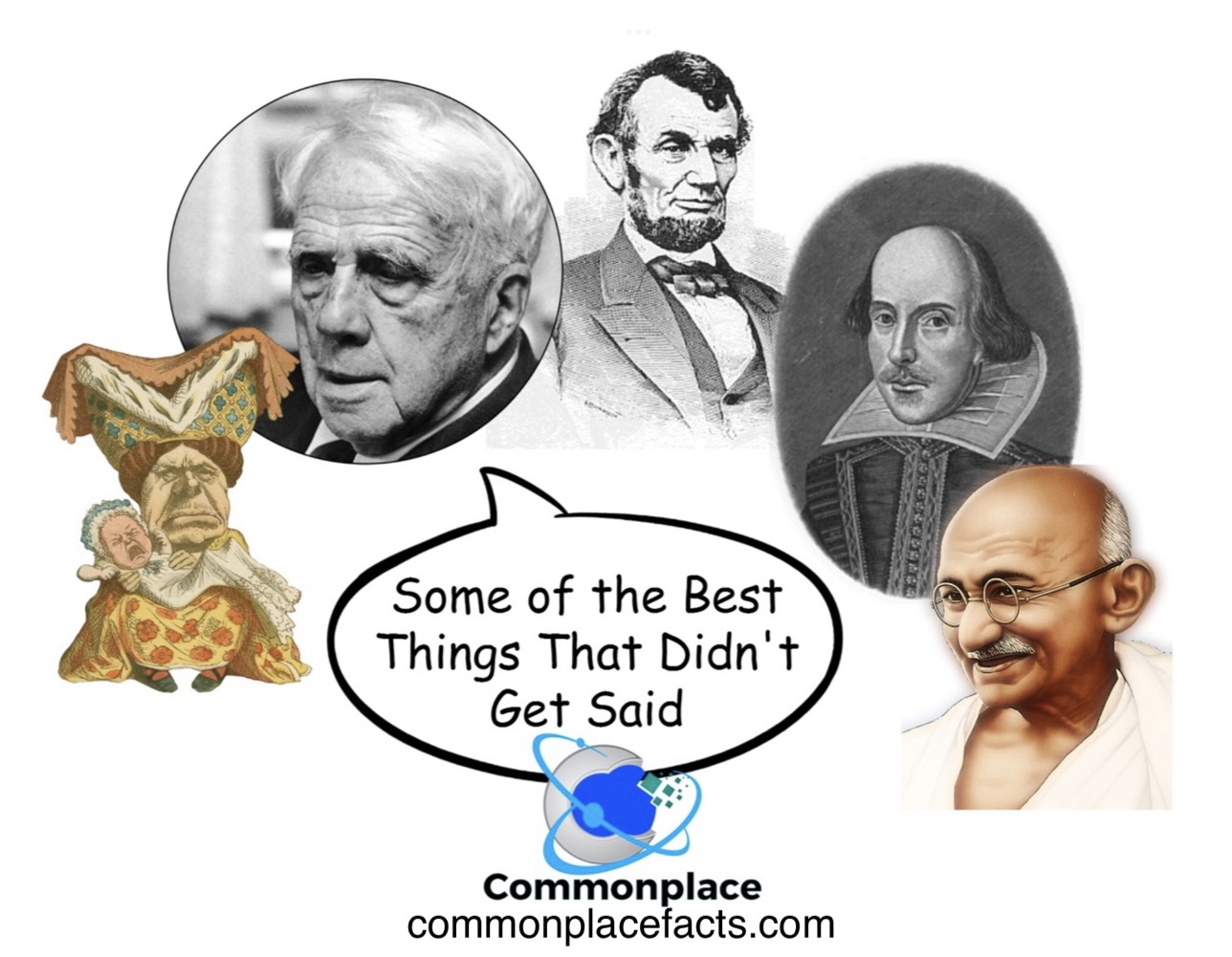

One of the most effective ways to illustrate a point is to use a profound quote from a great historical figure. While there is no shortage of such gems, there are a few that have taken on a life of their own by being misquoted so often that we no longer remember the original. Others are attributed to the wrong person, but it has been done so often that we are just positive in the usurper’s claim to authorship. Still other quotations have been taken out of their context and are now used to illustrate the complete opposite of what was originally intended. How certain are you of the origin, authenticity, and meaning of the following famous quotations?
“The Devil is in the Details”
Taking first place in the category of “Botched Quotations” is this phrase, attributed to German architect Ludwig Mies van der Rohe. What he really said was, “God is in the details.”
“Money is the Root of All Evil”
This solemn declaration about the dangers of wealth has to be authentic because it is biblical, right? Well, not exactly. It is true that the reference comes from I Timothy 6:10, but the actual verse is, “For the love of money is the root of all kinds of evil….” (New International Version)
“I took the road less traveled.”
Robert Frost’s poem “The Road Not Taken” is about a wanderer who encounters a divergence in a path, giving him the choice of which way to go.
We all know that he chose the lesser-traveled path and that it “made all the difference.” But did he?
Consider the opening stanza:
Two roads diverged in a yellow wood,
And sorry I could not travel both
And be one traveler, long I stood
And looked down one as far as I could
To where it bent in the undergrowth;
Then took the other, as just as fair,
And having perhaps the better claim,
Because it was grassy and wanted wear;
Though as for that the passing there
Had worn them really about the same,
Frost tells us there really is no difference between the two paths in terms of having been worn by travel or grown up from the lack thereof. While it is true that his decision of which path to travel made all the difference, the difference, it was because of where the path would lead him, not because one appeared to be better or less difficult to navigate. In the end, he arbitrarily chose one indistinguishable path from the other.
“Romeo, Romeo, wherefore art thou, Romeo?”
If you think Juliet utters these words because she wonders where her lover might be, think again. “Wherefore art” is an Old English way of asking “why,” not “where.” Juliet uses the phrase to question why Romeo was born as a member of the Montague family, the arch-rivals of her own.
“Love makes the world go ’round.”
This beautiful expression is frequently quoted in support of brotherhood, goodwill, and civility. The origin of the quote, however, suggests something different. The phrase appears in Lewis Carroll’s Alice in Wonderland. The Duchess makes this comment in an off-handed manner, immediately after calling for the beating of her sneezing baby. Taken as a whole, it appears that Carroll intended it to be understood sarcastically.
“Be the change you wish to see in the world.”
You will occasionally see this quote attributed to Mohandas Gandhi on bumper stickers or t-shirts. In actuality, the phrase is an attempt to take a more complex thought and reduce it to a catchy phrase. The actual quote is, “As a man changes his own nature, so does the attitude of the world change towards him. We need not wait to see what others do.”
“Curiosity killed the cat.”
This phrase is often used to warn against being overly inquisitive. What most people forget is that there is a second part of the expression: “Curiosity killed the cat, but satisfaction brought it back.” If the last part would be remembered, it takes away the terrifying consequences of curiosity by offering the hope of restoration.
“I disapprove of what you say, but I will defend to the death your right to say it.”
When two political sides differ on a position, this quotation by Voltaire is frequently offered in support of free and open debate. The only problem is that Voltaire never said it. It was actually written by Evelyn Beatrice Hall a century after Voltaire’s death.
“The only two certainties in life are death and taxes.”
Mark Twain’s famous quote is invariably repeated every year when income tax returns are due. While Mark Twain said a lot of things worth remembering, the above quote wasn’t one of them. Variations of the phrase are attributed to Christopher Bullock, who, in 1716, wrote, “Tis impossible to be sure of anything but Death and Taxes.” In 1724 Edward Ward wrote Dancing Devils, in which he attested, “Death and Taxes, they are certain.”
“There’s a sucker born every minute.”
P.T. Barnum usually gets the credit for this cynical assessment of the gullibility of the masses. If you think he is the source of the words, however, you may be one of those suckers. This phrase was actually coined by one of Barnum’s competitors to explain Barnum’s success.
“No rest for the wicked.”
This phrase is often used as a busy person excuse for staying up late, and it might be true, but that’s not what it means in its original form. The source is from the Bible. Isaiah 15:21 tells us, “There is no peace, saith my God, to the wicked.” The meaning is that there is no solace for the wicked and does not speak about catching a catnap.
“The British are coming!”
If ever a phrase could be tied to the American Revolution, it is Paul’s Revere’s famous cry, telling the colonists to take arms. If you had been around on that fateful night, however, you would have heard his actual words: “The regulars are out.”
“Hell hath no fury like a woman scorned.”
This observation about the temperament of a scorned woman is undoubtedly playwright William Congreve’s most famous quote, except no one ever seems to capture it the way he actually wrote it. It comes from 1697 play, The Mourning Bride, and it reads,
Heaven has no rage like love to hatred turned
Nor hell a fury like a woman scorned.
“Music hath charms to soothe the savage beast.”
For a fellow who is quoted so often, William Congreve never seems to be able to catch a break. The quote about the power of music is commonly incorrectly attributed to William Shakespeare, when, in fact, it comes from the above-referenced play, The Mourning Bride. Aside from the fact that it was Congreve, not Shakespeare, who penned the phrase, the words themselves usually get mangled. Congreve didn’t say that music could charm an animal; the real version is:
Music hath charms to soothe a savage breast,
To soften Rocks, or bend a knotted Oak.





Leave a Reply to alsavignanoCancel reply