

California has a reputation.
Depending on whom you ask, it is either a paradise of sunshine, innovation, avocados, and people who put kale in things that never asked for it, or it is a vast and undeniably weird realm inhabited by movie stars, surfers, people who do yoga with goats, and at least three cults in every subdivision.
In other words, a lot of people already think California sounds less like a normal place and more like a myth someone made up after eating questionable mushrooms.
As it turns out, that is not entirely unfair and appropriately ties in with how California got its name.
The name California appears to have come from an obscure 16th-century Spanish romance about a fantastical island full of gold and ruled by a powerful queen. This is one of those historical facts that sounds like it was invented by a tour guide in a gift shop, yet it is the explanation most historians accept. The state with Silicon Valley, Hollywood, Death Valley, the redwoods, Disneyland, and approximately nineteen separate microclimates decided to begin its naming career as fictional real estate.
Which, frankly, explains a lot.
Contents
The Story Begins in a Book Almost Nobody Reads Now
To find the origin of the name, we have to go back to the early 1500s, when Spanish readers were very fond of chivalric romances. These were sprawling adventure stories packed with knights, battles, noble quests, strange lands, improbable coincidences, dramatic speeches, and enough exotic scenery to make modern fantasy franchises look restrained.

One of these books was Las sergas de Esplandián, written by Garci Rodríguez de Montalvo and published around 1510. It was a sequel to the wildly popular Amadís de Gaula, which was basically the blockbuster franchise of its day. If you were a literate Spaniard with a taste for adventure and heroics, this was very much your thing. It was the sixteenth-century equivalent of a series about a bunch of underage wizards in a dysfunctional magical academy.
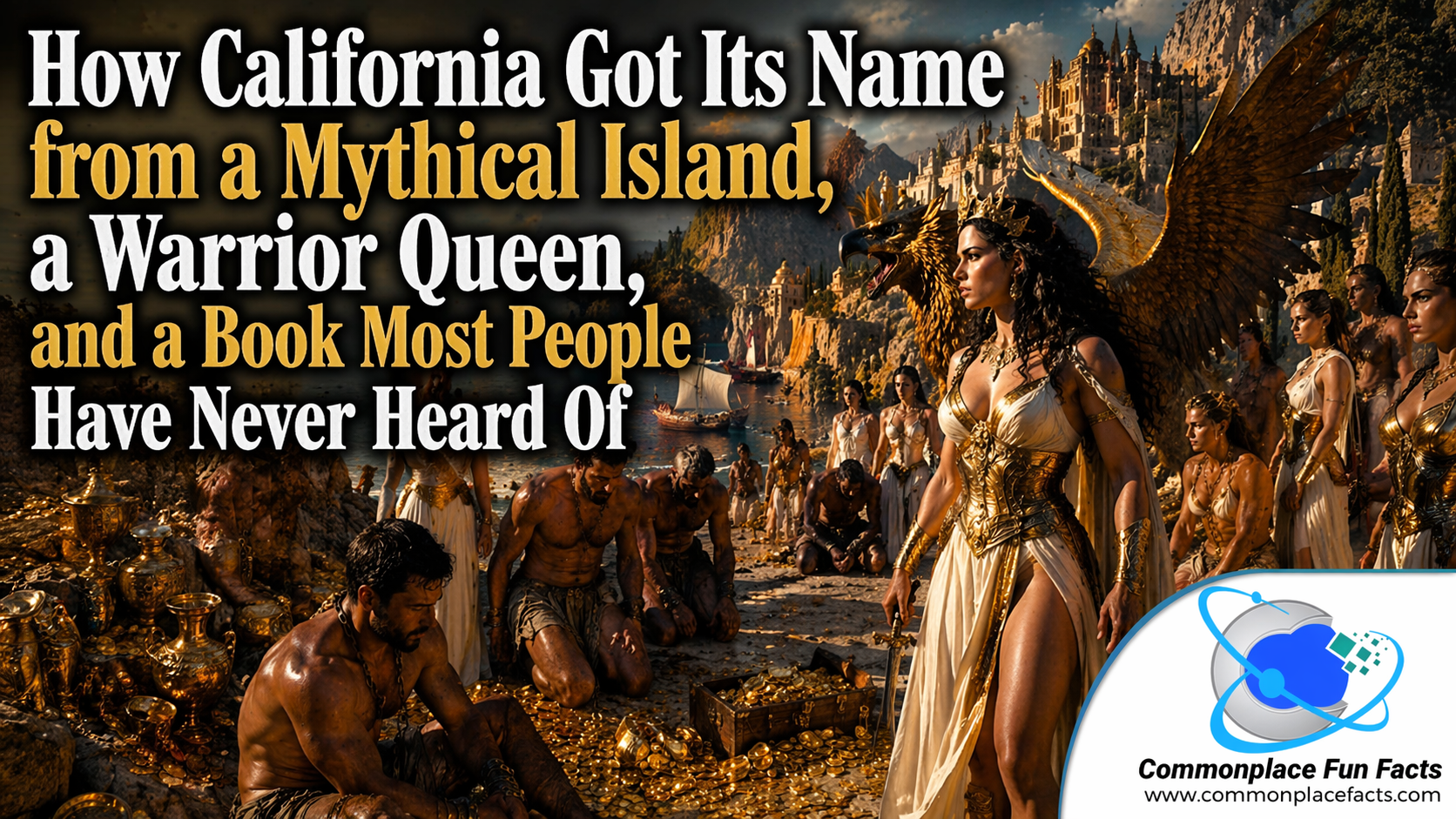
In Esplandián, Montalvo describes a fabulous island called California. It lies somewhere near the Indies and is ruled by Queen Calafia. The island is rich in gold, inhabited by fierce warriors, and presented as a place of wonder, danger, and exotic splendor.
It was fantasy. Romantic, extravagant, over-the-top fantasy.
And buried inside that fantasy was the name that would eventually be attached to one of the most famous places on earth.
The Original California Was Basically Themyscira with More Griffins and Worse Childcare Policies
No story like this was ever going to involve a perfectly ordinary civic committee making sensible zoning decisions. Naturally, the mythical California was ruled by an exotic queen. Her name was Calafia, and she presided over a land overflowing with riches and unconventional views about gender roles.

That alone should have guaranteed the story a certain afterlife, because history loves two things: a strange place full of treasure and a formidable ruler with a memorable name. Add both together and you have the kind of fictional setting that sticks in the mind, particularly if you are a Spanish explorer sailing westward into regions Europeans knew frustratingly little about.
The mythical California of Las sergas de Esplandián was not merely a glamorous island ruled by Queen Calafia. It was, in essence, an all-female warrior society in the old Amazon tradition. Montalvo describes it as a land inhabited entirely by women, with no men allowed to live permanently among them. These women were strong, warlike, wealthy in gold, and perfectly capable of taking care of themselves without some bloke mansplaining trade policy, sword maintenance, or how things were done back in his village.
The Californians lived in caves, sailed out in ships on raiding expeditions, and brought back male captives. The role of those men was not especially dignified. They were used briefly for reproduction and then killed, making one wonder if the praying mantis was their official mascot.
When children were born, the women kept the girls and killed the boys, thereby preventing any permanent male population from taking root on the island. It was, let us say, not a society organized around father-son fishing weekends.
Among the more memorable features of Montalvo’s mythical California were its griffins—numerous, aggressive, and apparently convinced that men existed primarily as a dietary option. These eagle-lion hybrids were active hazards, patrolling a land already inclined to be inhospitable to outsiders and serving as both guardians of its legendary gold and a final, emphatic deterrent to anyone who had somehow survived the island’s warrior society. In a narrative sense, they completed the package: wealth, danger, and just enough mythological excess to keep things lively. Modern California has earthquakes, wildfires, and traffic on the 405. Mythical California had griffins. We leave it to you to decide which is the more intimidating.
If the mythical all-female kingdom of California sounds a little familiar, it is because it sounds like a closely-related cousin of Wonder Woman’s home, Themyscira, also known as Paradise Island. It was an isolated society of formidable women, removed from ordinary male civilization, operating by its own rules and not especially interested in outside interference. The main difference is that Themyscira generally comes across as enlightened, noble, and spiritually elevated, whereas Montalvo’s California feels like Themyscira after being rewritten by someone who thought every story needed more gold, more violence, and several large carnivorous griffins for no reason whatsoever. Queen Calafia’s realm was less comic-book utopia and more medieval adventure-novel fever dream, which is precisely what makes it such a wonderfully strange ancestor for the name of modern California.
When Bestsellers Named a State—and Then Vanished from Memory
When Spanish explorers encountered unfamiliar lands, they did what humans have always done: they interpreted the unknown through the lens of the familiar. If you have read about a distant, gold-rich island ruled by a warrior queen, and then you stumble upon a mysterious coastline that might or might not be an island, the leap from fiction to geography becomes surprisingly short. It is not difficult to imagine someone saying, with complete confidence and minimal verification, “Yes, this seems like that place.”
That context makes it highly plausible that the name “California” was inspired directly by the book. The explorers were not naming things at random; they were drawing from the stories, expectations, and imaginative frameworks they already carried with them. Add in the fact that early explorers may have believed Baja California to be an island, and the resemblance to Montalvo’s fictional setting becomes even more convenient. Under the circumstances—imperfect maps, uncertain geography, and a general willingness to make bold assumptions—the decision to borrow the name of a mythical island makes perfect sense.

Which raises a far more interesting question: if the book was so popular that it helped name a major piece of geography, why did everyone forget it?
Because that is exactly what happened. Over time, the name “California” endured, but the literary reference behind it quietly slipped out of common knowledge. Generations continued to use the name without remembering its origin, while alternative explanations drifted in to fill the gap. This is a very human pattern. We inherit names, phrases, and traditions from the past and continue using them long after their original context has faded. The word remains; the story behind it dissolves. Eventually, no one is quite sure why things are called what they are, but everyone proceeds with great confidence anyway.
A number of alternative explanations were proposed for the name “California,” some more persuasive than others. One common line of thought tried to root the name in Spanish or Latin words. Scholars pointed to phrases like calida fornax (meaning “hot furnace”), suggesting a reference to the region’s heat, particularly in desert areas. Others looked to Spanish words such as caliente or calor, attempting to build a linguistic bridge from climate to name. These theories have a certain surface appeal—after all, parts of California do feel like a furnace with better scenery—but they tend to rely on creative reconstruction rather than direct historical evidence. There is little indication that early explorers consciously coined the name from these roots, and the linguistic gymnastics required to get from “hot place” to “California” often feel like assembling furniture with several missing instructions.
Another set of theories focused on possible indigenous origins, suggesting that “California” might have been derived from a Native American word or place name encountered by Spanish explorers. Given how frequently European explorers adopted or adapted local names, this would not be unusual. For a reminder of how unpredictable that process could be, see “Des Moines: the City That Got Its Name from a Practical Joke,” where a less-than-flattering Native American term appears to have been politely rebranded into something far more respectable. That said, in the case of California, no clear or convincing indigenous source has been identified that matches both the sound and the early historical usage of the name, leaving these theories intriguing but ultimately unsupported.
Like the linguistic theories, these ideas tend to fill the gap left by uncertainty rather than emerge from strong documentary support. In contrast, the appearance of the name in Las sergas de Esplandián—preceding its use on maps and in exploration accounts—offers a far more direct and historically grounded explanation, even if it comes from a source that sounds suspiciously like the plot of a forgotten fantasy novel.
The Nineteenth-Century Rediscovery
For centuries, the connection between California and Montalvo’s fictional island was largely overlooked. Competing theories emerged, some creative, some strained, and all trying to explain a name whose origin had been hiding in plain sight. It was only in the nineteenth century that scholars rediscovered the link and pointed back to Esplandián as the likely source. In hindsight, the answer had been sitting there all along, patiently waiting for someone to notice. History, it seems, does not always hide its secrets particularly well—it just counts on us to stop looking.

In 1862, Edward Everett Hale, a writer and scholar with the useful habit of paying attention to old texts, pointed to Las sergas de Esplandián as the likely source of how California got its name. He later laid out the case more fully, and other researchers followed up on it. The result was that a mystery people had largely misplaced was suddenly back on the table, now with receipts.
That rediscovery shows something historians know all too well: facts are not always lost because they were secret. Sometimes they are lost because everybody stopped looking in the obvious place. The answer had been sitting in a sixteenth-century book while generations of people apparently walked past it on their way to more complicated explanations.
It is a little like spending three hours trying to find your glasses only to discover they were on your head the whole time, except in this case the glasses were a state name, the head was Spanish literature, and the three hours lasted several centuries.
Once Hale and later scholars revived the connection, the literary explanation gained wide acceptance. Today, it is generally regarded as the most credible explanation of how California got its name.
So Yes, California Was Named After the Mythical California
That means one of the most influential states in the United States may owe its name to what was essentially a work of imaginative adventure fiction. Before California was associated with gold rushes, silent films, freeways, earthquakes, venture capital, celebrity scandals, and lifestyle influencers explaining hydration to the rest of us, it was associated with a mythical island ruled by Queen Calafia.
If that sounds ridiculous, we should remember that history is full of moments like this. Real life is forever borrowing from legend, literature, rumor, wishful thinking, and the deeply held conviction that if a place sounds rich enough, it probably is. Exploration has always attracted people with practical ambitions and highly impractical imaginations. Quite often, they were the same people.
Also, in fairness to the original namers, modern California has done its level best to live up to its fantastical branding. It contains deserts, mountains, giant trees, movie palaces, billionaire compounds, theme parks, vineyards, beaches, earthquakes, and neighborhoods where a person can spend twenty-eight dollars on toast without anyone appearing alarmed. It is a place that hosted a three-day divorce trial that was triggered by a single bite of a sandwich. A guy declared himself to be emperor, and folks went along with it. It has a prison that is so intimidating that it has its own psychological disorder. If you told a medieval listener that such a place existed, he would have assumed you were telling your own version of a fantasy story.
Why the Mythical Origin Feels Weirdly Appropriate
There is something almost too perfect about California being named after a legendary land.

For generations, the state has functioned in the American imagination as a place somewhat detached from ordinary reality. It is the land of reinvention, possibility, spectacle, and excess. People go there to strike gold, become famous, launch companies, discover themselves, surf, or just disappear.
Even people who have never been to California often talk about it as though it exists in a separate dimension. To admirers, it is a paradise of sunshine and opportunity. To critics, it is an overcomplicated fever dream held together by optimism, microchips, and very expensive real estate. To everybody else, it is where strange national trends seem to show up first, as though the entire state is a test kitchen for reality.
The fact that its name comes from a story about a fabulous island full of wealth and wonder feels less like a mismatch and more like the universe showing off its sense of humor.
Of course California was named after an imaginary place. Have you seen Los Angeles traffic? If ever there was something that could compete with a griffin for destroying one’s quality of life, that would be on the list.
A Name with a Long and Peculiar Afterlife
What makes this story especially delightful is the combination of obscurity and scale. The source text is not something most people casually read today. It is not like discovering that a state was named after Shakespeare or Homer or some other author still assigned in classrooms. Las sergas de Esplandián is the kind of title that causes most modern readers to say, “I’m sorry, the what now?”
Yet from that relatively forgotten book came a name now recognized around the world.
That is one of history’s favorite tricks. A minor-seeming detail in one era becomes enormous in another. A line in an old romance becomes attached to a place that would shape global entertainment, agriculture, aerospace, computing, politics, and culture. Somewhere in that sequence is a lesson about the butterfly effect, except with more conquistadors and fewer PowerPoint slides.
There is also something fitting about the origin being rediscovered centuries later. California did not merely inherit a fantastical name; it also acquired a backstory that briefly vanished and then had to be dug out of literary history by someone willing to connect dots that others had ignored. The whole thing has a faintly Indiana Jones feel, as though scholars brushed the dust off the label and discovered that the state had been standing there all along wearing an elaborate costume from a sixteenth-century adventure novel.
California has always occupied a space somewhere between reality and imagination—a place people project onto, dream about, argue over, and occasionally try to reinvent entirely. That it was named after a fictional land feels less like an accident and more like an origin story that simply took a few centuries to make sense.
In the end, California did not grow into its myth. It started as one.
You may also enjoy…

The Hollywood Origin Story and the Ironic Plot Twist That Derailed a Christian Utopia
Discover the ironic Hollywood origin story—a spiritual, booze-free utopia founded by a God-fearing couple. Fame wasn’t the plan. Temptation ruined everything.

The Idaho Name Hoax: How a Fake Name Became a State’s Identity
Did you know the Idaho name campaign was a hoax? Learn the fascinating history behind this made-up name and how it almost became Colorado instead!

Des Moines: the City That Got Its Name from a Practical Joke
Des Moines — Could It Be a Joke? The city of Des Moines is a jewel in the middle of Iowa. With skyscrapers breaking up the monotony of the prairie horizon and the gold-domed Iowa State Capitol building reflecting the sun’s rays, the city of over 200,000 has a lot to be proud of. As…






Leave a Reply