

Great technological revolutions often come wrapped in memorable lines.
Alexander Graham Bell famously summoned his assistant with, “Mr. Watson, come here, I want to see you,” and in that moment the telephone entered history sounding surprisingly like a man who had misplaced something in the next room.
Samuel Morse launched the telegraph era with the far more biblical-sounding “What hath God wrought,” which is a magnificent line if your goal is to make invention sound like a thunderclap from heaven instead of a nervous experiment involving wires.
That is usually how we prefer our breakthroughs: dramatic, eloquent, and neatly packaged for future textbooks. We like our world-changing moments to arrive with gravity and polish, as though history had hired a copy editor.
Then there is television.
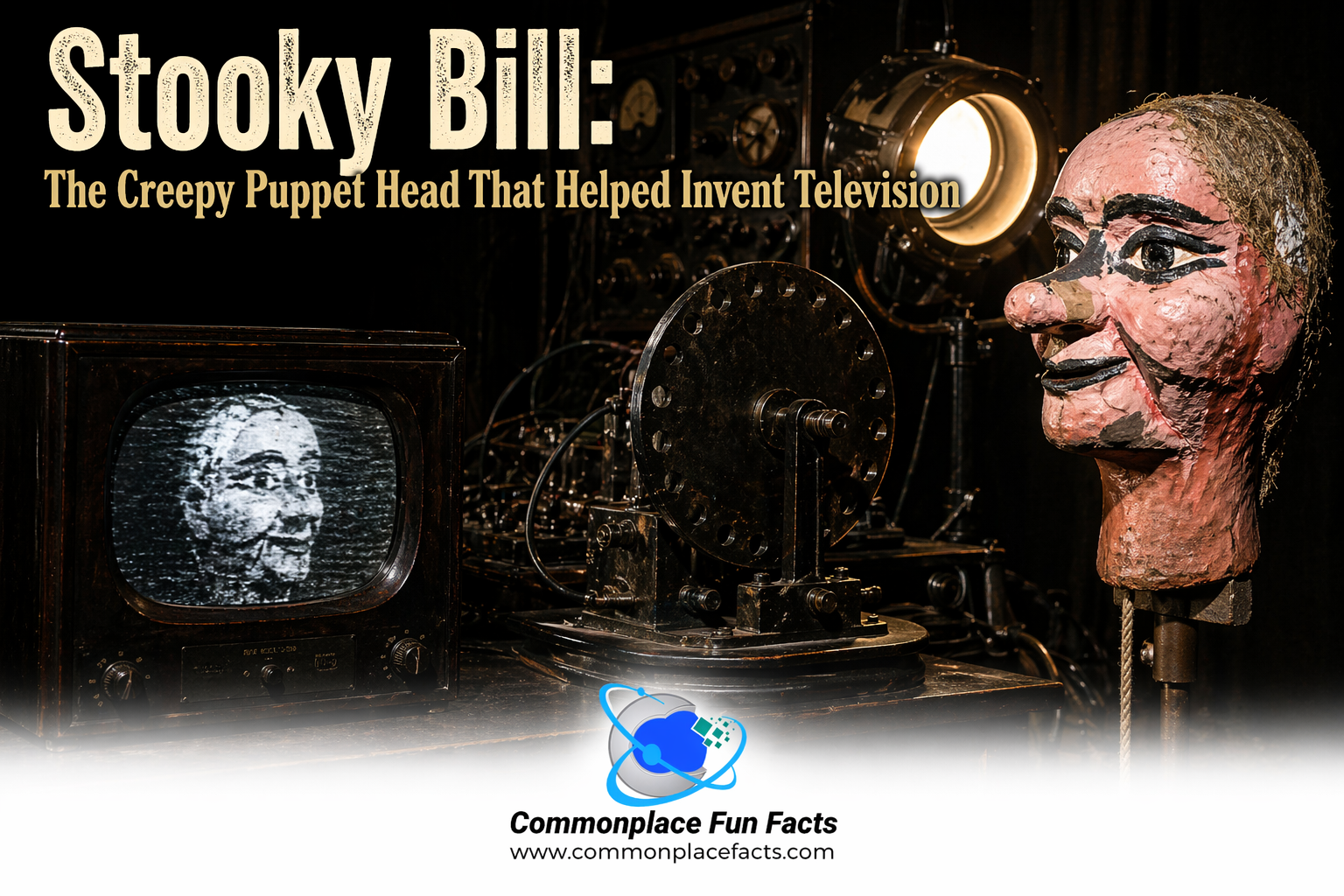
One of the earliest recognizable faces in television history was not a statesman, an assistant, or a solemn operator tapping out destiny. It was a ventriloquist’s dummy head named Stooky Bill.
Not a man delivering an immortal sentence. Not a genius peering nobly into the future. Just a creepy painted puppet face being blasted with enough light to guarantee no vampire would ever get the job.
So while other inventions got to enter the world sounding poetic or profound, television effectively stumbled onto the stage looking like something discovered in a trunk marked Do Not Open After Midnight.
Considering that television was invented by a teenager and became what it is today, that honestly feels about right.
Contents
The Birth of Television Was Less Sleek Than Advertised
The story begins with Scottish inventor John Logie Baird, one of the major pioneers of early television. In the mid-1920s, Baird was working out of 22 Frith Street in Soho, London, trying to solve a problem that had obsessed inventors for years: how do you transmit moving images from one place to another?

Today, the answer involves digital signals, flat panels, streaming platforms, and a family argument over who changed the password again. In Baird’s day, the answer involved a mechanical system that was part genius, part improvisation, and part “please do not stand too close to the light-emitting apparatus.”
His machine used a spinning disc to scan an image line by line. Light reflected from the subject would be converted into an electrical signal, and another synchronized disc at the receiving end would reconstruct the picture. It was ingenious. It was clunky. It was a little like inventing the smartphone by starting with a bicycle wheel, a paper plate, and a very optimistic attitude.
The crucial point is that Baird’s early system was primitive and demanding. It needed intense light. It needed strong contrast. It needed a subject that would sit still and cooperate while being blasted by illumination hot enough to make the whole experience feel like enhanced interrogation techniques.
Human beings, in one of our many failures to meet industrial expectations, were not ideal for this.
Why a Puppet Head Was Better Than a Human Face
This is where Stooky Bill enters the story, looking as though he had arrived by mistake from a far less cheerful branch of entertainment.

Stooky Bill, also often spelled Stookie Bill, was the head of a ventriloquist’s dummy that Baird used in his experiments.
The name “Stooky” or “Stookie” has Scots roots associated with plaster or stucco, and can also be used for a person who seems awkward or a bit slow. This means that the dummy’s name was already doing strong comic work long before posterity adopted him as a pioneer.
Stooky Bill sounds less like the herald of a new communications era and more like a fellow who should be unsuccessfully selling pencils outside a railway station. Instead, he wound up in the history of media.
The rationale for choosing a puppet was not artistic. No one anticipated Sesame Street or The Muppet Show. The reason was technical.
Baird needed a face with strong contrast. Human skin did not register especially well on his equipment, but the dummy’s painted features did. The artificial face was easier for the machine to process, which meant Stooky Bill could succeed where living, breathing, fully organic people had the audacity to be less visually convenient.
There was also the small matter of the heat. The powerful lights required by Baird’s setup were not exactly spa-friendly. Reports from the object’s history note that the heat eventually cracked Stooky Bill’s painted face, and accounts have long held that the dummy’s hair was singed as well.
Television was not easing gently into existence. Television was being dragged into the world through sparks, glare, spinning discs, and the slow roasting of a puppet head.
And yet it worked.
The First Human on Television Had to Be Persuaded Into It
Once Baird had successfully transmitted Stooky Bill’s painted face, he moved on to the next logical step: finding an actual person willing to stand in front of this alarming machine and let history happen to him.

That person was William Edward Taynton, a young office boy who is generally credited as the first human being televised in full tonal range. According to accounts of the experiment, Baird had to go downstairs and fetch him, which feels appropriate. Major breakthroughs in communication technology apparently depend not only on genius but also on the nearest available employee. Even in those days, when looking for someone who might be expendable, the young intern leads the list.
The public demonstration that followed on January 26, 1926 gave observers a glimpse of both the dummy head and a real person. This time, the subject was Baird’s business partner Oliver Hutchinson.
As The Times reported two days later, visitors were shown “recognizable reception of the movements of the dummy head and of a person speaking.” That may sound modest by modern standards, but it was an extraordinary claim at the time. The same report noted that the image was “faint and often blurred,” which is another way of saying that television had arrived, but it had not yet discovered the miracle of high definition.
Baird himself understood the significance of the moment. Looking back on the breakthrough, he wrote, “I was definitely able to transmit the living image, and it was the first time it had been done. But how to convince the sceptical, hide-bound, select and exclusive scientific world? … Would they admit that a wretched nonentity working with soap boxes in a garret had done something which many of them had stated was not possible?”
This is one of those gloriously transitional moments in history. Television did not simply arrive fully formed. It stumbled into the world in stages. First came outlines and shadows. Then a dummy head. Then an actual human being hauled into the experiment because the inventor had finally gotten the machine to behave itself.
It is difficult not to admire the drama of it all. The future of a communication medium that gave us generations of “talking heads” arrived in a Soho attic by first proving that it could successfully broadcast a painted face attached to no body at all.
Stooky Bill, Reluctant Star
There is something perfect about the fact that one of television’s earliest “stars” was a ventriloquist’s dummy.
Television would become the dominant medium of the twentieth century. It would shape politics, culture, fashion, language, advertising, and family furniture placement. It gave us moon landings, presidential debates, sitcoms, nature documentaries, prestige dramas, local weather people pointing accusingly at cold fronts, and commercials that make prescription medication sound as if the cure is worse than the disease. Entire careers would rise or fall because of how someone looked on camera. Governments would fear it. Children would sit too close to it. Critics would declare it shallow, corrosive, addictive, vulgar, educational, and revolutionary.
To be fair, it was all of those — and more.

Its first major test subject, meanwhile, was a wooden-faced prop that looked like it had a claim on your very soul.
That absurdity is part of what makes Stooky Bill so memorable. He captures the awkward phase of invention that history often tries to sand smooth. Once technologies succeed, we like to talk about them as if they emerged with dignity. We skip past the messy prototype stage. We forget the bizarre workarounds. We quietly omit the moments when the future depended on whatever happened to be lying around and could survive the equipment.
The Machine Behind the Madness
Baird’s early television system relied on a Nipkow disc, a rotating disc perforated with holes arranged in a spiral. As the disc spun, it scanned different parts of the subject in sequence. The system was mechanical rather than electronic, which means it belonged to a fascinating branch of technological evolution that now seems half visionary and half glorified clockwork — much like the first fax machine, which surprisingly arrived on the scene in 1843, over 80 years before Baird’s revolutionary experiments.
There is a tendency to imagine old inventions as quaint and simple. Mechanical television was not quaint in the cozy sense. It was ingenious in the “if you stand in the wrong place, part of this may detach itself at speed” sense.
Baird’s apparatus has been described as noisy, temperamental, and prone to breakdowns. Ironically, those same words appear repeatedly in this writer’s annual performance reviews.
Still, it achieved something extraordinary. It proved that televised images were possible. The image quality was rough. The screen was tiny. The equipment looked like a science project assembled during an electrical storm. None of that changes the central fact that it worked.
Once that door opened, the rest of television history followed.
Baird Did Not Stop at Television’s Creepy Puppet Phase
It would be easy to remember John Logie Baird as the man who got television off the ground with spinning discs, scorching lights, and a ventriloquist’s dummy that looked like it had been plucked from a dream you experience after eating some badly aged cheese. That would already be enough to secure his place in history. Baird, being Scottish, was not content to invent one world-changing medium and then spend the rest of his life smugly attending dinners. He kept tinkering.
Among his most important later innovations was color television. In 1928, only a couple of years after his famous early demonstrations of moving images, Baird successfully demonstrated a mechanical color television system. In other words, he was already trying to move beyond black-and-white television before black-and-white television had even properly settled in and unpacked its bags. He later continued that work with improved color systems, including his Telechrome experiments in the 1940s, which pushed toward fully electronic color television displays. For a man working with equipment that often looked as though it had been assembled from the contents of your kitchen’s junk drawer, this was impressively forward-looking.
Baird also worked on stereoscopic television, meaning three-dimensional television, because apparently ordinary television was not ambitious enough. Britannica notes that he demonstrated color television in 1928 and was reported to have completed research on stereoscopic television by 1946. In other words, Baird was experimenting with forms of television that still periodically resurface as “the future of entertainment” many decades later, usually accompanied by expensive upgrades and a fresh wave of optimism.
Another especially fascinating project was something called Phonovision, Baird’s attempt to record television signals onto discs. This was, in effect, an early video recording system. It did not become a commercial success, mostly because the technology was still awkward and limited, but the idea itself was remarkably ahead of its time. Baird was not merely trying to show moving images. He was already thinking about preserving them. In modern terms, he was groping toward the VCR decades before anyone would need one to tape a sitcom and forget to label it.
His imagination also wandered into night viewing. Sources credit him with developing what he called “Noctovision,” a system that used infrared light to produce images in the dark. Some writers have treated this as a precursor to radar, although that claim is disputed and experts note that Noctovision was not radar in the full technical sense. Still, the larger point remains: Baird had a habit of pushing image technology into places it had not gone before, including the dark. Television, color television, three-dimensional television, recording television, seeing in darkness — he kept showing up at the birth of modern media like a man determined to sign every page of the guest book.
He even had a long side career in wonderfully odd practical inventions. According to accounts of his work, he experimented with things like a rust-resistant glass razor, pneumatic shoes, and thermal undersocks. Not every one of these ideas was a triumph, which is another reason Baird is so likable as a historical figure. He was not one of those inventors who appears in retrospect as a marble statue with perfect instincts. He was a restless experimentalist, the kind of person who looked at the world and was constitutionally unable to leave the future alone.
Where Is Stooky Bill Now?
Stooky Bill survives today in the collection of the United Kingdom’s National Science and Media Museum in Bradford. Which is reassuring. Objects like this deserve preservation. A modern replica is used by the Narrow Bandwidth Television Association to reproduce and demonstrate Baird’s work.

Stooky Bill is preserved not just because he is historically important, although he certainly is. Not just because he is tied to one of the great technological turning points of the modern age, although he is that too.
He is preserved because he reminds us what invention actually looks like up close.
It looks improvised.
It looks fragile.
It looks faintly ridiculous.
It looks, in this case, like a painted dummy head enduring impossible light levels so that humanity can eventually binge-watch detective dramas in sweatpants.
The Real Lesson of Stooky Bill
The deeper charm of Stooky Bill is that he strips away the mythology of smooth progress. We tend to tell the story of technology as a parade of inevitabilities, as though television was always destined to arrive in polished form and dominate the century. Stooky Bill reminds us that progress is usually much stranger than that.
At the beginning, no one knew exactly which approach would win. Mechanical systems were competing with other ideas. The equipment was awkward. The images were crude. The results were inconsistent. The path forward was not obvious.
Then, in a rented attic in Soho, a painted dummy face appeared on a screen.
That did not finish the story, but it changed it. Suddenly the impossible had become merely difficult. Once that happens, history starts moving faster.
So yes, television transformed the modern world. It became a source of information, entertainment, propaganda, art, comfort, nonsense, and occasionally all five at once.
Still, it is worth remembering that before television had polished anchors, glamorous performers, and prestige programming, it had Stooky Bill: a ventriloquist’s dummy with cracked paint, scorched dignity, and a permanent place in the history of invention.
In terms of origin stories, television definitely earned this one.
You may also enjoy…

Philo T. Farnsworth: The Teenage Genius Inventor of the Television
Philo T. Farnsworth, a brilliant young inventor of the television, changed the world with his inventions. Find out more about him here.

The Entertainer Who Put a Lot of Heart Into His Work
Paul Winchell (1922-2005) may be best known as the voice of Tigger in Winnie the Pooh, Gargamel in The Smurfs, the characters in Green Eggs and Ham and many other animated characters, and for earning a star on the Hollywood Walk of Fame for his work in television. He holds another distinction, however, that frequently gets…

The Glitter Conspiracy: How a WWII Secret Invention Sparked a Sparkly Crisis
What is the Glitter Conspiracy? From WWII secrecy and ultra-precise manufacturing to environmental fallout and internet suspicion, this deep dive explores how glitter became permanent, pervasive, and just suspicious enough to worry everyone.





Leave a Reply