
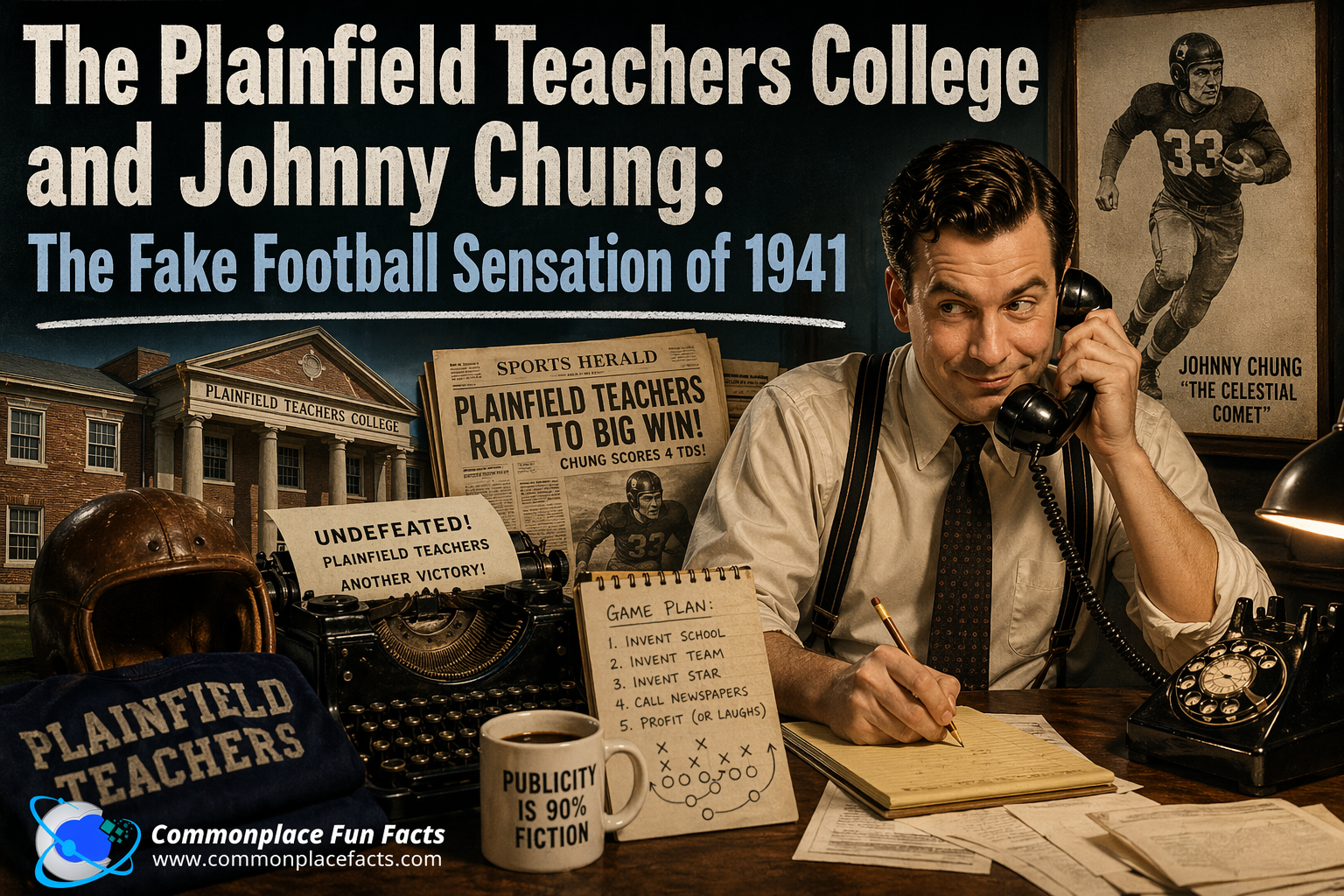

In the fall of 1941, sportswriters and football fans in the Northeast began hearing about a small but ferocious college team called Plainfield Teachers College. It was undefeated. It was rolling over opponents with cheerful brutality. It had a brilliant coach, a revolutionary offense, and a dazzling Chinese halfback named Johnny Chung, nicknamed the Celestial Comet. This young man, readers were told, was so electrifying that he was already drifting into the kind of sports mythology that guaranteed he would be remembered as one of the greatest players of all time.
So what became of the Celestial Comet? Why haven’t we heard of his contributions to the world of professional sports? And for that matter, what ever became of the Plainfield Teachers College football program? Why doesn’t it continue to turn out world-class athletes?
The answer is surprisingly simple: Plainfield Teachers College was fake.
The school was fake. The team was fake. The schedule was fake. The opponents were fake. The star player was fake. The press agent was fake. The whole thing was essentially a football season assembled out of telephone calls, stationery, imagination, and the willingness of newspapers to accept obscure scores without asking too many annoying questions.
Contents
The Mystery of the Obscure Football Score

The mastermind behind this nonsense was Morris Newburger, a Wall Street broker, Harvard graduate, sports fan, and a man who looked at the machinery of American journalism and thought, “I bet I can drive a clown car through that.”
According to contemporary accounts, the whole thing began on the night of October 25, 1941. Newburger was pondering a question that probably would not occur to a healthy person at dinner: how did newspapers get all of those scores from tiny schools with names that sounded like they had been invented by someone shaking a box of vocational brochures?
He had a point. Big-city reporters were not trekking out to every obscure college game in America. Many small schools simply phoned in their results. That was normal. That was accepted. That was how the system worked.

Newburger decided to test it. He stepped away from dinner, called the New York Times, and reported that Plainfield Teachers had beaten Winona, 27-3. Then he called the Herald Tribune and did the same thing. The next morning, both papers printed the score.
And just like that, a phantom football program had entered the American sporting bloodstream.
One imagines Newburger standing there with the stunned expression of a man who had just discovered that the vault door was not merely unlocked, but politely held open by the night watchman.
Building a Dynasty For a Fake Football Team
Most people, after successfully sneaking one fake score into the newspaper, would have considered the joke complete. They would have smiled smugly, told two friends, and gone back to their normal hobbies.
Morris Newburger was not most people.
Instead of stopping, he doubled down. Then tripled down. Then kept going until he had invented an entire football ecosystem.
Plainfield Teachers College began piling up wins over schools with names like Randolph Tech and Ingersoll. The team had a coach. The team had a system. The team had colors. The team had a future. Before long, it had something even more valuable than institutional legitimacy: sportswriter enthusiasm.
The fake coach was Ralph “Hurry-Up” Hoblitzel, who was credited with a bizarre “Winged W” formation that sounds less like a real football strategy and more like something a feverish man would sketch on a napkin after too much diner coffee. The team also featured an end named “Boarding House” Smithers, which is the kind of name that should have caused at least one copy editor to sit bolt upright and demand photographs to go with the story.
But the true star, the jewel in the crown, the figure who transformed this from a fake score prank into a full-scale athletic hallucination, was Johnny Chung.
Enter Johnny Chung, the Celestial Comet
Johnny Chung was introduced as a Chinese sophomore halfback whose speed, power, and general magnificence were quickly celebrated in print. He scored touchdowns. He dragged tacklers. He became the center of increasingly colorful press coverage. He was nicknamed the Celestial Comet, which sounds like one of the longshots at the Kentucky Derby.

It all escalated very quickly.
In no time at all, Chung was being described as one of the most exciting players in college football. Reporters repeated stories about his remarkable yardage and peculiar habits. One of the more absurd embellishments claimed that he gained stamina by eating rice between halves, which sounds less like the sort of thing that would trigger a fitness craze in the TikTok era.
The important thing, though, is not merely that these details were made up. It is that they were believed. Or at least believed enough to be printed, repeated, and folded into the growing legend of the Plainfield Teachers College.
Long before the internet gave us viral nonsense at industrial scale, 1941 had already produced a sports star whose entire career existed in the same place as unicorns and honest used-car commercials.
The Press Agent Who Was Also Fake
Having realized that Plainfield Teachers needed a proper publicity machine, Newburger created a press agent named Jerry Croyden.

A fake team calling in scores might be suspicious eventually. A fake team with an official-sounding representative sending out releases on letterhead feels organized. It feels real. It feels like something that belongs in the ecosystem of college sports. Once the public relations apparatus appeared, Plainfield Teachers stopped looking like a random line in the agate type and started looking like a program.
That was the genius of the hoax. It did not rely on one outrageous lie. It relied on a series of small, plausible details that supported one another like conspirators in matching neckties.
Newburger even had office materials made up for the fake athletic association. He understood something that frauds, grifters, and bureaucracy enthusiasts have known forever: paper has a hypnotic effect on people. Put nonsense on the right stationery and suddenly it acquires posture.
Why This Worked at All
The natural question, of course, is how on earth newspapers fell for this.
The answer is not that reporters in 1941 were uniquely foolish. It is that they were working within a system that had blind spots, and Newburger found one with the precision of a burglar trying every window on the block.
Sports pages printed huge numbers of scores from all over the country. Not every tiny school could be verified in real time. Small colleges regularly phoned in results. Communications infrastructure was uneven. Some schools appeared and disappeared. Others changed names. Still others sounded like they had been generated by throwing darts at a map and a faculty handbook.
Against that backdrop, Plainfield Teachers did not immediately scream “impossible.” It sounded odd, yes, but no odder than many real institutions of the period. That was the beauty of it. The hoax did not succeed because it was outrageously convincing. It succeeded because it was just ordinary enough to slide through unnoticed.
Which, if we are being honest, remains one of the great recurring themes of human civilization.
The Beginning of the End
Like many hoaxes, Plainfield Teachers eventually suffered from the fatal condition known as success.
The more attention the team got, the more likely someone was to look closely. Once Johnny Chung started attracting notice and the supposedly unstoppable Plainfield squad began appearing in wider coverage, the prank ceased to be a private joke and became a public challenge to the credibility of newspapers.
That is usually when editors develop a sudden and renewed interest in facts.
By November 1941, word was spreading that something was off. Accounts differ a bit on exactly who chased it down first and who had heard rumors when, but the central point is clear: reporters started checking, and the whole thing came apart with surprising speed. There was no campus. No program. No coach. No Chung. No team. Plainfield Teachers was not a Cinderella story. It was a ghost in shoulder pads.

Once exposure became inevitable, Newburger sent out one final press release under the Jerry Croyden alias. It announced that several players, including Chung, had failed their midterms and would be ineligible for the remainder of the season. This conveniently explained why Plainfield would not be playing its remaining games or appearing in the equally suspicious-sounding Blackboard Bowl.
It was a marvelous final flourish, like a magician concluding the act by pretending the rabbit had been suspended for using steroids.
The Salem Trade Comparison
If this all sounds a bit familiar, it’s because you might be thinking of the Salem Trade School football team, which we covered in this article. It involved actual human beings suiting up and playing actual football games for a school that did not exist. It was a fake institution attached to a real team. The boys were there. The bruises were real. The deception lay in who they claimed to represent.
Plainfield Teachers took that concept, stared at it thoughtfully, and decided even the players were an unnecessary expense.
Salem Trade was a counterfeit bill. Plainfield Teachers was someone drawing money on a napkin and getting it accepted at the bank.
That is the key distinction. Harold Burgess and the Salem Trade players at least had to show up on a field and risk being tackled. Morris Newburger had the far more elegant scheme of staying indoors and letting editors do the heavy lifting. One fraud required stamina and helmets. The other required a telephone and the confidence of a man who had never once considered the possibility of shame.
Both stories are delightful for the same reason: they expose how much of organized sports depends on trust, paperwork, routine, and the assumption that somebody else has already checked the details. Once that trust is in place, absurdity can stroll in wearing a varsity sweater and nobody notices until very late in the game.
Fictitious schools have a surprisingly long and oddly creative history in sports, ranging from outright frauds to elaborate inside jokes. Maguire University took the idea in a different direction: invented in 1963 by Chicago-area high school basketball coaches, it existed not to field athletes at all, but to qualify its “coaches” for free NCAA Final Four tickets, complete with a listed address, phone number, and a bar serving as its notional campus. Together, Salem Trade and Maguire University show that fake schools have been serving sports-related schemes for generations, whether the goal was winning games, getting perks, or simply proving that official-looking paperwork can sometimes carry an alarming amount of weight.
The Aftermath

What is striking is that the hoax was not remembered as some monstrous journalistic scandal. It was, instead, treated largely as a very funny embarrassment. Contemporary writers appreciated the absurdity. Some even honored Plainfield Teachers with mock tributes and songs.
That reaction tells us something important.
This was not a fraud designed to steal fortunes or ruin lives. It was a prank aimed at the machinery of publicity itself. Newburger exposed a weakness, yes, but he did it with enough wit that the result landed more as satire than malice. He showed that if you fed the news system a sufficiently plausible fiction, it would not merely print it. It would decorate it. It would give it a coach, a scheme, a hero, and a future bowl invitation.
In that sense, Plainfield Teachers was less a football hoax than a stress test for media credulity.
And the media, bless its heart, failed with real enthusiasm.
The Real Lesson Here
If this story has a moral, it is not merely that newspapers once got duped. Newspapers have always gotten duped. So has everybody else. The more enduring lesson is that institutions often rely on habits that work well enough until someone mischievous decides to examine them too closely.
Newburger saw that obscure scores were being accepted on trust. He also understood that once a falsehood is printed, subsequent lies become easier. If Plainfield Teachers won last week, then of course Plainfield Teachers can win again this week. If Johnny Chung scored once, then of course he can score again. If Jerry Croyden sent a release on official stationery, then surely there must be an office somewhere with a file cabinet and a secretary and perhaps a pennant on the wall.
That is how nonsense grows. It does not begin as a grand cathedral of deceit. It begins as a single brick no one bothers to inspect.
Which is one reason the Plainfield Teachers hoax still feels oddly modern. Strip away the fedoras and the sports pages, and the mechanism is painfully familiar. A dubious claim appears. It gets repeated. It acquires detail. Soon people are discussing implications, future prospects, and postseason opportunities for something that never existed in the first place.
History, as ever, was kind enough to invent social media before social media. It just delivered it more slowly and with better hats.
The Team That Never Was
In the end, Johnny Chung never ran for another touchdown. Coach Hoblitzel never unveiled another tactical marvel. Plainfield Teachers never finished its undefeated season. The Celestial Comet streaked across the sports pages for a few brief weeks and then vanished back into the firmament from which he had been fabricated.
But what a glorious run it was.
Salem Trade proved that a fake school could field a real team. Plainfield Teachers proved that even the team itself was optional. Put the two stories together and you get a kind of master class in athletic deception: one scam with too many players, the other with none at all.
Somewhere between them lies a useful truth about sports, media, and perhaps society in general. We are a people unusually willing to believe in underdogs, miracle runs, unknown stars, and institutions we have never heard of, provided they come wrapped in the right language and arrive in the proper column of the Sunday paper.
And honestly, there is something almost admirable about the audacity.
It takes nerve to invent a football dynasty from scratch.
It takes even more nerve to give it a Heisman-worthy star, a futuristic offense, and a respectable academic eligibility problem.
Plainfield Teachers never had a stadium, a locker room, or a student body. But for a few enchanted weeks in 1941, it had the most important thing any sports program can possess: good press.
You may also enjoy…

The Strange Story of the Salem Trade School Football Team: the Original Sports Scandal
Explore the intriguing story of the Salem Trade School football team, a fake high school squad that played throughout the 1920s before being exposed as a scam. Learn about Harold Burgess’s scheme and its place in sports history.

The Fantastic Tale of Sidd Finch: Baseball’s Fastball-Throwing, French Horn Playing Mirage
Discover the hilarious hoax of Sidd Finch, the fictional baseball prodigy who baffled the world with his 168 mph fastball, Tibetan training, and one hiking boot.

This School’s Most Famous Student Never Existed
Georgia Institute of Technology is a research university based in Atlanta, Georgia. Since its establishment in 1885, Georgia Tech has awarded degrees to tens of thousands of students. None of them have come close to surpassing the fame and accomplishments of 1930 graduate George P. Burdell. Although nearly a century has passed since Burdell’s enrollment,…





Leave a Reply