
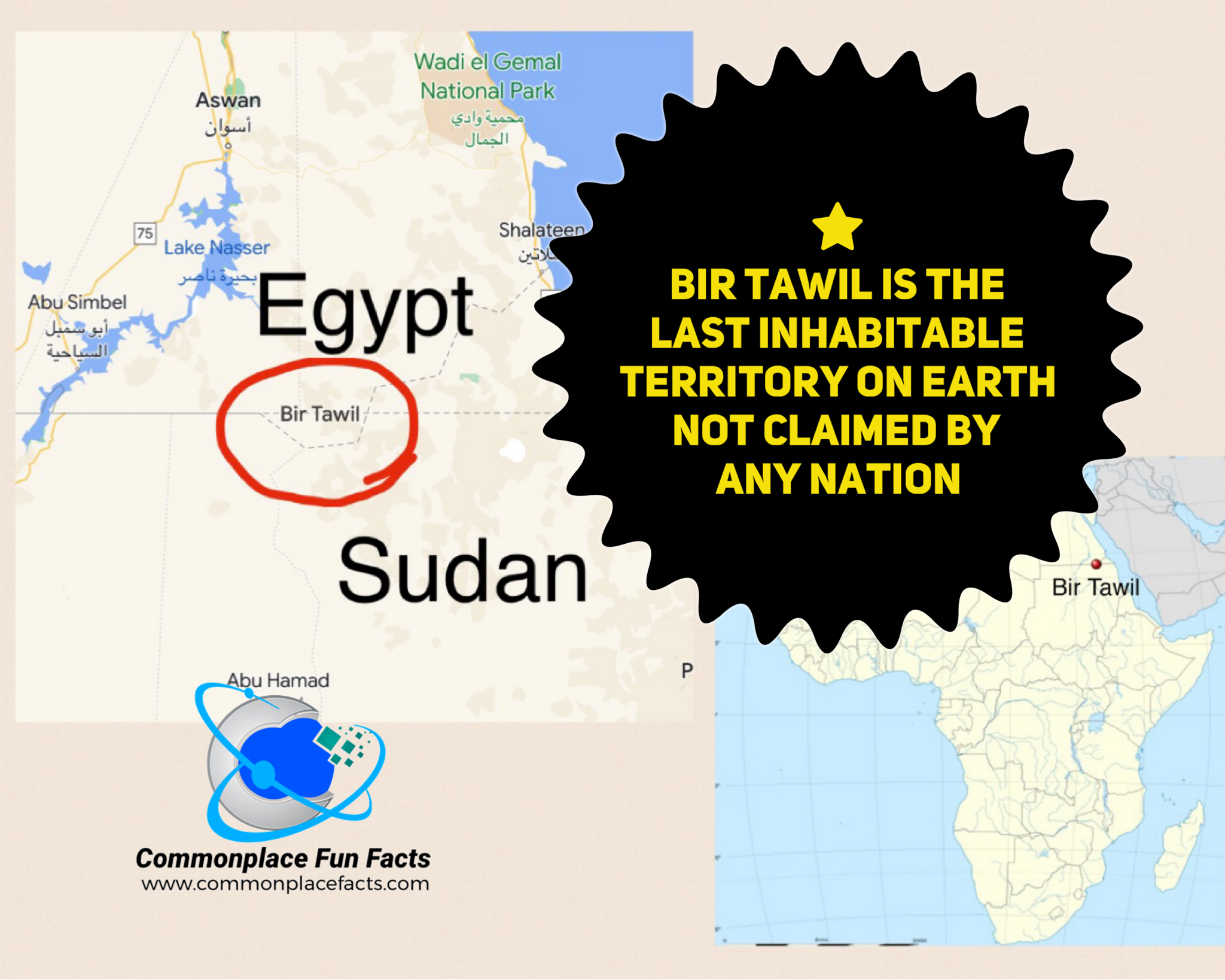

There’s nothing unique about disputed territory. It is one of the most common causes of war. When two nations cannot agree on who holds the right to possess a piece of real estate, conflict is inevitable.
Unless, of course, we’re talking about Bir Tawil. The conflict over the possession of Bir Tawil is similar to the conflict that existed over this writer among the girls in high school when it was time to find a date for the prom: no one was interested. That’s right, Bir Tawil is the scrawny, nerdy, socially-awkward kid in the world of international real estate. It is said to be the only habitable place on the planet that no one seems to want.

Smaller than the U.S. state of Rhode Island, Bir Tawil is a 2,060 km2 (795.4 mi2) piece of uninhabited land along the border of Egypt and Sudan. It exists because the two nations have differing ideas about what their common border looks like.
An 1899 treaty between Egypt and the United Kingdom refers to Sudan (then known as “Soudan” as the “territories south of the 22nd parallel of latitude.” The treaty initially gave Egypt control of the Red Sea port of Suakin. It was later amended to place Suakin under Sudan’s control.
Three years later, on November 4, 1902, a separate “administrative boundary” agreement was prepared by the United Kingdom. Its purpose was to address the use of the land by the regional tribes. Since the territory of Bir Tawil was used by the Ababda tribe as grazing land, the agreement placed it under Egyptian jurisdiction. It also placed territory to the northeast, the Hala’ib Triangle, under the control of Sudan.

As nations tend to do, Egypt and Sudan have since assigned different degrees of importance to these agreements. Egypt asserts the authority of the first 1899 treaty to define its southern border. Sudan, on the other hand, believes the 1902 document prevails. The resultant dispute is that Egypt thinks it owns the Hala’ib Triangle and that Sudan owns Bir Tawil. Sudan, however, insists that the Hala’ib Triangle is theirs and that Bir Tawil is Egyptian territory. In other words, in the global prom of nations, cheerleaders Egypt and Sudan are both fighting about which of them will get to take quarterback Hala’ib Triangle to the dance. Meanwhile, poor ol’ Bir Tawil is the only one in the entire chess club who can’t get a date.
Not that we harbor any bitterness about those high school days or anything.
Because of its size, inaccessibility to a body of water, and harsh climate (average high temperature of 42 C (108 F) during the summer months), there is no permanent human population in Bir Tawil. Members of the Bishari and Ababda tribes pass through. The only people who remain for an extended time are gold miners who work at various unregulated mines.
Despite its lack of airports, hotels, restaurants, or water supply, Bir Tawil has a WikiVoyage travel page, for hardy tourists who wish to visit this desolate place. In 2014, a man from the United States went there and planted a flag, declaring himself to be the sovereign of the “Kingdom of North Sudan.” He did this so he could fulfill his six-year-old daughter’s wish to be a princess. Thus far, no other nation has recognized this claim to sovereignty. Besides, he didn’t stick around to defend his title.
Perhaps you have an aspiring princess in your household. If so, a trip to Bir Tawil may be in your future. The good news is that you don’t need a passport to enter Bir Tawil. Unless you plan on staying there for the rest of your life, it would be a good idea to have a passport on hand for when you attempt to leave this last unclaimed piece of habitable land on the planet.

The Order of Malta: The Stateless State That Isn’t Quite a State
Passports without citizens. Stamps without post offices. Sovereignty without a country. Welcome to the strange world of the Sovereign Military Order of Malta.

The Nation of Celestial Space: Why One Man Believed He Owned the Moon—and Everything Beyond It
In 1949, James T. Mangan declared himself ruler of outer space by founding the Nation of Celestial Space. Discover the bizarre true story of stamps, sovereignty, and a typewriter-fueled empire.

The Conch Republic: The Micronation That Declared War, Surrendered, and Asked for Foreign Aid—all in Under a Minute
In 1982, Key West declared itself the Conch Republic, waged a one-minute war, and requested $1 billion in aid. Discover the hilarious true story of America’s quirkiest micronation.






Leave a Reply to sopantoothCancel reply