
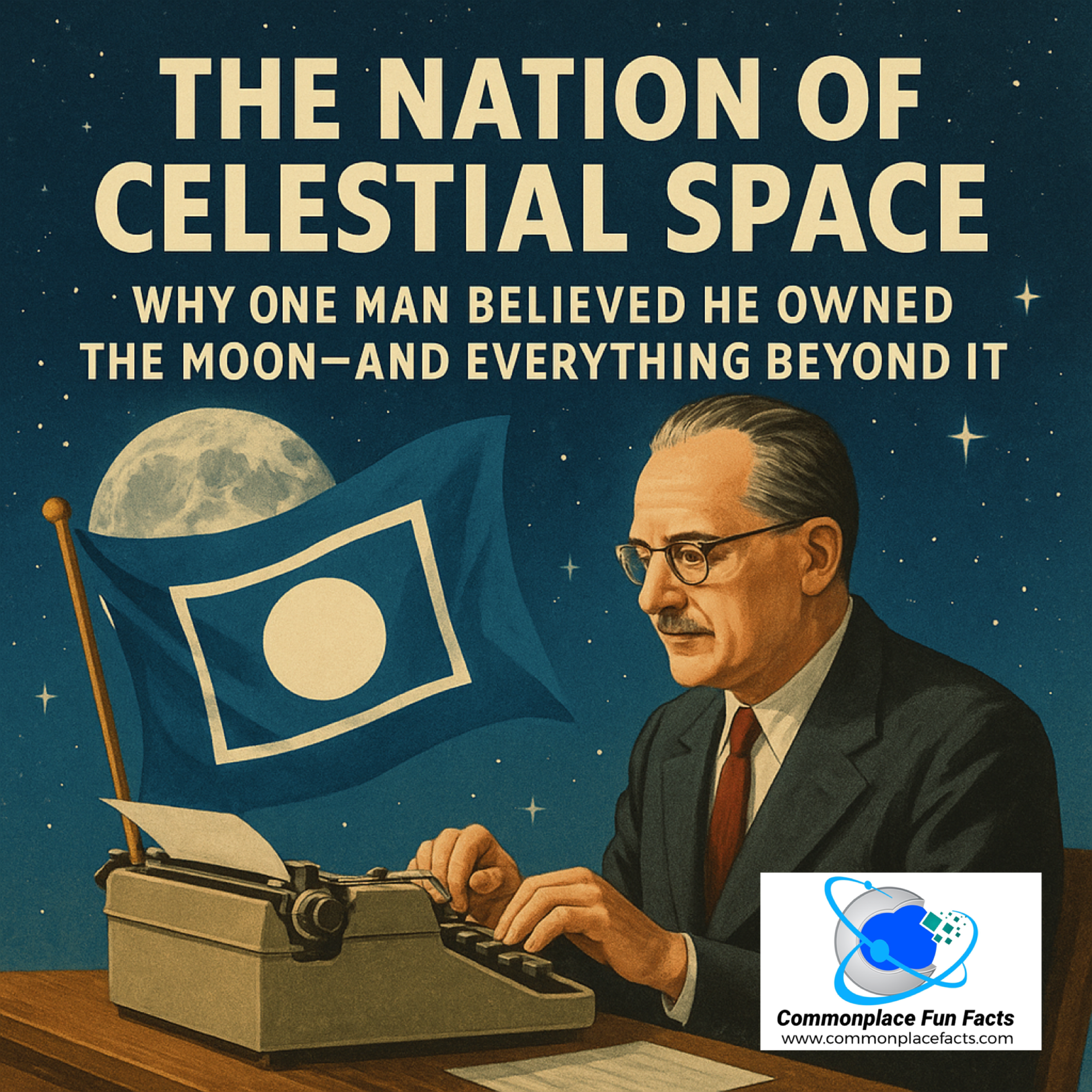

Some people dream of making a name for themselves. Others dream of making a nation for themselves. And then there’s James Thomas Mangan, who decided that the only logical next step was to claim all of outer space as his personal dominion. You know, like a cosmic Airbnb, but with more postage stamps.
Welcome to the delightfully bonkers tale of the Nation of Celestial Space, or Celestia for those who prefer their galactic empires with a side of brevity.
Contents
The Man Who Claimed the Cosmos
In late 1948, Mangan—a Chicago publicity man and self-described “industrial designer”—was having a casual conversation with his business partner when inspiration struck. His partner gestured vaguely toward the sky and remarked, “There’s plenty of stuff out there.” For most people, that’s where the conversation would end. For Mangan, it was the beginning of interstellar dominion.

At precisely midnight on December 20, 1948, Mangan declared the Nation of Celestial Space into existence. To ensure the pristine nature of his claim, he waited exactly nine minutes for Earth to move out of its current position so he could annex “absolutely flawless” territory. Because, as every good galactic founder knows, it’s all about location, location, and location.
He recorded this cosmic land grab with the Cook County Recorder of Deeds, who only accepted the paperwork after what was described as a “frantic and embarrassed consultation” with the State’s Attorney. Bureaucratic red tape, meet interplanetary sovereignty, with a smattering of Chicago politics.
When the UN Gets Mail from Space
In early 1949, 74 envelopes were dropped into a Chicago mailbox. Each was addressed to a different Secretary of State around the globe and contained a declaration from Celestia, requesting formal diplomatic recognition. The total number of responses received? Zero.
Undeterred, Mangan turned to the United Nations, applying for a seat as the representative of all space. Although the U.N. didn’t exactly roll out the red carpet, Mangan’s daughter Ruth once raised the Celestian flag outside their New York headquarters—without permission, of course.
Typewriters, Stamps, and Big Ideas

Celestia may not have had land, citizens, or functioning infrastructure, but what it did have was stationery. Lots of it. Mangan churned out manifestos, declarations, and diplomatic missives with the gusto of a caffeinated stenographer. Renowned type designer Robert Hunter Middleton was even recruited to lend some typographic gravitas to Celestia’s founding documents.
In a 1949 interview, Mangan lamented: “They are interested to an over degree, but their interest is completely unintelligent. Only my wife, my son and my partner see the depth of it. This is a new, bold, immodest idea.”
He was also quite bitter about being ignored by world powers. “Before I die, I’ll get at least one nation to recognize me,” he vowed. Spoiler alert: he did not.
A Government of One (With Opinions)
Mangan had some strong views on governance. “It will not be a democracy,” he declared, “because I don’t like voting.” He wasn’t a fan of taxes, either. Instead of citizens, Celestia would have “Participants”—people who bought a dollar’s worth of space. As for the rights of the “participants”? Limited to “suggestion rights or thinking rights,” which sounds like the onboarding policy at a very strange startup.
He promised not to sell any lots just yet, but claimed he’d already received 400 applications. Each parcel would be roughly the size of Earth, sold for one dollar — a concept that sounds cool, but could you fence off your interstellar real estate like you could if you had one square inch of the Yukon? It was the galactic version of buying land in Florida, but with slightly fewer mosquitoes, and like the woman who sold parcels on the sun, but with less likelihood of incineration when you visit your real estate.

To fund his dream nation, he planned to issue postage stamps. He looked to the tiny European nation of Liechtenstein, which had a solid side hustle selling stamps to collectors. Mangan even tried to convince a small American town to rename itself Celestia and serve as the national post office. The effort was unsuccessful—probably because nobody wants to live somewhere that technically includes a black hole in its zoning plan.
Trespassers Will Be Theoretically Prosecuted
James Mangan took his sovereignty seriously. Radio and television signals? “Trespassers.” Proposed space stations? Violating Celestian territory. He claimed he would take action against space-faring warcraft, although he admitted, “I don’t know what I can do about it.” A restraining order, perhaps?
He also scoffed at existing property laws that only extended upward to the point where birds stop flapping. “Once you leave Earth,” he explained, “the distance between the boundary lines grows more and more huge. The concept of owning property upward and downward is the biggest oversight in history.”
Space Is a Muscle (Apparently)
Before drafting a constitution, Mangan wanted to define space itself. He rejected the popular notion that “space undulates,” declaring it inadequate. His definition? “Space is the great servant of the Universe… it is a great muscle loaded with magnetism.”
Peace Through Scale
Mangan believed Celestia could serve as a force for world peace. “Look at it philosophically,” he said. “If you owned something 8,000 miles in diameter and 25,000 miles in circumference, you might realize that war is something to be laughed at.”
His logic is unassailable. If you can’t laugh at the concept of owning huge portions of emptiness, what can you laugh at?
A Cold Claim: Celestia Goes South
By 1958, Mangan had already staked his claim to the infinite void above Earth. But like any ambitious landlord, he started looking for expansion opportunities closer to home. His eyes fell on the one spot on Earth that most people actively try to avoid: Antarctica.
Mangan declared that since Antarctica wasn’t officially owned by any one country and existed outside traditional national control, it was fair game. So, naturally, he folded it into Celestia. This meant that his already ambitious real estate portfolio now included both all of outer space and the world’s iciest continent. Zillow had no idea what to do with that listing.
There was, of course, no actual expedition. No planting of a flag. No penguin census. Just more paperwork and proclamations, delivered via typewriter, stamped with unrecognized postage, and likely met with confused shrugs by anyone south of Argentina. But in Mangan’s mind, the Nation of Celestial Space now had a charming frozen annex.
Was this legally binding? No. Did it stop him? Also no. After all, if you’ve already claimed the Moon, a few glaciers and some emperor penguins are just bonus perks of the job.
Final Thoughts from Planet Earth
In his final act of statecraft, Mangan planned to revise his will to leave all Celestian property rights to his children, trusting they would carry on the legacy of the first nation to span the stars—and possibly your backyard satellite dish.
James T. Mangan passed away in 1970. Celestia never got U.N. recognition, nor did it collect taxes, enforce laws, or launch space stations. But it did get noticed—enough to warrant a spread in Science Illustrated, generate 100,000 stamps, and remain one of the most charmingly absurd footnotes in the history of international relations.
Mangan may not have conquered the stars, but he did something arguably more impressive: he convinced the world—if only for a moment—that a typewriter, a few stamps, and a whole lot of imagination could launch a nation. His tale remains a shining beacon for sovereign dreamers, amateur space czars, and anyone who’s ever tried to print their own passport on a lunch break.
In the annals of micronations, the Nation of Celestial Space truly stands alone—and may just be the quirkiest constellation of all.
You may also enjoy…

Visit the Fabled Paradise of San Serriffe
In 1977, The Guardian published a fictitious 7-page supplement celebrating the nonexistent island nation of San Serriffe, leading to widespread public interest. Conceived as an April Fool’s prank, it featured humorous wordplays and a semicolon-shaped map. The story sparked inquiries from travel agents and inspired various fan sites and publications.

The Many Monarchs of the Disputed Kingdom Where No One Wants to Live
Odds are that you have never heard of the Kingdom of Redonda. Even if you know where it is, it’s unlikely you have a map that is detailed enough to find it. This tiny island may be cloaked in obscurity, but it is claimed by at least 9 kings. Despite the disputed claim of these…

The Conch Republic: The Micronation That Declared War, Surrendered, and Asked for Foreign Aid—all in Under a Minute
In 1982, Key West declared itself the Conch Republic, waged a one-minute war, and requested $1 billion in aid. Discover the hilarious true story of America’s quirkiest micronation.




Leave a Reply