
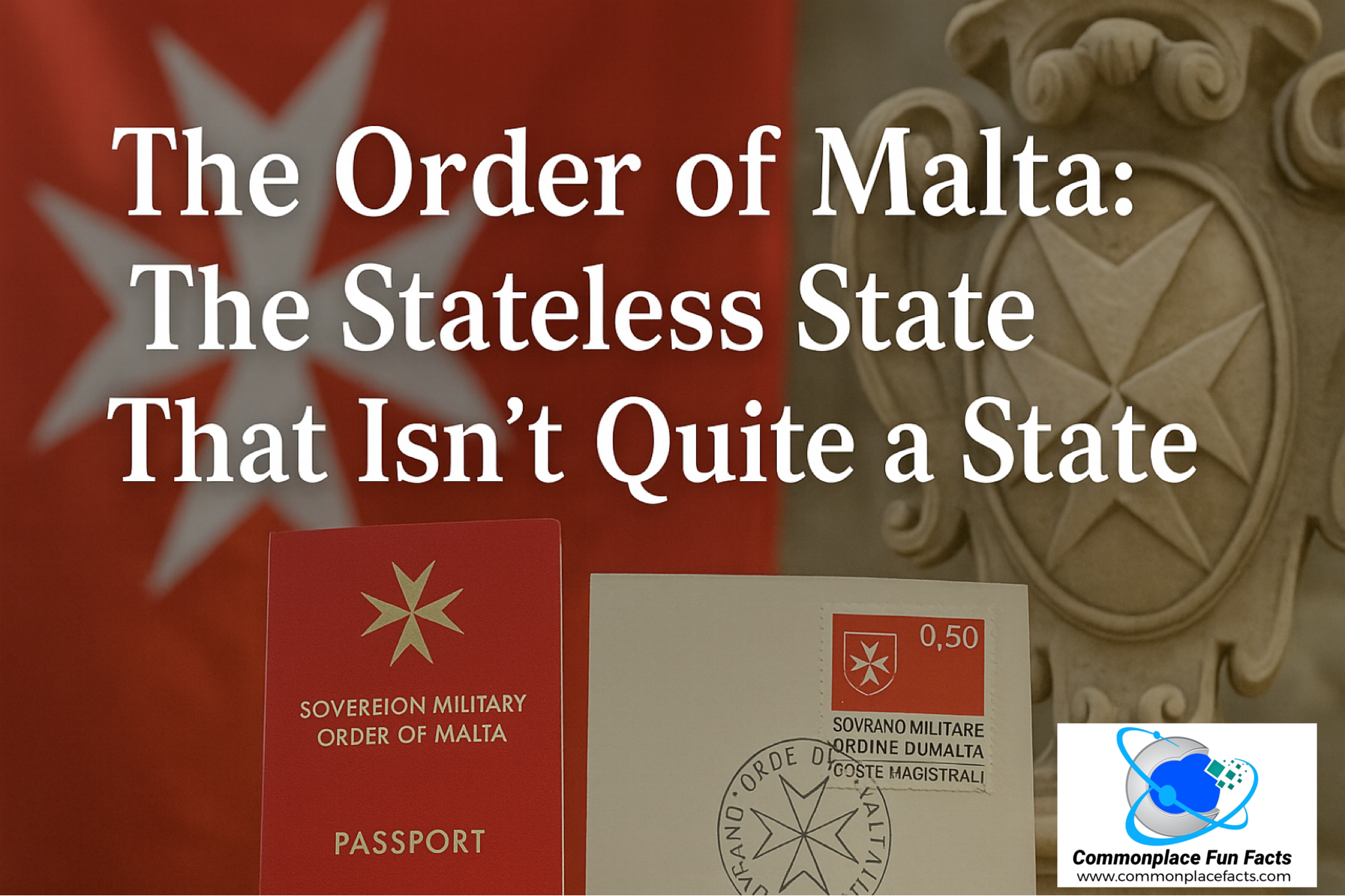

If you were asked to name all the countries in the world, you might proudly rattle off 193 United Nations members, toss in a few outliers like Taiwan, and maybe even flex with Vatican City. You might even be able to dazzle us by singing “Yakko’s World,” the Animaniacs song about the nations. But if you really want to stump your friends, tell them there’s a “country” with no territory, no citizens, and no army—yet it has passports, postage stamps, diplomatic relations, and palaces. That, dear reader, is the Sovereign Military Order of Malta, better known as the Order of Malta. It’s the geopolitical equivalent of Schrödinger’s cat: simultaneously sovereign and not sovereign, depending on whether you open the legal textbook.
Contents
From Hospitallers to Homeless: How the Order Got Here
The Order of Malta traces its origins back to the 11th century, when the Knights Hospitaller set up shop in Jerusalem to provide care for sick and injured pilgrims. Like many medieval charitable organizations, they quickly discovered that the easiest way to help people was to build fortresses, don armor, and develop a side hustle as a military order. This worked out well for centuries—until Napoleon showed up in 1798, evicted them from Malta, and sent the Knights packing. Ever since, the Order has been in the awkward position of being a sovereign order without sovereign land. Think of it as the geopolitical version of an adult crashing his parents’ sofa for over 200 years and still insisting, “I’m a grown-up, and you have no right to tell me what to do!”
Quasi-Sovereignty 101: So, What Are They?
How does the Order of Malta differ from made-up micronations such as the Nation of Celestial Space, The Conch Republic, or the Kingdom of Torgu?
Here’s where international law scholars start twitching. The Order of Malta is recognized as a sovereign subject of international law, which means it can sign treaties, send ambassadors, and issue passports. What it doesn’t have is a defined territory or a population. This would normally be disqualifying for statehood, but the Order’s longevity, continuity, and unique relationship with the Catholic Church have kept it in the game. It’s like the “grandfather clause” of sovereignty: everyone quietly agrees not to ask too many questions.
Governance: Who Runs the Stateless State?
The Order of Malta may lack borders, but it does not lack bureaucracy. Its governance combines religious tradition, chivalric ritual, and a dose of modern constitutionalism. Let’s untangle who’s in charge, how they’re chosen, and recent tension between independence vs. papal oversight.
The Institutional Setup
The Order is headed by the Prince and Grand Master (currently Fra’ John T. Dunlap, elected 3 May 2023). He is both sovereign (in the sense of international law) and religious superior of the Order. The title “Most Eminent Highness” is attached to his office.

Contrary to some misunderstandings, the Grand Master is not a cardinal. The Cardinal Patron is a separate office—appointed by the Pope—whose job is spiritual oversight and maintaining the Order’s ties with the Holy See.
Other organs of governance include:
- Sovereign Council: the executive body, including the Grand Master (or his Lieutenant if needed), four high officers (Grand Commander, Grand Chancellor, Grand Hospitaller, Receiver of the Common Treasure), plus additional councillors.
- Chapter General: the legislative assembly, which meets every six years. It elects the members of the Sovereign Council (and under certain conditions elects the Grand Master or Lieutenant).
- Lieutenant roles: If the Grand Master dies, resigns, or is permanently impeded, the Grand Commander serves as Lieutenant ad interim. There is also a Lieutenant of the Grand Master (if a full election is delayed)—both with constrained powers (limited innovation) compared to the Magisterial Grand Master.
- Magistral Courts: the judicial branch of the Order—internal court system.
Reforms and Challenges Under Pope Francis
If you thought the Order of Malta’s biggest problem was figuring out how to run a country without land, buckle up—because in recent years it’s been more like navigating a season of Game of Thrones, with a guest appearance by Pope Francis himself.
Beginning around 2016, the Pope started taking a very hands-on approach with the Order’s governance. Not quite an alien invasion, but enough to make some Knights start whispering about independence being more theory than practice.
The drama kicked off in late 2016, when Grand Master Matthew Festing showed Grand Chancellor Albrecht von Boeselager the door. The issue? A charitable project where contraception had been distributed—a scandal that made for juicy Vatican gossip.
Pope Francis, unimpressed with the ousting, ordered von Boeselager reinstated, demanded Festing’s resignation, and sent in Archbishop Giovanni Becciu as his Special Delegate. To the Order’s critics, this looked less like pastoral care and more like papal micromanagement.
By May 2017, constitutional reform was underway. The idea was to modernize governance—tweak how the Sovereign Council is structured, refine election rules, and clarify just how much the Pope gets to call the shots. Depending on your point of view, this was either long-overdue housekeeping or a creeping annexation by the Holy See.
The story didn’t end there. In 2022, Pope Francis dropped a brand-new constitution on the Order and even made provisional appointments to the Sovereign Council before the Order had a chance to vote. Again, reactions were split: modernization vs. meddling. Tomato, tomahto.
Then in 2023, the Pope swapped out Cardinal Raymond Burke (a long-time Order ally and occasional thorn in papal toes) for Cardinal Gianfranco Ghirlanda as Cardinal Patron. Officially, the role is “largely symbolic.” But let’s be honest—when it comes to Vatican politics, symbolism packs enough punch to make heavyweight boxers jealous.
So where does this leave the Order? Somewhere between independence and babysitting. The new constitution aims to draw clearer lines, but tensions remain—especially among veterans of the Order who remember the good old days before papal reform packages came standard with every administration. Whether these reforms strengthened the Order’s mission or clipped its sovereign wings is still up for debate. One thing’s for sure: the Order of Malta may not have land, but it certainly has drama.
Membership: Knights Without a Castle
So how do you get your name on the roster? Unlike your local country club, you don’t just flash a checkbook and pick out a polo shirt. Membership in the Order of Malta is divided into classes, each reflecting different levels of religious commitment and noble pedigree. The top tier is the Professed Knights, who take vows of poverty, chastity, and obedience, essentially becoming monks in armor. Below them are Knights and Dames who promise to live Christian lives but don’t make monastic vows—think of it as “associate membership that requires an upgrade for full privileges.”

Traditionally, noble birth was required, and in some ranks it still is. For centuries, if your family tree didn’t have enough coats of arms dangling from it, your application was politely ignored. In recent decades, however, the Order has broadened its reach, welcoming members based on commitment to service rather than just blue blood. Today, there are roughly 13,500 members worldwide, plus tens of thousands of volunteers and medical professionals who keep the humanitarian engine humming.
It may not look like much on a map, but the Order’s structure has kept it running smoothly for nearly a millennium. When your organization has survived crusades, plagues, Napoleon, and international law professors, you can be forgiven for being a little particular about who gets to wear the robe and cross.
Passports: Travel Documents Without a Nation
Yes, the Order of Malta issues passports. They’re biometric, ICAO-compliant, and embossed with a stately cross. Diplomatic passports go to the Grand Master, members of the governing council, and ambassadors. Service passports are for staff working on humanitarian missions. In total, there are only a few hundred in circulation—so don’t plan on ditching your U.S. passport for one just to cut the TSA line.
Where can you use them? Over 100 countries accept them for entry, though many still require the holder to present their “real” national passport. If you’ve ever seen someone flash one at customs, you were either in Geneva, Rome, or watching an episode of The Americans. These passports are practical for diplomatic staff, but for everyone else, they’re the ultimate collectible in the world of international bureaucracy.
Stamps and Postal Curiosities: The Poste Magistrali

Nothing says “real country” like issuing your own postage stamps. The Order of Malta obliges with the Poste Magistrali, headquartered in Rome. Their stamps are denominated in scudi (1 scudo = 12 tari = 240 grani) and often depict saints, castles, and the occasional charitable mission. Are they valid? Technically yes—through bilateral agreements, letters with Order stamps can travel in the Italian system and beyond. But outside those agreements, they’re more prized by philatelists than postal workers.
So if you’re hoping to mail your tax return with an Order of Malta stamp, don’t. The IRS may admire your sense of whimsy, but your refund will still get lost somewhere between Rome and Cincinnati.
Of course, that’s likely to happen if you use U.S. postage stamps, so that it for what it’s worth.
Palaces Without Borders: Extraterritorial Real Estate

While the Order doesn’t own a country, it does own prime real estate in Rome: the Magistral Palace on Via dei Condotti and the Magistral Villa on Aventine Hill. These properties enjoy extraterritorial status, which means Italian law doesn’t apply inside—much like embassies. Within these walls, the Order conducts its business, hosts its government, and probably argues about how many knights can fit on the head of a pin.
Still, let’s be clear: this is not the same as sovereignty over a territory. The Order can’t collect taxes, conscript soldiers, or put up border checkpoints around the Palazzo Malta. If you tried to defect there, you’d just end up standing awkwardly in front of a Roman palace while confused tourists asked for directions to the Spanish Steps.
Diplomatic Muscle: Treaties, Envoys, and a Seat at the Table
Despite its lack of turf, the Order of Malta maintains diplomatic relations with over 100 countries. It signs treaties, hosts embassies, and gets invited to diplomatic events along with the big boys.Their ambassadors carry the same privileges as those of other sovereign states. Picture the cocktail parties: France, Japan, Brazil, and… the Order of Malta, representing a country that technically doesn’t exist. Talk about holding your own in awkward small talk.
Comparisons: Malta’s Fellow Quasi-Sovereigns
Malta isn’t entirely alone in the “stateless sovereign” club. A few others share the spotlight:
- The Holy See vs Vatican City: The Holy See (the papal authority) is sovereign without being a state, while Vatican City is a state without a citizenry in the usual sense. Between them, they form a theological version of “who’s on first?”
- The International Committee of the Red Cross (ICRC): Not a state, but recognized in international law. The ICRC negotiates directly with governments, enjoys immunity, and its staff carry special documents. It’s what happens when neutrality comes with a side of paperwork.
- British Sovereign Base Areas in Cyprus: Akrotiri and Dhekelia aren’t colonies or territories in the traditional sense, but function like sovereign jurisdictions. They’re geopolitical leftovers from the British Empire, proof that empire packing always leaves something behind.
- UN-Administered Territories: Places like Kosovo (pre-2008) and East Timor (pre-2002) operated under UN authority with their own documents and systems, but not full sovereignty. Transitional, but another example that sovereignty can come in about as many flavors as Baskin Robbins ice cream.
Together, these comparisons show that Malta isn’t the only entity bending the rules of sovereignty—but it’s definitely the quirkiest.
Not to Be Confused With… The Island of Malta
Important clarification: the Order of Malta is not the same as the Republic of Malta. The latter is a Mediterranean nation with beaches, citizens, and a seat at the UN. The Order, on the other hand, is a medieval holdover headquartered in Rome. Confusing the two is a bit like confusing your landlord with your landlord’s lawyer.
To make things even muddier, King George VI awarded the George Cross to the entire nation of Malta for its heroic defense during World War II. This was an unprecedented honor, and the George Cross still appears on Malta’s flag today. But that story belongs to a different article—one you can find right here.
Debates: Is It Really Sovereign?
International law professors love to argue about this. On one side: the Order has diplomatic recognition, treaties, and observer status, which walk and talk like sovereignty. On the other: it lacks territory, citizens, and the normal apparatus of a state. Scholars have written entire books on whether the Order’s sovereignty is real, conditional, or just politely tolerated. In practice, most governments shrug and treat the Order as sovereign when it’s convenient, and as a religious charity when it’s not. Which, honestly, is not that different from how most of us treat our gym memberships.
Modern Role: Beyond Being a Historical Curiosity
For all its quirks, the Order of Malta isn’t just a legal oddity. Its real importance lies in its humanitarian work. The Order runs hospitals, provides disaster relief, and supports refugees worldwide. Its neutral, quasi-sovereign status helps it operate in conflict zones where national governments or NGOs might struggle. In other words, those passports and postage stamps aren’t just for show—they grease the wheels of a global charitable operation with 13,500 members, 80,000 volunteers, and countless projects.
Conclusion: Malta, the Stateless State That Isn’t Quite a State
The Order of Malta lives in a twilight zone of sovereignty. It has passports but no citizens, stamps but no postal service, a palace but no territory. And yet, for nearly a thousand years, it has endured—outlasting empires, outfoxing conquerors, and confusing international lawyers everywhere.
Is it a state? Not really. Is it sovereign? Sort of. Is it fascinating? Absolutely. And maybe that’s the lesson here: sovereignty, like fashion, comes in different styles. Some countries wear the full suit; others, like the Order of Malta, rock the vintage accessory. And somehow, that’s enough to keep them on the guest list of international diplomacy—proof that sometimes, the strangest arrangements are the most enduring.
You may also enjoy…

The Conch Republic: The Micronation That Declared War, Surrendered, and Asked for Foreign Aid—all in Under a Minute
In 1982, Key West declared itself the Conch Republic, waged a one-minute war, and requested $1 billion in aid. Discover the hilarious true story of America’s quirkiest micronation.

Cayo Blanco Del Sur : I Gave East Germany An Island, and All I Got Was This Lousy Teddy Bear!
Learn how Cuba gave the island of Cayo Blanco del Sur to East Germany and only got a stuffed animal in exchange.

The Nation of Celestial Space: Why One Man Believed He Owned the Moon—and Everything Beyond It
In 1949, James T. Mangan declared himself ruler of outer space by founding the Nation of Celestial Space. Discover the bizarre true story of stamps, sovereignty, and a typewriter-fueled empire.



Leave a Reply