
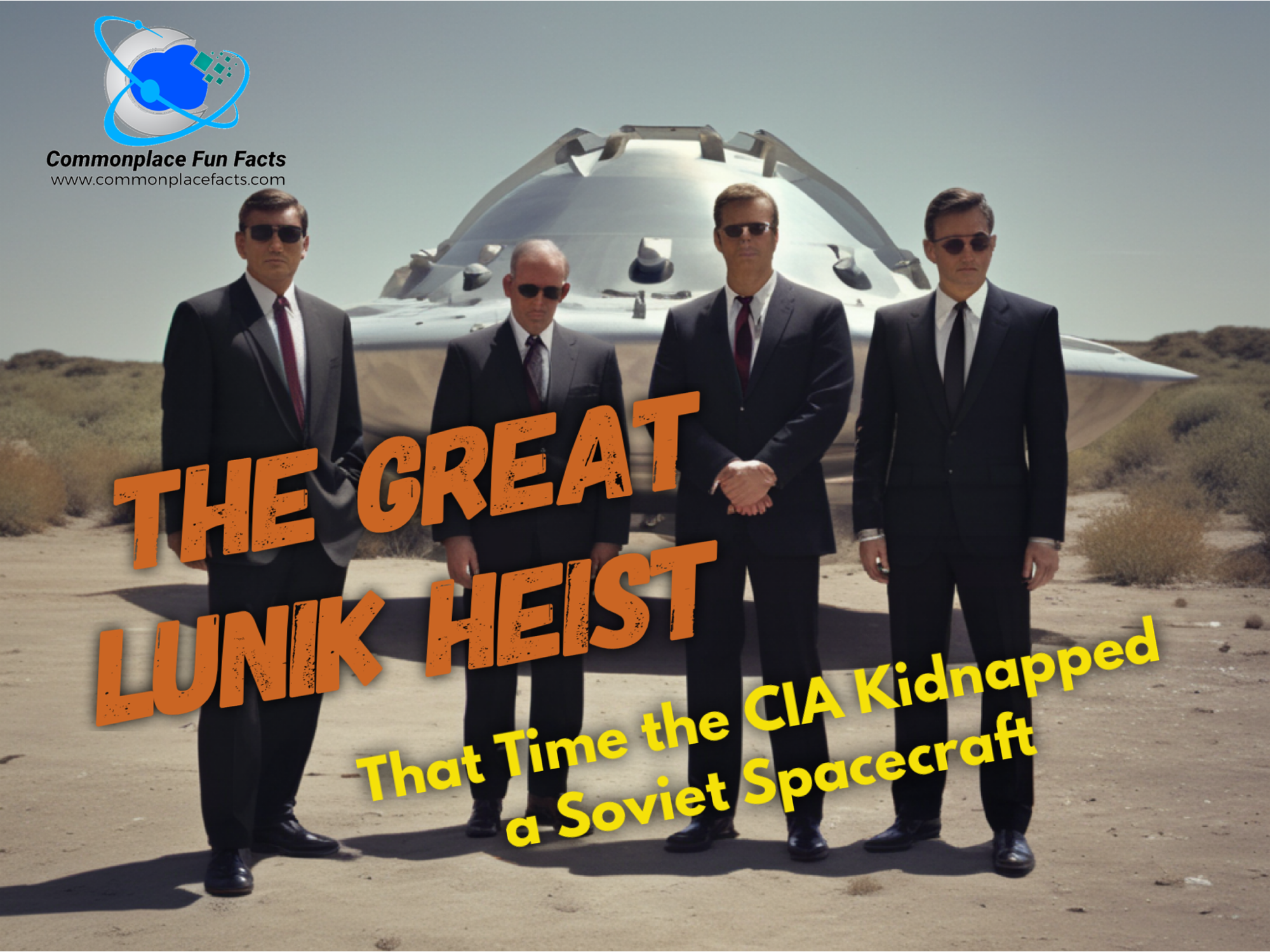

The Lunik Heist: The Cold War’s Soviet Spacecraft Kidnapping
Gather ’round, space cadets, for a tale of espionage so daring, it’ll make James Bond look like an amateur. It was the height of the Cold War: late 1959 or 1960 (the details are a bit fuzzy). CIA agents, creeping around in their socks, kidnapped and dismantled a Soviet spacecraft under an elaborate cloak of secrecy. It sounds like a curious combination of Ocean’s Eleven, Mission Impossible, and Star Trek.
This isn’t some strange made-for-TV movie, however. Thanks to top-secret documents that have been declassified (see them below), we can tell you all about the Great Lunik Heist and the CIA’s successful mission to kidnap a Soviet spacecraft.
Table of Contents
The Race to the Moon
The race to see which nation would be the first to make it to the Moon heated up on January 2, 1959. The Soviet Union announced, “Hey world, look what we can do!” and started the Luna Program. It was known in the west as “Lunik.” The first mission, Luna 1, was a wee bit off target and missed the Moon altogether. It did, however, become the first human-made object to escape the Earth/Moon system. With Luna 2, they struck gold (or rather, Moondust) by crashing the spacecraft onto the lunar surface. With Luna 3, the Soviets succeeded in snapping the first photos of the Moon’s far side. Meanwhile, the USA’s lunar program was like a horrible series of Gilligan’s Island episodes — lots of brilliant ideas that all ended in failure.
With the Soviets flexing their astrophysics muscles, the CIA decided it was time for some good old-fashioned espionage. They needed to understand the Soviet tech to keep up in the space race. Enter our sock-footed heroes, who hatched a plan that was so daring and audacious that it might actually work: kidnap a Soviet spacecraft from a traveling exhibit.
The United States was reeling from the Soviet successes. National morale was low, and the American psyche was in tatters. The terrifying reality that the enemy had bigger boosters and more advanced technology was setting in. The CIA knew they had to act fast to level the playing field.
Stealing the Spacecraft
The Soviets were high with success and eager to demonstrate their superiority to the world. To do this, they carted an actual Lunik spacecraft around as a traveling exhibition. The CIA, never one to miss a party, decided to “borrow” it during its travels. Their chance came when the exhibit moved by train.

One of the Soviet Union’s exhibitions was a display of a Sputnik satellite and a Lunik upper stage that contained the payload, the latter freshly painted with viewing windows cut into the nose. At first blush, many in analysts assumed the touring Lunik was just a model. Others suspected that the Soviets might be sufficiently proud of the spacecraft to bring a real one on the tour. These suspicions were confirmed when intelligence agents managed to gain unrestricted access to the spacecraft one night after the exhibit closed. They realized it wasn’t a model. It was a real production article. The agents gleaned what they could with their brief viewing but desperately wanted a better look. For that, they needed to get inside Lunik.
The Plan
This was easier said than done. The Lunik was heavily guarded, so examining it before or after the exhibit closed was ruled out. It did move around, though, which meant that it might be “borrowed” during the transport chain if there was a weak link. There was. The spacecraft, as well as every other piece of the exhibit, was transported in a crate by a truck to a rail yard where it was loaded onto a train and moved to the next city. At the rail yard, a guard took note of each incoming crate. What this guard didn’t have was a list of cargo and an expected delivery time for each crate. The CIA hatched a plan to steal the Lunik for a night and get it to the train station by morning for its journey to the next city.
The night came when the team of CIA agents put their plan into action. They arranged for the Lunik to be on the last truck out of the exhibit hall. Trailing it were agents in plain clothes, disguised as locals. They were looking out for any undercover Soviet escorts. Seeing none, they knew the coast was clear to spring into action. CIA agents stopped the truck at the last turn-off before the train station, escorted the driver to a hotel, covered the truck with a tarp, and then drove it to a nearby salvage yard that was surrounded by ten-foot-tall walls.
Game On
The guard at the rail yard, meanwhile, blissfully unaware of the diverted truck, dutifully noted the arrival of crates before clocking out for the night. A crack team of CIA agents, fueled by coffee and a taste for adventure, stayed on his tail to ensure he didn’t make an unexpected return.
Back at the salvage yard, the CIA team maneuvered their truck into a narrow alley, closed the gate, and waited for a full thirty minutes to make sure they hadn’t been followed. Once they were confident they were in the clear, it was game on.
They studied the crate and saw the sides were bolted together from the inside, making the roof the only viable entry point. Two agents, equipped with stealth and finesse, set to work removing the roof without leaving a mark. Fortunately, the crate had seen better days, making their task a wee bit easier. Meanwhile, the other two prepared the photographic equipment, ready to capture every detail of their cosmic prize.
Dismantling the Lunik
With the roof removed, the agents faced a new challenge: the Lunik spacecraft nearly filled the entire crate, leaving little room to maneuver. They split into pairs, one team tackling the nose, the other the tail. Clad in socks (and the rest of their clothes, of course. They weren’t perverts; they just removed their shoes), they descended by rope ladders, flashlights in hand, and began their delicate disassembly.
They snapped a full roll of film of the marks on the spacecraft’s antenna and sent it off for processing. The moment of truth arrived when the photos came back crystal clear. With renewed confidence, they pressed on.
At the rear of the spacecraft, the agents removed the base cap to study the engine area. Although the engine was missing, the mounting brackets, fuel tank, and oxidizer tank remained, offering clues about the engine’s size and power. Up at the nose, the team discovered a rod running through the spacecraft, supporting the centrally loaded payload. This rod was fixed in place at the front by a four-way electrical outlet, acting as a nut screwed into the rod, covered by a piece of plastic with a Soviet seal.
The seal was a potential deal-breaker. If it was missing, the Soviet guards would know someone had tampered with the spacecraft. But our crafty agents weren’t about to be thwarted by a piece of plastic. They checked with their offsite colleagues, who confirmed the seal could be duplicated in time to replace it. With the green light, they cut it off and sent it for duplication while they continued their exploration of the Lunik’s innards.
The Grand Finale
As the night wore on and the first light of dawn began to creep over the horizon, the team knew they had to wrap things up. They meticulously reassembled the Lunik, ensuring no trace of their clandestine activities was left behind. The fake seal was affixed, the crate’s cover replaced, and the entire assembly loaded back onto the truck.
By 5 a.m., the original driver was back at the wheel, and by 7 a.m., the truck was parked at the rail yard, ready for inspection. The guard, none the wiser, added it to his list, and the Lunik continued its tour, blissfully unaware it had been the star of a CIA escapade.
The Impact
This cloak-and-dagger operation wasn’t just a thrilling caper; it provided the CIA with invaluable insights into Soviet space capabilities. With a better understanding of the Lunik’s construction, the USA could strategize more effectively in the space race. Thanks to this wild night of espionage, America gained a crucial edge in gauging Soviet power, helping to shape the ultimate cosmic showdown.
The intelligence gathered from studying the Soviet spacecraft and missions allowed the CIA to anticipate launches, adjust American launch schedules, and understand Soviet technological limits. This effort involved intercepting telemetry data, analyzing post-flight information, and piecing together the puzzle of Soviet space endeavors. Each mission was like a “fresh flare in the sky,” demanding new and imaginative efforts to decode Soviet strategies.
So, next time you marvel at the space race, remember the unsung heroes behind the scenes—those spies in socks, playing the ultimate game of intergalactic hide-and-seek.

With a Little Help From My Friend Adversary
The SR-71 Blackbird was one of the greatest tools of espionage ever built. Flying at speeds of Mach 3, it could out-fly any enemy fighter or surface-to-air missile. In addition to its unmatched speed, the design of the aircraft made it nearly invisible to radar. In short, it was a technological marvel that gave the…

Spies, Invisible Ink, Toenails, and Other Declassified CIA Secrets
Invisible ink, often seen in spy fiction, was actually utilized by intelligence agencies like the CIA during World War I. Declassified CIA documents reveal methods for writing and revealing secret messages, including chemical recipes and techniques for discreet communication. These intriguing strategies showcase the blend of creativity and science in espionage.

Starbucks at the CIA: Customer Names Are a Grande Secret
Discover the Starbucks at the CIA — your one-stop-stop for caffeinated espionage.






Leave a Reply to sopantoothCancel reply