
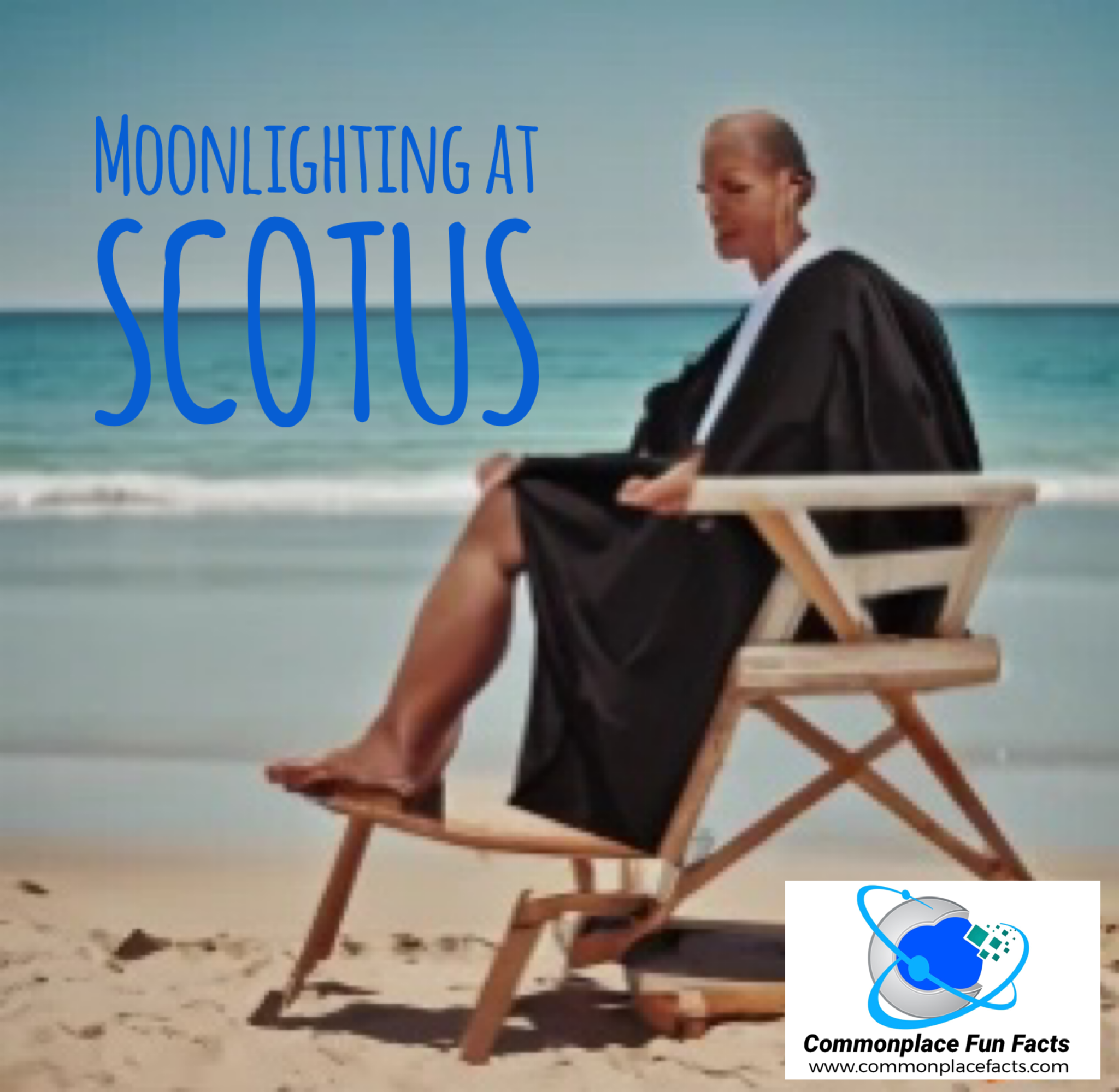

In these difficult economic times, it is not unusual to have more than one job. Delivering pizzas, flipping burgers, or working for a temp agency is a great way to supplement income and to turn unproductive hours into something profitable.
Having said that, we usually don’t think of the nation’s top judges having to resort to taking a summer job as a lifeguard. Only 116 men and women have served on the U.S. Supreme Court in its long history. The prestige and authority that comes with the office would typically be enough to satisfy even the most ambitious person. The current salary of $274,200 for an Associate Justice is usually enough to make ends meet.
When it comes to ambition, however, don’t underestimate those who serve in Washington, D.C. For a few members of the High Court, serving as a Justice or even as a Chief Justice hasn’t been enough of a challenge and they had to take on another job on the side. Take a look at the history of moonlighting at the Supreme Court of the United States.
John Jay — Running for Governor on the Side

John Jay had a prominent role in U.S. history prior to becoming the first Chief Justice of the United States. He served as a delegate in the first and second Continental Congress and as president of the sixth. He was the U.S. Minister to Spain and U.S. Secretary of Foreign Affairs under the Articles of Confederation. As one of the authors of The Federalist Papers, he helped make the case for the ratification of the Constitution. He was rewarded for his efforts when George Washington nominated him to the Supreme Court as its first Chief Justice in 1789.
Despite holding the top spot in one of the three co-equal branches of the federal government, Jay had his eyes on a different prize. He wanted to be governor of New York. He ran for election in 1792 and lost. He had better luck the second time and was elected governor in 1795. The Constitution places no restrictions on the ability of a sitting Justice to run for office. Additionally, as a federal judge, he had a lifetime appointment to the bench, and he wasn’t going to give it up until he had to. Jay resigned from the Supreme Court in 1795, only after his election to the governorship was assured. He holds the distinction of not only being the first Chief Justice but also having run twice for elected office while simultaneously serving on the Court.
Smith Thompson — Running for Multiple Offices on the Side
Another Justice who tried to follow John Jay’s example was Smith Thompson. Having two last names apparently wasn’t enough notoriety for him. He was appointed to the Supreme Court in 1823 by James Monroe. It appears he did not find the job challenging enough and looked for other employment by running unsuccessfully for several political offices. His final attempt at finding a non-judicial job came in 1828 when he ran an unsuccessful campaign for the governorship of New York. Having lost that election, he resigned himself to the sad fact that he would never be anything more than a Justice of the U.S. Supreme Court. He remained in that position until his death in 1843 without seeking another elected office.
David Davis — Running For President and Missing the Chance to Single-Handedly Select the President
David Davis was Abraham Lincoln’s campaign manager in the 1860 election. He was rewarded for his service and loyalty when Lincoln appointed him to the Supreme Court in 1862.
Davis wasn’t content to remain on the Court and set his sights on the presidency. Ultimately, he settled for becoming a one-term senator. Along the way, he narrowly missed out on the chance to become the man who could single-handedly decide a presidential election. For three years, he was also just one heartbeat away from becoming president.
The story of David Davis is so interesting that he earned his own article. You can read it here.
Charles Evans Hughes — Twice Appointed to the Court; Once Almost Elected President

If your concept of a Supreme Court justice is someone who quietly works behind the scenes and avoids publicity, you need to learn about Charles Evans Hughes.
Hughes was serving as governor of New York in 1910, when William Howard Taft nominated him to the Supreme Court. He served for six years before resigning his seat to make an attempt at winning the White House. He ran a spirited campaign against Woodrow Wilson. The conventional wisdom had him easily defeating the incumbent president. As election night drew to a close, Hughes had a comfortable lead in the vote count and went to bed, confident that he would wake up as president-elect. Much to his astonishment and disappointment, Wilson took the lead overnight. Wilson won the state of California by a razor-thin 3,000 votes, putting him over the top in the electoral college. Hughes came that close to becoming the only former Supreme Court justice to be elected president.
Hughes returned to public service in March 1921. Newly-inaugurated President Warren G. Harding appointed the former justice to his cabinet as Secretary of State. He continued to serve in that role under Calvin Coolidge after Harding’s death.
Hughes returned to private life in 1925, hanging out his shingle as a practicing attorney. His time away from the government was destined to be short-lived, however. He was named a Judge of the Permanent Court of International Justice. The institution came out of the League of Nations and was a forerunner of today’s International Court of Justice. Hughes’ service on the court was fairly unremarkable, but then again, the court itself was fairly unremarkable.
Hughes did not have to end his days in an obscure bureaucratic post, however. He found himself back at his old stomping grounds, and it was largely because of the man who had put him there in the first place. Two years after William Howard Taft appointed Hughes to the Supreme Court, he lost a re-election bid. Although disappointed at the loss, Taft never had his heart set on the presidency in the first place. The job he always aspired to was on the Supreme Court. He realized that dream in 1921 when Warren G. Harding appointed him Chief Justice of the United States. Taft served happily and competently in that role for nine years. When his health indicated that the time was approaching to find a replacement, all eyes turned to the man he had appointed twenty years earlier.
President Herbert Hoover sent Charles Evans Hughes back to the Supreme Court in 1930, this time as the 11th Chief Justice of the United States. There he remained until his retirement in 1941.
William O. Douglas
William O. Douglas was appointed to the Supreme Court in 1939 by President Franklin D. Roosevelt. He served on the court for 36 years, becoming the longest-serving justice in the Court’s history.
His record-breaking tenure might not have happened, however. In 1944, and again in 1948, Douglas was seriously considered as the Democratic Party’s vice presidential nominee. If he had been elected as VP in 1944, he would have become president upon the death of Roosevelt.
Arthur Goldberg

Arthur Goldberg was appointed to the Court in 1962 by President John F. Kennedy. He served for just three years. In 1965, President Lyndon B. Johnson persuaded him to resign from the Court and accept an appointment as the United States Ambassador to the United Nations. Johnson told Goldberg that he would have a Cabinet-level position and would be involved in all decisions for ending the Vietnam War. LBJ also promised Goldberg that he would strongly consider him as his running mate in the 1968 election.
One can only speculate about Goldberg’s reaction when LBJ decided against running for reelection. Goldberg resigned from government and went back to practicing law.
Robert Jackson
Robert H. Jackson’s appointment to the Supreme Court of the United States in 1941 marked the culmination of a distinguished legal career. Jackson had previously served as Solicitor General and then Attorney General under President Franklin D. Roosevelt. Known for his sharp legal mind and eloquent arguments, Jackson played a pivotal role in shaping Roosevelt’s New Deal policies and defending them before the Supreme Court. His appointment to the Court was a reward for his faithful service.
During his tenure on the Supreme Court, Jackson took a brief hiatus in 1945 to serve as the chief U.S. prosecutor at the Nuremberg Trials. His role in these historic trials, which prosecuted Nazi leaders for war crimes and crimes against humanity, underscored Jackson’s commitment to justice and the rule of law on a global scale. His eloquent opening and closing statements at the trials are remembered as powerful defenses of international law and the principles of humanity.
After his service at Nuremberg, Jackson returned to the Supreme Court in 1946 and continued to serve until his death in 1954.
Owen J. Roberts
Owen J. Roberts was appointed to the Supreme Court of the United States in 1930 by President Herbert Hoover. His nomination was notable for its relative lack of controversy, as Roberts was respected across political lines for his legal acumen and moderate views. Prior to his appointment, Roberts had served as a prominent attorney in private practice and had also held positions in government, including Assistant Attorney General and special counsel to investigate the Teapot Dome scandal. His confirmation to the Court was swift and unanimous, reflecting broad bipartisan support.
Roberts’ tenure on the Supreme Court was marked by several pivotal moments, one of which was his role as an investigator in the aftermath of the attack on Pearl Harbor in 1941. Following the devastating surprise attack by the Japanese military, President Franklin D. Roosevelt appointed Roberts as one of the commissioners tasked with investigating the events leading up to the attack and the response of the military and government agencies. As part of the Roberts Commission, he played a critical role in assessing the failures and recommending reforms to ensure national security.
Earl Warren
Earl Warren was appointed as Chief Justice in 1953 by President Dwight D. Eisenhower. Prior to his appointment, Warren had served as the Governor of California and had gained a reputation for his progressive stance on social issues and his strong leadership during World War II. Eisenhower, a Republican, appointed Warren, a former Republican turned Independent, in part to bridge political divides and ensure a fair and balanced judiciary.
In 1963, President Lyndon B. Johnson appointed Chief Justice Warren to chair the Warren Commission, formally known as the President’s Commission on the Assassination of President Kennedy. The commission was tasked with investigating the assassination of President John F. Kennedy in Dallas, Texas, on November 22, 1963. Under Warren’s leadership, the commission conducted an exhaustive investigation that included testimony from witnesses, forensic analysis, and examination of various theories surrounding the assassination. The Warren Commission’s final report, issued in 1964, concluded that Lee Harvey Oswald acted alone in assassinating President Kennedy, a finding that has been the subject of debate and controversy over the years. Warren’s role in leading the commission underscored his commitment to upholding the rule of law and ensuring transparency in investigating one of the nation’s most tragic events.

Supreme Court Justice Job Opening: Law Degree Optional
If you have ever wanted a top-level job in the federal government but feel that you don’t have the necessary education or experience, look no further than a spot on the Supreme Court of the United States. The Constitution of the United States places no requirements on any federal judge in terms of age, education,…

Supreme-ly Qualified Presidents
For an attorney, arguing a case before the United States Supreme Court is one of the highest honors imaginable. Twenty-six of the 44 men who have served as President of the United States have been attorneys. Eight of them have had the supreme honor of appearing before the highest court in the land. John Quincy…

Having 9 Justices Is Not Supremely Set in Stone
With the death of Justice Ruth Bader Ginsburg creating a vacancy in the United States Supreme Court, membership of the high court is down to eight. Much attention is focused on who will bring that number back up to nine. While we are used to having nine members of the Supreme Court, it hasn’t always…





Leave a Reply