
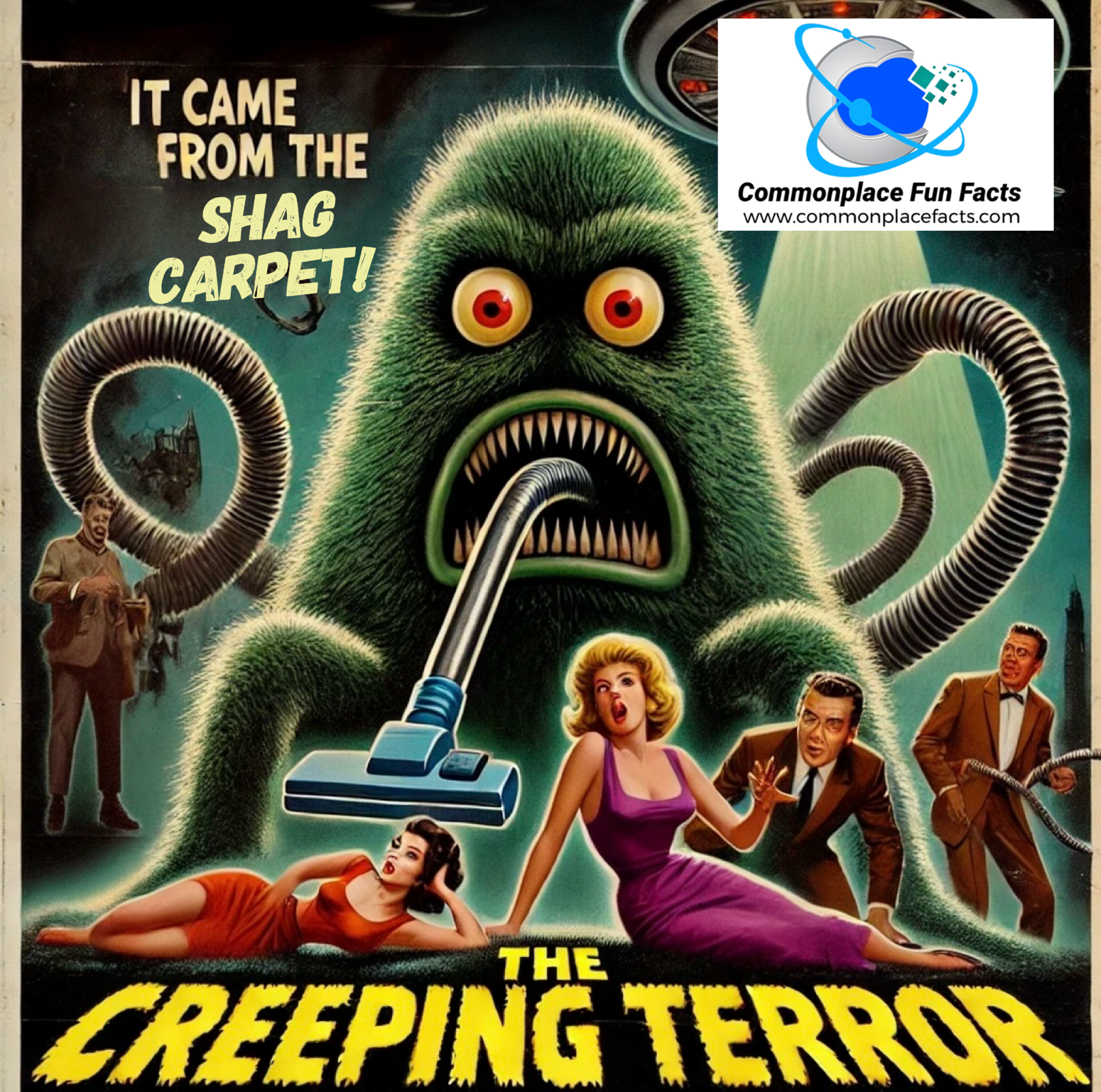

The Creeping Terror and the Scam Behind It
Ah, the world of cinema—a place where dreams are made, legends are born, and occasionally, where some poor schmuck decides that a giant shaggy carpet can pass for a terrifying alien monster. Enter The Creeping Terror, a 1964 sci-fi horror flick that proves that if you want to make movie history, you don’t need a good script, decent acting, or even a budget. You just need a carpet and an unshakeable belief that you can somehow make it work. It doesn’t hurt if you aren’t burdened by such tiresome things as scruples.
Let’s set the plot. Actually, scratch that. The word “plot” is a bit of a stretch when used with The Creeping Terror. Instead, let us give you the premise. The movie involves an alien creature crash-landing on Earth and deciding that humans are the tastiest snack in the galaxy. Theoretically, the creature instills horror throughout the land as it races about, munching on humans as if they are an endless supply of potato chips.

That’s how it was envisioned. How did it turn out? It was 74 minutes of disconnected scenes, uninspiring actors, weirdly inconsistent narration, and an alien menace that was nothing more than a pile of shaggy rugs sewn together and dragged around by a bunch of unfortunate souls hiding underneath. No, seriously. That’s the monster. It’s like someone raided a 1960s living room and decided, “Hey, this will do.” And thus, The Creeping Terror was born.
How did things get so botched up between concept and production? Meet Vic Savage, the real horrifying villain in this tale. His real name was A.J. Nelson. He had big dreams and even bigger delusions. Savage was a director, writer, and actor in this so-called film—a triple threat, if you will. With no real experience in filmmaking and a budget that could generously be described as “nonexistent,” he cobbled together a script, cast himself in the lead role, and embarked on a journey to create his magnum opus.
Faced with the minor inconvenience of not having any money for special effects, Savage did what any Ed Wood wannabe filmmaker would do. He went to the nearest carpet store, loaded up on shag, and passed it off as an alien creature. No need for fancy CGI technology when Savage could line up a few extras to crawl beneath the rug pile. One tiny problem — aside from it looking absolutely ridiculous — was that it was so heavy and clumsy that the monster moved slower than a government employee on a coffee break. Much of the movie consists of watching the monster slowly inch forward at a bunch of humans who seem to have forgotten how to run. Run? Actually, they could casually stroll away, pausing every couple of minutes for a sandwich, short nap, or haircut.
You could watch the entire movie and waste 74 minutes of your life that you will never get back, or you could watch the nearly 4-minute trailer here, and get the general idea. Warning: it will still feel as if you lost 74 minutes of your life.
Before we delve into the matter of how The Creeping Terror fared at the box office, let’s discuss the production side of things. Vic Savage wasn’t exactly known for his upstanding business practices. The behind-the-scenes drama that could easily be a plot for a scandalous Hollywood exposé. Although Robert Silliphant is the one listed in the credits as the writer, the original story was actually the brainchild of his younger brother, Allan Silliphant—who would later rebrand himself as Al Silliman Jr., and make a name for himself by writing, producing, and directing the 1969 comedy The Stewardesses. You see, the Silliphant family had some serious storytelling credibility. Stirling Silliphant, Allan’s other brother, was already a hotshot in the television world, having penned scripts for Alfred Hitchcock Presents, Perry Mason, and even co-creating hits like Naked City and Route 66.
Savage, ever the opportunist, decided to exploit this familial connection to reel in some unsuspecting investors. For the low, low price of a few hundred bucks, these poor souls were promised a slice of the non-existent profits and, as a bonus, a small role in the movie.
When director Pete Schuermann was making his docudrama The Creep Behind the Camera (2014)—a film all about the chaotic creation of The Creeping Terror—he interviewed Allan Silliphant. Allan recalled how Savage paid him a whopping $1,500 for the script. With that cash in hand, 21-year-old Allan banged out a nine-page treatment in just three days, pulling the story out of thin air based on a vague idea.
As the production trudged on, however, it became clear that Savage and Silliphant were not on the same page—probably not even in the same book. Silliphant envisioned a film that was outrageously over-the-top, but Savage seemed to have other (less coherent) ideas. This creative clash, combined with Silliphant’s growing concern that the film would drag down his family’s reputation—particularly that of his brother Stirling—led to his departure from the project.
Then there was the filming itself. Principal photography kicked off in late 1962, but instead of the scenic Lake Tahoe setting that Silliphant had pictured, the crew found themselves at a muddy pond in Spahn Ranch, Simi Valley, California. And because things couldn’t possibly go smoothly, the special effects creator, who hadn’t been paid, decided to make a swift exit—with the original creature costume in tow. This forced Savage and his crew to slap together a sorry excuse for a replacement—a monstrosity later described as “…an elongated alien monster resembling a clumsy shag rug…” by John Stanley in his Revenge of the Creature Features Movie Guide (1988).
The production dragged on in fits and starts due to Savage’s ongoing battle to secure financing, finally wrapping up in 1963. The troubles didn’t stop there. Dialogue? Barely any. Nearly all the vocal content was delivered by a narrator, thanks to Savage’s tendency to shoot scenes with little concern for sound quality. If sound was captured at all, it was either improperly transferred or just flat-out lost. Lacking the funds to fix this mess in post-production, Savage hired Larry Burrell—a radio newsreader with a few B-movie credits, including They Saved Hitler’s Brain and Not Tonight Henry—to narrate almost the entire film. What little dialogue there was often got drowned out by Burrell’s voiceover, leaving long, awkward stretches of silence reminiscent of those old educational films from the ‘50s and ‘60s. Another 7 minutes (10 percent of the entire movie) came from a cringeworthy scene from a dance. There we are treated to some of the worst dance moves ever caught on film, all done to the irritating sound of a band playing the five or six bars of music over and over. All this, as the creature shuffles toward the dance hall at a breathtaking speed of less than a mile per hour. Savage filled any remaining gaps in dialogue, narration, or irritating dance tunes, with loud organ music that he must have found in the dumpster outside a dubbing studio for silent films.
In the end, Savage seems to have hastily pieced together the film with a Moviola in some motel room, racing against the clock as lawsuits piled up. Just before the film’s supposed release, Savage pulled a vanishing act, facing a potential indictment on fraud charges. He disappeared from the film scene entirely and was never heard from again—until news surfaced that he died of liver failure in 1975 at the age of 41. His wife, Lois, later penned a “tell-all” novel in 2009, spilling the beans on her life with Savage, though she used aliases to protect the not-so-innocent.
The result? A film that’s both incredibly slow-paced and yet oddly mesmerizing in its absurdity. TV Guide called it possibly the second-worst movie ever made, second only to Plan 9 From Outer Space. It was so bad that it could not be released for general distribution to theaters. In 1974, it was sold as part of a syndication package to television stations in an effort to recoup some of the expenses.
Despite all this—or maybe because of it—The Creeping Terror has endured. It’s been parodied on Mystery Science Theater 3000, referenced on The Simpsons, and generally celebrated as a pinnacle of so-bad-it’s-good cinema. The Mystery Science Theater 3000 version has some of the best lines of the series, including this gem: “Bobby’s hopelessly inbred synapses began firing…”
Perhaps for this reason, The Creeping Terror has found new life through the cult movie crowd—the brave souls who seek out films so bad, they loop back around to being good. If that is the standard, The Creeping Terror is so bad that it must be an Oscar-worthy marvel, cherished by connoisseurs of cinematic schlock. It might not be a masterpiece of cinema, but it’s definitely a masterpiece of something.
The sight of a shaggy carpet dragging itself across the screen, gobbling up screaming actors, is the stuff of legend. It’s a reminder that sometimes, the line between horror and comedy is just one poorly executed special effect away.
If you would like to see the complete version of The Creeping Terror, here it is, in all of its glory:

Warhol’s 8-Hour Movie of the Empire State Building
Hello, faithful reader. How was your weekend? Did you see any good movies? Let us tell you about the movie we watched. We’ll try not to give away any spoilers. Admittedly, the dialogue was not the most compelling, and the plot was a little slow in developing. On the other hand, compared to The Curse…

Zyzzyx Road: The Dreadful Journey to the Lowest-Grossing Movie in History
Discover the horrible history of Zyzzyx Road — the lowest-grossing movie of all time.

Make Plans to Watch the Movie That Won’t Be Released Until 2115
As a result of COVID-19, moviegoers have had to deal with the delay of a number of long-awaited films. If you are one of those who struggle to have the patience to endure a few months of delay, just remember that it could be worse. There is one movie that is completed but won’t grace…





Leave a Reply to sopantoothCancel reply