

As autumn approaches, our thoughts turn to holiday foods and the delightful spices that make the season so wonderful. Near the top of the list is that perennial favorite, nutmeg. That fragrant little spice we so casually sprinkle on our holiday eggnog is more than a tasty treat. The unassuming commodity once had the power to shape empires, drive men to madness, and—believe it or not—decide the fate of Manhattan? Buckle up, dear reader, as we take a journey back to the 15th century, where nutmeg wasn’t just a spice—it was the stuff of legends.
The Spice Race: Europe Goes Crazy for Nutmeg
You probably have nutmeg in your kitchen and don’t give it much thought. Historically, a lot of blood has been shed over this little brown seed. “Nutmeg has been one of the saddest stories of history,” explains culinary historian Michael Krondl.

Europe was in the throes of a full-blown spice obsession in the 15th century. The smell of nutmeg alone could send people into a frenzy. Not only did it taste divine, but it was also believed to be an aphrodisiac, a hallucinogen, and a surefire way to ward off the Black Plague. Who wouldn’t want a piece of that action?
Here’s the catch: nutmeg only grew in one place on earth—the Banda Islands in the East Indies (modern-day Indonesia). Its scarcity led to it being incredibly valuable, so much so that European traders were selling it at a markup of nearly 6,000 percent.
The road to obtaining this “black gold” was far from smooth. You see, by the mid-15th century, the Ottoman Empire decided to play hardball by blocking traditional trade routes through the Middle East. This left European powers scrambling to find alternative routes, leading to two of the most famous nautical adventures in history: Christopher Columbus found his way to the Americas in 1492 and Vasco da Gama successfully rounding Africa’s Cape of Good Hope to reach India in 1497. Spoiler: da Gama’s trip was the more profitable of the two.
With da Gama’s ship loaded with spices, Portugal secured its place as the top dog in the East for the next century. By the early 1600s, the Dutch and British decided to get a piece of the action for themselvs. This resulted in a trade rivalry that would put the Cola Wars of the 1980s to shame.
The Manhattan Deal: How a Few Trinkets Became a Global Power Play
Fast forward to 1609, and we find English explorer Henry Hudson on a wild goose chase for a shortcut to Asia. He apparently didn’t update Google Maps because he didn’t get there. Instead, he stumbled upon Manhattan, which, at the time, was just a nice piece of land where local Native American tribes occasionally hunted and fished.
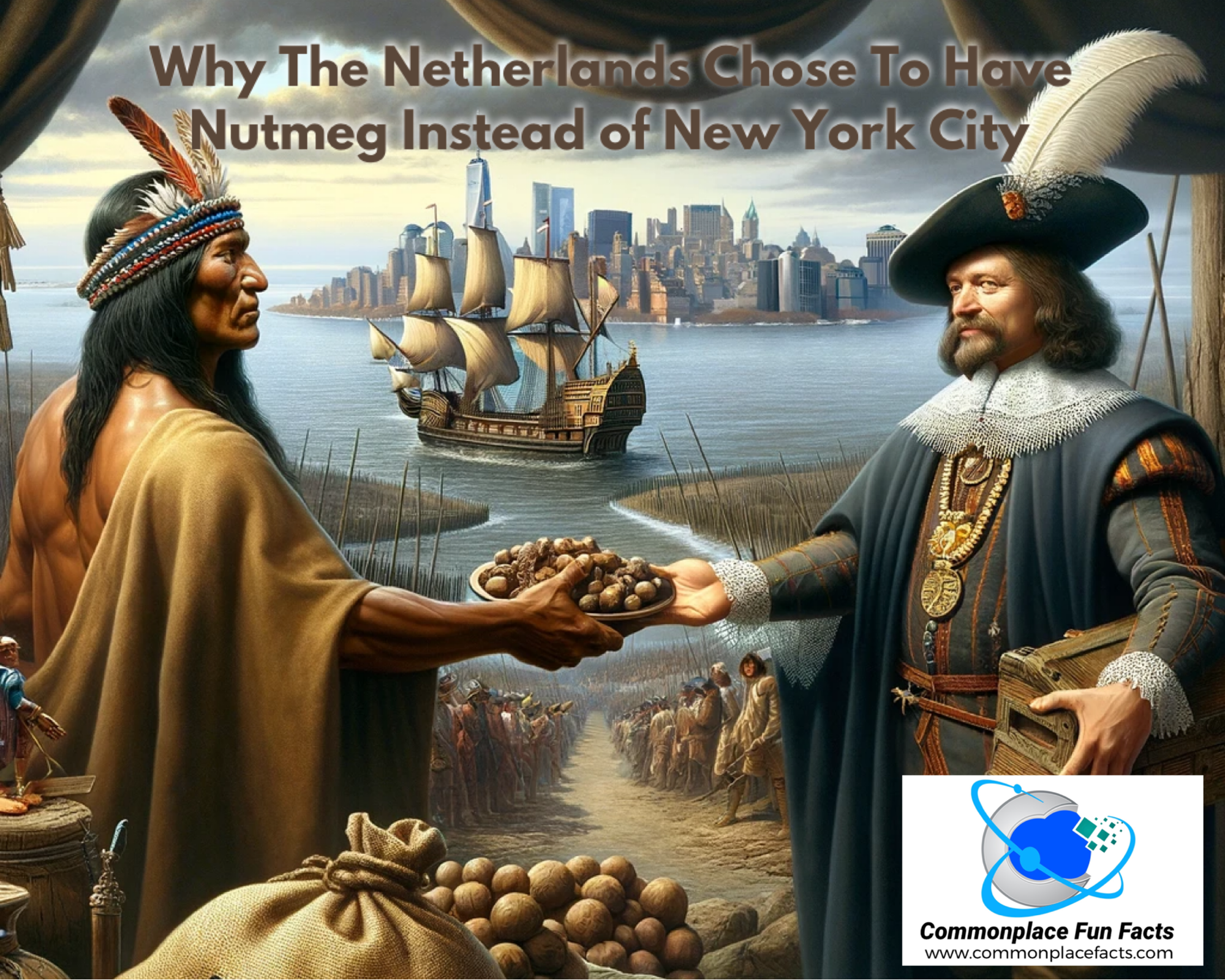
Enter Peter Minuit, the Dutch West India Company’s director-general. In 1626, he famously offered the local tribe a chest of beads and trinkets worth about 60 guilders (which some overly enthusiastic 19th-century historians pegged at $24). In exchange? The entire island of Manhattan. That’s right—Manhattan, the future home of Wall Street and Broadway, was traded for a collection of shiny objects. If you think that was a good deal, you might want to read this article and decide for yourself who really got ripped off.
While the Dutch were busy playing real estate agents in the West, their counterparts in the East were waging a far bloodier battle over nutmeg. The Banda Islands, the source of all that precious nutmeg, were under siege. The Dutch seem to have a thing for finding themselves in the middle of obsessive commodity trading. About the same time they were hyper-focused on locking in a steady supply of nutmeg, their economy was caught up in a crazy Tulip frenzy that is the stuff of legends. The Dutch East India Company was determined to monopolize the nutmeg trade, and they weren’t afraid to get their hands dirty to do it.
At first, the local Bandanese were glad to see the Portuguese go. When the Dutch started flexing their imperial muscles, things got ugly fast. Treaties were signed, misunderstandings were had, and soon the Banda Islands turned into a war zone. Villages were razed, chiefs were executed, and thousands of Bandanese lost their lives. The Dutch, never ones to leave loose ends, even imported their own farmers from Holland to take over nutmeg production.
The British weren’t going to sit back and let the Dutch have all the fun. They set their sights on Run, one of the smallest Banda Islands, which just so happened to be rich in nutmeg. Naturally, the Dutch and British butted heads, culminating in one of the great acts of sabotage of all time. Unable to wrestle control of the island outright, Dutch commander Jan Pieterszoon-Coenhe snuck in and burned down all the nutmeg trees. If he couldn’t have nutmeg in his eggnog, no one would!
The Treaty of Breda: Trading Manhattan for a Nutmeg Monopoly
As the Dutch and British duked it out in the East, things were heating up in the West too. By 1664, a British fleet had successfully seized New Amsterdam—Manhattan’s original Dutch name—putting the Dutch in a bit of a pickle. Their solution? The 1667 Treaty of Breda.
In a move that can only be described as historically ironic, the Dutch agreed to officially give up Manhattan in exchange for Run, the nutmeg-rich island in the East. The British, apparently not seeing the long-term potential of their new acquisition, initially tried to pawn off Manhattan for some sugar-producing land in South America. Thankfully for them (and for history), the Dutch declined, and the British kept the island, later renaming it New York.
The Final Twist: How Nutmeg Went Global
But wait, there’s more! During the Napoleonic Wars in the early 19th century, the British took over the Banda Islands, essentially ending the Dutch monopoly on nutmeg. They then transplanted the precious spice to places like the Caribbean, where it flourished. Today, Grenada is one of the world’s top nutmeg producers, and the spice is so important to the island that it even made its way onto their national flag.
The next time you sprinkle a little nutmeg on your holiday treat, consider how that tiny spice once determined the fate of one of the world’s greatest cities. Then again, you might enjoy your eggnog a lot more than you enjoy the Big Apple. If that is the case, you may wonder what the fuss was all about in the first place.

Splitting Up, Literally: The Bizarre Divorce of a Cambodian Couple Who Took Divorce to the Next Level
In a bizarre divorce settlement, a Cambodian man took asset division literally—by sawing his house in half. Read the unbelievable story!

You Can Reign in Hell (Michigan)
In Paradise Lost, John Milton paints a word picture of Satan being cast into Hell. The fallen angel, in making his choice of eternal rebellion, declares, “Better to reign in hell than serve in heav’n.” (Paradise Lost, Book One, lines 254-263). We sincerely hope none of our readers will follow his example. There is, however,…

Human Memory Began on Thursday, July 6, 1189
“Time immemorial.” That’s the term we use to describe anything that has been around for so long that no one knows when it started. It is older than human memory. It refers to how long we have had the practice of greeting each other by shaking hands. It describes the amount of time since the…




Leave a Reply