
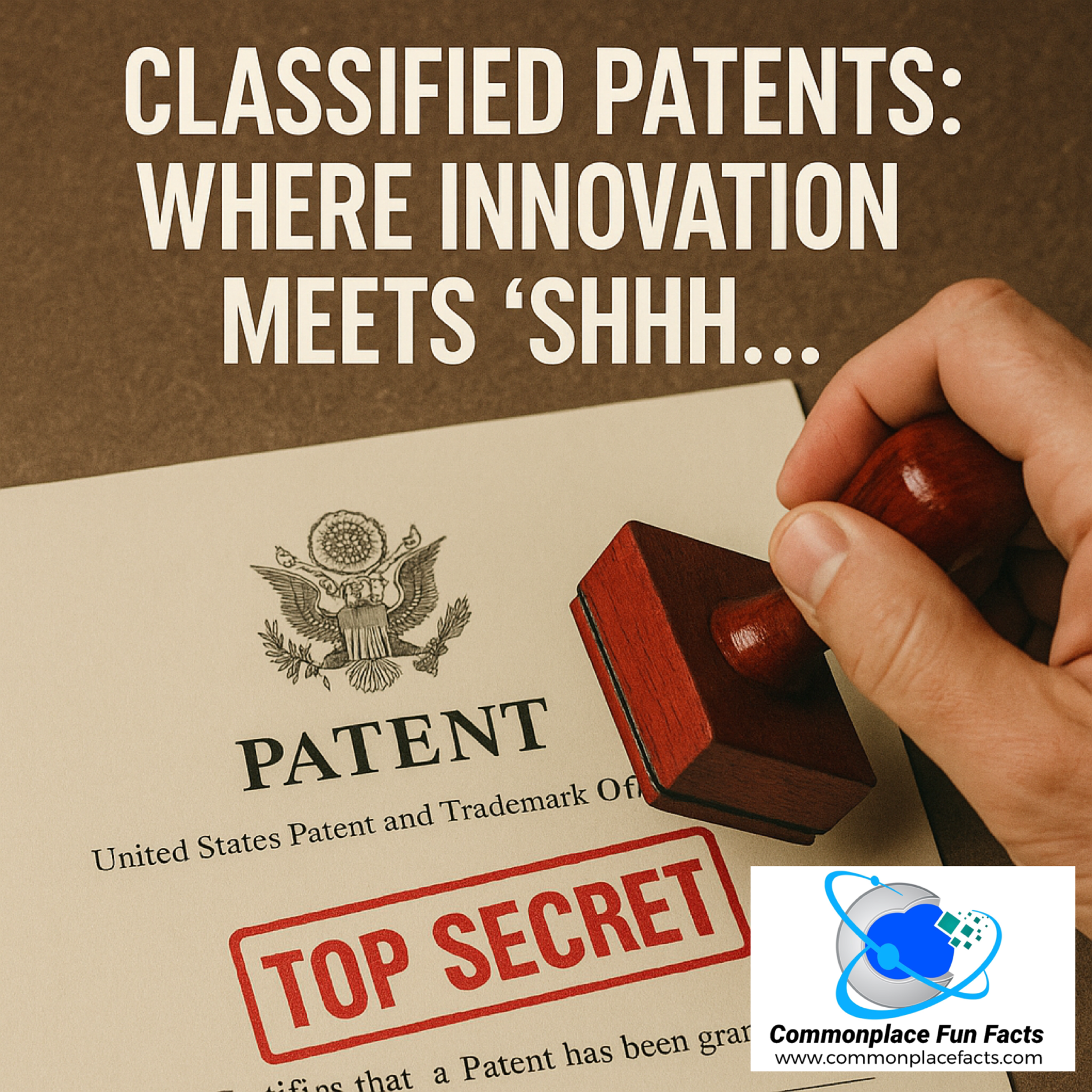

If you thought the most frustrating part of inventing something was getting the toaster to stop launching flaming Pop-Tarts across the kitchen, allow us to introduce you to a far more aggravating twist: inventing something truly groundbreaking, only to be told, “Nice work, but we’re going to have to pretend that never happened.”
Welcome to the shadowy world of classified patents—where your brilliant idea might be so good, the government won’t even let you have a patent for it.
Contents
Let’s Talk About the Invention Secrecy Act of 1951
Back in the Cold War days, when people still thought radioactive toothpaste was a good idea, Congress passed the Invention Secrecy Act of 1951 (35 U.S.C. ch. 17). The idea was simple: if an invention could pose a threat to national security, the U.S. government could slap a secrecy order on it faster than you can say “classified, top secret, eyes only.”
This means the patent application is frozen in bureaucratic amber. The inventor is legally gagged from talking about it, building it, or, heaven forbid, trying to sell it to someone other than Uncle Sam.
Is There a Statute of Limitations on the Gag Order?

In a word: nope. Secrecy orders are reviewed annually by various agencies (DoD, NSA, DOE—basically anyone whose offices require retina scans and keycards to just to be able to use the toilet), but there’s no mandatory expiration date.
Translation: your invention can stay in legal limbo for decades, especially if it’s the sort of thing that might help the Pentagon win a war or avoid one. Some secrecy orders have lasted more than 40 years. Your grandkids might inherit your classified invention along with your collection of commemorative state quarters and emotional baggage.
Do Inventors at Least Get Paid?
Technically, yes. Inventors are entitled to “just compensation” if the government suppresses their patent or uses the invention for itself. Realistically? Let’s just say it’s about as easy to get that compensation as it is to get a straight answer from someone in the witness protection program.
There’s a mechanism for pursuing payment through the Court of Federal Claims, but many inventors never even know they’re entitled to it—or they’re too intimidated to challenge the agency that just put a blackout curtain over their life’s work.
How Many Patents Are in the Government’s Innovation Dungeon?
As of now, around 5,000–6,000 secrecy orders are active at any given time. These aren’t just tinfoil hat anti-gravity blueprints, either (although, to be fair, we don’t know. Maybe there are blueprints for gravity-defying contraptions. Time will tell). Most are defense-related: radar systems, stealth tech, encryption tools, guidance systems, etc.
The peak came in 1991, with 6,193 secrecy orders—thank you, Gulf War—and it’s stayed surprisingly steady ever since. So if you ever feel like your own ideas are being stifled, just know there are thousands of inventors out there who are literally forbidden by law to tell anyone what they created.
Examples of Formerly Classified Patents
- The Laser: Gordon Gould’s work on lasers was subject to a secrecy order, delaying his patent and igniting a decades-long legal war to be recognized as the rightful inventor.
- Submarine Detection Tech: Magnetometers used for detecting enemy submarines were kept classified for years before finally being declassified—presumably once the enemy submarines stopped working, or we started using sharks with lasers instead.
- Stealth Fighter Innovations: Elements of the F-117 and B-2 stealth programs were under secrecy orders until the projects were publicly acknowledged. And even then, only bits and pieces were ever declassified. For all we know, the nation’s stealth technology is powered by a Potteresque Cloak of Invisibility.
What Kind of Inventions Get Secrecy Orders?
Here’s a short list of red flags that might make the government quietly step into your garage lab and tell you to zip it:
- Improved nuclear detonation triggers (always a crowd-pleaser)
- Long-range guidance systems with GPS disruption resistance
- Advanced stealth coatings or materials
- Encryption methods that even the NSA can’t break (Perhaps they should apply such technology to the CIA’s secret code sculpture that is still unsolved)
- The early warning system we devolved in 5th grade to let us know if pineapple and pizza come within 100 yards of each other. (Hey, that would explain why we still haven’t heard from the Patent Office, wouldn’t it?)
Oh, and let’s not forget the urban legends—like zero-point energy generators, anti-gravity drives, or mind-control headbands for squirrels. These don’t show up on official lists, but that doesn’t stop conspiracy theorists from hosting 9-hour livestreams in which they yell about them into their webcam microphones — all in 432Hz, of course.
Final Thoughts: Inventor? Or National Security Threat?
It’s a strange world where inventing something too useful can be your downfall. One minute you’re trying to revolutionize the energy industry, and the next you’re getting friendly visits from people who speak in acronyms and have no digital footprint.
So the next time your brilliant idea for cold fusion, invisibility cloaks, or self-cleaning Tupperware goes nowhere, don’t assume it’s because it’s dumb. It might just be too dangerous to be allowed to exist. And if you hear a knock at the door and see a man in a dark suit holding a non-disclosure agreement the size of a phone book… congratulations. You’ve invented something classified.
Just don’t expect to get paid. Or talk about it. Or ever see it again. But hey—great job, patriot.
You may also enjoy…

Fire Destroys Fire Hydrant Patent
Learn about the ironic twist of fate that resulted in the fire hydrant patent going up in smoke.

Henry’s Invention That Transformed Warfare
Henry was an ambitious officer. He had his sights set on greatness. He wanted his name to be remembered by future generations. He got his wish. This is the story of why you remember his name today, even if you didn’t know why you know it. He was born on June 3, 1761, in Bradford…

The Story of the Popsicle and its 11-Year-Old Inventor
What invokes happy memories of summer better than the popsicle? The cool, refreshing delight of a juicy frozen treat on a hot day can seem like manna from heaven. The next time you enjoy this iconic taste of summer happiness, take a moment and express gratitude to the 11-year-old boy who invented it. The young…


Leave a Reply