
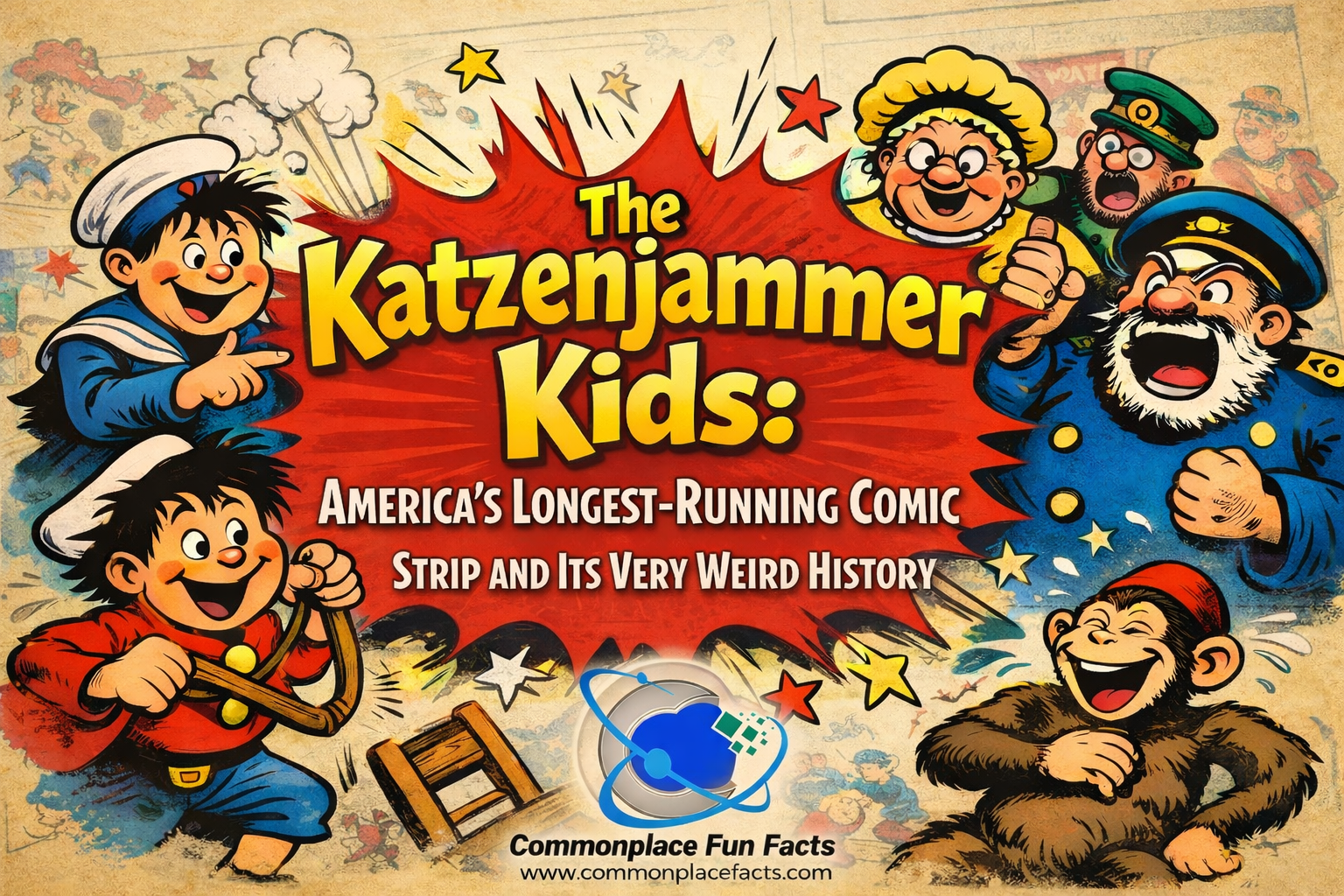

Modern culture has strong opinions about children behaving badly. We worry about screen time, TikTok pranks, and whether Fortnite has finally finished off the concept of indoor voices. It is therefore comforting—almost reassuring—to remember that American popular culture has been enthusiastically cheering delinquent children for well over a century.
Long before social media offered young people the chance to embarrass themselves publicly and permanently, newspaper readers were gathering every Sunday to watch two fictional boys lie, steal, break furniture, harass authority figures, and generally treat adulthood as a minor obstacle to be overcome with rope, fish, or blunt force trauma.
Those boys were Hans and Fritz. They were The Katzenjammer Kids, and their arrival did more than normalize weekly mischief. It launched one of America’s longest-running comic strips, helped invent the visual language of comics, and proved that very small boxes could contain a surprising amount of cultural mayhem.
Contents
Before the Internet Taught Children Bad Ideas
The comfortable myth is that childhood misbehavior is a modern crisis—something invented by cable television, perfected by YouTube, and monetized by influencers with unsettling levels of confidence. The truth is less flattering and considerably older. In 1897, when electricity was still a novelty and automobiles were mainly useful for terrifying horses, American newspapers introduced two of their biggest stars: a pair of children whose defining characteristic was unrepentant menace.

Those children were Hans and Fritz, better known as The Katzenjammer Kids. Created by cartoonist Rudolph Dirks, they made their debut on December 12, 1897, in the American Humorist, the Sunday supplement of William Randolph Hearst’s New York Journal. Their timing was perfect. The late 19th century was the height of the newspaper wars, when publishers discovered that nothing sold papers quite like scandal, illustrations, and children behaving appallingly in full view of polite society.
From the beginning, the strip was designed to be loud, physical, and impossible to ignore. Hans and Fritz weren’t troubled youths or misunderstood rebels. They weren’t learning lessons. They existed in a tidy weekly loop: scheme, execute scheme, torment the adults, receive punishment, reset. There was no character growth, no moral arc, and no concern for long-term trauma. This was comedy as a closed system, and readers loved it.
In hindsight, the structure feels uncannily familiar. Authority figures never improve. Children never reform. The status quo must be preserved at all costs so next week can promise fresh chaos. Long before television figured this out, The Katzenjammer Kids had already built the prototype.
An American Comic Strip with Very German Roots
Despite its American newspaper pedigree, The Katzenjammer Kids did not appear out of thin air. It was directly inspired by the wildly popular German illustrated story Max und Moritz by Wilhelm Busch, which followed two boys whose idea of fun involved elaborate pranks and an alarming disregard for other people’s safety. The story concludes when their exhausted uncle finally snaps, grinds them into meal, and feeds them to his ducks.
Children’s literature in the 19th century had not yet embraced the idea that discipline should involve a “Time Out Chair” and some private reflection on one’s emotional journey.
Dirks was asked to adapt Busch’s story for an American audience, but he made one crucial change: he kept the chaos and quietly discarded the fatal ending. The newspaper version opted for something far more sustainable—mild violence, shouted accents, and punishments severe enough to feel satisfying but never permanent enough to end the strip.
The result was not a moral fable but a ritual. Each week promised mischief, impending discipline, and the comforting certainty that everyone involved would return the following Sunday, bruised but intact.
Even the title carried a warning. “Katzenjammer” roughly translates to the wailing of cats and, by extension, the misery that follows poor decisions. In other words, the strip was accurately labeled from day one.

Inventing the Language of Comics While Nobody Was Looking
It’s easy to forget, when scrolling past panels that look comfortably familiar, that someone had to invent the grammar of comics. Speech balloons were not always a given. Motion lines did not always exist. Early strips often resembled illustrated tableaux with captions that politely explained what was happening, just in case. Mort Walker would later help define these terms (see “Grawlix, Plewds, and Briffit: the Literary Language of Cartoons and Comic Strips” for more about that.)
The Katzenjammer Kids helped create these concepts. Over its early years, the strip became one of the places where speech balloons settled into their modern role, letting characters speak directly, overlap, interrupt, and escalate chaos in real time. The result felt louder, faster, and more alive than much of what had come before.
Panels didn’t just depict action; they implied it. Characters moved. Objects flew. Consequences followed quickly and with theatrical precision. The strip didn’t just tell jokes—it demonstrated timing. It taught readers how to read comics the way we still do today, one mess at a time.
A Sitcom Before Sitcoms Knew They Were a Thing
If The Katzenjammer Kids feels strangely familiar, that’s because it perfected a formula American entertainment would reuse endlessly. Two agents of chaos. A small supporting cast of adults attempting control. A rigid hierarchy enforced primarily through shouting and corporal punishment. Reset button firmly engaged.

Hans and Fritz were not subtle characters. They were smart enough to plan, dumb enough to get caught, and confident enough to try again next week. Their nemeses—the Captain and Mama—existed largely as embodiments of authority rather than as people with inner lives. They were there to impose order and fail at it.
This dynamic would later show up everywhere: sitcom families, cartoon duos, workplace comedies, and any narrative where rules exist mainly so someone can violate them creatively.
Dialect, Accents, and the Long Shelf Life of Ethnic Comedy
One of the strip’s most distinctive features was its language. The dialogue was written in exaggerated, phonetic “German-flavored” English—a stylized accent that signaled immigrant identity while reliably delivering punchlines. Readers were expected to hear the voices in their heads, preferably loudly.

At the time, this kind of humor was both widespread and widely accepted. America was absorbing millions of immigrants, and popular entertainment processed that reality with accents, stereotypes, and an unspoken understanding that everyone was eventually supposed to blend in. The strip reflected its era with remarkable honesty, if not subtlety.
As decades passed, editors quietly smoothed some of the rougher edges. Reprints occasionally softened spellings, adjusted phrasing, or let time do the work of lowering expectations. The core joke, however, remained unchanged: the adults talk funny, the kids behave terribly, and nobody escapes unscathed.
By this point, the blueprint was complete. The strip had established its voice, its rhythm, and its worldview. And that’s when things got truly weird—because the next phase of The Katzenjammer Kids would involve lawyers.
The Lawsuit That Split the Comic Strip Universe
The natural life cycle of a wildly successful comic strip usually involves fame, spin-offs, merchandising, and a slow creative decline. The Katzenjammer Kids chose a stranger path: it wandered directly into early 20th-century copyright law and set up camp.
By the 1910s, Rudolph Dirks had grown tired. Producing a weekly strip indefinitely turns out to be less fun than it sounds, especially when your job consists of repeatedly inventing new ways for children to be hit with objects. Dirks asked Hearst for a break. Hearst said no. Dirks left anyway. Hearst immediately assigned another artist to continue the strip.

What followed was a legal showdown so perfectly on brand that it deserves its own panel. The court ruled that Hearst owned the title The Katzenjammer Kids, but Dirks retained the characters themselves. This was less a compromise than a cosmic prank.
The result was one of the most surreal outcomes in comics history: for decades, American readers could choose between two nearly identical comic strips, starring essentially the same characters, produced by rival creators, in rival newspapers, pretending the other one didn’t exist.
Dirks’ version eventually ran under the name The Captain and the Kids. Hearst’s version kept the original title. Together, they formed a legally distinct, morally identical universe of child-based mayhem.
World War I and the Sudden Fear of Umlauts
Then came World War I, which had a way of making everyone nervous about anything that sounded even vaguely German. This included the surname of the British royal family, sausages, sauerkraut, symphonies, and apparently fictional cartoon children.
During the war years, the Hearst version of the strip temporarily changed its name to The Shenanigan Kids, because nothing defuses nationalist panic like swapping one nonsense word for another. The characters were rebranded as Dutch, from Edam, which at least allowed everyone to continue wearing clogs and shouting without provoking diplomatic incidents.
Once the war ended, the strip quietly reverted to its original name, and everyone agreed not to talk about the episode ever again. This was not the first time America reinvented something to feel better and then acted as if it had always been that way.
Katzenjammer Goes Multimedia (Way Earlier Than Expected)
By the early 20th century, The Katzenjammer Kids were no longer just newspaper fixtures. They had escaped into the wider world, appearing in stage productions, merchandise, and even early film adaptations—at a time when cinema itself was still trying to figure out chairs.
Live-action shorts brought Hans and Fritz into motion as early as 1898, a development that must have thrilled audiences who were already perfectly content imagining objects flying through the air. The strip had become one of the early examples of cross-media branding, long before anyone coined the word “franchise” or learned to fear it.
Perhaps the most unexpected milestone came in 1929, when versions of the characters appeared as some of the earliest giant balloons in the Macy’s Thanksgiving Day Parade. This marked the moment when mischievous cartoon children became massive floating entities drifting above Manhattan, watching silently as adults fled in orderly terror.
The Impossible Longevity Problem
Most comic strips end. Some fade. A few limp along until editors intervene mercifully. The Katzenjammer Kids refused all of these outcomes.
In one form or another, the strip ran from the 1890s into the early 21st century, spanning three centuries, multiple wars, the rise of radio, television, the internet, and the extinction of several types of hats. Through it all, Hans and Fritz continued doing exactly what they had always done.
Although the final original Katzenjammer Kids strip ran in 2006, the comic has refused to stop entirely. Reprints distributed by King Features Syndicate have kept it in circulation, making it both the oldest comic strip still in syndication and one of the longest-running comic strips ever inflicted on American newspapers.
This longevity wasn’t due to deep storytelling or emotional evolution. It worked because the premise never expired. Children misbehave. Adults overreact. Punishment fails. Repeat.
It is the oldest engine in comedy, and it turns out you don’t need software updates when the design is already flawless.
What The Katzenjammer Kids Actually Reveals About Us
Strip away the accents, the slapstick, and the occasional lawsuit, and The Katzenjammer Kids reveals something simple and enduring about American humor.
We have always enjoyed watching authority struggle. We have always laughed when rules collapse under the weight of ingenuity and audacity. And we have always found it comforting when the world resets neatly after chaos, ready for next Sunday’s mess.
The strip didn’t just entertain readers; it trained them. It taught Americans how to read comics, how to enjoy serialized nonsense, and how to root—quietly but enthusiastically—for the people who cause trouble.
More than a century later, the tools have changed. The platforms are shinier. The children have smartphones. But the appeal remains untouched.
Somewhere, an adult figure is about to lose control. And somewhere else, two kids are already planning it.
You may also enjoy…

Unveiling The Golden Bat: The First Superhero?
So, there’s a debate about who holds the title of “World’s First Superhero.” While the Phantom is officially recognized, some argue that the Golden Bat, a Japanese character from 1931, deserves it too. He had powers and a cool backstory, influencing later heroes. Ultimately, it’s up to the readers to decide!

The Shadow: The Fedora-Wearing Phantom Who Paved the Way for Superheroes
Discover the mysterious legacy of The Shadow—radio’s original dark avenger who laid the foundation for modern superheroes. From pulp fiction roots to influencing Batman, this vigilante knew what evil lurked in the hearts of men.

Meet the Phantom: the World’s First Superhero
Editor’s Note: Subsequent to the publication of this article, we were made aware of The Golden Bat, who possibly has a better claim on the distinction of being the world’s first superhero. Be sure to read Unveiling the Golden Bat: The First Superhero? While many people assume Superman was the first superhero, fandom actually owes…





Leave a Reply