
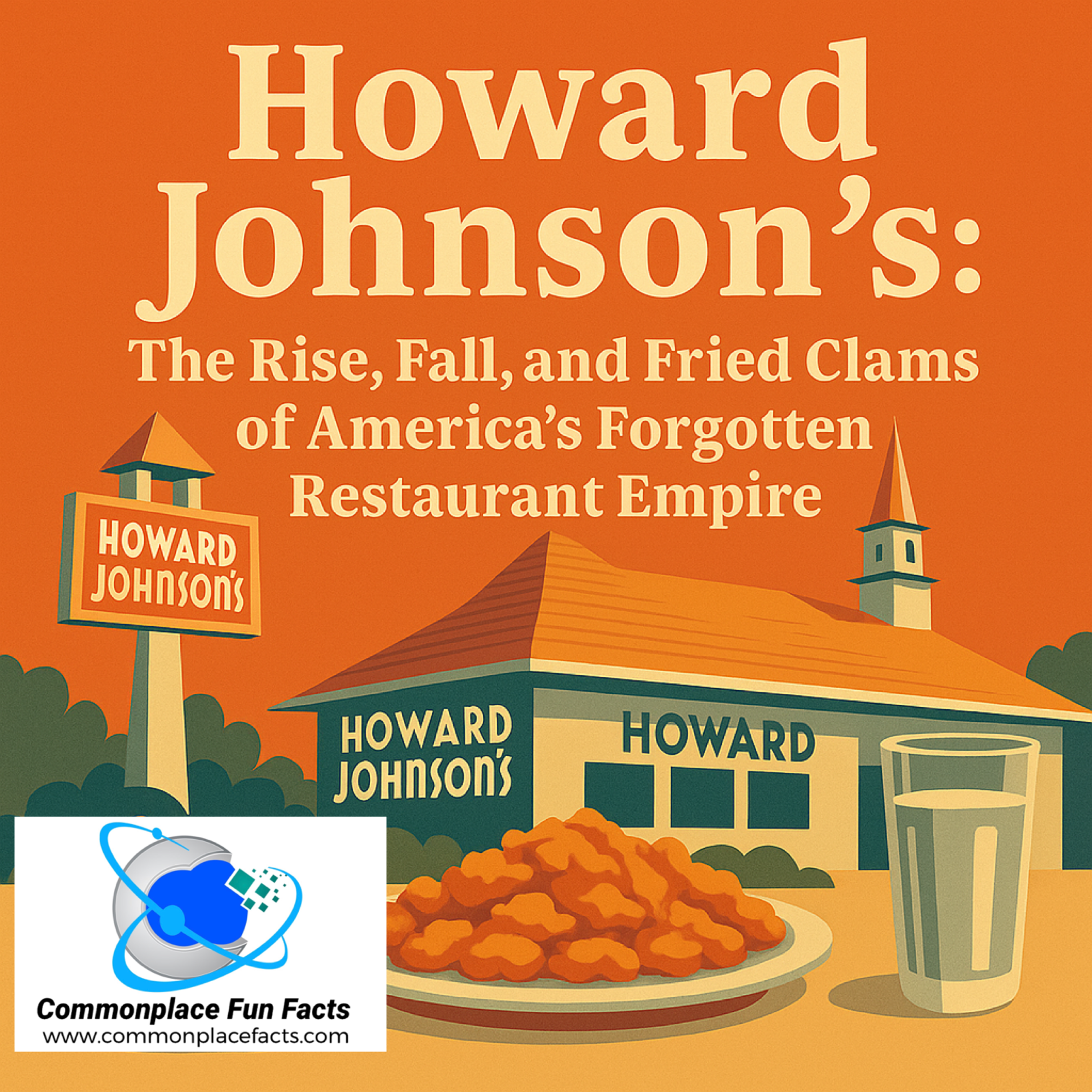

Before there was a Starbucks on every corner, before Ronald McDonald started franchising his questionable taste in architecture, and before Jared lost all that weight (and then lost our collective respect), there was Howard Johnson’s — the once-undisputed king of roadside dining. From humble beginnings to a thousand locations, this orange-roofed empire served more meals than anyone else in America… except for the U.S. military. And then — poof — like a magician’s assistant or your hopes of getting ice cream after 9 PM, it vanished.
Most people born after the 1990s only recognize the name Howard Johnson from hotels they didn’t mean to book. But this chain didn’t just feed America — it invented the entire modern restaurant franchising model and defined the mid-century road trip experience. So buckle up, grab a milkshake (or three), and let’s dive into the story of how one man turned ice cream into an empire and then managed to melt it all down again.
Contents
The Middle School Dropout Who Scooped the World

Our story begins with a fellow named Howard Deering Johnson, born in 1897 and a proud graduate of… eighth grade. (But before you dismiss his supposed lack of education, take a look at the type of final exams 8th graders had to take in those days.) His father ran a cigar business, which Howard joined early, probably thinking he’d spend his life selling fine tobacco to gentlemen with monocles and existential dread. But alas, the 20th century had other ideas. Cigarettes were in; cigars were out. The business tanked. His father died in 1923, leaving behind debt, disappointment, and a lot of unsold stogies.
Rather than starting fresh, Howard tried to save the business. It went as well as a soggy matchbook in a hurricane. By 1925, he was deep in debt and hustling for his next gig. Enter: a struggling newsstand and soda fountain in Quincy, Massachusetts. When the owner died, Johnson bought the place for $2,000 — using a loan from his mom and a doctor friend. This was the Roaring Twenties, when nothing said “business plan” like mixing root beer and desperation.
The Ice Cream That Launched a Thousand Restaurants
Johnson noticed that the soda fountain was the only part of the shop not hemorrhaging money, so he leaned in. Hard. He began experimenting with ice cream, eventually settling on a recipe that doubled the usual amount of butterfat. Was it his mom’s recipe? Did he buy it from a German pushcart vendor? Did he just wake up one day and say, “Let’s make this artery-clogging gold”? No one knows. But it worked. By 1927, he’d opened a second shop and, by 1928, he had seasonal beach stands slinging ice cream and hot dogs and grossing $240,000 (over $4 million today).
Oh, and he created 28 flavors — the original “we have more than just vanilla” pitch. Butter pecan, caramel fudge, coffee, butterscotch — the gang was all there, and America was hooked.
How a Clam Became a Brand (Not For Ice Cream, In Case You Were Wondering)
Success is like ice cream. There’s no such thing as enough. Johnson envisioned a full-service restaurant where travelers could enjoy quality food that reminded them of home — assuming their homes were very clean and staffed by people in matching uniforms. His first Howard Johnson’s restaurant opened in Quincy, Massachusetts, featuring American comfort food and a signature dish of tender-sweet fried clams — basically the part of the clam that won’t freak you out if you look at it too closely.
His culinary philosophy? Don’t get fancy. “If you say Halibut Dante, the average American will never buy it. But if you say halibut with cream and tomato sauce, he’ll not only buy it, but he’ll say it’s great.”
The Birth of the Franchise Empire

Then came the Great Depression. While most people were busy losing their shirts, Johnson was thinking outside the box — and inside the franchise agreement. Unable to get loans for expansion, he proposed a novel idea: what if others built the restaurants, used his brand and menu, and paid him a cut of the profits? Voila! Modern restaurant franchising was born — or at least, perfected.
In 1936, there were 41 Howard Johnson’s. By 1939? Over 100. All sporting the now-iconic orange roofs and blue spires, because if you’re going to sell ice cream, you might as well do it from something that looks like a creamsicle church.
The War, the Comeback, and the Rise to Glory
World War II hit Howard Johnson’s hard. Between gas rationing and fewer road trips, the chain dropped from 200 restaurants to just 12. Johnson pivoted, supplying frozen meals to the military and schools — and somehow managed to stay afloat until peacetime returned. When it did, business didn’t just bounce back — it exploded.
By 1950, HoJo’s was back to over 200 restaurants and grossing what would be $1.4 billion today. When Eisenhower launched the Interstate Highway System in 1956, Howard Johnson was ready. He placed his restaurants and new motor lodges strategically at exits like a culinary Bond villain — but with more pot roast and fewer cats.
Peak Howard Johnson’s: Fried Clams and World Domination
By 1965, HoJo’s had over 1,000 restaurants. It served more meals outside the home than anyone besides the U.S. military. The waitresses wore outfits designed by Christian Dior. The menus were curated by chefs Jacques Pépin and Pierre Franey. Pépin, in fact, turned down a gig as John F. Kennedy’s personal chef to work on fried clams. That gives you some idea of the prestige of the HoJo empire.
There was even a “Howard Johnson’s Bible” — a detailed operations manual so precise it probably told you how to fold the napkins and emotionally connect with the mashed potatoes. Uniformity was king. A meal at a Howard Johnson’s in Kansas tasted exactly the same as the one in Connecticut. Your arteries might disagree with your life choices, but at least they couldn’t complain about inconsistency.
And Then… the Cracks Appeared
So what happened? How do you go from feeding America to feeding its nostalgia?
Enter Howard Brennan Johnson, the founder’s son, who took the reins in 1959. He had some successes — going public in 1961, launching Ground Round, and acquiring Burger King franchises. But he also made the fateful decision to scale back franchising, preferring company-owned stores. Then came McDonald’s and the fast food boom.
While HoJo’s was still charging $0.35 for a burger, McDonald’s sold theirs for $0.15 — and they had drive-thrus. (Read how the drive-thru phenomenon started in this article.) HoJo’s had mashed potatoes. Mickey D’s had convenience. Guess who won?
Quality Control? We Hardly Knew Ye.
As profits dropped, Brennan Johnson cut costs. Fewer employees. Cheaper ingredients. Predictably, the quality tanked. So did customer loyalty. The hallmark consistency and care that defined Howard Johnson’s began to evaporate like free ice water in the Mojave.
Meanwhile, bad publicity — like franchise owners refusing service to Black diplomats, sparking international incidents — didn’t help. Despite Johnson’s personal push against segregation support for civil rights, the damage was done. Public perception started to curdle faster than the milk in a forgotten milkshake.
The Final Scoop

By 1979, the Johnson family sold the company to Imperial Group for $630 million. Imperial promptly sold it to Marriott in 1985, who weren’t interested in saving it — just flipping the real estate. Within two years, almost all company-owned restaurants were gone. The few remaining franchised locations limped into the 1990s before finally closing. The very last restaurant, in Lake George, New York, shuttered in 2022. RIP, fried clams. You were too crispy for this world.
The Legacy of the Orange Roof
Today, Howard Johnson lives on — sort of — in name only through Wyndham Hotels, which operates a few hundred HoJo-branded inns worldwide. But the restaurant that revolutionized franchising, roadside dining, and childhood road trip memories? That’s gone.
From zero to empire and back to zero — all within a generation. That’s something. Even so, next time you order a Happy Meal in a clean, well-lit building with predictable fries, tip your hat (or at least your napkin) to Howard Johnson. He didn’t just serve up 28 flavors of ice cream. He served up the very idea of eating on the road and knowing exactly what to expect — from soup to sundaes.
You may also enjoy…

How Circuit City Self-Destructed: Lessons from the Fall of a Retail Giant
Discover how Circuit City, once a consumer electronics giant, spiraled into failure through mismanagement, poor decisions, and missed opportunities. Learn the key lessons from their downfall.

How ‘I Don’t Care’ and ‘Whatever’ Became a Profitable Business Naming Strategy in the Telecom Industry
Discover how a clever business naming strategy like ‘I Don’t Care’ and ‘Whatever’ led to surprising profits in the telecommunications industry.

How A Fast-Food Phenomenon Was Started As a Service to Servicemen
The soldiers at Fort Huachuca had a problem. Their duties frequently had them traveling off base at meal times, and it was hard to get a good meal. It’s not that there was any shortage of restaurants. The nearby community of Sierra Vista in south Arizona offered plenty of dining establishments. The thing that stood…




Leave a Reply to Herald StaffCancel reply