
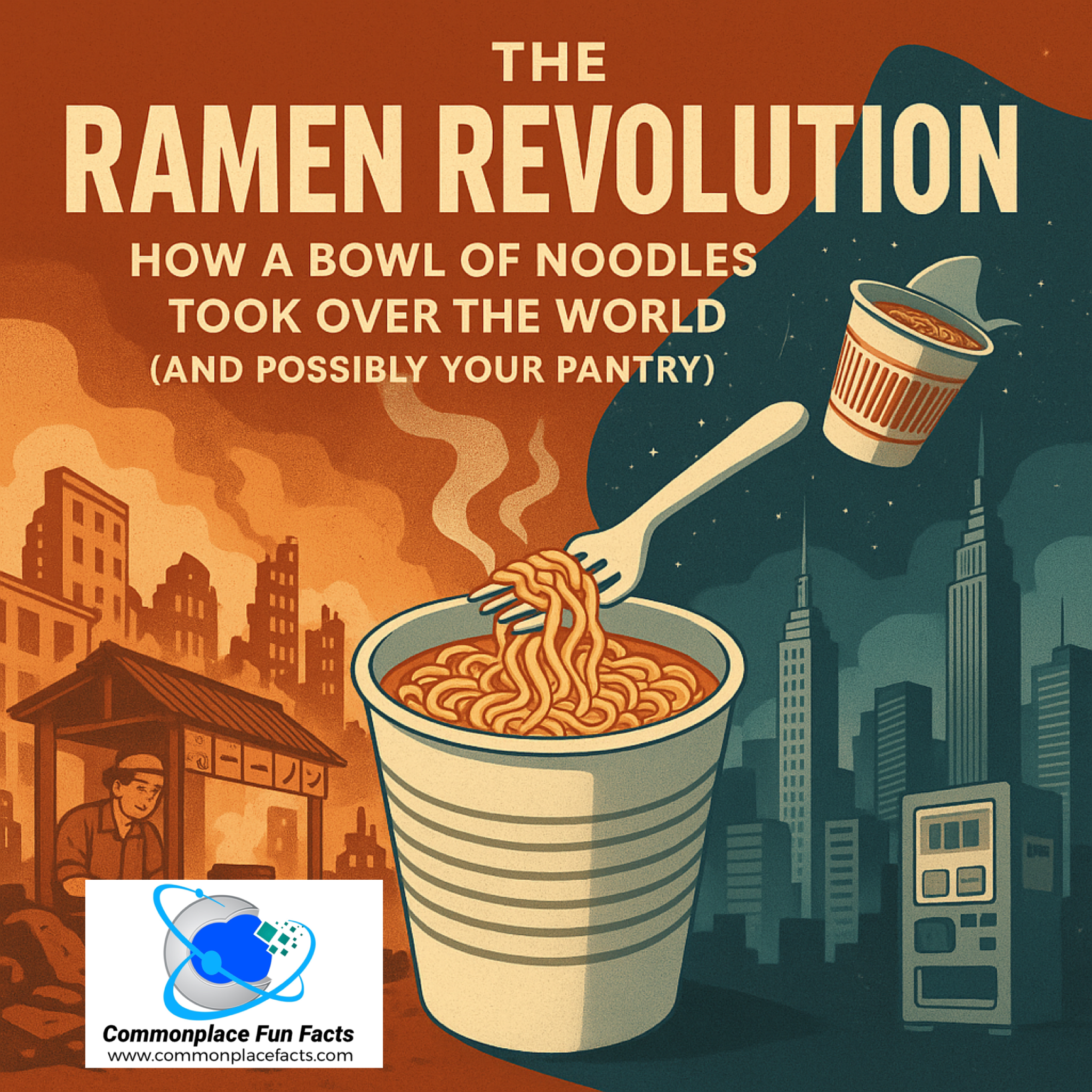

Instant ramen: friend to starving students, broke artists, overworked office drones, and anyone who’s ever looked in their fridge and was greeted with heretofore undiscovered lifeforms. It’s the culinary equivalent of a warm hug—if that hug came in a crinkly plastic package and cost less than the loose change in your couch cushions.
Today, ramen is a global juggernaut. We’re talking nearly 290 million servings consumed every day worldwide. That’s more than the population of Brazil (not that we’re advocating that you snack on a Brazilian if you are feeling peckish). But while we now associate this noodly goodness with college dorms, gas stations, and the top drawer of your desk at work, its origin story is anything but comforting. In fact, it comes straight out of the “Post-Apocalyptic Struggle for Survival” playbook.
Contents
Before It Was Instant, It Was… Complicated
Ramen (the non-instant kind) first slurped its way into Japanese bowls sometime in the late 19th or early 20th century, brought over by Chinese immigrants. Back then, making it was a time-consuming ordeal. You needed to boil, knead, slice, flavor, etc. It was the sort of thing you didn’t even start unless you generally had your life together. In other words, it was not exactly dorm-room compatible.
Everything changed after World War II. And by “everything,” we mean everything. Japan was devastated—Allied firebombing raids had torched the major population centers into charred memories. The country was hungry, broke, and barely functioning.
Along came the American Occupation and disaster response. The Americans had wheat in abundance, so that’s what they brought, handing it out like awkward houseguests bringing over unfamiliar casseroles.
To stave off mass starvation, the U.S. handed out massive amounts of surplus wheat and told the Japanese to bake bread. This seemed like a great idea, except… the Japanese weren’t really a bread-eating people. Imagine someone telling you to survive a crisis by eating only kale smoothies. It was that kind of vibe.
One Man, One Mission: Save the World with Noodles

Enter Momofuku Ando, the man who decided that salvation should come in noodle form. Born in 1910 on the island of Formosa (modern-day Taiwan), Ando moved to Osaka, Japan in 1933 and dabbled in various business ventures, including a salt company. But his eureka moment came while wandering post-war Osaka and seeing people shivering in the cold, lining up for bowls of black market ramen. They were miserable—but happily eating noodles. Ando was inspired.
“Peace prevails when food suffices,” he reportedly said, in a quote that would look great printed on a ceramic mug. But he couldn’t wrap his head around the government’s bread obsession. He told a Health Ministry official, “With bread, you need side dishes. But the Japanese are eating it with just tea. It’s not nutritionally balanced.” The official basically said, “Okay, genius—why don’t you solve it?”
Challenge accepted.
The Noodle Lab in the Backyard Shed
Ando transformed his backyard into a mad scientist’s culinary laboratory, using secondhand noodle-making gear and a healthy dose of determination. He was on a mission to invent the perfect post-war food: tasty, non-perishable, quick to prepare, cheap, and safe.
Legend has it he found inspiration while watching his wife fry tempura. What if, he wondered, you deep-fried cooked noodles? As it turned out, this technique dehydrated the noodles and created tiny holes that made rehydration super fast—aka the miracle of “just add boiling water.”

On August 25, 1958, the world met Chicken Ramen, Ando’s first mass-market product. The flavor? Chicken, of course—because it was tasty, nutritious, and seemed “American.” Ironically, despite now being the budget food of champions, it was initially a luxury item, costing six times more than fresh ramen. That’s like launching boxed mac and cheese and pricing it like a filet mignon.
From Niche to Nation
Sales were slow at first. But Ando wasn’t just a noodle maker—he was a marketing wizard. Thanks to savvy advertising and tireless promotion, sales exploded: 13 million packs sold in the first year, 200 million by 1963, and a staggering 3.5 billion by 1968. Instant ramen had officially gone from gourmet oddity to Japan’s national pantry item.
Then Came the Americans (Again)
By the mid-1960s, Nissin’s Japanese market had plateaued, and Ando turned his noodle-vision toward the United States. During a 1966 trip, he saw Americans doing something horrifying: crushing the noodles into Styrofoam coffee cups and pouring hot water on them. But instead of recoiling in culinary horror, he saw genius.

He returned to Japan and created Cup Noodles: noodles preloaded in a heat-resistant paper (later Styrofoam) cup. Later, he would add dehydrated veggies and a peel-back lid inspired by a snack container he saw on a flight. It was portable, instant, and kind of looked like the future.
Initially, Cup Noodles were seen as fancy and a bit weird. Also, eating while walking in Japan was considered rude. So Ando went full youth-market guerrilla style: he set up tasting booths in Tokyo’s trendiest districts. One event in 1971 sold over 20,000 cups in just four hours. Bonus PR? It was held right across the street from Japan’s first McDonald’s, instantly linking Cup Noodles with Western culinary innovation.
Kidnappings and Vending Machines: The Weird Side of Marketing
Ando didn’t just benefit from invention and marketing brilliance. It seemed that things just always tended to work in his favor. Take, for example, the Asama-Sanso Incident in 1972. Leftist militants took a hostage in a mountain lodge. The television and print coverage showed national police camped outside—slurping Cup Noodles to stay warm. Clearly, this was the meal of choice for busy, important people who needed convenience. The country watched. Sales skyrocketed. Maybe there really isn’t such a thing as bad publicity.
Vending machines soon followed—ones that could add hot water for you. Cup Noodles outsold the original Chicken Ramen by 1989 and continue to dominate. They even changed how people eat: since walking while using chopsticks was awkward, Ando included a tiny plastic fork with each cup. Instant ramen was no longer a meal—it was a lifestyle.
America, the Beautiful (and Constantly Eating Ramen)
The U.S. fell head over Styrofoam for Cup Noodles. Nissin opened its first American factory in Lancaster, Pennsylvania, in 1973. Today, Americans slurp down over 4.5 billion servings of instant ramen each year—because nothing says “American lifestyle” like adding hot water to a sodium bomb in a cup.
Ramen Around the World (and Out of It)
Since 1958, instant ramen has gone global. As of today, more than 103 billion servings are consumed annually. China leads with 40+ billion, followed by Indonesia (12 billion), India (6), Japan (5.7), and Vietnam (5.2). Basically, the sun never sets on the empire of slurp.
And if you think ramen’s reign is confined to Earth, think again. In 2005, Nissin developed Space Ram—a special, low-gravity ramen for astronaut Soichi Noguchi aboard the Space Shuttle Discovery. Because even in orbit, humans crave noodles.
A Legacy You Can Taste
Despite creating a food empire that made billions, Ando never lost sight of his original mission: feeding the world. In 1997, he founded the World Instant Noodles Association, which distributes ramen in disaster zones, war zones, and famine-stricken areas. After the 2011 Tōhoku earthquake and tsunami, thousands of displaced Japanese citizens were sustained by—you guessed it—instant ramen.
Momofuku Ando passed away in 2007 at age 97. His funeral was held in a baseball stadium and attended by two former Prime Ministers, 34 clergy members, and presumably enough noodles to feed a small country. He was eulogized as “the creator of a culinary culture that postwar Japan can be proud of.”
His fellow citizens agree. In 2000, a poll ranked instant noodles as the single most important invention of the 20th century. Keep in mind that the 20th century gave us such things as airplanes, computers, microwave ovens, and butter sticks.
So next time you pop open a packet of instant ramen, take a moment to thank the man who turned war-torn despair into slurpable salvation. Then raise a plastic fork in his honor.
Or better yet, eat it with chopsticks like a proper connoisseur. Just not while walking.
You may also enjoy…

The Story of the Popsicle and its 11-Year-Old Inventor
What invokes happy memories of summer better than the popsicle? The cool, refreshing delight of a juicy frozen treat on a hot day can seem like manna from heaven. The next time you enjoy this iconic taste of summer happiness, take a moment and express gratitude to the 11-year-old boy who invented it. The young…

Pez Candy: The Iconic Treat That Made Dispensers Collectible Worldwide
Pez candy, originating as a peppermint breath mint in 1927, evolved into a pop culture phenomenon, with iconic dispensers becoming collectibles. The addition of character heads and diverse flavors in the 1950s shifted its market focus towards children, and today, rare Pez dispensers can fetch thousands of dollars. Pez continues to thrive through innovation and…

Meet Mr Delicious: The Fast-Food Mascot So Unappetizing, He Bankrupted an Entire Chain
In the golden age of fast food, Rax Roast Beef rose to fame with its simple, no-frills approach. But a misguided attempt at diversification and a bleak mascot, Mr Delicious, led to its downfall. The chain filed for bankruptcy and now only five locations remain, serving as a cautionary tale about losing sight of one’s…





Leave a Reply