
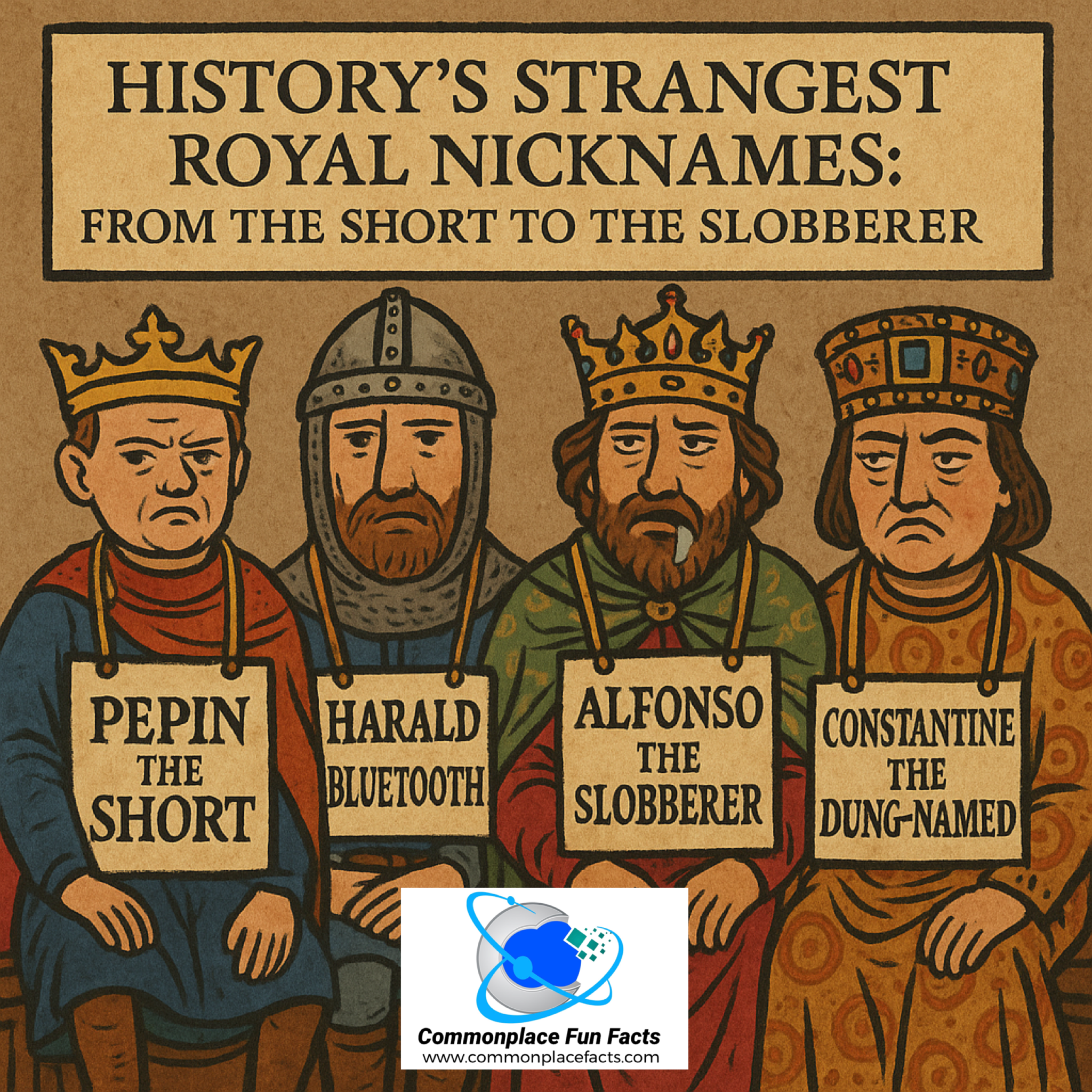

A Stroll Through the Strangest Royal Nicknames
Nicknames. We’ve all had them — sometimes they’re the kind you secretly hope will catch on, like “The Legend” or “Captain Awesome,” and sometimes they’re the kind that cling to you like a bad smell. Maybe you wanted something impressive, like the popular guy in high school who was universally known as “Mr. Smooth,” or the star athlete everyone called “The Rocket.” But instead, you got stuck with something like “Pudding Pants” after that unfortunate incident at lunch, or “Zit Boy” all because your yearbook photo coincided with one of adolescence’s least desirable gifts.
History’s rulers had the same problem, only their unfortunate monikers got carved into chronicles and remembered for centuries. If you think “Foot Fungus Phil” is hard to live down, imagine being Pepin the Short, Alfonso the Slobberer, or Harald Bluetooth. At least yours won’t end up in the history books… probably.
Join us as we examine history’s strangest royal nicknames, from mildly descriptive to outright character assassination. These are some of history’s most memorable (and occasionally regrettable) royal monikers — along with the backstories that made them stick.
Contents
Pepin the Short (King of the Franks, reigned 751–768)
Pepin was short. That’s… basically the whole story. As the first Carolingian king of the Franks, he was more important for being Charlemagne’s dad than for his own stature. Still, it’s telling that history boiled his entire reign down to “vertically challenged.”
Louis the Do-Nothing (King of France, reigned 986–987)
Louis V’s reign lasted just over a year, and apparently that was enough time for him to earn a nickname suggesting he’d rather be anywhere but on a throne. “Do-Nothing” wasn’t exactly a medieval compliment — think less “laid-back” and more “couldn’t be bothered.”
Charles the Bald (Holy Roman Emperor, reigned 875–877; King of West Francia, 843–877)
The awkward part? Charles may not have even been bald. Some historians think the title was ironic, others that it was political shade. Either way, his PR department clearly wasn’t working overtime.
Ethelred the Unready (King of England, reigned 978–1013 and 1014–1016)
Before you picture a king scrambling for his misplaced crown while an invasion happens, know that “Unready” comes from Old English unræd — “poorly advised.” Unfortunately, the result was the same: he spent much of his reign fending off Vikings with mixed success.
Ivar the Boneless (Viking leader, c. 873–873 active period)
Whether due to a genetic disorder, an inability to walk, or possibly an over-publicized case of impotency, Ivar’s nickname made him legendary. Despite the apparent disability, he was one of the most feared Viking leaders, proving you don’t need bones to terrify your enemies.
Harald Bluetooth Gormsson (King of Denmark, c. 958–c. 986; King of Norway, c. 970–c. 986)

He united Denmark and Norway — and centuries later, lent his nickname to wireless technology. The “Bluetooth” probably referred to a dead tooth or a dark-colored one. We probably wouldn’t remember him at all, except someone had the bright idea of connecting his name and rune to the technology that you’re probably using right now.
Ladislaus the Short (King of Poland, reigned 1320–1333)
Poland’s King Władysław I Łokietek continues the medieval fascination with height. His name literally translates as “Elbow-High.” Ladislaus may have been physically small but politically savvy — uniting much of Poland under his rule. Apparently “the Strategic” didn’t test well with focus groups.
Wenceslaus the Idle (King of Bohemia, reigned 1378–1419)
Wenceslaus IV inherited the throne young and earned a reputation for preferring hunting and drinking over actual governing. Not to be confused with “Good King Wenceslas,” whose PR team did a much better job.
Alfonso the Slobberer (King of León, reigned 1171 to 1230)
Possibly due to a speech impediment or a tendency to foam at the mouth when excited, Alfonso IX’s nickname is… unflattering. Still, he managed to reconquer Toledo from the Moors, proving you can drool and still rule.
Antigonus the One-Eyed (King of Macedon, 306–301 BCE)
Lost an eye in battle, kept fighting anyway. Antigonus was a general under Alexander the Great and later a king in his own right. In an era of truly wild nicknames, this one looks like he should have been leading a battalion of dwarves in a Lord of the Rings remake.
Constantine the Dung-Named (Byzantine Emperor, reigned 741–775)
Constantine V, known to enemies as Kopronymos (“dung-named”) after an alleged infant mishap during baptism. It’s the kind of PR problem you never shake, no matter how many wars you win.
Ivan the Terrible (Tsar of Russia, reigned 1547–1584)
In Russian, “Grozny” means “formidable” or “awe-inspiring,” but the English translation didn’t do him any favors. Then again, given the massacres and purges, “terrible” wasn’t entirely inaccurate.
Urraca the Reckless (Queen of León & Castile, reigned 1109–1126)
“Urraca” means “magpie” in Spanish, but her nickname came from her political moves — including a messy marriage-and-annulment episode with Alfonso I of Aragon that sparked a civil war. Not one for quiet reigns.
Bajazet the Thunderbolt (Ottoman Sultan, reigned 1389–1402)

Bayezid I was so fast in battle that he earned a nickname that sounds as if it is straight out of a Saturday morning cartoon. Bajazet the Thunderbolt stuck. His rapid campaigns expanded Ottoman territory — right up until he was defeated and captured by Tamerlane, which really kills the whole thunderbolt vibe.
Kamehameha the Great (King of Hawaii, c. 1782–1819)
His name sounds like a martial arts move, but Kamehameha I was a shrewd leader who united the Hawaiian Islands for the first time. Not bad for a man whose birth was allegedly foretold by a comet.
Lord of the Auspicious Conjunction (Mughal Imperial Title, 16th–18th Century)
One of many florid titles in the Mughal court, this one sounds like it should come with a free horoscope reading. In reality, it signified cosmic favor — and made for impressively long introductions at royal banquets.
Strangest Royal Nicknames for the Ages
Royal nicknames are a little like bad tattoos: some are bold declarations of pride, some are inside jokes gone public, and some are lifelong reminders that you really should’ve thought things through. Whether they were earned through epic deeds, embarrassing quirks, or just political trash talk, these monikers have outlasted crowns, castles, and entire kingdoms. The thrones are empty now, the wars are over, and the royal bloodlines have long since branched out—but the names remain, still making us chuckle, raise an eyebrow, or thank our lucky stars that history isn’t keeping a permanent record of our high school nicknames. At least, we hope not.
You may also enjoy…

Why is Chicago Called the Windy City? The Surprising Truth Behind the Nickname
Why is Chicago called the Windy City? Contrary to popular belief, the nickname isn’t about the weather! Discover the surprising political and historical origins behind Chicago’s famous moniker.

Harald Bluetooth: The Intriguing Story of How a 10th-Century Viking King Is Responsible for Technology You Use Today
Bluetooth technology originated from efforts in the late 1980s by Nils Rydbeck and his team at Ericsson to develop wireless headsets. Named after 10th-century Viking king Harald Bluetooth Gormsson, it symbolizes the unification of devices. The name stuck due to its popularity, leaving a lasting legacy of innovation in connectivity.

What Do You Call A Group Of…? Animal Group Names Explained
Everyone knows a group of cattle is known as a herd and a bunch of fish is called a school, but how well do you know the animal group names for other animals?




Leave a Reply to Herald StaffCancel reply