
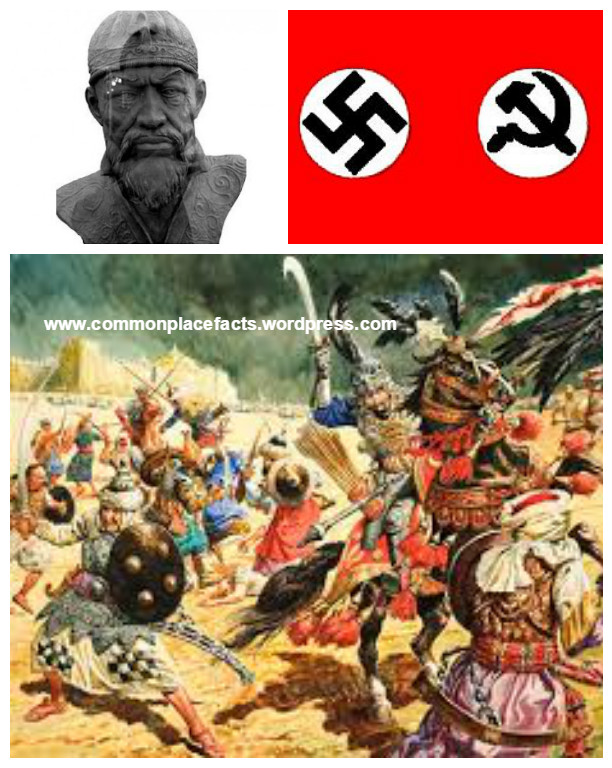

Beware the Warning of the Tamerlane Curse
In something that sounds very much like the plot of an Indiana Jones movie, a curse may have been released by the opening of an ancient tomb.
Tamerlane (also known as Timur) was a 14th century descendant of Genghis Khan. By the time of his death, he extended his empire from southeastern Turkey into Russia, encompassing Iran, Iraq, Kuwait, Syria, Afghanistan, Kazakhstan, Turkmenistan, Kyrgyzstan, Uzbekistan, Pakistan, and India. More than 17 million lives were lost as he extended the borders and scope of his power. He died in 1405 at the age of 68 while unsuccessfully trying to conquer China.
Tamerlane was entombed in Gūr-e Amīr, a mausoleum at Samarkand, Uzbekistan. The tomb was sealed with warnings, which read, “When I rise from the dead, the world shall tremble,” and “Whoever opens my tomb will unleash an invader more terrible than I.”
Joseph Stalin gave the order to disregard the warnings and open the tomb. On June 20, 1941 Tamerlane’s tomb was exposed to the outside world for the first time in over 500 years. Tamerlane’s remains were sent to Moscow for study.
Two days later, Nazi Germany broke its peace treaty with the Soviet Union and invaded the USSR.
Stalin eventually ordered that Tamerlane be returned to his tomb with proper burial rights. This happened on December 20, 1942, after a year and a half of fighting and millions of Soviet deaths. Shortly after this happened, the Battle of Stalingrad — one of the bloodiest battles of all time — ended with the defeat of the Nazi forces.
You may also enjoy…

The William Shakespeare Curse: Creepy Blessings and a Missing Skull
The legend of the William Shakespeare Curse can be traced to William Shakespeare’s epitaph, inscribed with a warning against disturbing his grave. In characteristic dramatic flair, he states his intention to curse any grave robbers. Despite the potential theft of his skull in 2016, no dire consequences have been reported for the intruders. Visitors are…

Tamerlane and the Towers of Severed Heads
Tamerlane and Psychological Warfare If you are looking for someone who exemplified the art of subtlety, don’t spend a lot of time studying Tamerlane (1336-1405). He was also known by the name Timur the Lame, but don’t make the mistake of thinking the “Lame” meant that he was boring. The nickname was given to him…




Leave a Reply