
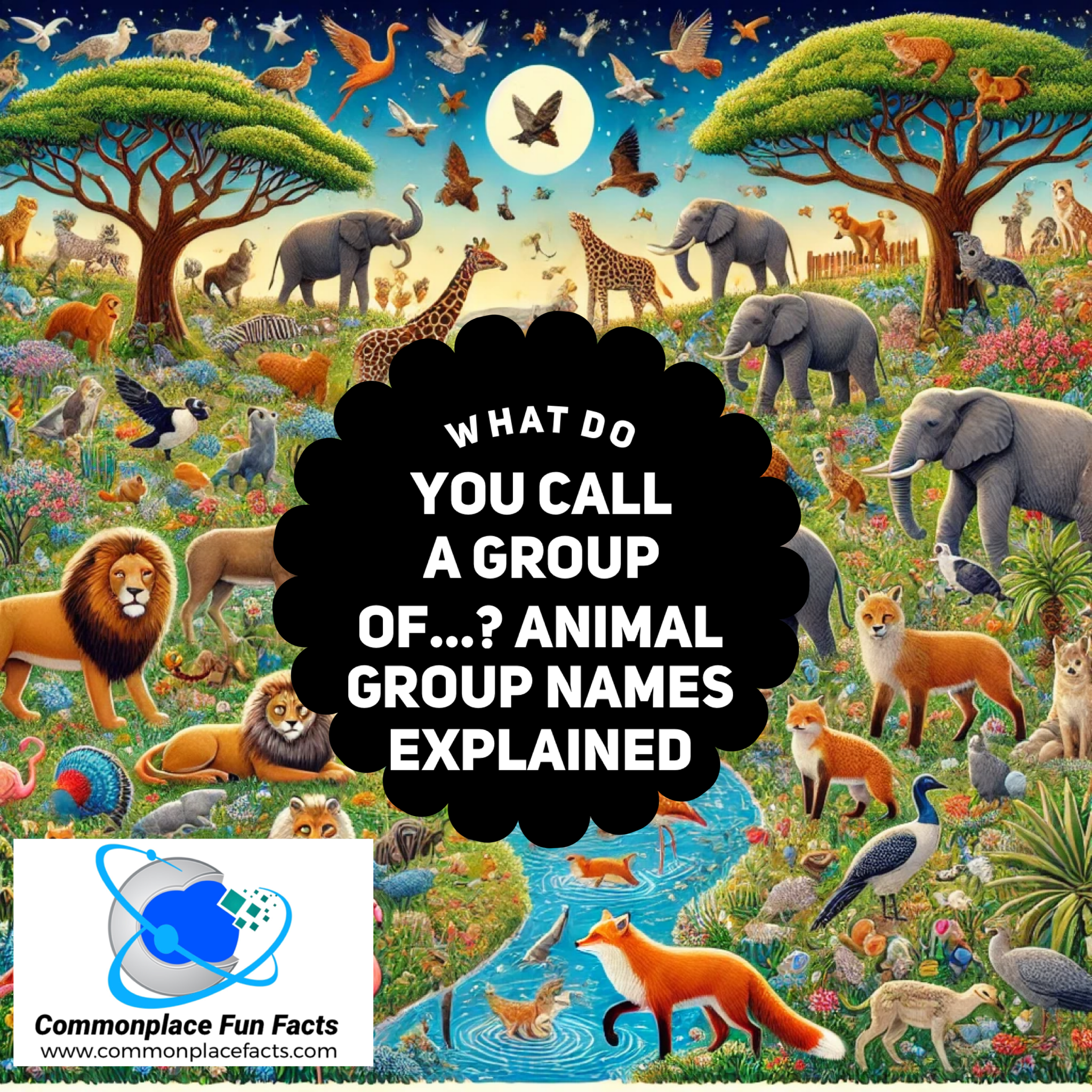

Everyone knows a group of cattle is known as a herd and a bunch of fish is called a school, but how well do you know the animal group names for other animals?
Contents
Before we get into the reasons for these curious sounding collective animal nouns, let’s test your knowledge with this Animal Group Names Quiz:
Animal Group Names Quiz
How well do you know your animal group names? What should you call a bunch of toads, crows, or peacocks? Try your animal knowledge here!

What Do You Call A Group Of….?
The animal kingdom consists of wonderfully quirky creatures, and English is a wonderfully quirky language. Instead of simply calling a group of animals a “group,” we assign each species a collective noun, often with baffling and poetic results. We could have settled for something practical, but no—why have a “bunch of crows” when you can have a murder? Why refer to owls as a “flock” when you can call them a parliament?
Take, for example, one particularly elegant example: a muster of peacocks.
Why a “Muster” of Peacocks?

To “muster” means to assemble or gather, often for display or inspection. It’s a fitting term for peacocks, given their tendency to strut about like they’re on an imperial catwalk. The word comes from the Old French moustrer, meaning “to show”—which is exactly what these birds do best.
In fact, peacocks have a backup collective noun: an ostentation. That’s right—if a muster of peacocks doesn’t sound fancy enough, you can always refer to them as an ostentation. Given their flair for dramatic feather displays, both names seem entirely appropriate.
Is Cow Tipping for real? Separate the myth from reality in this insightful article.
A Menagerie of Curious Animal Collective Nouns
It isn’t just the peacocks that have earned a stylish name; it has done the same for plenty of other animals. Here are a few of our favorites:
- Alligators – A congregation: Because nothing says “welcoming house of worship” like a gathering of cold-blooded, toothy reptiles.
- Ants – An army: Small but mighty, these tiny soldiers wage war on your kitchen counters with ruthless efficiency.
- Apes – A shrewdness: Admittedly, some of them give the appearance of shrewdness; maybe the others are just trying to trick us.
- Badgers – A cete: Because “grumpy little diggers” was apparently too on the nose.
- Bears – A sleuth or sloth: Either they’re world-class detectives or just really lazy—there is no in-between.
- Bees – A swarm: The appropriate level of panic for when they show up uninvited.
- Butterflies – A flight or kaleidoscope: Either floating gracefully through the air or dazzling you with a hypnotic explosion of colors.
- Camels – A caravan: Because when you spend your life trekking across deserts, you might as well travel in style.
- Cats – A clowder or pounce: Either a regal lounging party or an ambush waiting to happen.
- Cattle – A drove: Because herding them is like trying to manage a very slow, very large traffic jam.
- Cockroach – An intrusion: Honestly, that’s a horrifyingly accurate description.
- Crows – A murder: The most PR-damaging collective noun in the animal kingdom, yet oddly fitting.
- Deer – A herd: A polite, scenic way to cause unexpected damage to your car.
- Dolphins – A pod: The friendliest, most intelligent marine mammals—unless you’re a fish.
- Ducks – A raft: Because when they’re not flying in a V, they’re just bobbing along, chill as can be.
- Eagles – A convocation: A formal term, because these majestic birds demand respect—even when stealing your lunch.
- Elephants – A herd: The only group that can make a grand entrance just by showing up.
- Elk – A gang: Imagine the gang initiations!
- Falcons – A cast: Swift, deadly, and always ready to swoop in like a scene from an action movie.
- Ferrets – A business: Ferrets: serious about stealing your socks and burrowing into chaos.
- Fish – A school: Proof that peer pressure works, even underwater.
- Flamingos – A flamboyance: Because no one pulls off hot pink quite like these guys.
- Foxes – A skulk, leash, or earth: Because foxes always look like they just got caught sneaking into somewhere they shouldn’t be.
- Giraffes – A tower: Nature’s graceful skyscrapers, casually munching on treetops.
- Geese – A gaggle: Loud, opinionated, and always on the move—like a group of unruly tourists at the airport.
- Gorillas – A band: Drumming on their chests with more rhythm than most human musicians.
- Hamsters – A horde: Because once you have one, you’ll mysteriously have 47 in no time.
- Hippopotamuses – A bloat: Equal parts adorable and terrifying, and definitely not something you want charging at you.
- Horses – A team: Built for power, speed, and dramatic movie scenes where they gallop into the sunset.
- Hyenas – A cackle: The only group that sounds like they’re permanently mid-evil-laugh.
- Kittens – A kindle, litter, or intrigue: A fluffy conspiracy of adorableness.
- Larks – An exaltation: Because their cheerful singing deserves a standing ovation.
- Leopards – A leap: The fastest, sneakiest way to remind prey that life is short.
- Lions – A pride: Because “a massive gang of hungry, majestic hunters” was too long.
- Monkeys – A troop: The original troublemakers, swinging through trees and causing mischief.
- Otters – A romp: The most playful animal name on the most playful animal. Perfection.
- Owls – A parliament: Because if any bird looks like it’s debating policy, it’s the owl.
- Oysters – A bed: Because they spend their whole lives just lying there.
- Peacocks – A muster or ostentation: A fancy way to say “a group of attention-seekers in feathered tuxedos.”
- Penguins – A colony: Small, waddling diplomats in permanent tuxedo attire.
- Porcupines – A prickle: The sharpest name on this list.
- Ravens – An unkindness: As if Edgar Allan Poe hadn’t already made them spooky enough.
- Rhinoceroses – A crash: When your sheer mass and momentum define your group name.
- Salamanders – A congress: We can think of a few other animals that probably should qualify for this description.
- Sharks – A shiver: The exact feeling you get when you realize you’re swimming near one.
- Starlings – A murmuration: The most poetic name for their hypnotic, swirling flight patterns.
- Swine (Pigs) – A sounder: Because calling them a “mess” would be rude.
- Tigers – A streak: Just in case they weren’t already terrifying enough.
- Toads – A knot: Now try picturing a bunch of toads tied together. You’re welcome.
- Turkeys – A rafter: Because even flightless birds need a fancy name.
- Turtles – A bale: Slow-moving, wise-looking, and somehow part of farm equipment terminology.
- Vultures – A wake: Always circling, always waiting… probably not for anything good.
- Wolves – A pack: Whether hunting or howling, always a team effort.
- Zebras – A zeal: When black-and-white fashion meets boundless enthusiasm.
Use It or Lose It
While most of us will never have a reason to refer to a group of porcupines in casual conversation, these words exist for a reason. Why settle for boring when you can call a group of peacocks a muster or an ostentation?
So go ahead—next time you see a bunch of crows, impress your friends by referring to them as a murder. A word of warning: it’s probably not best to point and scream at the top of your lungs, “I’ve just witnessed a murder!” unless you plan on sharing your vast animal knowledge at the local police station.
You may also enjoy…

Meet the Strange, Silly, and Spectacular Potoo
Listen to this article on Spotify. Today’s venture into the category of “Nature is Really, Really Weird,” we bring you one of the funniest-looking, strangest-sounding, and expert-camouflaging creatures of the animal kingdom. Meet the potoo. Depending on whether it wants to be seen, you can’t help but notice this amazing bird. Its massive yellow eyes…

You Are Probably Hearing an Imposter When You Hear a Bald Eagle
In Hollywood musicals of the 1950s and 1960s, actresses like Deborah Kerr, Natalie Wood, and Audrey Hepburn had their singing voices dubbed by Marni Nixon. Similarly, the iconic cry of the bald eagle in films is actually the sound of the red-tailed hawk, not the bald eagle’s actual cry. It’s a tradition of substituting voices,…

Cube-Shaped Wombat Poop and Other Scientific Breakthroughs
We at Commonplace Fun Facts are big fans of the Ig Nobel Prize and its mission to “first make people laugh, then make them think.” The list of 2019 laureates touched on many different facets of human knowledge, including the geometric dimensions of wombat dung, the differences between living and dead magnetized critters, and proving…





Leave a Reply