

The Comedy of Errors of the Queen Victoria Coronation
Coronations are supposed to be the ultimate display of regal dignity—polished to perfection, choreographed down to the last trumpet blast, and steeped in centuries of tradition. In theory, they’re history’s answer to the Oscars, except the dress code is stricter and the afterparty involves a throne. But on June 28, 1838, Britain’s attempt to crown its brand-new monarch, nineteen-year-old Queen Victoria, played out less like a faultless state ceremony and more like an extended blooper reel in formal wear.
On paper, it was set to be a once-in-a-generation spectacle: a glittering procession through London, a majestic service in Westminster Abbey, and a reaffirmation of Britain’s thousand-year-old monarchy. In reality, it became a five-hour masterclass in what happens when you combine a complex medieval ritual with zero rehearsal, unclear instructions, and a roomful of people in heavy robes who can’t quite remember what comes next. There were misfired cues, wardrobe malfunctions, confused clergy, noble pratfalls, altar-side snacks, and even a souvenir-related stampede—all against a backdrop of diamonds, trumpets, and cheering crowds.
Yet, despite (or maybe because of) the chaos, the day was a resounding public relations win. It cemented Victoria’s image as a gracious, good-humored young queen and gave Britain a coronation so memorable it made the history books—not for its flawless execution, but for the glorious, very human mess that it was.
Join us as we take a look behind the scenes at the big event that was memorable for all of the wrong reasons.
Contents
Setting the Stage: Big Crowds, Bigger Expectations
By June 28, 1838, Britain’s new monarch was nineteen years old, barely five feet tall, and fresh from a sheltered upbringing under the suffocating “Kensington System.” It was her first major public appearance as queen, and she was about to be the centerpiece of the biggest show London had seen in centuries.
Prime Minister Lord Melbourne envisioned a lavish public spectacle to mark the occasion. Coronations had traditionally been private court business, but this would be different. London’s population swelled by an estimated 400,000 visitors—thanks largely to the new railway network—turning parks into tent cities. The £70,000 budget (about £5 million today) went mainly into the grand procession, the longest since Charles II’s return in 1660. The Gold State Coach rolled past cheering crowds and Yeomen of the Guard while bands played and spectators perched on every scrap of scaffolding. This part went beautifully—possibly because it was the only part that had a plan.
A Coronation Designed by People Who Didn’t Believe in Coronations
The planners were in unfamiliar territory. Victoria’s uncle, William IV, had loathed pomp and staged a stripped-down, £30,000 coronation in 1831 that ditched or shortened ancient rituals. When Victoria’s team tried to restore the grandeur, they didn’t quite know how the traditional bits fit together. The result was a patchwork of medieval pageantry and modern improvisation assembled by people who had, apparently, never read the instructions.
Rehearsals Are for Amateurs
No one was given clear guidance. Lords, bishops, and Abbey staff wandered through the day unsure what came next. Even Victoria wasn’t certain where to stand; she may have popped in the night before just to scope it out. Benjamin Disraeli summed it up neatly: “They were always in doubt as to what came next, and you saw the want of rehearsal.” That’s Victorian statesman-speak for, “This was chaos.”
Inside the Abbey: A Ceremony That Forgot Its Choreography

Sir George Hayter’s 1839 painting Coronation of Queen Victoria in Westminster Abbey shows the event in serene grace. Reality was a bit different.
Thousands of nobles, clergy, soldiers, and guests squeezed into the Abbey’s sweltering interior. The official service on paper was majestic; in practice, it was a sequence of unscripted surprises:
- The train wreck: Victoria’s pages had tiny trains of their own, which tangled with hers in a slapstick routine worthy of a silent film.
- The ring fiasco: The coronation ring, crafted for her little finger, was forced onto her ring finger by the Archbishop of Canterbury. It stayed there all day, and she needed an ice bath to pry it off afterward.
- Orb déjà vu: The Archbishop got confused and handed her the orb… twice. She accepted it both times with royal politeness, possibly wondering if this was some Anglican running joke.
- Bishops in disarray: The Bishop of Durham fumbled his cues, the Bishop of Bath and Wells skipped two pages, and at one point a bishop announced the ceremony was over—sending Victoria toward St Edward’s Chapel. Once the mistake was realized, she was hastily summoned back to complete the important part of the ceremony that was on those skipped pages.
- Costume confusion: Wardrobe changes were mistimed, forcing the queen to switch back into ceremonial gear midstream.
Picnics at the Altar and Noble Tumbles

St Edward’s Chapel, resting place of a saint, doubled as a catering station. Sandwiches, bottles of wine, and assorted refreshments were laid out on the altar for the clergy. Victoria, trapped there for nearly an hour while staff sorted out the departure procession, struggled to remove the too-tight ring.
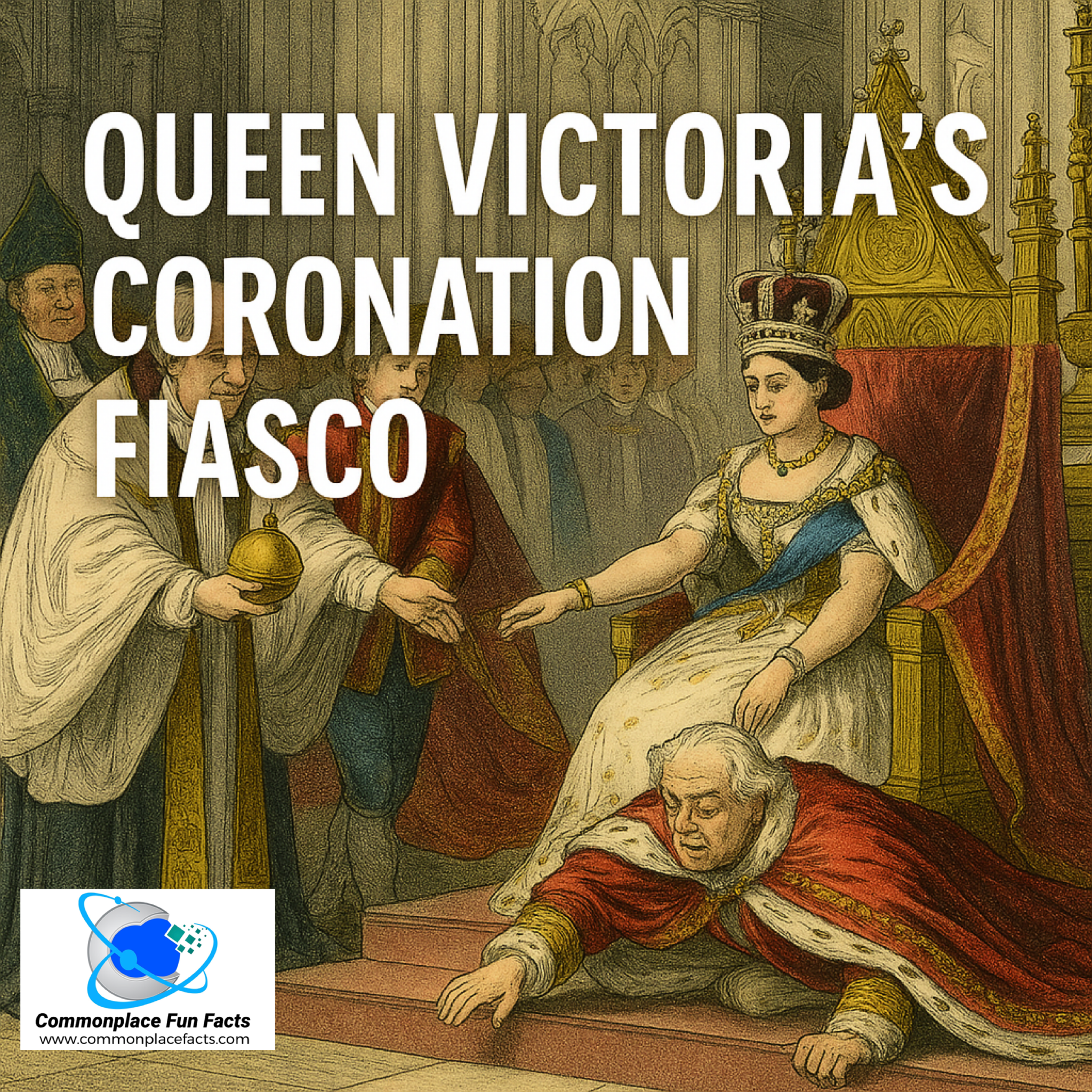
Then came the most famous pratfall of the day. Lord Rolle, aged somewhere between 82 and 88, attempted to climb the steps to do homage, tripped on his robes, and rolled back down in slow motion. Rather than wait for him to risk a sequel, Victoria stepped down to meet him halfway—a spontaneous act of kindness that won her instant public affection. Diarist Charles Greville called it “a remarkable union of naïveté, kindness, and propriety.” Humorist Richard Harris Barham immortalized it in verse:
Then the trumpets braying, and the organ playing,
And the sweet trombones, with their silver tones;
But Lord Rolle was rolling; — ’twas mighty consoling
To think his Lordship did not break his bones!
If the Music Doesn’t Kill You, the Stampede Might
The music program was no triumph. Conductor Sir George Smart tried to direct an orchestra of 80, a choir of 157, and play the organ at the same time. Franz Cramer, the Master of the Queen’s Music, contributed nothing new, so the setlist leaned heavily on old Handel works. Critics noticed the lack of originality.
And in a final bit of questionable event management, the Treasurer of the Household tossed commemorative silver medals into the crowd, triggering a souvenir stampede and a few injuries. Because nothing says “God save the Queen” quite like dodging flying metal discs.
Heavy Is the Head That Wears the Crown

St. Edward’s Crown has traditionally been used for coronations, and it was available, having been repaired after Colonel Blood squashed it during the only successful heist of the Crown Jewels. At 4.9 pounds (2.23 kg), however, it was far too heavy for the neck of the tiny queen.
Instead, the monarch opted to design a lighter crown. The Imperial State Crown made for Victoria’s coronation was dazzling—over a thousand diamonds, plus pearls, sapphires, emeralds, and the Black Prince’s Ruby. It was half the weight of St. Edward’s Crown—but still heavy enough to double as gym equipment. By the time the ceremony was over, Victoria’s neck felt as if it needed to be supported by a whiplash collar.
Learning from the experience, she commissioned a smaller, lighter crown, deciding that neck strain was not a regal look. It would not be ready until 1870, however.
Missing Traditions and New Drama
The medieval tradition of the Queen’s Champion riding into the coronation banquet to challenge doubters was quietly retired; instead, the champion got a baronetcy and a seat in the stands. The traditional coronation banquet was scrapped entirely—more budget for the parade, less for roast peacock.
Aftermath: A Royal Mess Worth Remembering
The whole affair lasted five hours, included ceremonial confusion, altar-side snacking, a noble tumble, and a souvenir-related stampede. And yet, for all its chaos, it was a public relations triumph. Victoria was thrilled, writing of the “enthusiasm, affection, & loyalty” of the crowds. The spectacle marked the beginning of a 63-year reign that would reshape Britain and give her name to an era. Future coronations would learn from the mess—Edward VII’s in 1902 went far more smoothly, apart from the small matter of his emergency appendectomy. But that’s another story.
You may also enjoy…

Understanding the Different Types of Queens
When it comes to queens, there are all sorts. There are bees, playing cards, rock-and-roll bands, and men who wear women’s clothing. And, of course, there is “The Queen,” the one person who can legitimately respond to any lame joke by saying, “We are not amused.” Even in talking about the job title of queen,…

Buckingham Palace: Where Even the 78 Bathrooms Probably Have Crown Molding
Take a royal tour of Buckingham Palace—775 rooms, a swimming pool, its own post office, and enough drama to rival any Netflix series. Get the full story behind the monarch’s London home in this witty deep-dive.

A King So Nice They Crowned Him Twice
Robert the Bruce (1274 – 1329) was crowned King of Scots on March 25, 1306, by Bishop William de Lamberton at Scone, near Perth, Scotland. By tradition, the Earl of Fife had the role of placing the monarch on the Stone of Destiny, the ancient stone upon which the Scottish kings have been crowned. Duncan,…


Leave a Reply to Herald StaffCancel reply