
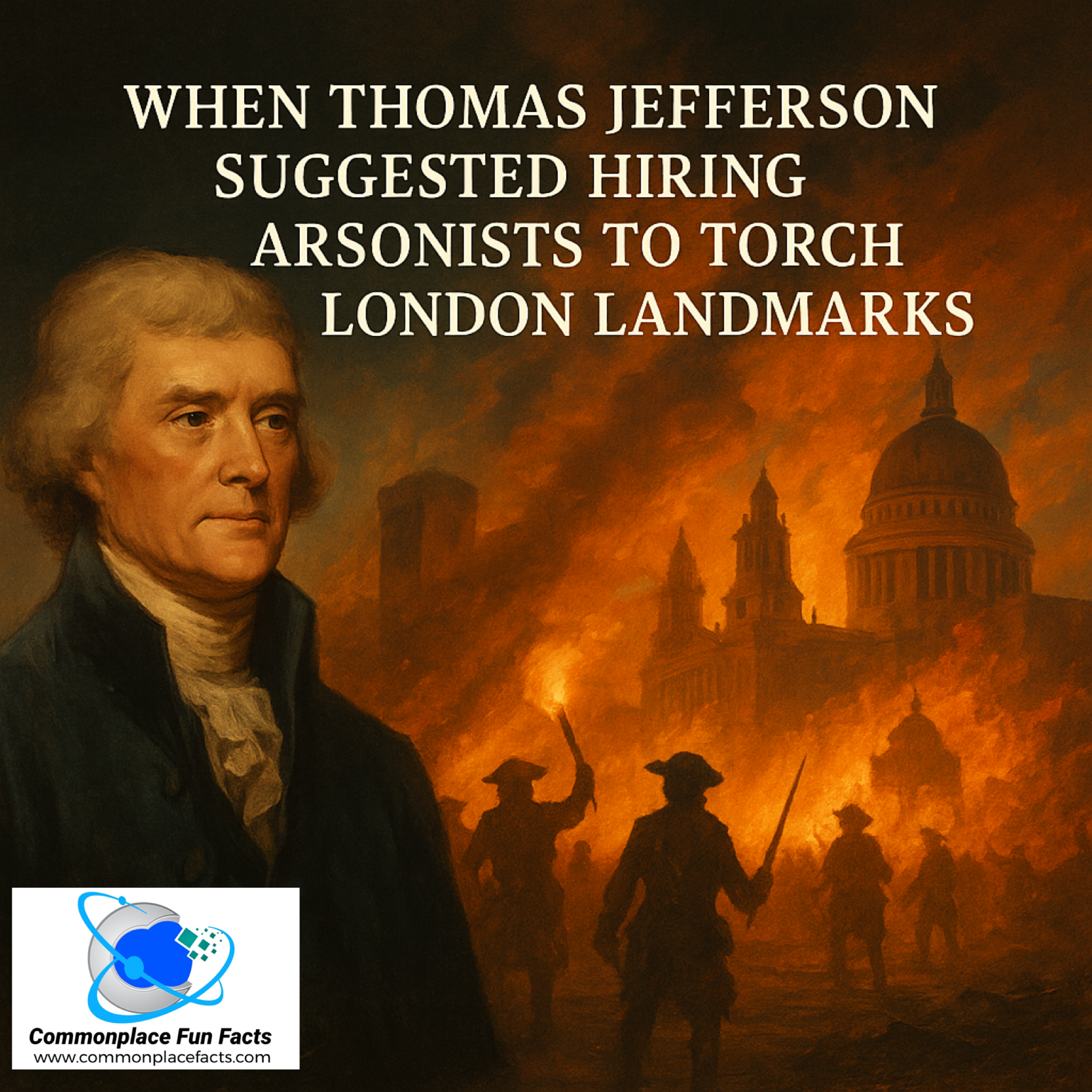

Thomas Jefferson is remembered for many things—authoring the Declaration of Independence, founding the University of Virginia, and designing Monticello, to name a few. But “Mastermind of an International Arson Plot” isn’t usually on the résumé. Yet, in the smoke-choked aftermath of 1814’s British torching of Washington, Jefferson sat down and penned a private letter that casually entertained the idea of paying London’s poor to set fire to some of Britain’s most prized landmarks—yes, including St. Paul’s Cathedral. It was part moral thought experiment, part revenge fantasy, and entirely the sort of historical gem that makes you blink twice and say, “Wait… he suggested what?”
Contents
The Context: Washington in Flames
August 24, 1814, was not a great day to be an American city. British forces marched into Washington, D.C., and torched the Capitol, the President’s House, and other government buildings. The Library of Congress? Gone. Records and artifacts? Toast—literally. This was payback for an earlier U.S. raid on York (now Toronto), and it was designed to send a message. Jefferson, by this time retired at Monticello, was watching events unfold with the mix of indignation and “hold my quill” energy that often accompanies historical grudges.
A Letter to Thomas Cooper

On September 10, 1814, Jefferson wrote to Thomas Cooper, an English-born political philosopher and academic who had settled in the United States. Cooper was one of Jefferson’s trusted correspondents, the kind of person to whom you could confide, “You know what would be fun? Hiring some poor Londoners to set fire to St. Paul’s.” Jefferson’s actual words were a bit more refined, but the sentiment was clear: instead of pouring millions into a navy, why not use “hired incendiaries” to burn down iconic British landmarks? He even specified targets: the Tower of London and St. Paul’s Cathedral.
The letter (you can read it in full here) offered the following insights:
Some of our public buildings have been burnt, and some scores of individuals on the tidewaters have lost their moveable property and their houses. I pity them and execrate the barbarians who delight in unavailing mischief. But these individuals have their lands and their hands left. They are not paupers. They have still better means of subsistence than 24/25 of the people of England.
Again, the English have burnt our Capitol and President’s House by means of their force. We can burn their St. James’s and St. Paul’s by means of our money, offered to their own incendiaries, of whom there are thousands in London who would do it rather than starve. But it is against the laws of civilized warfare to employ secret incendiaries. Is it not equally so to destroy the works of art by armed incendiaries? Bonaparte, possessed at times of almost every capital of Europe, with all his despotism and power, injured no monument of art.
If a nation, breaking through all the restraints of civilized character, uses its means of destruction (power, for example) without distinction of objects, may we not use our means (our money and their pauperism) to retaliate their barbarous ravages? Are we obliged to use, for resistance, exactly the weapons chosen by them for aggression? When they destroyed Copenhagen by superior force, against all the laws of God and man, would it have been unjustifiable for the Danes to have destroyed their ships by torpedoes? Clearly not. And they and we should now be justifiable in the conflagration of St. James’s and St. Paul’s. And if we do not carry it into execution, it is because we think it more moral and more honorable to set a good example than follow a bad one.
The Moral Gymnastics of Thomas Jefferson
Now, to be fair, Jefferson didn’t just gleefully propose turning London into a barbecue. He framed the suggestion as a moral thought experiment, contrasting it with the accepted practice of bombarding cities during war. He asked whether covert destruction by hired hands was really more barbaric than the “civilized” method of rolling in with troops and cannons. He even cited historical examples—like the Danish response to the British bombardment of Copenhagen—and noted that Napoleon, for all his faults, had refrained from attacking cultural monuments. It’s a little like saying, “I’m not saying we should steal their lunch money, but isn’t it worse to just punch them in the cafeteria?”
How Far Did the Plan Go?
Yes, Jefferson really did write this. Yes, he really named St. Paul’s Cathedral. And no, there’s no evidence that he opened a secret account labeled “London Fire Fund.” The letter remained private, and historians generally treat it as rhetorical hyperbole—albeit hyperbole laced with some genuine frustration.
Jefferson’s letter is a fascinating glimpse into the raw emotions of the War of 1812. It shows how even the most enlightened minds can drift toward drastic, even destructive, fantasies when national pride is singed—literally. It also offers an unexpected insight into the ethical debates of the time: what is “civilized” warfare, and is indirect destruction really less savage than direct assault? In an age before drone strikes, Jefferson’s “hired incendiary” idea was essentially a prototype for covert operations with plausible deniability.
The Non-Inferno Ending
In the end, London never saw flames courtesy of Jefferson’s secret agents. St. Paul’s Cathedral stands to this day, its dome un-singed by any American plot. The letter lived quietly in archives until later published in collections like The Founders Online collection of the National Archives. It’s now a historical footnote—a quirky, eyebrow-raising example of how even America’s Founding Fathers occasionally indulged in a little armchair arson planning.
Closing with a Spark
So, was Jefferson a philosopher-statesman or a would-be pyromaniac? Maybe a bit of both—though only on paper. The next time someone tells you Jefferson was all about enlightenment ideals, you can lean in and say, “Sure, but did you know he once suggested hiring arsonists to burn London’s biggest church?” Then sit back and enjoy their face as they try to process the image of Mr. Monticello with a box of matches.
You may also enjoy…

Thomas Jefferson’s Nephews, a Grisly Murder, and the Earthquake That Wouldn’t Let Them Get Away With It
Uncover the chilling true story of Thomas Jefferson’s nephews, Lilburn and Isham Lewis, who murdered an enslaved boy during the catastrophic New Madrid earthquakes of 1811–1812. A haunting tale of crime, chaos, and historical fallout.

When the British Burned the White House and Nature Fought Back: The War of 1812’s Weirdest Day
Discover the fiery tale of the day the British burned the White House, Dolley Madison’s heroism, British mockery, a mythic tornado, and the truth behind the White House name. A wild chapter in U.S. history!

Fire Destroys Fire Hydrant Patent
Learn about the ironic twist of fate that resulted in the fire hydrant patent going up in smoke.




Leave a Reply