
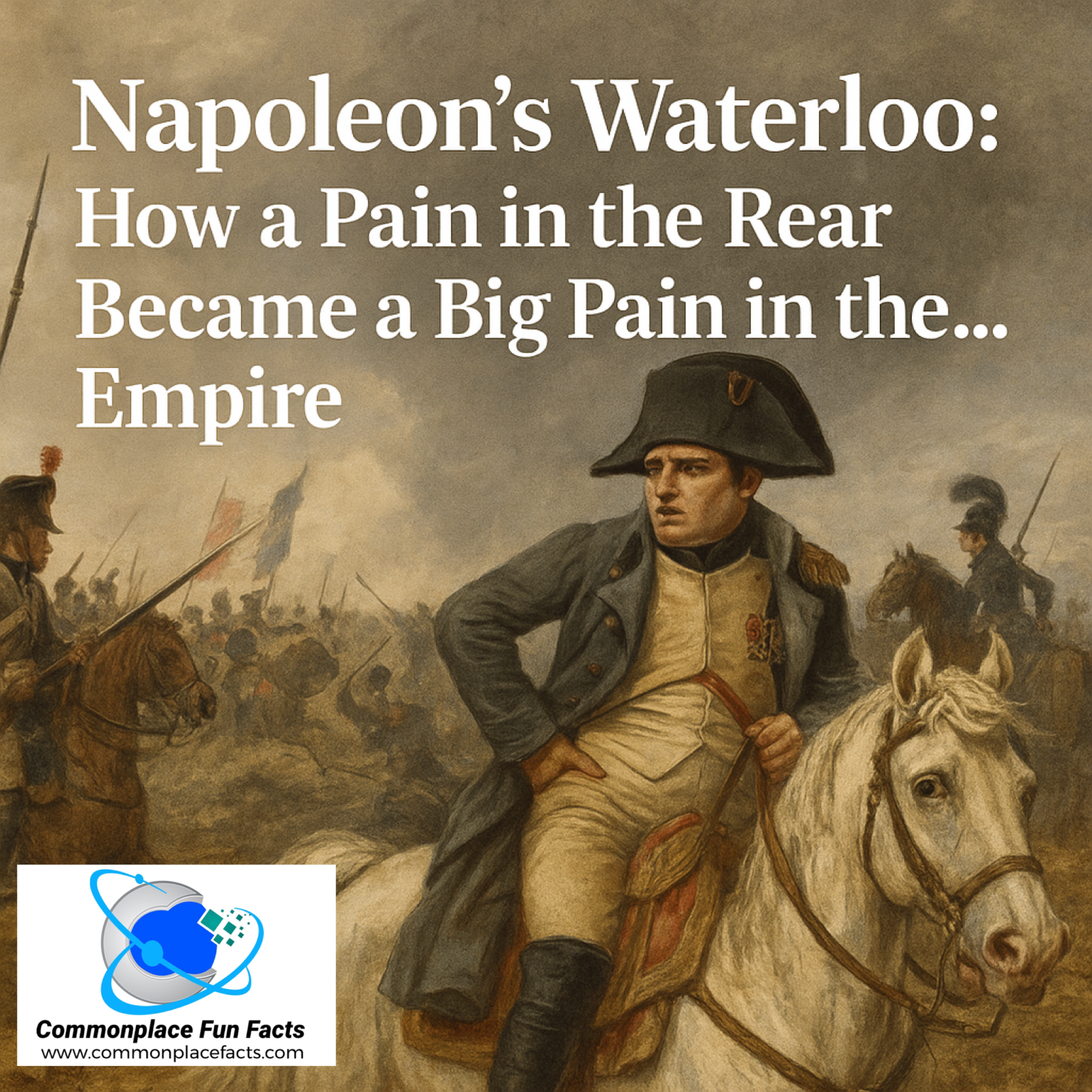

Sometimes the fate of nations hangs on brilliant maneuvers and the clash of empires. Other times, it may depend on whether one man can sit comfortably in a saddle. At Waterloo, mud and Prussians were inevitable—but add in a rumored flare-up of Napoleon’s hemorrhoids, and suddenly we have to ask: did the destiny of Europe really turn on a pain in the rear?
Contents
A Quick Reminder: What Was at Stake
In the spring of 1815, Napoleon Bonaparte returned from exile like the headliner of a surprise reunion tour, reclaimed France in the Hundred Days, and marched north to break the coalition forming against him. His plan was crisp. He would smash the Allies in Belgium before they properly fused: defeat the Prussians under Blücher, then wheel on Wellington’s Anglo-Allied army. A familiar recipe for a man who built a career by getting there first with the most.
He struck the Prussians at Ligny on June 16 and won a tactical victory, then sent Marshal Grouchy (whose name sounds like a central character in Sesame Street: The War Years) to pursue them. He turned toward Wellington, who took up a defensive position along the ridge of Mont-Saint-Jean near a village called Waterloo. The stage was set for June 18, a Sunday, a slugfest, and the last act of the Napoleonic era.
The Hemorrhoid Hypothesis

Now for the part of the story that causes historians to squirm almost as much as the Emperor allegedly did. A long-standing claim holds that Napoleon suffered an acute flare-up of hemorrhoids on the morning of the battle. The story continues with a greatest-hits medley of period medicine: leeches gone missing, laudanum administered in liberal quantity, and a general whose usual habit of racing along the line to micromanage formations was curtailed by sheer physical misery.
By the way, if that kind of treatment sounds a wee bit barbaric, you should consider the one that was recommended by the Father of Medicine. Read “Hippocrates’ Horrifying Method For Dealing With Hemorrhoids” for that remedy that is garanteed to cause your sphincter to involuntarily clench.
Did he suffer? Evidence suggests he had chronic health issues and may indeed have been in considerable discomfort on June 18. Did doctors misplace the leeches and tranquillize him into delay? That part belongs more to lore than to the reliable record. It survives because it is tidy, memorable, and mildly scandalous, which is exactly how odd details sink hooks into public memory.
Even if the Emperor’s seat was not at its best, the assertion that physical pain alone “lost” the day oversimplifies a complex fight. This battle was a many-cause problem. Still, the image of a restless, hyperactive commander suddenly tethered to a saddle with a grimace has narrative power. File this under “may have mattered” rather than “case closed.”
Why the Battle Started Late
One reason for Napoleon’s late start is not controversial: weather. A ferocious downpour on the night of June 17 turned the fields into porridge. Artillery was the Emperor’s calling card, and cannon are best introduced to a party on a firm floor. Firing on saturated ground loses bounce and penetration, limbers bog, and ammunition trains crawl.
The opening bombardment did not commence at dawn. The first large-scale infantry attacks went in closer to midday. That pause is compatible with a practical decision to wait for drier ground. It is also compatible with a commander taking stock of a layered defensive position that would stubbornly absorb heavy blows all day.
What Napoleon Could Usually Do—And What He Could Do That Day
Napoleon’s command style was as kinetic as a cavalry charge. He habitually rode the line to see ground with his own eyes, nudged brigades like chess pieces, and unleashed artillery concentrations where the enemy looked most brittle. Mobility served him well from Italy to Austerlitz.
At Waterloo he reportedly spent more time than usual away from the extreme forward edge. Whether that was discomfort, prudence, or the simple reality of a sprawling battlefield is debated. Even a short reduction in mobility could matter for a leader whose edge was timing. A general can send orders by staff, yet there is a reason great captains preferred to see, then strike. A ridge like Wellington’s hid a great deal. What you could not see could punish you.
The Other Pieces of the Puzzle: Ridge, Farm, Marshals, Prussians
The Ridge That Refused to Budge
Wellington selected his ground like a man picking the right table in a crowded restaurant. The reverse slope of the Mont-Saint-Jean ridge concealed troops, shielded them from artillery, and forced French attacks to crest into concentrated musketry. Strongpoints such as Hougoumont and La Haye Sainte anchored the line and absorbed hammer blows that would have broken a less carefully arranged position.
Mud and Metal
Even after the skies cleared, the field sucked at boots and hooves. Batteries labored to deploy. French infantry advanced under fire up a churned incline, often without the synchronized support that turned Napoleon’s earlier set-piece attacks into decisive thrusts.
Ney’s Cavalry Roulette
Marshal Ney, courageous to a fault, launched massed cavalry charges without adequate infantry or artillery support. They looked spectacular. They achieved little besides shattered squadrons and blown horses. British infantry in square, steady and stingy with panic, refused to break. French troopers galloped around them like waves around a rock.
The Prussian Clock
Blücher’s Prussians, battered at Ligny yet unbroken, marched toward the guns. They began to arrive on Napoleon’s right flank in the late afternoon. Pressure mounted steadily. The French guard’s last assaults were not merely frontal; they were contested while a second enemy grew stronger by the hour. A battle that might have been decided in the middle became a race against time, and time wore a spiky black pickelhaube.
The 1814 Suicide Attempt: The Night the Curtain Almost Fell Early
There might actually never have been the need for the Battle of Waterloo at all. Napoleon had already tried to write his own dramatic exit a year earlier. In April 1814, after the French forces collapsed, Paris fell, and four major powers (Britain, Russia, Prussia, and Austria) marched in to collect their trophy, the once-invincible Emperor decided he was finished. On the night of April 12, in his palace at Fontainebleau, he reached for a vial of poison he had carried like a macabre good-luck charm ever since his disastrous retreat from Moscow.
One can almost imagine him rehearsing a suitably grand set of last words—something about honor, destiny, and the fickleness of fortune. Instead, what followed was less Shakespearean tragedy and more slapstick comedy. The poison had long since lost its potency. Instead of providing a swift and dramatic death, it gave Napoleon a violent bout of nausea. Some accounts even throw in hiccups for comic effect, which makes for a mental picture of the great general keeling over not with a solemn sigh, but with an undignified “hic!” before vomiting the whole dose back up.
The result: no glorious death scene, no curtain call, just the Emperor staggering back into bed with the ignominious realization that he couldn’t even manage to kill himself properly. For a man who had reshaped Europe, this was a humbling reminder that chemistry does not always cooperate with destiny.
The irony is thick enough to spread on toast. Had the poison worked, there would have been no Hundred Days, no return from Elba, and no Waterloo. Wellington might have retired with his greatest claim to fame being the dish named after him. Europe might have reorganized itself without that one last, mud-spattered, blood-soaked day that defined an era. Instead, thanks to a stale vial of Moscow-era poison, Napoleon vomited his way into a second act.
So… Did Hemorrhoids Lose Waterloo?
Short answer: no. More nuanced answer: they may have made a difficult job harder for a commander whose comparative advantage was agility and timing. The chief reasons for the French defeat live elsewhere—terrain chosen with care, stubborn Allied defense, operational missteps, and the Prussians arriving like a plot twist.
Still, the hypothesis clings because it feels true in the way life feels true. Grand designs are often foiled by small, human things. A general’s body is not separate from the battle. Pain distracts. Mobility matters. Even legends have circulatory systems that occasionally remind them who is in charge.
Waterloo is rich with “what-ifs.” If the ground had dried sooner, if Hougoumont had fallen, if Ney had coordinated better, if Grouchy had cut the Prussians off, if the Imperial Guard had cracked the center—each path leads to a different Europe. The hemorrhoid angle fits snugly into this gallery of contingencies because it is vivid. It has a protagonist, a villain, and an image you cannot unsee. It is also a humbling reminder that history is written with ink and sweat and, occasionally, ointment.
Napoleonic Grab-Bag: Facts, Myths, and Dinner-Party Trivia
- Height: he was not exceptionally short for his time. Confusion over French inches and British propaganda did a number on his reputation. Read “Think Napoleon was Short? Think Again” for the details.
- Stomach troubles: he suffered chronic gastric issues. His autopsy cited stomach cancer; later hair analyses sparked arsenic-poisoning debates and wallpaper theories, which make for lively arguments but no unanimous verdict.
- Diet and habits: he ate quickly, favored simple fare, and kept odd hours. He could fall asleep anywhere, which is a skill every modern traveler envies.
- He was just barely French: If Napoleon had been born just three months earlier, he wouldn’t have been born in France. See “Napoleon Was French — Just Barely” for the explanation.
Conclusion: The Day the Empire Winced
Napoleon did not lose Waterloo solely because of personal discomfort. He lost because Wellington’s ridge held, because Ney’s cavalry exhausted itself, because artillery struggled in mud, and because Blücher’s dark mass arrived on the right. Even so, it is entirely plausible that physical pain trimmed the sharpest edges off the Emperor’s style. A commander built for speed met a day built for friction.
No grand narrative should hang on one inflamed nerve. Yet it is fair to concede this much: when the history of Europe pivoted on a Belgian hillside, the fate of nations and the complaints of one very sore general briefly shared a saddle. Empires fall for many reasons. Occasionally they also wince.
Regardless of whether it was hemorrhoids or other factors, it’s safe to say that after Waterloo, Napoleon’s biggest problems were behind him.
A shout out to Phil Mason, whose book, Napoleon’s Hemorrhoids and Other Small Events That Changed History, inspired this article. The book has some great stories, but we feel compelled to point out that you need to take many of them with a grain of salt. Even so, it’s a very entertaining read, and we recommend it.
You may also enjoy…

When Rabbits Take On the World’s Most Powerful Men
In Monty Python and the Holy Grail, the Killer Rabbit of Caerbannog is humorous, yet historically, both Napoleon and Jimmy Carter faced surprising rabbit attacks. Napoleon’s 1807 hunt turned chaotic as rabbits attacked him, while Carter encountered an aggressive rabbit while fishing in 1979, leading to humorous reflections on leadership and vulnerability.

The Napoleonic Influence on American Law Enforcement
As Napoleon Bonaparte caused war to spread throughout Europe and his growing empire threatened to destroy long-established national borders, some in the United States feared that even the Atlantic Ocean would not be able to stop him. With significant French holdings to the west of the fledgling USA, it didn’t take much of an imagination…

Hippocrates’ Horrifying Method For Dealing With Hemorrhoids
Hippocrates is considered to be the father of modern medicine. Even so, you may find his treatment of hemorrhoids particularly troubling.





Leave a Reply