
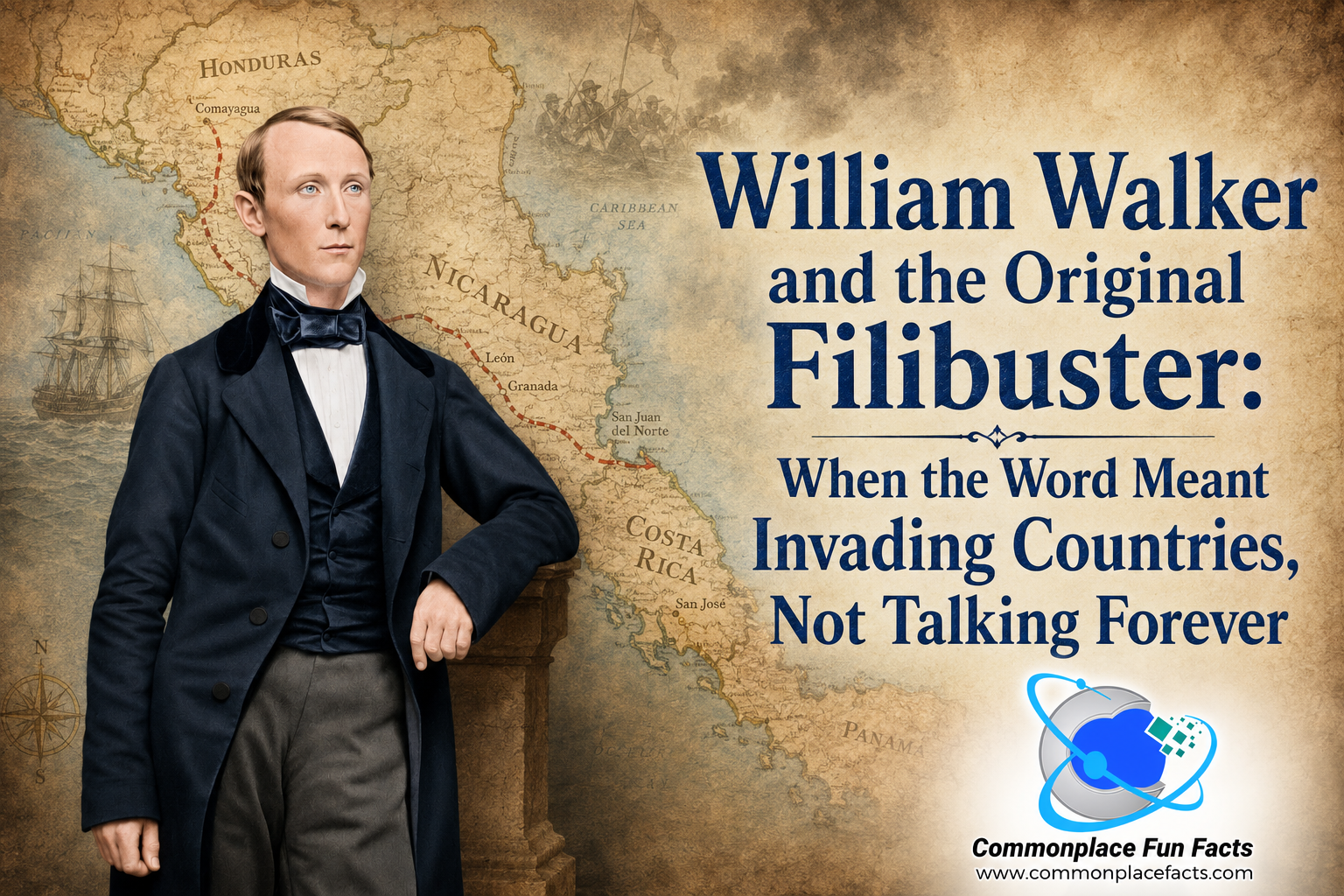

Today, when we hear the word filibuster, we usually picture the United States Senate, where a determined legislator can prevent action by talking, delaying, objecting, maneuvering, and generally treating the legislative calendar like a hotel breakfast buffet: something to be lingered over long past the point where everyone else has lost interest.
In modern American politics, a filibuster is a procedural weapon. It is a way for a minority to block or delay a vote. Depending on your political preferences and who currently controls the Senate, it is either a noble safeguard against majority tyranny or a democratic sinkhole with mahogany paneling.
But that is not what the word originally meant.
Before a filibuster was a senator talking until everyone else lost the will to stay awake, a filibuster was a private military adventurer. More specifically, it referred to men who launched unauthorized military expeditions into foreign countries, especially in Latin America and the Caribbean. These were not soldiers carrying out official national policy. They were freelance empire-builders, armed dreamers, opportunists, and heavily armed nuisances who looked at sovereign nations and thought, “You know what this place needs? Me.”
The most famous of these men was William Walker.
Walker was a doctor, lawyer, journalist, adventurer, self-declared liberator, actual president of Nicaragua, and eventual cautionary tale with a firing squad. He was the kind of man who saw international law not as a binding framework for relations among nations but more as a set of suggestions.
His story explains not only the original meaning of filibuster, but also how the word traveled from pirates and private armies to congressional procedure. The weapons changed. The basic idea did not.
A filibuster, then and now, is someone who hijacks the normal process and refuses to let everyone else proceed.
Contents
Before the Senate Got Involved, “Filibuster” Meant Pirate
The word filibuster comes from older words meaning “freebooter” or “pirate.” The Dutch had vrijbuiter, referring to someone who seized booty for himself. The Spanish had filibustero, a term used for pirates, especially those operating in the Caribbean.

Eventually, English borrowed the word, because English is less a structured language than a raccoon rummaging through other languages’ garbage cans and coming away with something shiny.
By the 1840s and 1850s, Americans were using filibuster to describe private military adventurers who tried to seize or influence territory in Latin America. These men were not officially representing the United States, although many of them very much wanted the United States to benefit from their adventures after the fact. Their expeditions were often linked to Manifest Destiny, commercial ambition, racial ideology, and, in some cases, the desire to expand slavery.
In other words, a filibuster was not just someone with a gun and a bad map. He was part of a broader culture of expansion, entitlement, and opportunism that flourished in the decades before the Civil War.
The United States had recently acquired enormous western territories. California had become a state. The Mexican-American War had rearranged the map. Expansionists looked south toward Mexico, Cuba, Nicaragua, and the Caribbean and saw not independent nations with their own governments, cultures, and laws, but potential additions to the American sphere.
This was Manifest Destiny with fewer congressional hearings and more muskets.
William Walker: The Gray-Eyed Man of Destiny, Which Should Have Been a Warning Label
William Walker was born in Nashville, Tennessee, on May 8, 1824. He was brilliant, educated, and apparently immune to the ordinary human instinct that says, “Perhaps I should not invade a foreign country today.”

Walker studied medicine. Then he studied law. Then he worked as a journalist. This was already an impressive résumé, and possibly a cautionary tale about a man whose career aspirations seemed tied to moving through professions that would, in later generations, take turns being loathed by the public. Had he lived a century later, he no doubt would have continued the progression as a used-car salesman, then a telemarketer, before finally becoming the sort of landlord whose tenants begin every sentence with, “Technically, the lease says…”
For Walker, the next step after journalism was pirate/world conqueror.
Physically, he seemed ill-suited to the role of fearsome invader of nations. He was small, often described as slight and unimposing, with pale skin and striking gray eyes. His admirers called him the “Gray-Eyed Man of Destiny,” which sounds romantic until one remembers that history is full of men called “of Destiny” who would have benefited from having an intimidating mother unafraid to whack them with her handbag before they got ideas involving borders, rifles, and self-appointed presidencies.
Walker eventually made his way to California, where the political atmosphere was thick with expansionist dreams. The Gold Rush had filled the region with fortune-seekers, adventurers, speculators, and people whose life plans could be summarized as “surely this will work out somehow.”
For Walker, California was not the destination. It was the launching pad.
The Republic of Lower California: Nation-Building for People Who Skipped the Permission Step
Walker’s first major filibustering expedition targeted Mexico.
In 1853, he led a small band of men into Baja California and declared the creation of the Republic of Lower California. This was bold and decisive.
It was also illegal under even the most generous interpretation of international law.
Mexico, having not misplaced Baja California in the diplomatic couch cushions, objected.
Walker appointed himself president of his new republic, because when you create a fake country by armed expedition, it is important to establish a clear chain of command before everyone runs out of food. He later expanded his imaginary jurisdiction to include Sonora, creating what he called the Republic of Sonora.
The whole thing had the political and emotional stability of a 19th-century group project run by a man who had read too much Napoleon and not enough logistics.
Walker hoped to attract American settlers and supporters. He imagined a new American-aligned state in northern Mexico, perhaps one that could eventually be annexed by the United States. Unfortunately, empires require more than dreams. They also demand supplies, manpower, diplomacy, and some minimal connection to reality. Walker’s expedition was short on all four.
The campaign collapsed. His men suffered from hunger, desertion, and Mexican resistance. Walker retreated back into the United States, where he was put on trial for violating American neutrality laws.
He was acquitted.
If you are wondering how a man could invade Mexico, proclaim a republic, appoint himself president, and then walk away from a neutrality trial as though he had merely parked badly, welcome to the 1850s. Please keep your hands and feet inside the moral catastrophe at all times.
Far from ruining Walker, the failed Mexican adventure made him famous. To many Americans, especially expansionists, he was a daring adventurer. To others, he was a lawless pirate in a frock coat. Both groups had a point, though only one of them seemed adequately concerned.
Nicaragua: Where the Filibuster Became President
Walker’s next and most famous adventure began in Nicaragua.
In the 1850s, Nicaragua was divided by civil conflict between rival political factions. One faction invited Walker to help in the fighting. This gave him an opening, and Walker was not a man known for glancing at openings and saying, “No, thank you, that seems irresponsible.”

He arrived in Nicaragua in 1855 with a small group of armed men. They were sometimes called “The Immortals,” which is a splendidly dramatic name for a group of men operating in tropical warfare, disease, political instability, and supply shortages. Fate hears names like that and begins sharpening its pencil.
Walker proved capable, ruthless, and politically clever. He did not simply help one side win. He gradually made himself the central figure in Nicaraguan politics. By 1856, he had become president of Nicaragua.
Yes, an American filibuster became the actual president of Nicaragua.
This is one of those historical facts that sounds like something a desperate student would write in a final exam after failing to crack the book on any of the required reading. Nevertheless, it happened.
Walker’s government was even recognized for a time by the administration of President Franklin Pierce. That recognition gave Walker a degree of legitimacy, though “legitimate” is doing a heroic amount of work in that sentence.
Walker now controlled a strategically important Central American country. He had international attention, American supporters, and dreams far larger than Nicaragua itself.
Naturally, this is when things got worse.
Why Nicaragua Mattered: The Transit Route Before the Panama Canal
To understand why Walker cared so much about Nicaragua, we need to remember that the Panama Canal did not yet exist.

In the 1850s, getting from the eastern United States to California was difficult, expensive, and sometimes miserable enough to make people reconsider the entire concept of westward mobility. One important route crossed Nicaragua, using a combination of river, lake, and overland travel to connect the Atlantic and Pacific sides of Central America.
That made Nicaragua enormously important.
Control the transit route, and you controlled one of the great commercial shortcuts of the age. This was especially valuable during the California Gold Rush, when people were desperate to reach the Pacific without spending half their natural lives bouncing around Cape Horn.
American business interests were deeply involved in Nicaraguan transit. Cornelius Vanderbilt, the great transportation magnate, had interests in the route. Walker eventually interfered with those interests, which turned out to be one of his less brilliant decisions.
There are many people one should avoid angering while trying to hold a foreign country. Cornelius Vanderbilt is high on the list, somewhere between “the neighboring armies” and “the British Empire.”
Walker’s regime was therefore not merely a bizarre political adventure. It sat at the intersection of commerce, imperial ambition, slavery politics, and global transportation. Nicaragua was not a random target. It was a prize.
Walker Restores Slavery, Because Apparently the Story Was Not Already Grim Enough
One of the most important and ugly facts about Walker’s rule is that he relegalized slavery in Nicaragua.
Nicaragua had abolished slavery. Walker reversed that, hoping to attract support from Southern slaveholders in the United States. In the decade before the Civil War, the question of slavery’s expansion dominated American politics. Many pro-slavery expansionists looked beyond the existing United States and imagined new slaveholding territories in the Caribbean and Central America.
Walker wanted their support.
This was not a side note. It was central to the politics of filibustering. Some supporters saw Walker not merely as an adventurer, but as a possible agent of Southern expansion. His Nicaragua could become part of a broader slaveholding American empire.
That helps explain why Walker was so alarming to Central America and so appealing to certain Americans. He represented not just foreign intervention, but the possible export of the United States’ most explosive moral and political conflict.
It is one thing to show up uninvited. It is another to bring slavery back with you like the world’s worst fruitcake.
Central America Says, “Absolutely Not”
Walker’s neighbors understood the threat.
Costa Rica, Honduras, Guatemala, and El Salvador did not look at Walker’s Nicaragua and think, “Well, at least he seems focused on one country.” They recognized that if Walker could seize Nicaragua, he might not stop there. Other filibusters might follow. The whole region could become vulnerable to private American military adventurers backed by money, ideology, and the convenient fiction that they were spreading civilization.
Central America fought back.

The struggle against Walker became known as the Filibuster War. In Costa Rica especially, the fight against Walker became a defining national memory. President Juan Rafael Mora helped rally resistance, and Central American armies joined the effort to drive Walker out.
This is where American tellings of the story sometimes go wrong. Walker can seem, from a distance, like a colorful eccentric — a tiny, gray-eyed conqueror with delusions large enough to require their own customs declaration. But to Central Americans, he was not a quirky footnote. He was an invader.
He threatened sovereignty. He threatened independence. He threatened the region’s political future. And by restoring slavery in Nicaragua, he threatened to drag Central America into the brutal racial order of the slaveholding American South.
Walker was ridiculous, yes. But ridiculous men can still be dangerous. History keeps proving this, mostly because history refuses to hire better security.
The Collapse of Walker’s Nicaragua
Walker’s position deteriorated quickly.
His enemies multiplied. Central American forces pressed him. Vanderbilt-backed opposition helped undermine him. Supplies became harder to maintain. Disease and desertion took their usual toll. The great dream of Walker’s Central American empire began collapsing under the weight of military pressure, bad decisions, and the fact that countries generally dislike being conquered by visiting freelancers.
In 1857, Walker surrendered to the U.S. Navy and returned to the United States.
One might assume that returning home after losing control of a foreign country would be politically embarrassing. One might also assume that people would say, “Perhaps we should discourage this sort of thing.”
One would be underestimating the 1850s.
Walker remained popular among many supporters. He was celebrated in parts of the United States as a hero. He gave speeches. He wrote about his campaign. He defended his actions. He became a symbol of daring expansion to those who liked their foreign policy with less diplomacy and more ammunition.
And then he tried again.
Of course he did.
The Last Expedition
Walker launched further attempts to return to Central America. His final expedition took him to Honduras in 1860.
This time, British authorities became involved. Britain had interests in the region and no great enthusiasm for Walker’s ongoing hobby of destabilizing Central America. Walker was captured and turned over to Honduran authorities.
On September 12, 1860, William Walker was executed by firing squad in Trujillo, Honduras.
He was 36 years old.
By that age, he had been a doctor, lawyer, editor, invader, president, fugitive, celebrity, and executed threat to regional stability. Most people at 36 are just trying to remember whether they renewed their car registration.
So How Did “Filibuster” Become a Senate Word?
The political meaning of filibuster developed during the same general period that men like Walker were making the military meaning infamous.

The transition makes sense when you think about the underlying idea. A military filibuster hijacked foreign territory. A legislative filibuster hijacks the ordinary process of government. One seizes land. The other seizes time.
In Congress, the term came to describe obstruction by delay, especially through extended debate. A lawmaker who used procedure to prevent action was compared to the freebooting adventurers of the day. He was raiding the process. He was refusing to let business proceed. He was, in parliamentary form, doing what the old filibusters had done militarily: taking control without broad permission.
The metaphor stuck.
Eventually, the military meaning faded from common use, while the political meaning became dominant. Today, almost no one hears filibuster and thinks of William Walker, Nicaragua, or private armies. We think of Senate rules, cloture votes, and speeches long enough to make time itself file a grievance.
But the old meaning is still hiding inside the new one.
A filibuster is still a disruption. It is still an attempt to prevent the normal machinery from moving forward. It is still a way of seizing control by refusing to yield.
The only major difference is that modern filibusters usually involve fewer rifles.
From Freebooters to Floor Speeches
The evolution of the word filibuster is one of those linguistic journeys that feels almost too perfect.
It starts with pirates.
Then it moves to unauthorized military adventurers.
Then it lands in Congress.
This is either a fascinating development in political language or a subtle insult to the Senate. Possibly both.
In its earliest sense, the filibuster was an outsider using force to interfere with the established order. In its modern political sense, the filibuster is an insider using procedure to interfere with the established order. The battlefield changed from Central America to Capitol Hill. The costume changed from military gear to suits. The central act — obstruction by seizure — remained.
That is why William Walker’s story is more than a bizarre sidebar in American history. He helps explain the word itself. He represents the original filibuster: the man who did not merely talk too long, but crossed borders, raised armies, took power, and forced entire nations to deal with his ambitions.
It makes the modern Senate version seem almost restrained by comparison, which is not a sentence one gets to write every day.
The Man Who Turned a Word Into a Warning
William Walker’s life reads like a warning label that someone forgot to attach to Manifest Destiny.
He was brilliant but reckless, ambitious but destructive, brave but morally catastrophic. He reflected some of the most dangerous currents of his time: expansionism, racial hierarchy, pro-slavery imperialism, and the belief that American power had a natural right to spread wherever American adventurers could carry it.
His supporters saw him as a hero. His enemies saw him as a pirate. Central Americans saw him as an invader. History, being occasionally capable of multitasking, can see all three perspectives while still reaching the obvious conclusion that the man was trouble with an ego and travel plans.
Walker’s career also reminds us that words carry their histories with them. When we use filibuster today, we are using a word that once belonged to pirates, private armies, and unauthorized invasions. The modern political version is less bloody, but it retains the same basic flavor of disruption.
So the next time someone complains about a Senate filibuster, remember William Walker. Remember Nicaragua. Remember that the word did not begin with speeches, rules, and procedural votes.
It began with pirates.
It passed through men with guns and delusions of empire.
And then, somehow, it ended up on C-SPAN.
History does not always move in a straight line. Sometimes it invades Nicaragua, loses, comes home, and becomes a Senate rule.
You may also enjoy…

Poyais: The Imaginary Country and Audacious Scam of Gregor MacGregor
Discover the incredible story of the Poyais Swindle—how Gregor MacGregor convinced hundreds to invest in an imaginary kingdom, leaving them stranded in a jungle paradise that didn’t exist. Learn about one of history’s most bizarre con.

The Outrageous Con of Earth’s Representative to Venus
Harold Jesse Berney, a master conman, spun elaborate tales in the 1950s, tricking investors like Pauline E. Goebel with fantastical schemes involving television antennas, a “Telewand Corporation,” and even extraterrestrial encounters. Despite his eventual arrest and imprisonment, Berney’s cosmic con swindled well over half a million dollars, cementing his status as a notorious con artist.

Asleep at the Senate
On February 7, 2017, Vice President Mike Pence became the first Vice President to cast the tie-breaking vote in the US Senate for the confirmation of a cabinet member. Under the terms of the Constitution, the Vice President presides over the Senate, but does not have a vote except for the purpose of breaking a…





Leave a Reply