
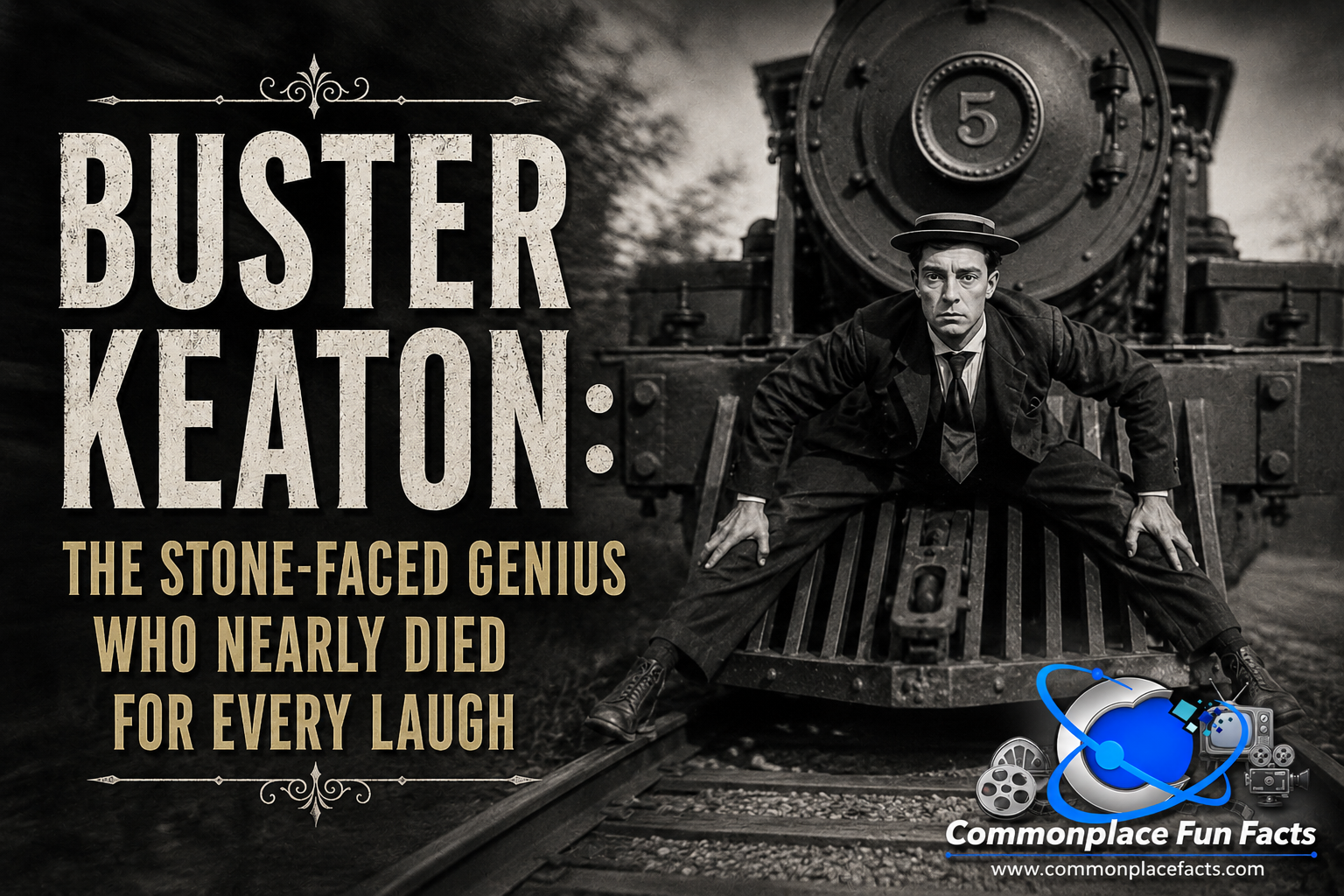

Modern audiences have become somewhat spoiled by movie magic.
Today, if a superhero leaps from a collapsing building, swings through traffic, crashes into a helicopter, and lands unharmed on a moving train, there is a reasonable chance that nobody involved was ever within fifty feet of actual danger. Somewhere, a computer quietly rendered the whole thing, while a heavily caffeinated visual effects artist muttered darkly about deadlines. If actual physical risk is required, a professionally trained stunt double usually absorbs most of it in exchange for a paycheck and, ideally, decent health insurance.
Buster Keaton came from a different era.
When Buster Keaton stood in front of a collapsing two-ton house façade and allowed a single open attic window to fall perfectly around his body without killing him, there were no computers involved. There was no digital enhancement. There was no safety rig. There was simply a man standing very still while gravity made a life-altering decision.
Ironically, this level of fearless physical commitment was not associated with an action hero, swashbuckler, or cowboy. It belonged to one of the greatest comedy stars in cinematic history.
Keaton remains one of the most influential filmmakers ever to step behind a camera, despite the fact that many people today vaguely recognize his face while struggling to remember whether he was “the sad one,” “the silent one,” or “the guy who almost got flattened by architecture.”
He was, in fact, all three.
Behind that famous deadpan expression was a brilliant director, engineer, stunt performer, editor, gag writer, and cinematic innovator who helped invent visual comedy as we know it. His life also included child labor, a serious drinking problem, near-fatal injuries, catastrophic studio interference, financial collapse, and enough physical punishment to make a modern insurance adjuster immediately resign and move into candle-making.
Contents
The Child Who Was Literally Thrown Around for Entertainment
Buster Keaton was born Joseph Frank Keaton in 1895 in Piqua, Kansas, into a family where “show business” meant “try not to die before the applause.” According to family lore, he was still a small child when he took a spectacular fall down a flight of stairs and emerged with the nickname that would follow him for the rest of his life.

The story Keaton himself helped popularize was that magician Harry Houdini saw the tumble and remarked, “That was some buster.” The story is simultaneously legendary, charming, and perhaps the most early-1900s sentence imaginable, but it is probably more legend than fact. The nickname more likely came from another vaudeville performer, George Pardey. Either way, the name stuck.
Today, a toddler falling down stairs results in emergency room visits, parenting blogs, and at least seventeen strangers online demanding criminal investigations.
At the time, it resulted in a celebrity branding opportunity.
Buster’s parents were vaudeville performers. It wasn’t long before he joined the family act known as “The Three Keatons.” The routine largely consisted of young Buster being tossed across the stage, slammed into scenery, dragged around by suitcases, and hurled into orchestra pits for audience amusement.
This was not metaphorical.
His father literally threw him into the scenery as part of the act.
Anyone who happened to be the youngest brother in a large family of boys has received similar training.
That sounds horrifying, and by modern parenting standards it would probably trigger a visit from child protective services, a congressional hearing, and at least one deeply concerned podcast. Keaton, however, consistently described the act as carefully practiced rather than reckless abuse. He said he learned how to fall, roll, and go limp in ways that protected him from injury, and he later remembered his childhood performing years with affection. Whether that reassures you or merely confirms that vaudeville was basically show business with fewer guardrails is a separate question.
The remarkable part is that it worked. Audiences loved it. Buster learned timing, physical control, stunt coordination, and audience psychology before most children today learn not to eat crayons. He also learned how to protect himself during falls and impacts, which would later prove useful during a film career that frequently resembled an OSHA training video titled Please Do Not Attempt Any of This.
Discovering Movies and Quietly Revolutionizing Them
In 1917, Keaton met silent film comedian Roscoe “Fatty” Arbuckle, who invited him to appear in films. Keaton became fascinated with the mechanics of filmmaking almost immediately. He even took apart a movie camera to understand how it worked and reassembled it successfully by morning.
Some people casually become cinematic geniuses, while the rest of us need three YouTube tutorials to operate a printer. Life can be unfair at times.
Keaton rapidly evolved from performer to filmmaker. Unlike many silent comedians who relied heavily on exaggerated facial expressions, Keaton developed his famous deadpan style. His expression rarely changed, even when trains crashed, buildings collapsed, or entire worlds appeared to implode around him.

This earned him the nickname “The Great Stone Face.”
The expression was not laziness. It was strategy.
Keaton understood that the audience found him funnier when his character remained serious. The world around him could descend into complete insanity, but his stoic determination somehow made the chaos even more absurd.
Modern comedy still borrows this constantly.
Every exhausted sitcom character staring blankly into the camera while disaster unfolds around them owes something to Buster Keaton.
The Human Cartoon Who Refused to Use Stunt Doubles
Keaton’s films quickly became legendary for their elaborate physical stunts.
And when we say “stunts,” we do not mean carefully choreographed modern action scenes involving hidden harnesses and twelve lawyers standing nearby.
We mean actual danger.
Real trains. Real collapsing structures. Real explosions. Real impacts.
In Steamboat Bill, Jr., Keaton performed the famous falling-house sequence in which the façade of an entire building crashes down around him while he stands motionless. The only reason he survives is because he is positioned exactly where an open attic window lands. Had he been off by even a few inches, the film would have instantly transformed from comedy into a deeply upsetting news story.
Keaton later admitted the stunt was genuinely dangerous.
That qualifies as one of the great understatements in entertainment history.
In another film, Sherlock Jr., Keaton suffered a neck injury after being slammed onto railroad tracks by a water tower. He did not realize how serious the injury was until years later when doctors discovered he had fractured his neck.
Imagine breaking your neck and responding with, “Huh. That explains some things.”
Keaton’s movies often feel less like scripted films and more like someone challenged physics to a duel.
The General: The Movie That Failed Before Becoming a Masterpiece
Today, The General is considered one of the greatest silent films ever made.

In 1926, audiences mostly responded with the cinematic equivalent of a shrug.
The film was inspired by a real Civil War train chase and featured astonishing practical effects, enormous sets, and one of the most expensive stunts of the silent era: an actual locomotive crashing into a river.
Not a miniature.
An actual train.
Because apparently Buster Keaton approached budgets the way medieval kings approached siege warfare.
The film was expensive and initially underperformed financially. Critics at the time were mixed. Some viewers apparently expected broader slapstick comedy and were uncertain what to do with a movie that combined visual comedy with genuine cinematic artistry.
History eventually corrected this mistake.
Modern critics routinely rank The General among the greatest films ever made.
This happens surprisingly often in art history.
Humanity frequently reacts to innovation by staring blankly at it for twenty years before finally announcing, “Actually, that was brilliant.”
If you would like to see why film historians speak about this movie with the reverence usually reserved for lost religious artifacts and perfectly cooked barbecue, you can watch The General in full at the Internet Archive.
The Worst Decision of His Career
By the late 1920s, Keaton was one of Hollywood’s most respected filmmakers. Then he made what he later called the worst mistake of his life: signing with MGM.
This turned out to be roughly equivalent to taking a finely tuned Swiss watch and assigning it to a committee.
Keaton had thrived under creative freedom. MGM operated like an industrial factory. Executives preferred rigid scripts, committee oversight, and production efficiency. Keaton preferred experimentation, improvisation, and inventing visual gags through trial and error.
These approaches did not blend well.
Keaton later complained that MGM executives “didn’t realize the best comedies are simple.”
The studio increasingly limited his creative control. The transition to sound films complicated matters further. Meanwhile, Keaton’s personal life deteriorated. His marriage collapsed, his creative control vanished, and during the early 1930s his drinking became a serious and destructive problem. Eventually MGM fired him in 1933.
For a time, one of the greatest filmmakers in history was bankrupt, struggling with alcohol, and largely forgotten by the industry he helped build.
Hollywood has always possessed a remarkable ability to treat geniuses like expired coupons.
The Strange and Impressive Comeback
Fortunately, this is not where the story ends.
Keaton gradually rebuilt his life and brought his drinking under control. He married Eleanor Norris in 1940, and the marriage proved far happier and more stable than his first. He worked as a gag writer, performed in smaller roles, and slowly experienced a major critical rediscovery during the late 1940s and 1950s.
Film critics and historians began reevaluating silent comedy and realizing that Keaton had not merely been funny.
He had been revolutionary.
Younger audiences discovered his films. Television introduced him to new viewers. He also returned to the movies, including a memorable appearance with Charlie Chaplin in Limelight (1952), giving audiences the rare treat of seeing the two greatest comedians of the silent era share the screen.
There is something deeply satisfying about the fact that Keaton lived long enough to witness his own artistic resurrection.
History occasionally gets around to apologizing.
Buster Keaton Enters The Twilight Zone
One of Keaton’s most fitting late-career appearances came in 1961, when he guest-starred in The Twilight Zone episode “Once Upon a Time.” Naturally, the episode involved time travel, silent-film homage, and pants-related distress, because apparently Rod Serling understood the assignment.
Keaton played Woodrow Mulligan, a grumpy janitor living in 1890 who is convinced that modern life has become unbearable. His town is too noisy. Prices are too high. Traffic is out of control. The national budget surplus is only $85 million, which he regards as a clear sign that civilization is circling the drain. Then he discovers a time helmet that sends him to 1961, where he learns that the future contains automobiles, city noise, higher prices, and a refreshing new appreciation for how quiet 1890 suddenly seems.
The episode was designed as an affectionate tribute to Keaton’s silent-film career. Its 1890 scenes are presented in silent-movie style, complete with intertitles and piano accompaniment, before the story shifts into the louder, faster, more chaotic modern world. In other words, Keaton was cast as a man from the silent era who gets dropped into the age of television and spends the rest of the episode trying to survive progress. Subtle, it was not. Appropriate, however, it absolutely was.
The plot also works as an oddly perfect summary of Keaton’s own career. He had been one of the giants of silent comedy, a master of visual storytelling whose best work needed no dialogue. Then sound arrived, the studios changed, MGM boxed him in, and Hollywood’s new machinery nearly swallowed him whole. Like Woodrow Mulligan, Keaton was a man from an earlier world who found himself transported into a noisier, more complicated future that did not always know what to do with him.
The difference is that Keaton eventually found his way back—not to 1890, thankfully, because indoor plumbing had made some persuasive arguments—but to recognition. By the time he appeared on The Twilight Zone, younger audiences were rediscovering his genius, critics were reassessing his films, and television was helping introduce the Great Stone Face to people who had missed him the first time around. “Once Upon a Time” is funny on its own, but it also feels like a small act of historical justice: the modern medium that helped bury silent comedy paused long enough to tip its hat to one of the men who made screen comedy possible.
Hollywood Tries to Explain Buster Keaton
In 1957, Hollywood released The Buster Keaton Story, a biographical film starring Donald O’Connor as Keaton. Unfortunately, the movie demonstrated that Hollywood could recreate train wrecks more accurately than biographies. The film took enormous liberties with Keaton’s life, rearranging timelines, inventing dramatic material, simplifying relationships, and generally treating historical accuracy as more of a polite suggestion than an actual obligation.
Keaton himself worked with the production and helped coach O’Connor in some of the physical comedy sequences, but he was never enthusiastic about the final product. Later, he reportedly said the only thing he truly liked about the movie was Donald O’Connor’s performance. Still, Keaton maintained enough perspective to appreciate one practical benefit: the money he received for the film rights helped him buy a house. Considering how often Hollywood had previously managed to cost him money, that alone may have counted as a happy ending.
Why Buster Keaton Still Feels Modern
Many silent films feel historically important without necessarily feeling modern.
Keaton somehow avoids this problem.
His pacing, visual storytelling, camera experimentation, and physical comedy still feel astonishingly contemporary. Some of his films seem decades ahead of their time. Modern directors including Jackie Chan, Wes Anderson, Johnny Knoxville, and countless others have openly acknowledged his influence.
Critics and filmmakers have spent decades trying to explain why Keaton mattered so much, although many eventually gave up and simply started speaking about him with the reverence usually reserved for Renaissance painters and people who can successfully assemble IKEA furniture without swearing. Film critic Roger Ebert called Keaton “the greatest of the silent clowns,” arguing that while Charlie Chaplin may have moved audiences more deeply and Harold Lloyd made them laugh just as hard, “no one had more courage than Buster.”
Perhaps the most striking praise came from filmmaker Orson Welles, who described Keaton as “the greatest of all the clowns in the history of the cinema” and “a supreme artist.” Welles went even further, saying Keaton was “beyond all praise” and “one of the most beautiful men I ever saw on the screen.” Considering that Welles was not exactly known for casually handing out compliments like free samples at Costco, that praise carries weight. He also declared that “in the last analysis, no one came near him,” which is about as close as film history gets to a mic drop.
Even today, Keaton’s work feels strangely fresh because his comedy rarely depended on dialogue or topical references. Instead, he focused on universal problems:
- Machines refusing to cooperate
- Buildings trying to kill you
- Transportation becoming catastrophic
- Society descending into chaos for no obvious reason
- A man attempting to remain calm while the universe actively disagrees with that plan
Honestly, that last one may explain why modern audiences connect with him so strongly.
Buster Keaton specialized in portraying the exhausted expression of a person attempting to survive an increasingly absurd world.
That remains relatable.
The Legacy of the Great Stone Face
Buster Keaton died in 1966 at age 70. Remarkably, many people around him did not realize he was seriously ill. Even near the end of his life, he continued working and performing.
His reputation has only grown since then.
Today, Keaton is widely regarded as one of the greatest filmmakers and comedians in cinema history. Seven of his films have been preserved in the National Film Registry. Eight, if you count his appearance as one of Norma Desmond’s “waxwork” friends in Sunset Boulevard.
And perhaps the most remarkable thing about Buster Keaton is that his work still produces genuine awe.
Not nostalgia.
Not polite historical appreciation.
Awe.
Modern viewers still watch his stunts with the same horrified admiration people experienced a century ago. There remains something almost supernatural about watching a human being perform impossible physical comedy with absolute precision while maintaining the facial expression of a man mildly disappointed by parking regulations.
That is why Keaton deserves to be remembered—not merely as a relic of silent film, but as one of the people who taught movies how to move, how to surprise, and how to make danger funny without pretending it was never dangerous.
He spent his life letting the world collapse around him, then stepping calmly through the open window.
That was Buster Keaton: the man who never needed to crack a smile to leave everyone else laughing.
If you enjoyed learning about the Great Stone Face, one of the best resources on the internet is the International Buster Keaton Society. The organization is dedicated to preserving Keaton’s legacy, restoring and promoting his films, encouraging historical accuracy, and helping modern audiences discover why a man with one facial expression became one of the greatest filmmakers in history. Their site includes film information, historical articles, rare photos, restoration news, events, and enough Buster Keaton material to keep you happily wandering through silent-film history for quite some time.
You may also enjoy…

Charlie Chaplin: The Superstar Who Made the World Laugh (Then Got Himself Kicked Out of America)
Discover the extraordinary life of Charlie Chaplin — from global fame as the world’s most beloved silent film star to political scandal, exile from the United States, and even a posthumous grave robbery. Explore how The Tramp conquered hearts, mocked dictators, and left a legacy that still shapes comedy and cinema today.

The Murder of William Desmond Taylor: Hollywood’s First Great Unsolved Scandal
Hollywood’s first great unsolved scandal: the 1922 murder of director William Desmond Taylor, the stars pulled into the mystery, and the clues that still refuse to behave.

Al Jolson: The Voice That Changed Broadway, Hollywood, and Music Forever
Discover the dazzling career of Al Jolson, “The World’s Greatest Entertainer,” from Broadway glory to The Jazz Singer, record-breaking hits, and unforgettable showbiz moments that shaped entertainment history.


Leave a Reply