
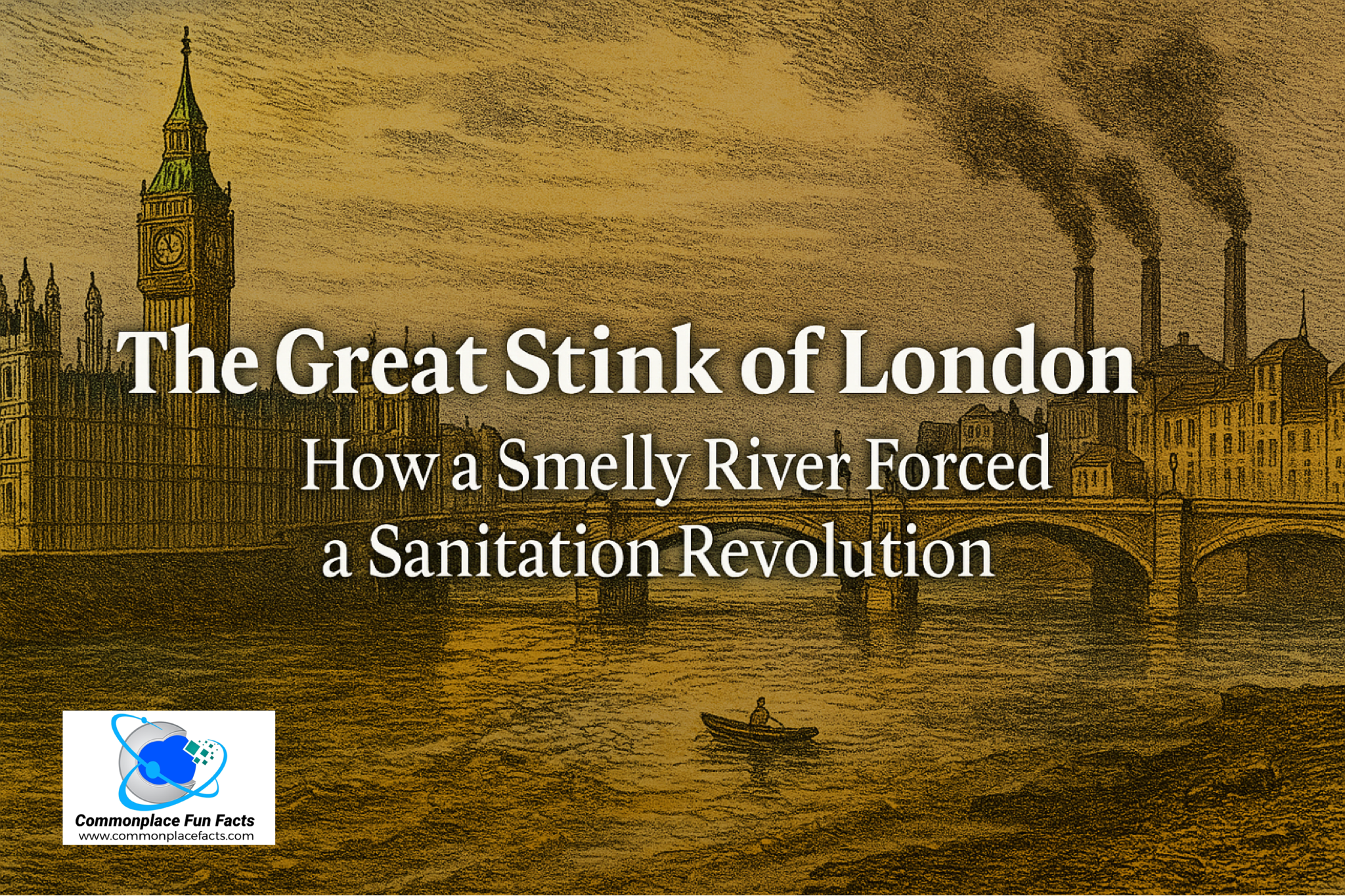

Suppose you could travel through time and arrive in London in the summer of 1858. You are too late for the Frost Fairs, but you’re probably expecting to have your senses delighted by the sights and sounds of the Victorian Era. You are not disappointed. The city was bustling with carriages, top hats, and corsets so tight you could pass out before you finished your afternoon tea. Industry was booming, the British Empire was at its height, and London was the beating heart of global power.
Unfortunately, in addition to the sights and sounds, you are being assaulted by another sense that drowns out everything else. You arrived in the midst of what could only be described as a colossal toilet bowl. Enter: the Great Stink — the moment when the River Thames became so unbearably smelly that it practically chased Members of Parliament out of their own chambers and forced a sanitation revolution.
Contents
The Scene Before the Stink
Mid-19th-century London was a marvel in many ways. It was the largest city in the world, teeming with more than two million people. Unfortunately, no one had really paused to consider where those two million people’s “contributions” to the waste stream would end up. The answer was depressingly simple: the Thames. Every cesspit, every chamber pot, every street-side gutter eventually found its way into the river that was supposed to serve as London’s water supply. The Victorians may have invented the locomotive, the telegraph, and the penny dreadful, but plumbing was apparently an optional feature of civilization.
The city did have “night soil men.” This was a job title that sounds a lot better than the exalted Egyptian office of Shepherd of the Royal Anus but it did little to make up for the unglamorous responsibilities. These hardy fellows earned their keep by emptying cesspits and carting away human waste. That may sound noble, until you realize their ultimate disposal method was to dump it all back into the river anyway. Londoners were, in effect, recycling before recycling was cool, except they were recycling cholera and typhoid germs. It was the kind of circular economy that made everyone dizzy — literally.
A River Runs Through It (And Smells Like It Too)

As if polluting a river with human waste wasn’t bad enough, consider the role the Thames played for London. It wasn’t just a sewer. It was also the city’s pantry and water fountain. People drank from it, bathed in it, and cooked with it, all while standing on bridges staring down at dead animals, industrial runoff, and things too unspeakable to name bobbing along. Charles Dickens, never one to pass up a vivid description, called the Thames “a deadly sewer” and complained that it was “obscene as a vast stagnant pool.” Which was being charitable, really. The Victorians themselves nicknamed it “the Monster Soup.”
Still, the prevailing scientific wisdom of the time was that the real danger wasn’t the bacteria you couldn’t see — because germ theory was still a twinkle in Louis Pasteur’s eye — but the smells you could smell. The “miasma theory” argued that bad odors alone caused disease. So, in a sense, people were half right: the smell was a warning sign, but the danger was in the invisible microbes. This explains why Londoners of the 1840s and 1850s went about their business complaining of the stench while still dipping their cups in the river for refreshment.
Cholera, Cholera Everywhere
By the time of the Great Stink, London had already been walloped by several cholera outbreaks. In 1832, 1849, and 1854, the disease swept through the city like a scythe. (Across the pond, America was dealing with the same problem — particularly at the White House). Tens of thousands died in each wave, and no one could figure out why. Enter Dr. John Snow, a physician who grew so tired of seeing patients die that he decided to try some radical innovation called “science.” Snow’s meticulous mapping of cases in 1854 led him to a water pump on Broad Street, which he boldly ordered disabled. The cholera outbreak abated almost immediately, and in doing so Snow gave the world one of the first great epidemiological studies. Of course, his contemporaries largely ignored him. After all, what did a doctor know compared to the established wisdom of sniffing the air?
Even as Snow demonstrated the link between water and cholera, Parliament and public opinion remained fixated on miasma. Which set the stage for the summer of 1858, when the miasma became so overpowering it could no longer be ignored.
The Summer of the Great Stink
June 1858 was hot. July was hotter. By August, the River Thames had effectively transformed into a steaming, reeking broth of everything unpleasant that two million people and countless factories could produce. Imagine every garbage can you’ve ever forgotten to take out in midsummer heat, multiply by a thousand, then add industrial waste, rotting animal carcasses, and centuries of human output. Now forget about that because London’s perfume was worse.

Contemporary newspapers described the river in tones of horrified awe. The Times called it a “Stygian pool, reeking with ineffable and intolerable horrors.” (Fun fact: That’s almost exactly how we describe one particularly troublesome offshoot of our family tree.) The Morning Chronicle warned readers that the stench was “a topic of popular conversation in every rank of life.” One MP, bravely venturing onto the terrace of the Houses of Parliament, staggered back indoors declaring the smell had nearly knocked him flat. Chloride of lime was poured on curtains, hung from windows, and smeared on walls in a desperate attempt to ward off the stink. It was like spraying Febreze on a burning landfill — admirable, but ultimately futile.
The Queen is Not Amused and Parliament Holds Its Nose
Even the monarchy couldn’t escape the olfactory nightmare. Queen Victoria and Prince Albert once attempted a pleasant river cruise on the Thames, only to abort the mission within minutes when the royal noses detected an aroma that could only be described as “please God, make it stop.” If the Queen of England herself was gagging, it was no longer just the rabble complaining. The stench had officially become a national crisis.
“[The Thames is a] stygian pool, reeking with ineffable and intolerable horrors.”
— The Times
The smell grew so overwhelming that it directly disrupted the business of government. For a rare moment in history, the stench outside was worse than the political fumes inside. Imagine politicians unable to debate because the air was too noxious. (On second thought, that might not be such a bad idea.) Members of Parliament literally fled the chamber during debates, and there was serious talk of relocating the seat of government altogether. Only the looming fear of appearing weak in the face of bad smells kept them in their seats. The Great Stink had accomplished what no political opposition could: it united Parliament in a desire to do something.
The Hero with a Sewer Plan: Joseph Bazalgette

It was Joseph Bazalgette who came to the rescuse. As chief engineer of the Metropolitan Board of Works, Bazalgette seized the crisis of the Great Stink to push through his ambitious plan: a network of 82 miles of intercepting sewers, 1,100 miles of street sewers, and multiple pumping stations that would reroute the city’s waste downstream. His genius was in overbuilding. Anticipating that London might double in population, he doubled the capacity of his sewers. That foresight kept London’s plumbing functional for more than a century. For once, a government project was guilty not of shortchanging the public, but of overdelivering.
Bazelgette had a powerful ally in this ambitious plan. Prince Albert was more than a casual gag-reflex sufferer; he was a genuine advocate for public health. When Joseph Bazalgette unveiled his plans to overhaul London’s sewers, Albert lent his name — quite literally — to the machinery. The southern sewer system collected waste from Putney, Wandsworth, and Norwood, funneled it down to Deptford, and then used a pumping station to lift the effluent 21 feet into the main outflow sewer. From there, the waste made its stately way to the magnificent Crossness Pumping Station on the Erith Marshes, where it was politely dumped into the Thames at high tide. Out of sight, out of nose — sort of.
And powering this temple of effluent? Four colossal beam engines manufactured by James Watt & Co., each lovingly christened with a royal name: Victoria, Prince Consort, Albert Edward, and Alexandra. Forget portraits and statues — nothing immortalizes your reign quite like having your name bolted to a sewage pump. Somewhere in the annals of regal legacy, “Defender of the Faith” sits comfortably next to “Namesake of London’s Toilet Engines.”

Crossness wasn’t just a pumping station. Designed by Bazalgette and ironwork specialist Charles Driver, it was a Romanesque masterpiece, with ornate cast iron interiors so impressive that English Heritage now considers them nationally important. If you’re going to flush millions of gallons of sewage, why not do it from inside a building that looks like a cathedral? The Victorians, after all, never missed a chance to make even the most utilitarian structures architecturally dramatic.
Bazalgette’s sewers were a marvel of engineering, hidden beneath Londoners’ feet but saving their lives daily. One historian even claimed that Bazalgette saved more lives than any single Victorian, thanks to his elimination of cholera and other waterborne diseases. Not bad for a man whose crowning achievement was figuring out where to put the poop.
Legacy of the Great Stink
The Great Stink was disgusting, but it was also transformative. Parliament, forced to act by the sheer power of its collective gag reflex, funded Bazalgette’s project. The new system not only cleaned up the Thames but also reshaped London’s landscape, producing the Embankments — Victoria and Albert again lending their names to monumental stretches of riverbank now lined with trees, roads, and gardens. Cholera outbreaks diminished, public health improved, and London became a model for cities worldwide.
Modern parallels abound. From Flint’s water crisis to sewage challenges in developing nations (and arguably contributing to the tragic death of the mayor of Betterton, Maryland, who drowned in the city’s sewage treatment facility), the lessons of the Great Stink still resonate: don’t wait until your city reeks to take public health seriously. But the story also proves that sometimes the only way to get politicians to act is to make them physically uncomfortable. As policy motivators go, nothing beats the smell of raw sewage wafting across the House of Commons.
Fun (and Smelly) Side Notes
- Charles Dickens wasn’t exaggerating: he genuinely avoided riverside strolls because the smell made him ill.
- Queen Victoria reportedly had vials of perfume at hand to counter the stench, though even lavender water could only do so much.
- Punch magazine had a field day with satirical cartoons, depicting Parliamentarians plugging their noses while passing laws.
- Even with Bazalgette’s improvements, London’s sewer system wasn’t fully odor-free for decades. Progress, it seems, still carried a whiff.
- The sewage issue may have been solved, but pollution continued to be a problem. For five days in 1952, the whole city disappeared under a massive toxic cloud of smog. Read this article to learn about the Great Smog of London.
Conclusion: When a Smell Changed History
The Great Stink of 1858 is remembered today as one of those bizarre moments when nature (or, more accurately, human negligence) forced a city to confront its own mess. It wasn’t a battle, a plague, or a revolution that changed London’s future, but the unbearable smell of its own river. That smell galvanized Parliament, empowered Bazalgette, and immortalized the royal family in the unlikely setting of sewage pumps. In the end, the Great Stink was less a disaster than a turning point: a reminder that civilization is only as strong as its plumbing.
So the next time you grumble because the garbage pickup is a day late or your city forgets to plow the streets after a snowstorm, pause and give thanks. At least you don’t live in London in the summer of 1858, when an entire government nearly collapsed because its capital smelled worse than the inside of a cesspit on a hot day. The Great Stink may be gone, but the lesson lingers: deal with your waste before your waste deals with you.
You may also enjoy…

The Strange Case of Mrs. Prodgers — The Terror of London Cabmen
Caroline Giacometti Prodgers, an infamous figure in 1890s London, gained notoriety as the Terror of London Cabbies for her relentless legal battles against cab drivers, filing over 50 lawsuits. Known for her dramatic courtroom antics, she became a symbol of consumer advocacy and garnered both fear and ridicule from cabbies. Her death in 1890 was…

The River Thames Frost Fairs: The Coolest Parties in History
Discover the history of London’s River Thames Frost Fairs, when the River Thames froze solid during the Little Ice Age. From markets and ox roasts to King Charles II and an elephant on ice, explore the quirkiest winter festivals in British history.

Space Smells Like Raspberries: The Sweet Chemistry of the Cosmos
Scientists have discovered that a massive dust cloud in our galaxy, Sagittarius B2, contains ethyl formate, which gives raspberries their flavor. In other words, space smells like raspberries! This finding implies that space is richer in molecules essential for life than previously thought. These discoveries may help answer questions about the origins of life on…




Leave a Reply to cat9984Cancel reply