
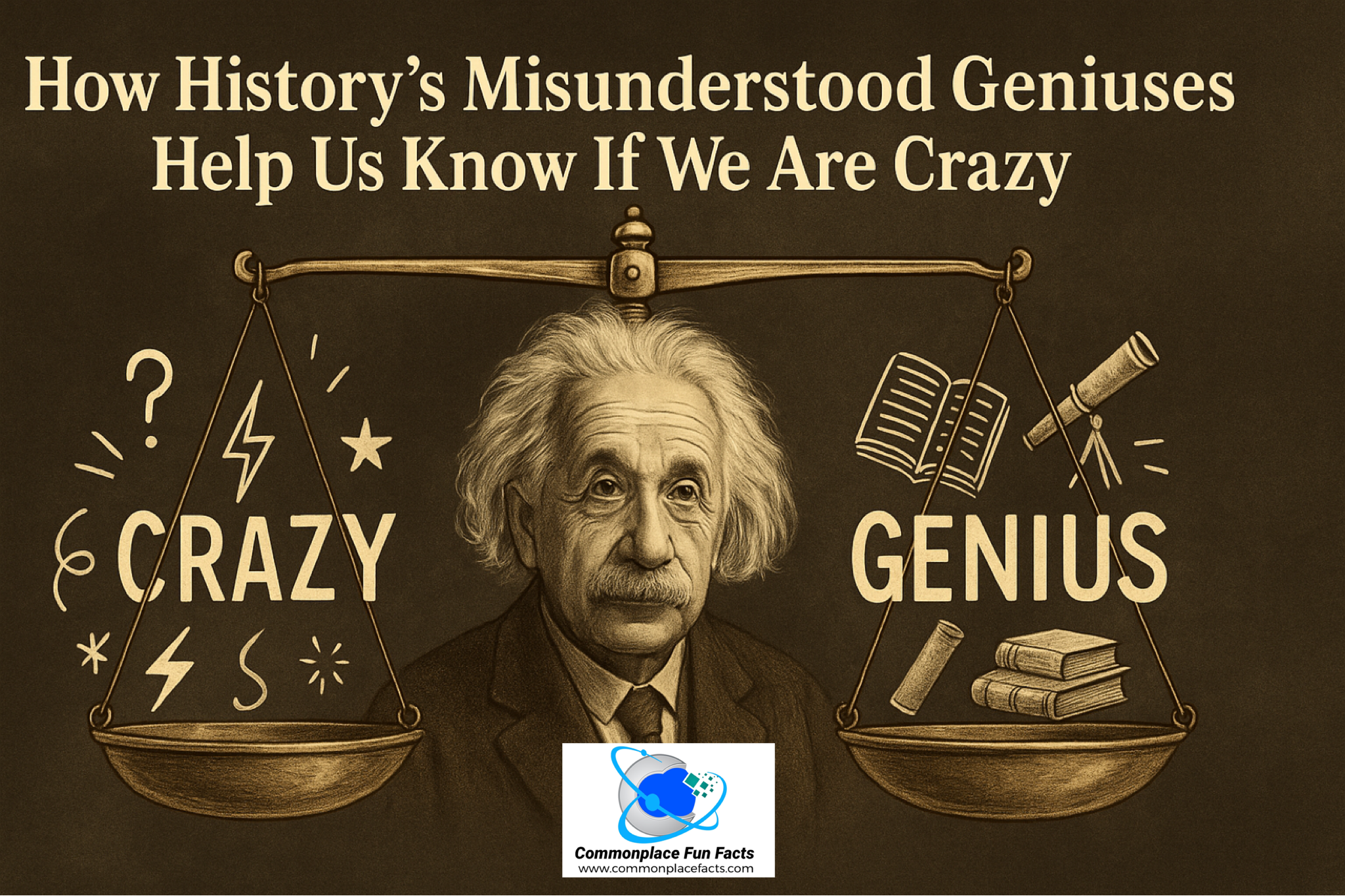

Do you ever look at the world around and think, “Everyone is crazy”? More to the point, have you ever asked that question so often that you find yourself thinking, “Maybe I’m the one who’s crazy, and everyone else is normal”?
Are you the only sane person in an asylum run by the inmates, or are you the one who really should be institutionalized? We’re unqualified to answer that question. (Although, you’re reading Commonplace Fun Facts, so if nothing else, you have exquisite taste, an inquiring mind, and we’re guessing you create a rather attractive reflection in your mirror, too.) Although we’re not in a position to opine about your mental state, you might draw some inspiration and comfort from some of history’s greatest geniuses who turned their eccentricities and “craziness” into superpowers.
Join us as we take a look at history’s misunderstood geniuses and ask, “Am I the only sane person here?”
Contents
Albert Einstein: The Hazy Genius
Of course, no exploration of “crazy” brilliance would be complete without discussing Albert Einstein, the man whose name is synonymous with “genius.”

This is the guy whose theories bent time, space, and just about everyone’s brain. Relativity wasn’t just a new way of looking at physics—it was a new way of looking at reality itself. Naturally, when you tell people that time runs differently depending on how fast they’re moving, you get a few raised eyebrows and more than a few mutterings about padded rooms.
Einstein himself felt the tension. He wasn’t surrounded by fellow physicists 24/7; he spent much of his time with ordinary folks who thought “space-time” was what happened when you fell asleep on the sofa. Surrounded by polite bafflement, he wondered whether he was the one out of step. He summed up the inner conflict with, “A question that sometimes drives me hazy: am I or are the others crazy?” wasn’t a throwaway quip—it was the lived reality of a man whose genius often isolated him from the people around him.
Here’s the thing: Einstein’s willingness to look foolish, to ask the questions no one else dared, and to stand firm in the face of skepticism is exactly why we now talk about relativity with the same casualness we reserve for weather reports. His “hazy” doubt reminds us that sometimes, questioning your own sanity is just part of the process of being ahead of your time.
Galileo: Stargazing Heretic
People’s Exhibit B: Galileo Galilei. Today, we hand out “Galileo” references like candy whenever we want to signal brilliant defiance. In his own time, however, Galileo was accused of heresy for suggesting the Earth wasn’t the center of the universe. The Church told him to recant, and he ended up under house arrest for the audacity of pointing a telescope skyward and reporting what he saw.
Was Galileo crazy? Well, he didn’t exactly help his “normalcy” case with a few quirks of his own. For starters, he insisted on writing in Italian instead of Latin, which scandalized scholars but thrilled everyday readers. He was also hopelessly obsessed with pendulums—legend says he discovered their principle by staring at a swinging cathedral chandelier and timing it against his own pulse, which is equal parts genius and oddly specific hobby. And then there was his fondness for wine (he once praised a Tuscan vintage as excellent for both health and inspiration), his love affair with telescopes, and his tendency to absolutely roast opponents in debate. His book Dialogue Concerning the Two Chief World Systems featured a character named “Simplicio”—Latin for “simpleton”—who conveniently voiced the Pope’s arguments. Shockingly, that didn’t go over very well in Rome.
Were his scientific observations crazy? History tells us no. But when your neighbors are convinced the sun revolves around them, you start to feel like the one with the wobbly compass. Fast-forward a few centuries, and Galileo is canonized in the pantheon of scientific greats. Being misunderstood, it turns out, was just a temporary condition.
So yes, Galileo was a heretic to some, a nut job to a few, a genius to others, and an eccentric to nearly everyone. If history has taught us anything, it’s that eccentricity and genius often walk hand in hand—sometimes swinging like a pendulum.
Tesla: The Mad Scientist Who Lit Up the World

Then there’s Nikola Tesla. The man wanted to wirelessly transmit electricity through the air, tried to pay a hotel bill with a “death beam,” and once tried to cure Mark Twain’s constipation by shaking him until the situation resolved itself. To the people around him, Tesla was equal parts wizard and lunatic.
Thomas Edison mocked him. Investors abandoned him. His hotel bills went unpaid, and he spent his final years feeding pigeons in New York City. And yet, much of our modern world runs on Tesla’s alternating current system—the very innovation that Edison dismissed as dangerous nonsense.
Was Tesla crazy? Well, yeah, probably at least a little bit. He had a phobia of round objects (possibly trypophobia, which means “fear of holes” in Greek), and he hated human hair, jewelry, and anything that was not divisible by three. He felt extreme affection for a pigeon that he believed foretold the future. So admittedly, his grasp of sanity was probably a bit tenuous, at best, but he was also incredibly brilliant and way ahead of his time, so maybe we’re the crazy ones.
Marie Curie: The Glowing Exception
Marie Curie is another example of misunderstood brilliance. At a time when women weren’t expected to have scientific opinions—much less win two Nobel Prizes—she pioneered the study of radioactivity. Colleagues and critics alike treated her with suspicion, partly because she was a woman in science and partly because, well, she glowed (figuratively, but also literally, thanks to the vials of radium she carried around).
Her discoveries revolutionized medicine and physics, but she faced enormous resistance along the way. Was Curie crazy for thinking she could handle substances that made Geiger counters go wild? Maybe. But her “madness” became the foundation of nuclear physics and cancer treatments.
Van Gogh: Madness with a Masterpiece

Not all misunderstood geniuses wore lab coats. Vincent van Gogh, for instance, sold exactly one painting in his lifetime. His neighbors considered him unstable, his colleagues avoided him, and yes, he famously cut off part of his own ear (possibly not the best thought out PR move, but everyone remembers him for it, so there’s that).
But his work—once derided as the scribblings of a madman—is now valued in the hundreds of millions. Those bold brushstrokes that unsettled his contemporaries now inspire art lovers around the world. Van Gogh’s “crazy” was simply beauty ahead of its time.
The Pattern of “Crazy”
What do Galileo, Tesla, Curie, Van Gogh, and Einstein have in common? They all experienced the isolating doubt that comes with standing on the edge of the known world and peering beyond it. Their brilliance wasn’t immediately obvious—it often looked like folly.
Einstein’s “hazy” question captures this perfectly. When the crowd insists you’re wrong, when the laughter stings, when your big idea gets you side-eyed instead of celebrated, it’s natural to wonder if you’re the one who’s lost your marbles. But history tells us over and over: the exceptional often masquerades as eccentric until hindsight sets in.
When Madness Makes for Great Leadership
Einstein wasn’t alone in wondering whether a touch of “crazy” might actually be an asset. Psychiatrist Nassir Ghaemi, in his book A First Rate Madness: Uncovering Links Between Leadership and Mental Illness, makes a provocative case: some of history’s greatest leaders were effective because of their mental struggles, not in spite of them.
Think Abraham Lincoln, wrestling with depression and suicidal ideation, yet finding the empathy and steadiness to guide a nation through civil war. Winston Churchill, battling the “black dog” of his moods, who nevertheless summoned the bulldog determination Britain needed during its darkest hours. Even Martin Luther King Jr., whose bouts of despair sharpened his resolve to confront injustice with compassion and clarity. These leaders weren’t great because they fit a neat, well-adjusted mold. They were great because their struggles gave them vision, resilience, and an uncanny ability to see the world as it really was, not as people pretended it to be.
Ghaemi’s point is startling but reassuring: the qualities we often dismiss as instability—emotional intensity, unconventional thinking, refusal to accept the obvious—can be exactly what makes someone capable of steering through chaos. In times of peace and prosperity, the steady, predictable leaders do fine. But in crises? History suggests we need someone who sees what the so-called sane majority cannot.
A Bit of “Crazy” for Our Own Times
Which brings us back to Einstein’s hazy question. In a world wrestling with global pandemics, political polarization, climate anxiety, and technological change that moves faster than a caffeinated kindergartner, maybe “normal” isn’t cutting it. Maybe what we need now isn’t more steady hands on the wheel, but a few people willing to take the wheel off entirely and invent something better.
A dash of “craziness”—the kind that questions assumptions, rejects easy answers, and imagines wild alternatives—might be exactly what this particular moment demands. If history is any guide, tomorrow’s “crazy” could very well become the sanity that saves us.
Be Exceptional Anyway
So what does this mean for us, the ordinary folks scrolling through history’s highlight reel? It means that being misunderstood isn’t proof of being wrong. Sometimes it’s a neon sign that you’re onto something no one else can quite see yet.

Einstein wasn’t lamenting when he asked whether he or the others were crazy. He was acknowledging the price of thinking differently. If the smartest man in the room had to wrestle with doubt, the rest of us can cut ourselves some slack.
When your ideas make people squirm, when your passions sound impractical, when your goals don’t fit the mold—that’s when you channel your inner Einstein. Ask the hazy question if you must, but remember the answer: maybe you’re not crazy. Perhaps you’re exceptional.
Unless, of course, you’re the guy who sent that ranting 8-page email yesterday about the hidden alien messages encoded in apostrophes. We’re pretty sure that you’re flat-out loony-bin nuts.
You may also enjoy…

The Contagious Insanity of the Lincoln Assassination
Is insanity contagious? Consider all of the bouts of insanity that were tied to Abraham Lincoln’s assassination.

Leonardo da Vinci: The Extraordinary Genius Who Outperformed Everyone for 500 Years and Still Thought He Was a Slacker
Leonardo da Vinci was one of the most brilliant people of all time. His accomplishments transformed the fields of art, engineering, mathematics, and so much more. Despite all of this, his last words showed that he felt he was a slacker. Learn more here!

Abraham Lincoln’s Battle with Depression: Overcoming Suicidal Thoughts and Tragedy
Discover Abraham Lincoln’s struggle with depression and suicidal thoughts, how he faced personal tragedies, and his journey to becoming the “Great Emancipator.”




Leave a Reply