
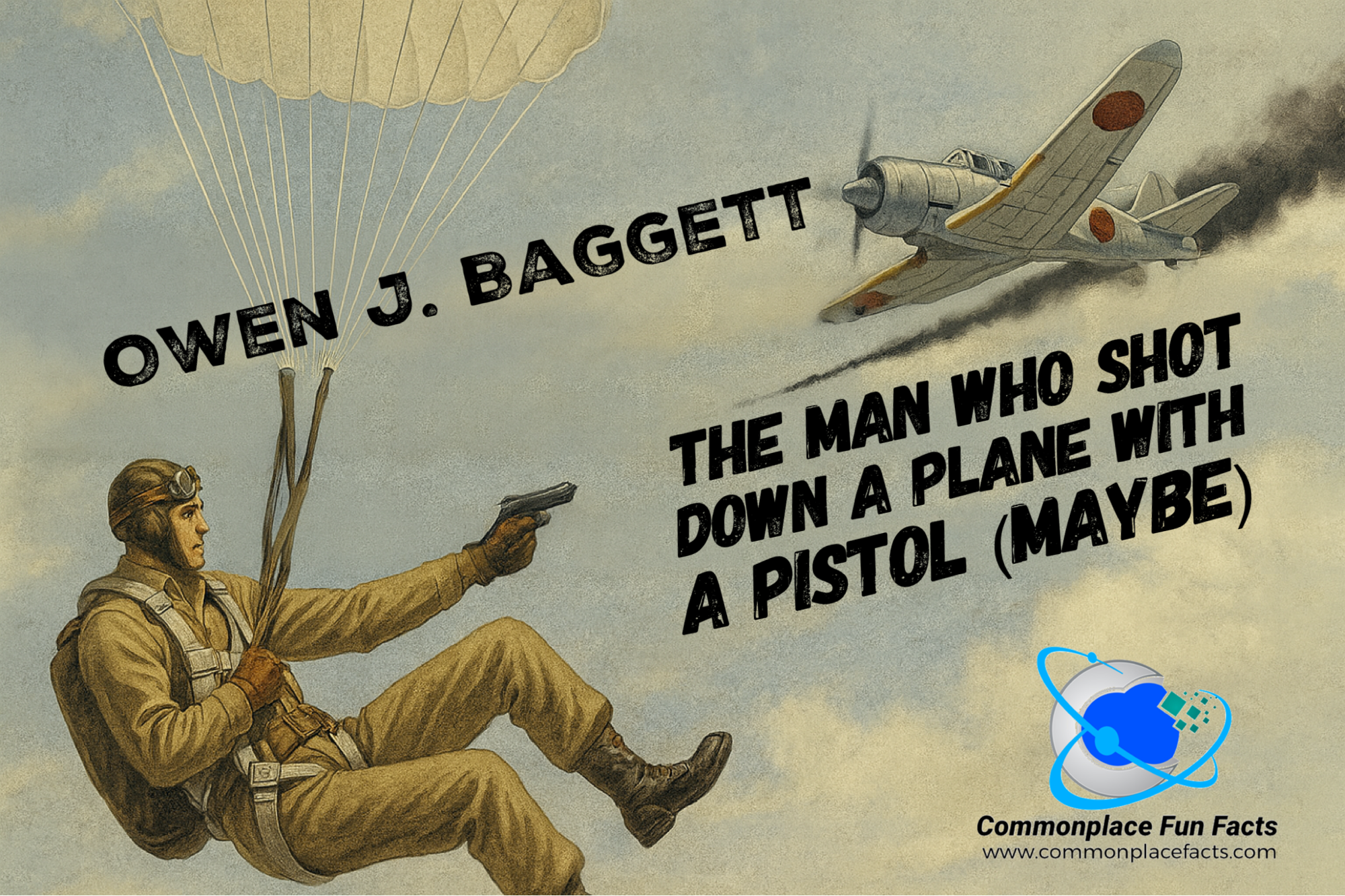

History is full of improbable tales. A wooden horse conquers Troy. George Washington skips a dollar across the Potomac. Chuck Norris divides by zero. But few stories test the boundary between “that’s amazing” and “you’ve got to be kidding me” quite like the tale of Owen Baggett — the U.S. Army Air Forces pilot who, depending on whom you ask, became the only man in history to shoot down an enemy plane with a handgun while floating through the sky on a parachute.
That’s right. Not from the cockpit of a fighter jet. Not from the gun turret of a bomber. Just a Colt .45, a parachute, and more composure under pressure than most of us can muster while trying to parallel park.
Contents
The Setup: Burma, 1943, and a Bad Day at the Office
Owen J. Baggett was born in 1920 in Texas, graduated from Hardin–Simmons University, and joined the U.S. Army Air Forces during World War II. By 1943, he was serving as a co-pilot with the 7th Bomb Group, flying missions out of India into Japanese-occupied Burma — where “bumpy ride” meant dodging bullets, not spilled coffee.

On March 31, 1943, Baggett and his crew took off in their B-24 Liberator on a mission to bomb a railroad bridge at Pyinmana. You’d think destroying a bridge in the jungle would be difficult enough, but fate — and the Imperial Japanese Army Air Service — had other plans. A swarm of Japanese fighters intercepted the bomber group, shredding the B-24s with gunfire. Baggett’s plane was hit, engines on fire, crew wounded, and one of the rare examples of a flight experience more unpleasant than traveling on Aeroflot.
The order came to bail out. Baggett leapt into open air, badly burned but alive. So far, so good — if you ignore the screaming descent, the chaos, and the fact that the Japanese pilots weren’t feeling particularly charitable toward parachuting enemies.
Floating Targets and Flying Samurai
Baggett had barely stabilized his chute when a Japanese Zero began circling him like a hawk that had just spotted lunch. Reports say the pilot opened fire on the helpless airmen drifting below, turning parachutes into piñatas. Baggett, realizing he couldn’t exactly out-maneuver a plane with 1,000 horsepower and machine guns, decided on Plan B: play dead. He went limp in his harness, hoping the enemy would mistake him for a corpse instead of a future problem.

It worked — sort of. One Zero approached, canopy open, perhaps to confirm his kill or to enjoy the rare pleasure of taunting an opponent who couldn’t shoot back. Unfortunately for him, Baggett wasn’t as dead as advertised. The Texan, hanging beneath his silk umbrella, quietly drew his service pistol, took aim at the approaching pilot, and fired four shots.
Eyewitnesses later claimed the Japanese plane suddenly pitched upward, stalled, and spiraled into the ground. The pilot was reportedly found dead, still strapped in, with a single bullet wound to the head. If true, that’s a pistol shot at a moving target, from a moving shooter, while falling at terminal velocity. A “Good Marksmanship” citation hardly does justice.
Did It Really Happen?
And now we arrive at the “fun” part of history — the bit where eyewitness memory, wartime chaos, and national storytelling all throw elbows. The official Japanese records from that day report no aircraft lost in that engagement. None. Zip. Nada. Skeptics argue that if a Zero had crashed, it would’ve been logged somewhere. Others point out that records in the Burma theater weren’t exactly known for precision — paperwork tends to get messy when everyone’s on fire.
Baggett himself never bragged about being the man who shot down a plane with a pistol. When he was rescued and later debriefed, he said he believed he hit the pilot, but couldn’t confirm. American POWs and locals passed along stories that seemed to back him up. Over time, the tale solidified into legend — the kind of story that military pubs love because it sounds like something Hollywood would reject for being too unbelievable.
So did it happen? Maybe. Probably. Possibly not. But let’s be honest — if you’re hanging from a parachute while being strafed by an enemy fighter, and you even try to shoot back, you’ve already crossed the line into legendary territory. The rest is just ballistic detail.
After the Smoke Cleared

Baggett’s victory, confirmed or not, was short-lived. He was captured soon after landing and spent the rest of the war as a prisoner in Japan. Surviving that alone deserves a medal and possibly a lifetime supply of free coffee at any self-respecting diner. After the war, he continued his service in the newly established U.S. Air Force, eventually retiring as a colonel. He later worked in the defense industry, perhaps occasionally looking at his sidearm with a faint smile and thinking, “You and me, kid — we made aviation history.”
He passed away in 2006 at the age of 85, reportedly modest about the incident to the end. The man who shot down a plane with a pistol (possibly) never made much of the legend — which, of course, only makes the legend stronger.
The Moral (If There Is One)
Some historians argue the story is exaggerated. Others swear by it. But whether it’s a myth, a miracle, or just the world’s luckiest shot, the legend of Owen Baggett captures something deeper about wartime folklore. Humans need stories that remind us courage isn’t always measured in tonnage, horsepower, or the number of guns you can bolt to a wing. Sometimes, it’s a man with a pistol against the sky, proving that even when gravity’s winning, you can still take a shot.
And if nothing else, it’s a solid reminder: never underestimate a Texan with a sidearm and a bad attitude about being interrupted mid-fall.
You may also enjoy…

Jimmy Stewart: The WWII Pilot Who Became a Legend In and Out of War
Learn about the largely unknown military heroics of Jimmy Stewart during WWII.

The Ingenious WWII POW Escape Attempt By Building an Airplane Inside a Nazi Fortress
Discover the daring WWII POW escape attempts from Colditz Castle. From ingenious disguises to the iconic Colditz glider, these stories defy belief.

George H.W. Bush and His Near Escape: Cannibals, WWII, and Political Survival
During WWII, George H.W. Bush narrowly escaped capture by the Japanese. Learn the shocking truth about his fellow airmen and the horrors of Chichi Jima.







Leave a Reply to Herald StaffCancel reply