
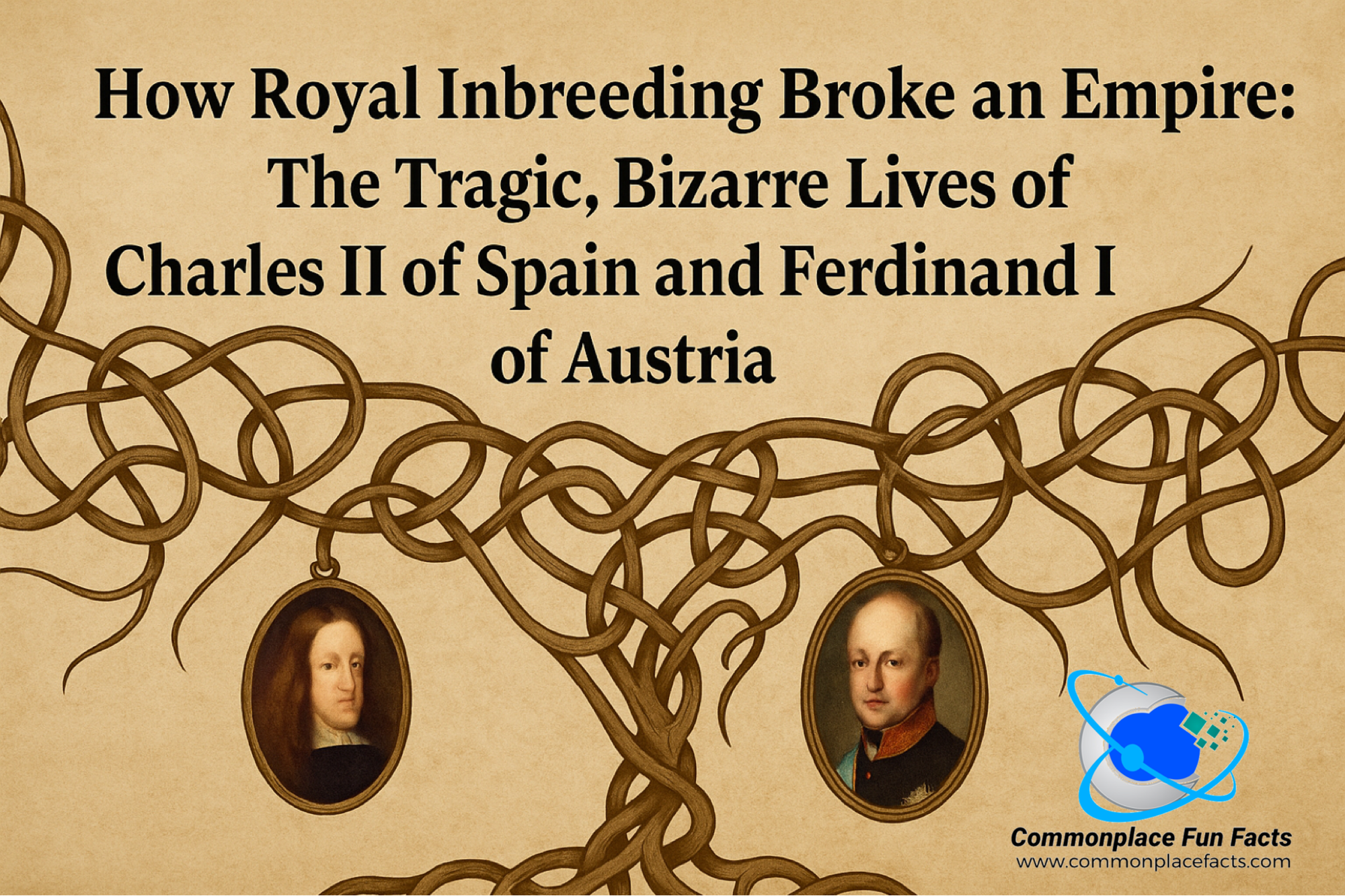

Every family has its enduring traditions. Some pass along a fondness for gardening. Some hand down a suspicious casserole recipe that may or may not violate local health codes. And then we come to the Habsburgs — a dynasty so fiercely devoted to keeping their bloodline “pure” that their family tree eventually resembled a Möbius strip drawn by someone who’d misplaced the eraser. Their commitment to pedigree became such an obsession through generations of royal inbreeding that their children inherited things a lot creepier than Grandma’s porcelain doll that follows you with its eyes no matter where you stand.
Still not convinced that “kissing cousins” should never be a political strategy? Allow us to introduce the two stars of today’s chronicle: Charles II of Spain and Ferdinand I of Austria, a pair of Habsburg poster children for the cautionary pamphlet titled “Please Stop Marrying Your Relatives.”
Separated by more than a century, ruling over different territories, dealing with very different political landscapes — and yet both men bore the unmistakable fingerprints of a dynasty that simply could not bring itself to marry outside the extended family.
Their lives weren’t punchlines. They were human beings born into situations they never asked for and could not escape. But their stories, taken together, offer a strangely compelling saga of empire, biology, politics, and the consequences of generations of questionable marital decisions. So buckle up as we follow the Habsburg gene pool down its increasingly narrow corridor.
Contents
The Habsburg Family Tree — Or Possibly a Wreath
The Habsburg motto could have been something like, “Why expand the family when you can reuse the parts you already have?” For centuries, the dynasty believed political stability depended on keeping the bloodline tidy — and if that meant you married your niece, your cousin, or the occasional dangerously close in-law, well, that was a small price to pay for maintaining the brand.
Those who study such things measure intertwining family trees in terms of the inbreeding coefficient. It’s one of those scientific terms that sounds like it belongs on a math test, but it’s really just a polite way of asking, “So… exactly how many branches does this family tree not have?” It’s a numerical score used by geneticists to measure how closely someone’s parents are related and how much identical DNA they’re likely to have inherited from both sides of the family. A coefficient of 0 means your parents come from two completely separate gene pools, while a coefficient of 1 would mean they are literal clones. Most people sit safely near zero. The Habsburgs, however, treated the scale like a competitive sport. By the time Charles II came along, his inbreeding coefficient hit 0.25 — the same genetic similarity you’d expect if his parents had been full siblings. Even by royal standards, that’s… ambitious. It should not be surprising, therefore, to learn that the genetic dice rolls for their offspring tended toward the ominous side of things.
Ferdinand I of Austria, born in the late 18th century, inherited a slightly less intense version of the Habsburg family’s marital enthusiasm for people who shared their last name. His branch hadn’t gone quite as aggressively all-in on cousin marriage as the Spanish line, but there was still enough genealogical overlap to make any court physician mutter a quiet prayer before opening the medical file. Modern geneticists estimate Ferdinand’s inbreeding coefficient at about 0.20, which is alarmingly high by normal human standards. Ferdinand’s score meant his parents were closely related enough to pass along a hefty portion of identical DNA — not quite the full-sibling-equivalent category achieved by Charles II, but close enough that the family tree still looped in suspiciously familiar directions. And, predictably, the genetic bill came due.
Let’s meet each of these case studies in royal inbreeding in turn.
Charles II of Spain: When a Dynasty Reached Its Breaking Point
Charles II of Spain entered the world in 1661, and it quickly became apparent that the royal cradle was rocking on a precarious foundation. Even contemporaries whispered that something wasn’t right. He struggled to feed, struggled to grow, struggled to thrive. His jaw was so prominent that chewing became an Olympic-level challenge. Walking took years. Speaking took even longer. Illnesses dogged him like a pack of highly determined mosquitos.

The Spanish court, not known for its transparency, decided the best solution was to simply tell everyone that Charles was robust, intelligent, and developing beautifully. This was technically true, in the sense that he was developing in some direction. It just wasn’t the one anyone hoped for.
By adolescence, Charles suffered from a long list of medical problems: chronic infections suggestive of immune weakness, neurological issues, stunted growth, chronic fatigue, intestinal disorders, and endocrine problems. If Charles had been born today, he would have been surrounded by doctors, specialists, and diagnostic terminology as long as a dragon’s grocery list. In 17th-century Spain, however, his symptoms were often attributed to sorcery.
That’s right. According to many in the court, Charles II wasn’t the product of inbreeding. He was bewitched.
The Bewitching Theory That Solved Everything (Except Reality)
When things went wrong in early modern Europe — a bad harvest, a lost war, a mysterious illness — someone somewhere blamed witchcraft. So when the king of Spain could not walk properly, speak clearly, or produce the heir everyone was expecting, the answer seemed obvious: witches.

Priests performed exorcisms. Holy objects were placed under his pillow. Nuns prayed furiously. Witch-finding committees whispered their theories in palace corridors. None of it helped Charles, of course, but it gave the court something to talk about that wasn’t the politically inconvenient truth that someone needed to pour some chlorine into the royal gene pool.
Politics in a Kingdom Falling Apart
Spain in Charles’s day was not the swaggering empire of the 1500s. Decades of wars, debts, rebellions, and questionable economic decisions were causing the great imperial machine to rattle. Ministers and nobles competed to control the throne. Regent queens rose and fell. Foreign ambassadors circled like vultures waiting for the moment Charles would fail to produce an heir.
The king’s body became a political chessboard. His marriages were national strategies. His sickbed became a diplomatic battlefield. His heirs — or lack thereof — shaped the future of the entire continent.
Unfortunately for the prevailing political strategy — but fortunately for the sake of the gene pool — children did not come. Two queens, zero pregnancies. Spain’s Habsburg line hung by a strand of court gossip and collective denial.
The Autopsy That Made Everyone Reconsider Their Life Choices
When Charles II died in 1700 at the age of 39, his autopsy left physicians reaching for the nearest chair. His body was described as having “no blood,” a heart “the size of a peppercorn,” intestines blackened and shriveled, and testicles “the size of small barley grains.” Whether these details were exaggerated or not — 17th-century autopsy reports had a flair for the dramatic — the message was clear: the human body was not designed to endure centuries of gene recycling.
Charles’s death brought an end to the Spanish Habsburg line and launched the continent into the War of the Spanish Succession, a conflict so complicated that even today historians occasionally need a whiteboard and a strong cup of tea just to explain it.
Ferdinand I of Austria: The Emperor Who Lived in a World the Rest of the Empire Couldn’t Explain
If Charles II was the dramatic final act of the Spanish Habsburgs, Ferdinand I of Austria was the slow, haunting echo that reminded everyone the dynasty hadn’t exactly solved its “marrying-your-relatives” problem. Born in 1793, Ferdinand arrived wrapped in brocade, welcomed by palace bells, and immediately subjected to whispered concern from anyone who saw him up close. Behind the polished smiles, the truth was hard to ignore: something was wrong.

Ferdinand was quiet when newborns are supposed to protest the trauma of being born. His limbs were stiff, his head unusually large, and as he grew, the list of medical issues lengthened faster than a royal name. He had hydrocephalus, severe epilepsy, tremors, weak muscle control, difficulty chewing, and chronic trouble forming or understanding language. His development zigzagged—an occasional flash of comprehension followed by long stretches of confusion. For a family that measured prestige in cousins-per-square-inch, he became the clearest sign yet that the Habsburg gene pool needed a lifeguard.
Still, the dynasty insisted publicly that Ferdinand was simply “delicate,” which was an optimistic way to describe someone who couldn’t reliably walk, speak, or feed himself. Behind closed doors, palace life rearranged itself entirely around his limitations. Tutors didn’t teach him how to rule; they taught him how to look like he might. Lessons consisted of ceremonial phrases, simple nods, and practicing his signature without drooling on the paperwork. Court staff avoided long sentences. Meals were softened to near-liquid. Everything in Ferdinand’s world was carefully staged, cushioned, and simplified.
And then came the moment that would follow him forever. During a dinner outburst, Ferdinand reportedly slammed his fist on the table and declared, “I am the emperor and I want dumplings.” The line became infamous not because it was funny—though it was—but because it captured the quiet absurdity of the entire monarchy: a ruler expected to steer an empire who, in reality, was capable of understanding or caring only about what was being served for supper.
As he aged, his seizures grew more severe. He sometimes wore a padded helmet beneath his ceremonial hats. He fainted during parades. He wandered away from officials who were supposed to be guiding him. Yet suggesting that Ferdinand couldn’t rule was unthinkable. Acknowledging reality would mean acknowledging the genetic cost of centuries of tight-loop marital strategy. And the Habsburgs were not ready for that conversation.
“I am the emperor and I want dumplings.”
— Ferdinand I of Austria
So they built a workaround. An unelected circle of power—his uncle Archduke Ludwig, Metternich, and several high-ranking advisors—formed the Secret State Conference. This committee made the decisions. Ferdinand signed what they placed in front of him. He nodded when instructed. He appeared in public when necessary, then returned to his carefully managed world of routine, repetition, and very soft meals. Portraits showed him regal and composed. The real Ferdinand trembled behind the scenes, overwhelmed and anxious, confused by events that moved far faster than he could process.
Even marriage—the final box every Habsburg ruler was expected to check—became another staged performance. Ferdinand wed Princess Maria Anna of Savoy, a quiet, devout woman ten years his senior. Their marriage was praised as dignified. Behind palace walls, Ferdinand seemed not to possess the faintest idea of what marriage entailed. Doctors stood by on the wedding night “just in case,” which is not a detail one finds in happy romances. The “just in case” may never have happened, and it’s quite possible Ferdinand never understood that it was supposed to. They had no children. Again, a problem for dynasty planning, but a blessing for genetics. Maria Anna soon became caretaker more than wife, attending ceremonies with him while living her emotional life largely alone. And yet she stayed for more than forty years, through seizures, collapses, and long stretches where Ferdinand slipped into silence.
Then came 1848, the year Europe collectively decided it had had enough. Revolutions erupted. Barricades went up. Political pamphlets flew through Vienna. Metternich fled the empire in disguise. While protestors shouted for constitutions and rights, Ferdinand paced palace corridors, unaware of the crisis unfolding around him and occasionally becoming distracted by meals. The empire was collapsing, and its emperor could not comprehend that anything was wrong.
When Vienna erupted into open rebellion, the imperial family fled. The facade finally cracked. Ferdinand abdicated in December 1848, handing the throne to his eighteen-year-old nephew Franz Joseph with the heartbreakingly simple farewell: “God bless you. Be good. It’s my pleasure.” No riots followed. No national mourning. Just a quiet acknowledgment that the emperor had long been a symbol rather than a ruler.

Exile, however, was the greatest kindness the empire ever gave him. In Prague, Ferdinand finally found something he had never experienced as emperor: peace. No ceremonies. No committees using him as a signature machine. No tutors drilling scripted phrases. He gardened. He drew. He attended church. His seizures eased. His days settled into a rhythm that suited him. And Maria Anna remained with him through it all—wife, nurse, protector, and the one constant in a life shaped by forces he never understood.
Ferdinand lived until 1875, a remarkable age given his illnesses. Prague adored him as “Ferdinand the Good,” not for military victories or political reform, but for his gentleness. In the end, he became a living reminder of everything the Habsburgs tried to hide: the cost of centuries of inbreeding, the fragility of inherited power, and the human toll behind royal portraits and ceremonial crowns.
Two Men, One Dynasty, and a Shared Genetic Burden
Charles II of Spain and Ferdinand I of Austria lived in different centuries, ruled over different lands, and faced wildly different political climates. But the similarities in their conditions were unmistakable. Both were born with severe disabilities linked to generations of cousin marriage. Both struggled mightily with basic daily functions. Both were shielded, stage-managed, and used as symbols by courtiers who preferred illusion over uncomfortable truth.
But there were differences too.
Charles II was the tragic endpoint — the moment where the dynasty’s marriage strategy snapped under its own weight. His disabilities steered Spain into crisis, reshaped European power, and started a major war.
Ferdinand I was the echo — proof that the problem hadn’t gone away, even as the Austrian branch diversified slightly. But his gentle personality, a competent bureaucracy, and a rapidly modernizing Europe shifted the consequences. Instead of a continental war, the result was a quiet abdication and a long, peaceful retirement.
The Human Story Behind the Genetics
It’s easy to turn these stories into caricatures — the Bewitched King, the Dumpling Emperor, the dynasty that couldn’t stay out of its own DNA. But behind the anecdotes were two men who didn’t ask for their lives, didn’t choose their destinies, and suffered for decisions made centuries before they were born.
Charles II lived with constant illness, chronic pain, emotional turmoil, and political manipulation. Ferdinand I lived with seizures, confusion, developmental challenges, and a lifetime of being treated like a ceremonial object rather than a person.
Both were loved by some, pitied by many, and used by all.
Lessons From a Dynasty That Married Too Close for Too Long
The combined stories of Charles II and Ferdinand I offer a cautionary tale that goes far beyond royal gossip. They remind us that:
- Genetics matter — even for kings and emperors.
- Diversity isn’t just a social concept; it’s a biological necessity.
- A dynasty can have all the gold in Europe and still be undone by its refusal to marry outside the family.
- Power doesn’t protect anyone from the consequences of human biology.
- Sometimes the powers that be are more comfortable propping up a clearly incompetent leader rather than give up the power behind the throne.
Fortunately, European royal families have since broadened their horizons. Despite a checkered history that includes a king who slept for an entire year and another who thought he was made out of glass, today’s royals marry commoners, actors, athletes, lawyers, and people with last names that are not already on the family crest. And that is a very good thing for everyone involved.
Conclusion: When the Gene Pool Needs a Lifeguard
The stories of Charles II and Ferdinand I are sometimes tragic, sometimes darkly humorous, sometimes astonishing, and always revealing. They show what happens when tradition outweighs biology, when political strategy ignores common sense, and when an empire’s greatest threat comes not from abroad but from within its own marriage contracts.
Between the king who was blamed on witches and the emperor who wanted dumplings, the Habsburg dynasty produced two unforgettable reminders that just because you can marry your cousin doesn’t mean you should.
You may also enjoy…

The Hatfields and McCoys: Genetics to Blame for a Famous Feud?
A rare medical condition may be partly to blame for the violent feud between the Hatfields and the McCoys. The feud is the most-celebrated rivalry between two families. Between the years 1863 and 1891 violence between the two families resulted in at least a dozen deaths and many judicial proceedings, including a ruling by the…

The Haunting Legend of Sawney Bean: Scotland’s Scary Cannibal Clan
Discover the chilling legend of Sawney Bean, the Scottish cannibal who may—or may not—have eaten over 1,000 people. Truth, myth, and dark folklore collide.

Charles VI: The King Who Thought He Was Made of Glass
King Charles VI of France suffered from a debilitating delusion that caused him to believe he was made out of glass. Read about this strange case here.





Leave a Reply to cat9984Cancel reply