
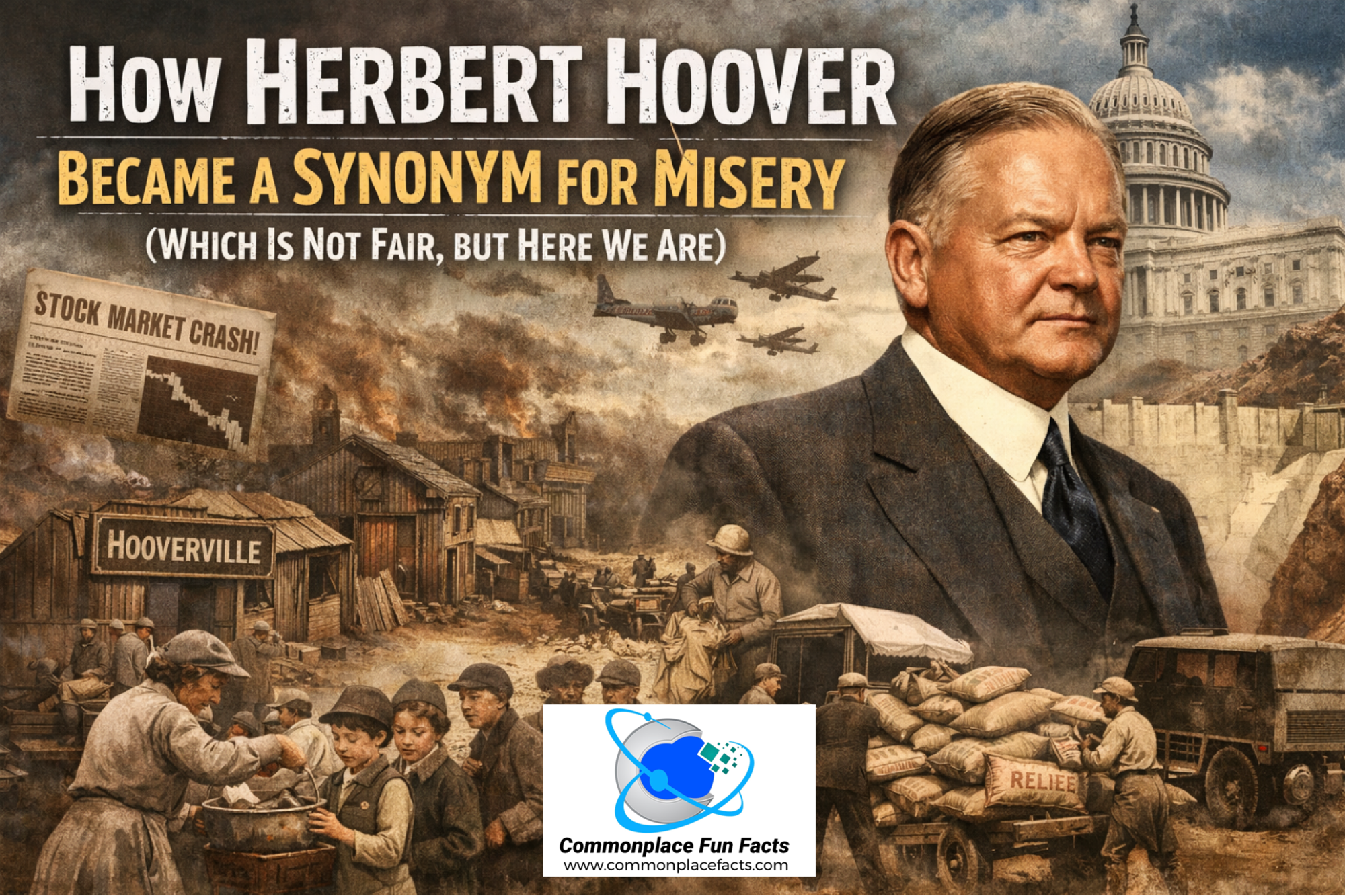

History has a habit of turning complicated human beings into punchlines. Some people get remembered for a single heroic charge. Others get remembered for inventing sliced bread. Herbert Hoover got remembered for economic collapse.
That is a branding problem of historic proportions.
For most Americans, Hoover’s name exists in the same mental drawer as the Great Depression, bread lines, and makeshift shantytowns known as “Hoovervilles.” When your last name becomes shorthand for national despair, you have officially lost control of the narrative.
The unfair part? Hoover did not invent the Great Depression. He did not wake up on a crisp autumn morning in 1929 and say, “What if we crater the global economy?” He happened to be sitting in the Oval Office when the bottom dropped out of the world.
Had Hoover never become president, his historical reputation would likely read something like this: Brilliant engineer. Global humanitarian. Master organizer. The man who fed millions during wartime Europe. A logistical wizard with a talent for making enormous systems actually function.
Instead, he drew the short straw of economic timing. History has never been especially sympathetic to unlucky executives.
So before we reduce him to the patron saint of cardboard shacks, it is worth looking at the earlier chapters of his life—the part where he was, by almost any objective measure, astonishingly effective.
Contents
The Quaker Kid Who Became a Global Troubleshooter
Herbert Hoover was born in 1874 in West Branch, Iowa, into a Quaker family. The Quaker tradition emphasizes modesty, discipline, and doing useful things quietly. It does not emphasize self-promotion. This matters later.

By the time he was ten years old, Hoover had lost both of his parents. If you are looking for the origin story where the future villain vows revenge, this is the wrong movie. Hoover was instead sent west to live with relatives and eventually enrolled in a brand-new university in California called Stanford. He was part of its first generation of students.
He studied geology. He did not study “How to Become the Face of an Economic Disaster.” Geology was practical. Rocks make sense. Markets occasionally do not.
After graduating in 1895, Hoover did what ambitious young engineers do: he went wherever the work was. Australia. China. London. Remote mines. Chaotic operations. Places where things were complicated and expensive and badly in need of someone who could bring order to them.
Hoover developed a reputation for walking into a mining operation that resembled financial and managerial confusion, and leaving behind something that functioned. He was not glamorous. He was methodical. He solved problems. He organized. He implemented systems.
And he did extremely well for himself. By his early 40s, Hoover was independently wealthy from engineering work and technical publications. He did not need politics. Politics would later need him.
World War I: The Man Who Fed Europe
In 1914, Europe exploded into war. Belgium was invaded. Civilians were trapped between occupying forces and blockades. Starvation loomed.
Enter Herbert Hoover, mining engineer.
Through a combination of organizational talent, relentless persistence, and a willingness to negotiate with everyone from British officials to German authorities, Hoover helped create and lead the Commission for Relief in Belgium. The operation delivered food to millions of civilians in occupied territory.

Pause and appreciate the logistical absurdity of this. He was coordinating international shipping, neutral relief, wartime diplomacy, and financial operations—all while armies were actively trying to win a war.
If you are imagining a superhero whose power is “efficient grain distribution under hostile conditions,” that is essentially the plot.
When the United States entered World War I, President Woodrow Wilson appointed Hoover to head the U.S. Food Administration. Hoover encouraged conservation at home and managed agricultural production to sustain both American forces and allies abroad. He preferred voluntary cooperation to coercion, which fit his personality and his Quaker sensibilities.
After the war, Hoover continued coordinating massive relief efforts across Europe, including famine-stricken areas. He became one of the most recognizable humanitarian administrators in the world.
For a time, “Hoover” meant “the guy who prevents starvation.”
History has a dark sense of humor.
The Secretary of Commerce Who Built the Boring Infrastructure of Modern Life
In 1921, Hoover became Secretary of Commerce. If that sounds dull, that is because it is. It is also quietly powerful.
Hoover did not treat Commerce as a ceremonial stopover. He treated it as an engineering challenge. He pushed for product standardization so that parts made in one factory could work in another. He supported research into business cycles. He encouraged cooperation among industries to reduce waste and inefficiency.
He also played a key role in shaping the early development of radio broadcasting and commercial aviation. At a time when both technologies were chaotic and experimental, Hoover helped guide them toward something resembling order. Airplanes would not remain expensive toys for the bold and slightly reckless. Radio would not remain a free-for-all of electromagnetic shouting.
Then came the Great Mississippi Flood of 1927. It was one of the worst natural disasters in American history. Hoover was tapped to coordinate relief efforts.
He organized resources, mobilized volunteers, and directed aid on a massive scale. Newspapers praised his competence. The public saw a man who could marshal chaos into action.
By the late 1920s, Herbert Hoover was widely viewed as the ultimate problem-solver. Efficient. Capable. Honest. Successful. The kind of man who had a knack for walking into a mess and leaving behind a functioning system.
Then he was elected president in 1928.
And shortly thereafter, the system itself caught fire.
The Presidency: When the Building Collapsed During Your Shift
Herbert Hoover was inaugurated on March 4, 1929. He was elected on the tide of popularity of Calvin Coolidge and a wave of prosperity for the nation that seemed unstoppable, taking 58 percent of the popular vote and 444 of the 531 electoral vote.

He didn’t have long to bask in that popularity. Eight months into his presidency, the stock market collapsed. This is what historians call “unfortunate timing.”
It is difficult to overstate how catastrophic the global downturn became. Banks failed. Businesses folded. International trade contracted. Unemployment soared. Entire sectors of the economy simply stopped.
Hoover had spent his life solving concrete, logistical problems. This was not a malfunctioning mine or a flooded river basin. This was a planetary financial seizure. The tools available to presidents in 1929 were not the tools we think of today. There was no established federal safety net. No modern understanding of macroeconomic stimulus. No Federal Reserve playbook refined by decades of crisis management.
Hoover believed in action, but he believed equally in institutional stability. He pushed for cooperation between businesses, encouraged voluntary efforts to maintain wages, supported public works projects, and backed measures aimed at stabilizing banks and credit. In 1932, he signed legislation creating the Reconstruction Finance Corporation, designed to provide emergency loans to financial institutions and key industries. That idea—federal support to prevent systemic collapse—would later become a central pillar of New Deal policy.

One of the ironies of Hoover’s presidency is that some of the mechanisms expanded under Franklin Roosevelt were rooted in structures Hoover helped initiate. But Roosevelt had the advantage of arriving later, with the political space and public appetite for more dramatic expansion.
Hoover’s personality did him no favors. He was not a theatrical optimist. He did not deliver soaring fireside reassurances. He spoke in the language of administration and systems. When the public wanted emotional triage, they got a technical briefing.
During this time, Hoover’s health began to suffer. Doctors urged him to reduce both his stress and his waistline—two challenges not easily solved while presiding over a collapsing economy. The breakthrough came in an unexpected form: a heavy medicine ball and a tennis court.
Hoover began playing a vigorous game of catch with aides, hurling a weighted medicine ball back and forth across a net. It was exhausting. It was competitive. It was precisely what his doctors ordered. Hoover’s attempts to jumpstart the national economy may have fallen short, but he did, at least, leave the country with the enduring legacy of “Hoover-ball”—a sport played on a tennis court, somewhat resembling volleyball, except with fewer spikes and significantly more strained lower backs.
He worked tirelessly, but since he did not do it in a flashy or public way, his critics were successful in selling the message that the president was in over his head, wasn’t doing anything, or at least wasn’t doing anything effective.
It is also worth noting something that tends to get lost in the caricature. Hoover did not personally profit from the presidency. He never accepted compensation for his federal service. Already independently wealthy, he donated his presidential salary to charity. This does not reverse the economic collapse, but it does complicate the portrait of a grasping politician indifferent to suffering. Hoover believed public service was precisely that: service.
Unfortunately, nuance rarely survives bread lines.
Franklin D. Roosevelt defeated Hoover decisively on election day. Hoover’s popular vote was 39.6% —an 18.% decline from four years earlier. In the electoral vote, Hoover lost 59–472, carrying only six states.
The Long Winter: Exile After 1933
When Franklin D. Roosevelt took office in 1933, Hoover’s political reputation was in ruins. The transition between the two men was strained at best. Roosevelt represented energy, optimism, and sweeping experimentation. Hoover represented a previous approach that voters had just rejected.

For years afterward, Hoover existed in a kind of political exile. He criticized aspects of the New Deal and found himself on the outside of federal power looking in. The man who had once directed global relief operations was now largely sidelined.
Symbolism piled on. The massive Colorado River dam project authorized during Hoover’s presidency had originally been referred to as Hoover Dam. In the early years of the Roosevelt administration, the name “Boulder Dam” was used instead in official contexts. It was a small thing in practical terms. It was not a small thing in spirit. Bureaucratic pettiness is a bipartisan art form.
In 1947, Congress restored the name Hoover Dam. Redemption sometimes comes in concrete form.
The Truman Return: Efficiency Has a Comeback Tour
Herbert Hoover’s reentry into public life came from an unexpected quarter: President Harry Truman.

Truman, a Democrat with his own uphill battles, saw value in Hoover’s experience and administrative mind. In 1947, he appointed Hoover to head what became known as the Hoover Commission, tasked with reorganizing and streamlining the executive branch of the federal government.
The pairing was politically surprising, but practically sensible. Hoover had spent a lifetime studying how institutions work—and how they fail. The commission’s recommendations led to significant changes in federal organization, reducing redundancies and modernizing operations.
It was a reminder that Hoover’s core skill had never evaporated. He was still the man who could walk into bureaucratic complexity and leave it more coherent than he found it.
Then there is the pension story, which illustrates both Hoover’s financial independence and his regard for the office.
After leaving office, former presidents did not initially receive formal pensions. Truman’s modest financial circumstances became a public concern, eventually contributing to the passage of legislation providing presidential pensions. Hoover did not need the money. He was wealthy. But he agreed to accept the pension.
By doing so, he normalized it. The benefit was framed not as charity for one struggling former president, but as a standard recognition of service. In accepting something he did not require, Hoover helped protect the dignity of the office—and, quietly, Truman himself.
It was classic Hoover: practical, understated, and concerned with institutional stability over personal optics.
The Counterfactual: A Different Memory
If Herbert Hoover had retired wealthy in 1928 and never sought the presidency, his historical obituary would read very differently.
It would highlight the orphaned Quaker boy who built a global engineering career. It would celebrate the humanitarian who fed millions in war-torn Europe. It would praise the administrator who shaped commerce, aviation, radio, and disaster relief in ways that helped modernize the United States.
It would describe him as one of the most effective large-scale organizers of his era.
Instead, history fastened his name to an economic catastrophe like a permanent label.
That does not mean Hoover was flawless. He misjudged the scale of the crisis. He underestimated the public’s need for visible reassurance. He governed during a moment when the tools of policy were evolving faster than the institutions themselves.
But the man was more than the downturn that happened on his watch.
Herbert Hoover did not engineer the Great Depression. He simply happened to be in the president’s chair when the world’s economic machinery seized up. Before that moment—and long after it—he was a builder, an organizer, a humanitarian, and a reformer.
When he died in 1964 at the age of 90, NBC News acknowledged his humanitarian work: “At this moment, on this evening, let it be said [that] twice when there was hunger in the world, he addressed himself to feeding the hungry, and in so doing he probably saved more lives than any man in history.” But then, of course, the discussion turned to the Great Depression.
History sometimes remembers people for their worst timing rather than their best work. In Hoover’s case, the timing stuck.
The work deserves to be remembered too.
To learn more about the life and presidency of Herbert Hoover, visit the Herbert Hoover Presidential Library and Museum
You may also enjoy…

The Sorrowful Presidency of Franklin Pierce
Franklin Pierce, the 14th U.S. president, faced personal tragedy and political setbacks. His one-term presidency was marred by the death of his son, his wife’s seclusion, and accusations of alcoholism. His support for divisive policies and his anti-abolitionist stance further diminished his popularity. Despite close friendships, Pierce’s legacy is one of misfortune and missteps.

John Tyler: The Accidental President Who Refused to Back Down
John Tyler, the 10th U.S. President, is often overshadowed in history, but his legacy is anything but simple. From shaping the annexation of Texas to facing a divided Congress, explore the complicated story of a president who defied expectations. #AmericanHistory #JohnTyler

Fanny Crosby and Grover Cleveland: The Unlikely Friendship Between a Blind Hymnist and a President
Discover the inspiring story of the friendship between Fanny Crosby and Grover Cleveland—an unlikely connection that shaped history and influenced a future president.





Leave a Reply to Commonplace Fun FactsCancel reply