
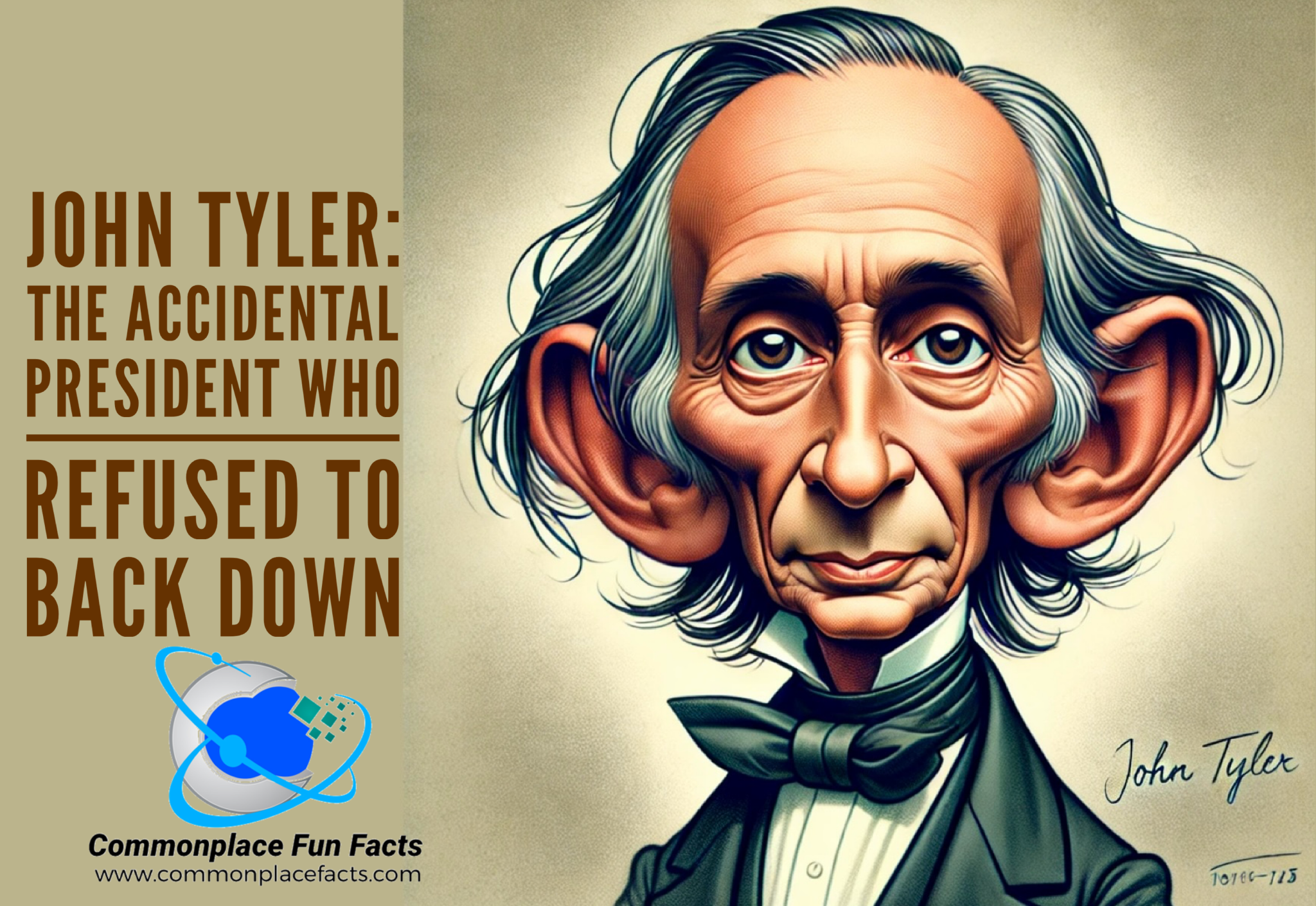

John Tyler is one of those presidents who tend to hover in the background of presidential history. He’s not the “I cannot tell a lie” guy, the “Honest Abe” of Civil War fame, or even the chap who frequently gets confused with the cartoon cat with a shared name. No, Tyler’s legacy is a little more like that teacher you had back in middle school whose name you can never remember, but if someone says it, it all comes back to you.
Contents
Tyler’s presidency began with the decidedly awkward event of William Henry Harrison dying only 31 days into his term. Harrison may have gone down in history for his impressively brief stint as commander-in-chief, but Tyler, his vice president, was about to make some history of his own. Some of it would admittedly be really important and valuable. Much of his legacy, however, is in desperate need for a public relations expert. Join us as we delve into the forgotten history of His Accidency, John Tyler, the accidental president.
John Tyler: The Accidental President
William Henry Harrison was elected as the 9th president in 1840. He remains as a vivid reminder of why we should all listen to our mothers and bundle up before going out in the cold — particularly if we plan on giving long, boring speeches in unfavorable weather. He gave the longest inaugural address in history, causing more than a few people in the audience to wonder if it was literally possible to be bored to death. The record is silent on whether anyone died of boredom, but it is clear that Harrison did not fare well from the experience. He got sick and died just 31 days into his term. When that happened, the political world was thrown into disarray.
It was an unprecedented situation. What do you do when the president kicks the bucket so early in the game? You might think the Constitution is clear on this issue, but in truth, the matter of presidential succession was a bit vague. Article II, Section 1 stated, “In Case of the Removal of the President from Office, or of his Death, Resignation, or Inability to discharge the Powers and Duties of the said Office, the Same shall devolve on the Vice President…” That’s all well and good, but does that mean John Tyler became the new president or merely assumed “the powers and duties of the said office” as an “Acting President”? Regardless of your answer to that question, how long was he to be in that role? Did he get to finish out Harrison’s 4-year term, or did he just keep things going until Congress could call a new election? For something as important as the presidency, there were a lot of unanswered questions. It would, in fact, be well over a century before the Constitution formally addressed many of these matters. You can read about those developments in this article, but Tyler didn’t have the luxury of waiting around for the answers.

Without any clear direction in the Constitution, Tyler announced that he was, as of that moment, the Big Cheese himself. He would hear nothing about being called “Mr. Acting President” or “Mr. Kinda-Sorta President.” He was the for-real Commander-in-Chief, and it was up to him to carry on for the rest of his predecessor’s term. Tyler took the oath of office faster than a contestant grabbing the last vowel on Wheel of Fortune. In doing so, he set a critical precedent for how future vice presidents would handle the untimely demise of their presidential counterparts. The result was an orderly transition of power. Think of Tyler’s decision as the granddaddy of future smooth transitions following the deaths of Presidents Taylor, Lincoln, Garfield, McKinley, Harding, Roosevelt, and Kennedy.
That’s not to say that everyone agreed with his decision. Some of the biggest opposition came from members of Tyler’s own party. The Whigs had nominated him as Harrison’s running mate in 1840 only because they needed a warm body from Virginia to help win the election. They may have been OK with a Vice President Tyler. When he elevated himself to the top spot, that triggered some grumbling. Some even took to calling him “His Accidency.” Tyler knew he was unlikely to be remembered with anything as catchy as “The Father of His Country,” but he certainly didn’t want “The Accidental President” to be part of the John Tyler legacy. Others, clearly unable to handle Tyler’s audacity, addressed letters to “Acting President Tyler.” He refused to open those letters and marked them “Return to Sender.”
He had made up his mind that he was the president, and as far as he was concerned, that matter was firmly settled. For better or worse, he would be a part of presidential history.
The Second Big Decision of the John Tyler Legacy
His first big decision was controversial, but history shows that it was the right one. Unfortunately, not all of his decisions were quite so brilliant. Tyler had rightfully decided he would finish out Harrison’s term, but that means he also decided to keep Harrison’s cabinet. That included some Whigs who were among the biggest opponents of Tyler’s sudden promotion.
During his brief term in office, Harrison announced that major policy decisions would be made by a vote of the cabinet, in which he would have one vote, equal to the others. Tyler would have none of that and firmly declared there was only one vote that mattered, and it was his.
He said, “I beg your pardon, gentlemen; I am very glad to have in my Cabinet such able statesmen as you have proved yourselves to be. And I shall be pleased to avail myself of your counsel and advice. But I can never consent to being dictated to as to what I shall or shall not do. I, as president, shall be responsible for my administration. I hope to have your hearty co-operation in carrying out its measures. So long as you see fit to do this, I shall be glad to have you with me. When you think otherwise, your resignations will be accepted.”

His cabinet was outraged, none more than Henry Clay. Clay was the most powerful member of the cabinet. He was the real puppeteer behind the Whig party. Clay had assumed he would continue pulling the strings as he had with Harrison. He was in for a rude awakening, however. Tyler wasn’t about to be anyone’s puppet.
Within weeks, Tyler found himself in a situation that could only be described as hostile. Congress, led by Clay, despised him, and Tyler returned the favor. Tyler called a special session of Congress, and soon enough, a bill to resurrect the Bank of the United States (something Andrew Jackson had demolished a decade earlier) landed on his desk. Tyler, committed to his states’ rights philosophy, vetoed the bill. Congress tried again with slightly different language. Tyler, like a kid rejecting broccoli at dinner, vetoed it again.
As a result, every member of his cabinet except for Daniel Webster resigned in protest. The Whigs, not ones to take a slight lightly, promptly kicked Tyler out of the party and publicly denounced him as a traitor. They even demanded that he step down and let the Senate President Pro Tempore take over. Tyler, naturally, refused to budge. If there’s one thing Tyler was good at, it was staying put when people wanted him gone.
Tyler vs. Congress: The Battle Continues
With his cabinet in disarray and no friends left in the Whig party, Tyler cobbled together a new group of advisors, mostly conservative Democrats who probably took the job because no one else wanted it. The administration continued to limp along, with Congress and Tyler locked in an almost cartoonish stalemate, with one of the least cooperative legislative relationships in presidential history.
The Whigs, clearly out for revenge, began impeachment proceedings against Tyler. It was mostly a spiteful move, but it didn’t gain much traction. Tyler was eventually censured by Congress for his troubles. That essentially means that Congress went on record to say, “We REALLY don’t like John Tyler.”
Ironically, one aspect of the John Tyler legacy, though marked by chaos, proved one thing: even a president with no party support could wield substantial power. Tyler showed that a stubborn president could block Congress from enacting its agenda, using vetoes like a toddler throwing Legos to prevent his siblings from building anything. Clay’s hopes of passing a national bank, high tariffs, or public land distribution bills were dashed on the rocks of Tyler’s obstinacy. Congress even tried to amend the Constitution to make it easier to override presidential vetoes, but that effort fell flat.
A Tragic Love Story and a Second Chance at Happiness

Amid all the political chaos, Tyler’s personal life took a heartbreaking turn. His wife, Letitia, who had been ill for some time, passed away in 1842. But the president didn’t stay lonely for long. A mere five months later, Tyler began courting Washington socialite Julia Gardiner, a woman thirty years his junior and younger than some of his children. Their whirlwind romance became the talk of the town, with everyone raising an eyebrow at the age difference and the speed of the courtship. But Tyler didn’t care. He had a presidential precedent to set, and apparently, a second love story to write. On June 26, 1844, Tyler added another “first” to presidential history. He became the first president to get married while in office.
The Texas Gamble: Tyler’s Last Stand
Although lucky in love, John Tyler continued to strike out in the political realm. He hoped to use the annexation of Texas to claw his way back into political respectability. Sadly, he had another thing coming. Texas, having declared its independence from Mexico years earlier, was in a bit of a limbo. Tyler knew he lost the support of his party, so he tried to create a new one. He hoped that the annexation of Texas would give him enough popular support to build his party around that issue. Mexico still claimed Texas, however. Annexation carried the strong possibility of war. On top of that, many Americans weren’t exactly eager to welcome another slave state into the Union.
Tyler’s biggest blunder in the Texas debacle came when he appointed John C. Calhoun, the infamous pro-slavery firebrand, as Secretary of State. Calhoun’s obvious enthusiasm for the institution of slavery scared off potential supporters. Even though Tyler tried to push the annexation treaty through the Senate, it failed. Tyler, being Tyler, didn’t give up. He managed to secure Texas’ statehood through a joint resolution requiring only a simple majority, and in March 1845, Texas officially joined the Union. Tyler signed the bill into law just three days before leaving office.
The Final Insult
As if to remind Tyler that he wasn’t exactly leaving on a high note, Congress overrode one of his vetoes on his final day in office. It was a minor bill about funding some ships, but it marked yet another first in presidential history: it was the first time in history that Congress had overridden a presidential veto. This was a final parting shot at a president who had spent four years doing little else but vetoing.
And so, John Tyler, “His Accidency,” left office, not in triumph, but with a legacy of stubbornness, political isolation, and a Texas-sized gamble that, for better or worse, changed the course of American history. He may not have been loved, or even liked. Just read his obituary, if you have any doubts about that.

Almost Famous: How Benjamin Wade Came Just 1 Vote from the Presidency and Still Got Ghosted by History
Discover the fascinating story of Benjamin Wade, the U.S. Senator who came one vote away from becoming President—and was promptly forgotten by history. A fiery Radical Republican, nearly a Commander-in-Chief, now a trivia question.

Presidential Deaths Fun Facts: When the Commander-in-Chief Checks Out
Explore the weirdest and most intriguing trivia about U.S. presidential deaths, from July 4th exits to longevity legends. History has never been so bizarre!

Theodore Roosevelt and the Runaway Streetcar: How a Speeding Trolley Nearly Took Down a President
In 1902, President Theodore Roosevelt narrowly escaped death when a streetcar collided with his carriage, killing a Secret Service agent. His close call with death brought the nation perilously close to losing two presidents in one year. While Roosevelt was able to joke about the incident later on, the incident highlighted the nation’s vulnerability to…

Leave a Reply