
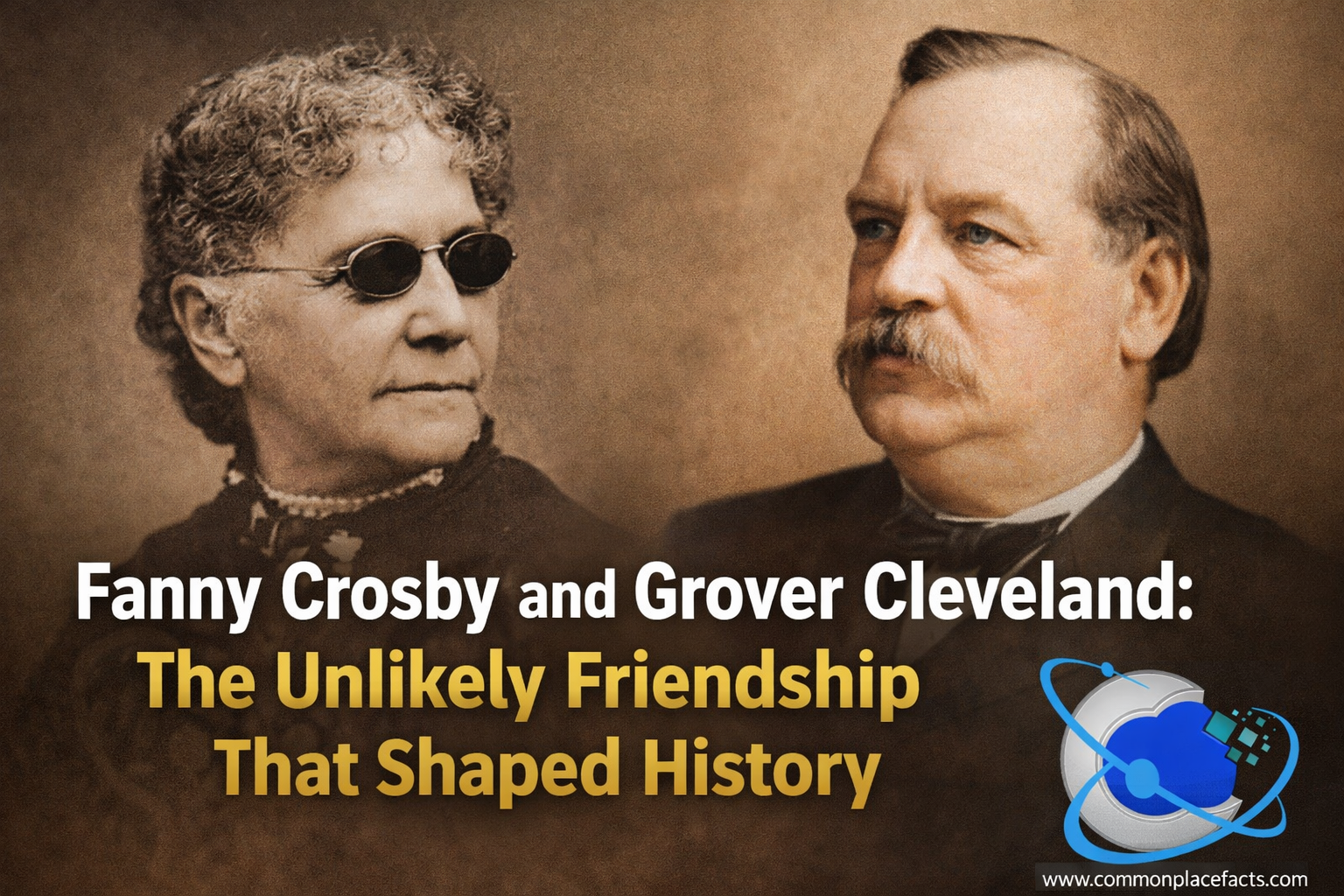

Fanny Crosby and Grover Cleveland: The Unlikely Friendship That Shaped History
Fanny Crosby was a blind hymn writer who became one of the most influential figures in American religious music. She also shared a lifelong friendship with Grover Cleveland, who would go on to become President of the United States. Their unlikely connection—formed long before political ambition entered the picture—quietly shaped two remarkable lives.
Frances and Grover were unlikely friends. For one thing, she was seventeen years his senior. Beyond the obvious difference in their ages, the two could not have been more different.
Contents
Early Life of Fanny Crosby

Frances started life with the odds stacked impressively against her. Born in 1820, she was just six weeks old when an infection settled in her eyes. Whether it was the illness itself or the mustard poultices applied in what we will generously call “early experimental medicine,” the result was permanent damage to her optic nerves and total blindness.
As if that were not enough for one infant to handle, her father died that same year. Her mother, now the sole provider, had to work outside the home, leaving Frances in the care of her grandmother.
Blindness, Faith, and Finding Her Voice
If Frances ever entertained the idea of giving up, history has been kind enough not to record it. Instead, she did something far more inconvenient for anyone expecting a tragic narrative: she embraced her blindness.
She discovered that while she could not see the world, she could describe it—beautifully. By the age of eight, she was already writing poetry, including reflections on her blindness that were remarkably free of self-pity.
Her poem on the death of President William Henry Harrison brought her national attention when it was published in the New York Herald. From there, her work began appearing regularly in newspapers, which is not bad for someone who technically could not read them.
Quick Facts About Fanny Crosby
- Born: 1820
- Blind since: 6 weeks old
- Occupation: Poet and hymn writer
- Hymns written: 8,000+
- Famous works: “Blessed Assurance,” “To God Be the Glory,” “Praise Him! Praise Him!”
- Known for: One of the most prolific hymn writers in history
Education and Influence in Washington
At fifteen, Frances enrolled at the New York Institution for the Blind, where she spent a decade refining her writing and musical talents. She also developed a passion for advocating for education for the blind—a cause that led her directly into the halls of power.
At just 23 years old, she became the first woman to speak before the United States Senate, reciting one of her poems. Not content with that milestone, she later performed at the White House for President James K. Polk.
In short, she had a knack for making influential people stop what they were doing and pay attention—which, as it turns out, would come in handy later.
Meeting Stephen (Grover Cleveland)
In 1846, Frances returned to the Institute as a teacher. It was there that she met a 16-year-old student named Stephen—tall, imposing, and grieving the recent loss of his father.

Stephen’s older brother, who taught at the school, asked Frances to spend time with him. She agreed, and what began as a simple act of kindness turned into a friendship that would last more than fifty years.
Stephen, who would later become known as Grover Cleveland, was not exactly a model student at the time. He was reluctant, unsettled, and trying to figure out what to do with his life—like many teenagers, but with fewer modern distractions and significantly more 19th-century expectations.
A Friendship That Lasted a Lifetime
Even after Frances left the school in 1858, the two stayed in touch. Stephen watched from afar as her name appeared regularly in newspapers, while she followed his gradual rise through law and politics.
Whether her early influence directly shaped his ambitions is impossible to prove, but it is difficult to ignore the coincidence. The boy who once needed encouragement went on to become a prosecutor, sheriff, mayor of Buffalo, Governor of New York—and eventually, President of the United States.
Fanny Crosby’s Musical Legacy
Frances preferred to be called Fanny, and history has wisely complied. Under the name Fanny Crosby, she became one of the most prolific hymn writers of all time, composing more than 8,000 hymns.
Her works—such as “Blessed Assurance” and “To God Be the Glory”—have been sung by millions. By some estimates, more than 100 million copies of her hymns have been printed, which places her somewhere between “successful” and “single-handedly responsible for a significant portion of church music.”
Grover Cleveland’s Rise to Power
Stephen eventually abandoned his first name in favor of his middle name—Grover—which sounds less like a frontier strongman and more like someone destined for ballots and history books.
His rise through politics was steady and impressive. By 1886, he had become President of the United States—and, in a detail that feels almost scripted, the first president to be married in the White House. The First Lady’s name was Frances, which must have given Fanny at least a moment of amusement.
Why Their Story Still Matters
The story of Fanny Crosby and Grover Cleveland is a reminder that history is not just shaped by elections, speeches, and policies. It is shaped by relationships—often quiet ones—that influence people long before they step into the spotlight.
It is also a story about resilience. Crosby did not merely overcome blindness; she redefined it as an advantage. Her life challenges assumptions about limitation, while Cleveland’s story reflects how early encouragement can echo across decades.
A Friendship That Endured
Their friendship endured for more than half a century. On the occasion of her 85th birthday, President Grover Cleveland wrote to her, reflecting on their long acquaintance and expressing admiration for her life’s work:
My dear friend:
It is more than fifty years ago that our acquaintance and friendship began; and ever since that time I have watched your continuous and interested labor in uplifting humanity, and pointing out the way to an appreciation of God’s goodness and mercy.
Though your labors have, I know, brought you abundant rewards in your consciousness of good accomplished, those who have known of your works and sympathized with your noble purposes owe it to themselves that you are apprized of their remembrance of these things. I am, therefore, exceedingly gratified to learn that your eighty-fifth birthday is to be celebrated with a demonstration of this remembrance. As one proud to call you an old friend, I desire to be early in congratulating you on your long life of usefulness, and wishing you in the years yet to be added to you, the peace and comfort born of the love of God.
Yours very sincerely,

It was a fitting tribute—not just from a president, but from a former student who never forgot the woman who took the time to talk to “the boy.”
The friendship between Fanny Crosby and Grover Cleveland reminds us that influence does not always announce itself. Sometimes, it looks like a conversation, a bit of encouragement, or a teacher who simply shows up at the right moment.
You may also enjoy…

The Little Dwarf Who Advised a President: How the Julia Sand Letters to Chester A. Arthur Shaped a Presidency
Julia I. Sand, became an unexpected moral advisor to President Chester A. Arthur and helped shape his presidency. Through 23 bold letters, she criticized his past and urged him towards reform. Becoming one of the most unlikely of presidential advisors, Sand made a remarkable impact in a male-dominated political landscape.

Olympic Competition Couldn’t Divide This Eternal Friendship
What happens when two highly-competitive friends go head-to-head in the biggest competition in the world? Something has to give; will it be friendship or Olympic-sized dreams? When the world’s top athletes gathered in Berlin for the 1936 Olympic games, two Japanese pole vaulters proved that friendship was something more precious than a medal. When American…

Grace Bedell: The Girl Responsible for History’s Most Famous Beard
Abraham Lincoln is one of the most-recognized figures in history. If you ask anyone to describe him, inevitably you will hear that he was tall, wore a stovepipe hat, and had a beard. Of those, the beard is the one that seems the most memorable. The beard for which he would be remembered did not…




Leave a Reply