
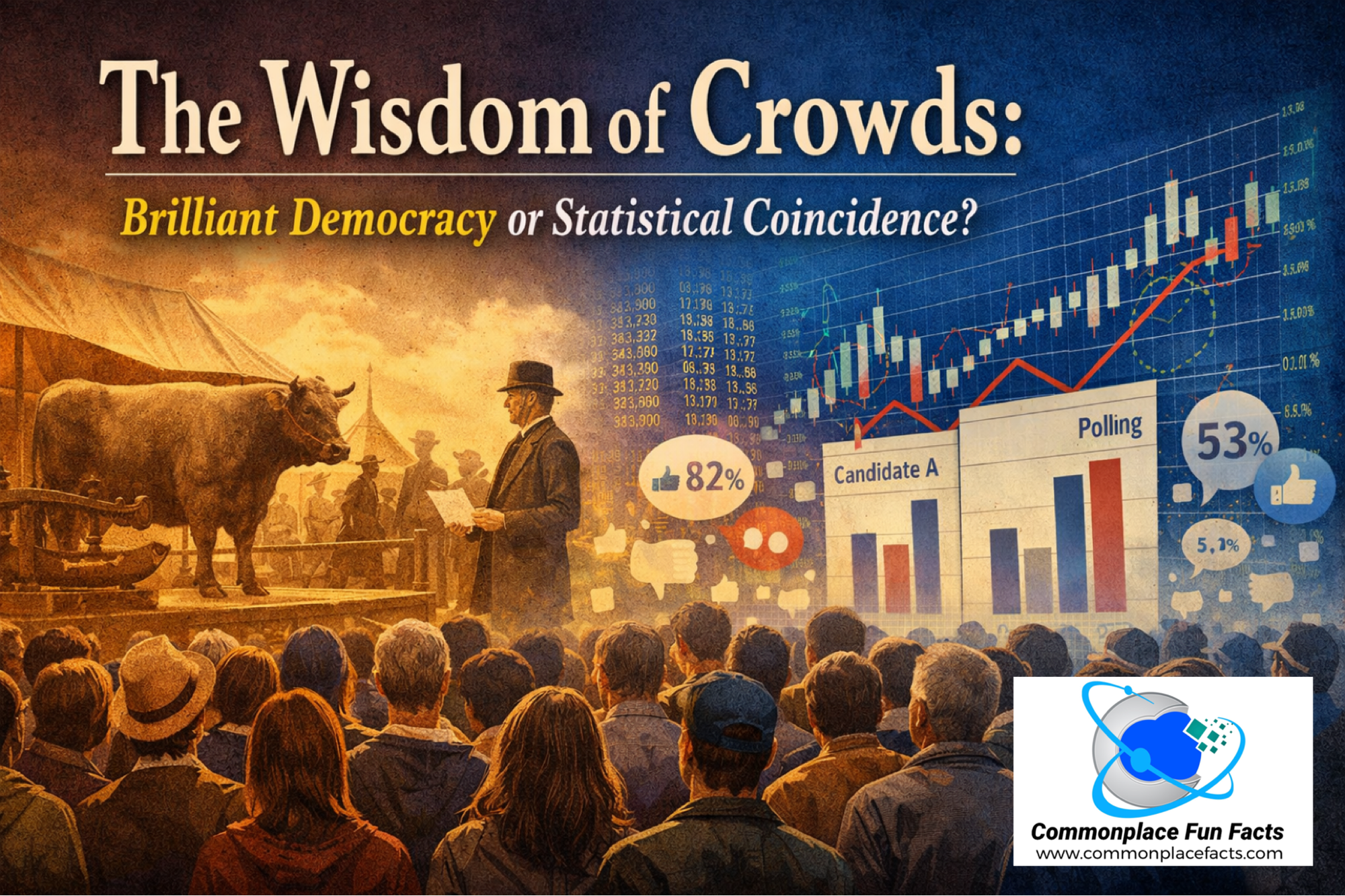

Humanity has long cherished a comforting idea: while individuals may be foolish, humanity in bulk is apparently brilliant.
Put enough of us in a room, the theory goes, and truth will float to the surface like cream rising in an old-fashioned milk bottle. The crowd will correct our mistakes. Democracy will hum. Statistics will sparkle. Conventional wisdom will lead us to the correct result because the wisdom of crowds is infallible.
It is a lovely thought.
It is also more fragile than most of us realize.
Contents
The Ox That Launched a Thousand Conference Talks
In 1906, Sir Francis Galton—Victorian polymath, statistician, explorer, and cousin of Charles Darwin—attended a livestock fair in England. Being the kind of man who could not attend a fair without quietly inventing a branch of mathematics, he noticed a guessing competition.

Seven hundred eighty-seven people each paid to guess the weight of an ox. Farmers, butchers, casual fairgoers—an assortment of humanity in hats.
Individually, they were not impressive. No single guess nailed it.
But Galton, ever the number-cruncher, gathered all 787 guesses and calculated their average.
It was astonishingly accurate—within about a pound of the ox’s true weight.
He described the episode in a 1907 paper in Nature titled “Vox Populi” (Latin for “voice of the people”). The story has since been told so often that one suspects the ox deserved a royalties agreement. It became Exhibit A for what would later be branded “the wisdom of crowds.”
The lesson seemed clear: large groups can outperform experts. The logical conclusion is that conventional wisdom is nothing to be sneezed at. When in doubt, you should trust the wisdom of crowds, because what an individual may not know, humanity collectively does.
That’s the conventional wisdom interpretation of the experiment. Ironically, the conventional wisdom didn’t quite get it right.
Francis Galton: The Man Who Measured Everything
If the Victorian era had a patron saint of measuring things, it was Sir Francis Galton.
Born in 1822 into a well-to-do English family — and inconveniently overshadowed at dinner parties by the fact that his cousin was Charles Darwin — Galton spent his life trying to quantify humanity. Where most people saw personality, talent, weather, or heredity, Galton saw variables waiting to be graphed.

He was a genuine polymath. Explorer. Meteorologist. Statistician. Early psychologist. Amateur inventor of devices that no one had previously felt the absence of. He helped develop modern weather mapping. He pioneered fingerprint classification for forensic science. He conducted some of the first large-scale questionnaires in the social sciences. If there was a phenomenon that could be measured, Galton felt morally obligated to measure it.
He also popularized the phrase “nature versus nurture,” framing one of the central debates of modern psychology. His fascination with inheritance led him to study family lineages in an attempt to determine whether genius ran in bloodlines. In doing so, he laid the groundwork for the statistical concepts of correlation and what he called “regression toward mediocrity” — now known as regression toward the mean.
If you have ever plotted a best-fit line on a scatter graph, you are living inside Galton’s intellectual legacy.
He even invented a device — now called the Galton board — that drops beads through a forest of pegs to demonstrate how random variation naturally forms a bell curve. Victorian parlor entertainment, but make it probability theory.
As if that weren’t enough, Galton also proposed an improved way to cut a cake and published his groundbreaking method in a letter in Nature.
Not all of his ideas aged gracefully. Galton coined the term “eugenics,” promoting the notion that human populations could be improved through selective breeding. Later generations turned that concept into policies whose consequences were tragic and appalling. Read “Better Babies: When State Fairs Judged Babies and Went From Blue Ribbons to Eugenics” for more about this phenomenon. History tends to preserve genius and cautionary tale in the same biography.
Which makes Galton a fitting figure in the story of crowd wisdom. He was a man who believed, deeply, that numbers could illuminate human behavior. Sometimes he was brilliantly right. Sometimes he was profoundly wrong.
But he never stopped counting.
Did the Ox Experiment Prove the Wisdom of Crowds?
Galton’s ox experiment seemingly demonstrated that collectively, a bunch of people can find the answer that no individual can provide. The reason it worked was because several very specific conditions happened to be true at the same time.
First, the guesses were diverse. Farmers brought experience. Others brought intuition. Some were wild. Some were cautious.
Second, the guesses were largely independent. People wrote them down privately. They weren’t standing in a circle chanting numbers at one another.
Third, there was a real, fixed answer. The ox did not change its weight mid-afternoon due to public opinion.
Fourth, Galton used a proper method of aggregation: the mean. When errors are random and independent, mathematical averaging cancels out the mistakes.
Imagine one guess is 50 pounds too high and another is 50 pounds too low. Together, they form something close to brilliance.
That is not hive intelligence. That is error cancellation.
A key concept that is carrying the heavy lifting here is independence.
Enter Herding, Stage Left
Now picture a different scenario. A jar of candy sits on a table. The first person confidently declares there are 500 pieces inside. You have no idea how many pieces the jar holds. You’re quite certain it isn’t 10 million. You can tell that it’s more than 12. Before you heard the first person, you probably were leaning toward something closer to 250, but then you heard 500. You have to make a guess, so what do you do? Whether you realize it or not, you are subtly pulled toward 500.
This is anchoring bias. Behavioral economists such as Daniel Kahneman and Amos Tversky showed that once a number enters the air, it exerts gravitational force.
Add to this the Dunning-Kruger Effect—the tendency of people with limited knowledge to overestimate their own competence—and you have a crowd that is not merely influenced, but confidently misled. When inaccurate certainty spreads faster than cautious expertise, the “wisdom” of crowds can begin to resemble synchronized misunderstanding.
The crowd stops behaving like 787 independent statisticians and starts behaving like a mildly anxious choir.
When guesses are visible, independence evaporates. Instead of canceling errors, you amplify them.
The result is not wisdom.
It is synchronization.
When Crowds Manufacture Reality

The situation becomes even more combustible when there is no single fixed answer.
The ox had a definite weight. The jar held a specific number of pieces. Financial markets do not operate that way. Neither do political outcomes. These systems are reflexive, meaning that beliefs about the system affect the system itself.
If enough investors believe housing prices will rise forever, they buy houses. That buying pushes prices higher. The belief reinforces itself. Then gravity returns.
Political polling starts years before the election. The only true poll that matters is the vote on Election Day, so why are we seeing so many polls that don’t matter? It’s because they do matter—for shaping public opinion and convincing people to follow “the wisdom of crowds.” After all, if 60% of a polling sample thinks that Vermin Supreme will lead the nation on ponies to a bright zombie-powered future, then they must know what they’re talking about.
This is herding behavior on a grand scale. Tulip mania. Beanie Babies. The housing bubble. Meme stock frenzies. The crowd is not estimating reality; it is inflating it.
In such cases, the “wisdom of crowds” can look less like a sage elder and more like a stampede of caffeinated lemmings (who don’t actually commit mass suicide—yet another delusion caused by this very phenomenon).
Does Diversity Actually Save Us?
In 2004, political scientist Scott Page and other researchers demonstrated something both reassuring and slightly inconvenient: under the right conditions, a diverse group of reasonably competent problem-solvers can outperform a homogeneous group of experts.

Before anyone drafts motivational posters, we need to clarify what kind of diversity is doing the work.
The research points primarily to cognitive diversity—differences in mental models, assumptions, heuristics, and problem-solving strategies. One person approaches a problem algebraically. Another frames it historically. A third thinks in systems. A fourth relies on pattern recognition. They are not merely different people; they are applying different internal frameworks.
When frameworks differ, errors differ. And when errors differ, they are less likely to align.
A room full of experts trained in the same discipline may be highly competent, but they often share the same blind spots. Averaging their answers can simply preserve those shared limitations. Agreement alone does not produce insight. Sometimes it merely produces confident symmetry.
This is why surface-level variety is insufficient if it masks intellectual uniformity. A group can look different and still think alike. If the assumptions, incentives, and interpretive lenses are the same, the average will faithfully replicate them.
What strengthens collective judgment is not representation as a checklist but the presence of genuinely different ways of seeing the problem. The mildly disagreeable dissenter—the one who questions the model, reframes the premise, or resists the prevailing interpretation—often improves outcomes precisely because their errors are misaligned with everyone else’s.
The aim is not diversity for optics. It is diversity for interference. When blind spots do not overlap, cancellation of errors becomes possible. If everyone in the room has the same preconceptions about what is right and wrong with the world, whatever comes out of their “wisdom of crowds” will continue to carry those same preconceptions.
In crowd dynamics, uniformity is comfortable.
Difference is useful.
Diversity doesn’t save us because it is virtuous; it helps because it scrambles our blind spots.
The Recurring Irony
Some commentators now argue that the “wisdom of crowds” has been oversold. Mathematicians and statisticians increasingly emphasize its limitations, pointing out how fragile the necessary conditions really are. Independence is rare. True cognitive diversity is uncommon. Herding creeps in faster than we notice. Under scrutiny, the miracle looks less miraculous.
Which introduces an enjoyable paradox. If a growing consensus among experts concludes that crowds are unreliable, what exactly are we watching? A collection of individuals independently reaching the same conclusion? Or a crowd of specialists arriving at a shared judgment about crowds?
Experts, after all, attend the same conferences, read the same journals, cite the same papers, and occasionally nod along to the same keynote speakers. Intellectual communities can herd just as efficiently as financial markets. The fact that the participants possess PhDs does not immunize them against social influence.
This does not mean the critics are wrong. It simply means the phenomenon is recursive. The critique of crowd wisdom must itself satisfy the conditions it prescribes: independence, diversity of thought, and resistance to echo chambers. Otherwise, the objection risks reenacting the very dynamics it seeks to expose.
The result is not a contradiction but a reminder. There is no vantage point outside the system. Every theory about collective judgment is produced by a collective. Even skepticism travels in packs.
When Should You Actually Trust the Crowd?
All of this begs the practical question: when, exactly, should you trust the wisdom of crowds?

Start with a dramatic scenario. You are staring at a ticking device. Three wires: red, yellow, blue. Twenty people with no training begin shouting instructions. Twelve yell “Red!” Five insist on “Blue!” Three bravely suggest “Yellow!”
Should you go with the majority?
No. You should probably ask whether any of them have ever defused a bomb before.
The wisdom of crowds does not magically generate expertise out of thin air. Aggregation only works when individuals are bringing partially accurate, independently formed estimates to a question with a measurable answer. Twenty uninformed guesses do not cancel each other’s errors; they merely multiply them.
Then there is the reassuring phrase: “Eight out of ten dentists recommend this toothbrush.” That sounds suspiciously like consensus. And sometimes it reflects exactly that—expert aggregation within a defined domain. If eight trained professionals independently evaluate plaque reduction data and reach similar conclusions, averaging their judgment has statistical value.
What matters is who the crowd is, what they know, whether their opinions were formed independently, and whether the question has a stable answer. If the group consists of informed individuals evaluating evidence separately, majority agreement can be meaningful. If the group consists of uninformed voices reacting to each other in real time, majority agreement may simply reflect social gravity.
In other words, trust crowds when they are estimating something measurable and when each participant is thinking independently. Distrust crowds when the participants lack domain knowledge, when visibility shapes responses, or when the system itself changes in response to belief.
Under the right conditions, a crowd is a distributed computing system. Under the wrong conditions, it is just a microphone with feedback.
So Should You Trust the Crowd?
The most honest answer is conditional.
Trust the crowd when individuals are independent, incentives are varied, diversity is high, and there is a real factual answer waiting to be discovered.
Doubt the crowd when opinions are visible, prestige attaches to being first, emotion runs high, or when beliefs can alter the outcome itself.
You should also be wary when everyone in the crowd shares the same worldview. Consensus in that case may reflect a well-insulated echo chamber rather than independently reasoned conclusions.
In other words, trust conventional wisdom like you trust fireworks: when properly contained and supervised, they are dazzling. When loose in dry grass, less so.
An Unconventional Word About Conventional Wisdom
The wisdom of crowds is not a fairy tale, and it is not a fraud. It is a conditional phenomenon that works beautifully under the right circumstances and collapses spectacularly under the wrong ones.
When individuals think independently, bring different mental models, and respond to questions with stable answers, crowds can approximate truth with eerie precision. The averaging process smooths out random mistakes. The noise fades. The signal sharpens.
But when visibility replaces independence, when incentives align, or when shared assumptions dominate the room, the same machinery can amplify error instead of canceling it. In those moments, agreement feels reassuring precisely when it should make you nervous.
The real lesson is not “trust the wisdom of crowds” or “distrust the wisdom of crowds.” It is learn to diagnose the conditions. Ask whether the voices are independent. Ask whether the models differ. Ask whether the question has a fixed answer at all.
Human beings do not transform into sages simply by forming a group. Nor do they become fools merely because they agree with each other. Crowds are tools. And like most tools, they work remarkably well when used properly and remarkably poorly when misapplied.
The ox at the fair was weighed with surprising accuracy because the circumstances cooperated. Outside the fairgrounds, the world is noisier, more reflexive, and far less accommodating. The responsibility, then, falls not on “the crowd” in the abstract, but on us—to understand when collective judgment is likely to illuminate and when it is likely to mislead.
Because in the end, the crowd is not wise or foolish on its own. It is human. And humans, whether alone or aggregated, require conditions to be at their best.
You may also enjoy…

The Dunning-Kruger Effect: Why People Who Know the Least Yell the Loudest
Why do those who know the least seem to insist that they know the most? Welcome to the Dunning-Kruger Effect!

The Deceptiveness of Conventional Wisdom
“Nothing is more unpredictable than the mob, nothing more obscure than public opinion, nothing more deceptive than the whole political system.” —Cicero, 106–43 B.C.

H.L. Mencken: Betting on the Intelligence (or Lack Thereof) of the Masses
“No one in this world, so far as I know — and I have searched the records for years, and employed agents to help me — has ever lost money by underestimating the intelligence of the great masses of the plain people.” — H.L. Mencken




Leave a Reply to Jim BordenCancel reply