
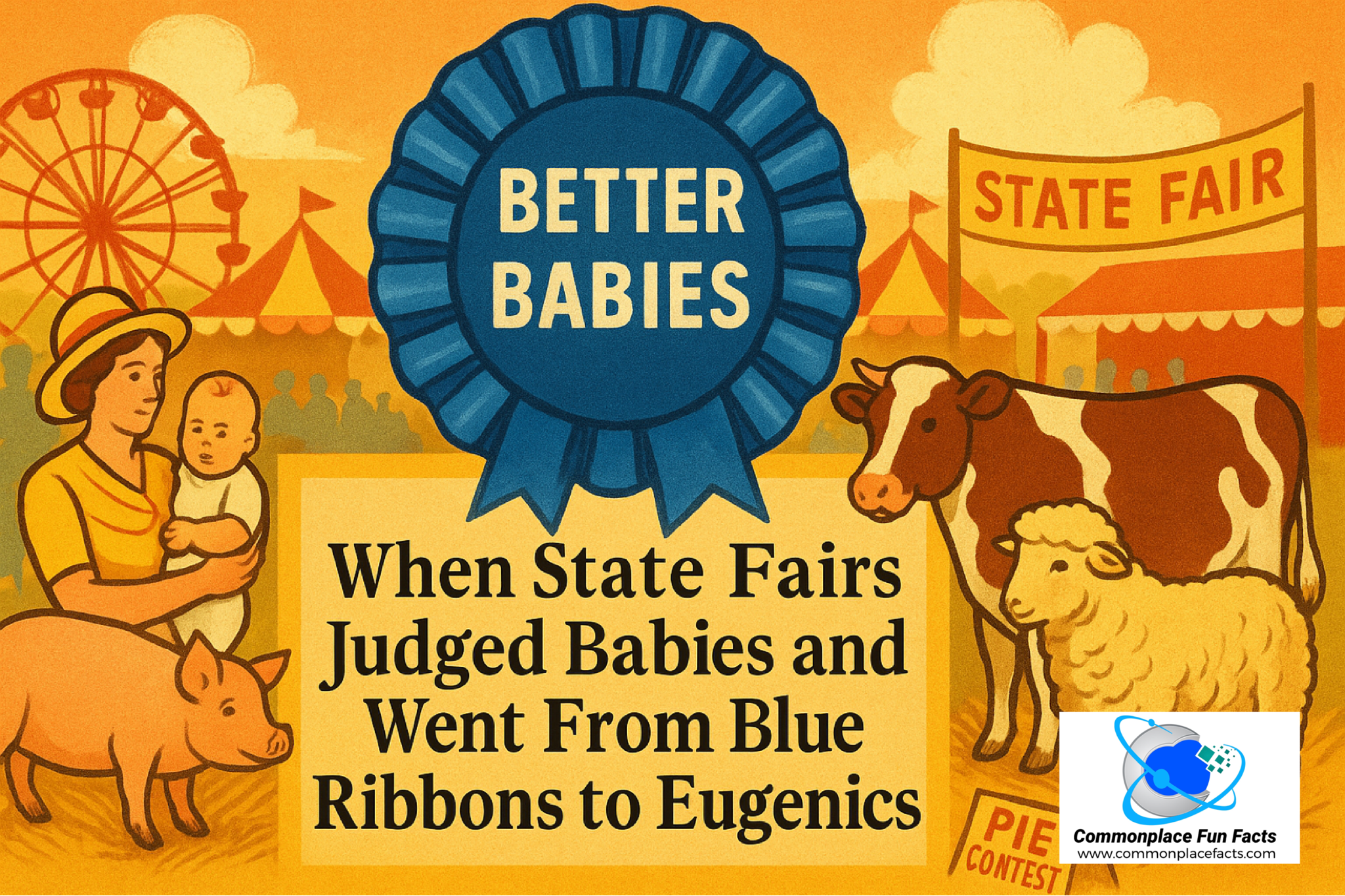

Step right up, folks! Past the prize-winning pigs, just beyond the blue-ribbon pies, lies the strangest contest you’ve never heard of: the Baby Judging Competition. Yes, really.
Picture it: the midway of a state fair, buzzing with cotton candy fumes and livestock bleats. You stroll past the Ferris wheel, nod approvingly at a giant pumpkin, and then stumble across a line of mothers proudly presenting their infants to a panel of judges. The babies aren’t juggling, tap dancing, or even wearing cowboy hats (though that would have made for great photos). Instead, they’re being measured, weighed, and graded on a standardized scorecard. Welcome to the world of “Better Babies” contests, where the hopes for healthier children is going to turn dark very quickly as we discuss how it collided with the disturbing currents of the eugenics movement.
Contents
Origins: The Babies Behind the Blue Ribbons

The early 1900s in America was a time of reform, progress, and the occasional questionable idea (see also: the 16th and 17th Amendments, drinking radium water as a health tonic, and similarly destructive “good ideas”). Infant mortality rates were high—nearly one in ten babies didn’t survive their first year (see “How Freak Shows Revolutionized Medical Care for Babies”). Reformers wanted to change this, and many believed the answer lay in science and education. Enter Mary DeGarmo, a Louisiana schoolteacher who, in 1908, launched the first “Better Babies Contest.” Her vision was simple: if we judged livestock to promote healthier herds, why not do the same with children?
And so, the babies were weighed, measured, poked, and prodded like prize heifers. Each contestant was graded on health, weight, physical development, and even mental qualities. Winners got blue ribbons, and parents got bragging rights that their child wasn’t just adorable—it was scientifically superior. Organizers insisted this was about public health, not vanity. But as with most seemingly innocent traditions (looking at you, Victorian arsenic makeup), things got complicated fast.
The “Perfect” Baby: William Charles Flynn
If the Better Babies contests had a poster child (literally), it was William Charles Flynn. Meet the toddler who racked up more wins than most show ponies: according to The Spokesman-Review of March 27, 1915, three-year-old William had already won 14 first prizes in baby eugenics shows across the country. Judges gave him the coveted “perfect 100-point” tag, making him the early 20th-century equivalent of a household name.

And because no good fairground story is complete without a dash of romance, enter Alene Calvert Houck, a 17-month-old girl who had already bagged six wins herself. After yet another contest where both emerged with “perfection” tags, their mothers decided fate was clearly calling. The two were—wait for it—dedicated to each other in the hope that they would one day marry and produce the ultimate eugenic super-child. According to their mothers, it was destiny. According to anyone reading this today, it sounds like a plot that got cut from a very dark historical drama.
The newspapers played up the spectacle with headlines like “Mate Found for Perfect Boy.” The whole thing had the air of a fairy tale—if your fairy godmother was really into heredity charts and bloodlines. It also revealed how deeply contests like these blurred the line between public health reform and outright eugenics pageantry. It wasn’t enough for babies to be healthy; they had to be perfect specimens destined to reproduce with equally perfect partners, ensuring the “improvement of the stock.”
Here’s where the “perfect baby” saga loses its epilogue. Despite all that media attention — the ribbons, the headlines, the “destined for each other” talk there seems to be no reliable record of what ever became of William Charles Flynn or Alene Calvert Houck as children growing up, let alone whether their mothers’ ambitious matchmaking ever bore fruit.
This was not a one-off. Other “perfect” children were similarly paraded, photographed, and written up as examples of what America should strive for. But William Flynn’s fame shows how the contests turned human children into public mascots for pseudoscience—blue ribbons, romance plots, and all. The Better Babies contests were sensational in their time, but many of the children involved seem to have drifted out of public view once winning trophies stopped being fresh news.
Sliding Into Eugenics
Here’s where the butter sculpture melts into the darker corners of history. While Better Babies contests began with the admirable goal of reducing infant mortality and promoting maternal education, they soon intertwined with eugenics—the idea that humanity could (and should) be improved through selective breeding. Think of it as Darwin’s “survival of the fittest,” except applied much more aggressively by people with their own notions of what constitutes “the fittest.”

Progressive reformers believed good nutrition, hygiene, and education mattered, but many also bought into the notion that genetics determined destiny. The contests encouraged parents to produce “fit” babies and, by implication, suggested some babies—and their families—were less worthy. Before long, organizers introduced “Fitter Families” contests, expanding the judging to entire bloodlines. Instead of just grading chubby cheeks, judges examined family medical histories, moral character, and even hereditary “traits.”
This is where things get messy. On one hand, Better Babies contests genuinely promoted valuable public health measures: encouraging mothers to breastfeed, vaccinate, and seek regular check-ups. Infant mortality rates did improve in some communities. On the other hand, the underlying message was that genetics trumped nurture, and only certain families—specifically white, middle-class, Protestant ones—could hope to win. Immigrant families, poor families, and families of color were often excluded or ignored entirely.
The contradiction was baked right in: organizers claimed the contests proved that healthy practices could improve any baby’s chances. Yet the winners almost always came from privileged backgrounds. It was a bit like holding a pie contest where only apple pies were judged and using the results to prove that apple pie was inherently superior to pecan.
Case Studies from the Baby Barn
Louisiana, 1908
Mary DeGarmo’s inaugural contest drew attention and set the tone. Mothers brought their children for examinations that looked more like livestock judging than pediatric checkups. The event was a hit, with local newspapers hailing the winners as examples of American vigor. DeGarmo argued this was about improving public health, but the seed of eugenics was already planted.

Indiana’s Baby Parades
In Indiana, Ada Estelle Schweitzer—an enthusiastic doctor with a flair for public spectacle—organized Better Baby contests between 1920 and 1932. She insisted on medical exams and promoted hygiene, vaccinations, and breastfeeding. Infant mortality in Indiana dropped, which was great news. But her contests also reinforced existing racial and class divides. Non-white families rarely had a chance to compete, let alone win. The lesson seemed to be: “Yes, healthier babies matter—so long as they look like us.”
Kansas and Iowa: Fitter Families
By the 1920s, the contests had expanded into “Fitter Families” competitions. Entire families filled out forms detailing their ancestry, medical history, and moral habits. Judges handed out medals to those deemed most genetically worthy. If this sounds disturbingly like livestock pedigree charts, that’s because it basically was. Winning families were hailed as examples of American stock worth reproducing, while others got the subtle (or not-so-subtle) message that they probably shouldn’t.
The Legacy: What Got Better, What Got Worse

Let’s give credit where it’s due: Better Babies contests did improve awareness of child health, nutrition, and hygiene. Parents learned about breastfeeding, regular checkups, and vaccinations. Public health initiatives spread across rural America, saving lives in the process. Infant mortality rates dropped, which is no small thing.
But there’s a darker side to this legacy. The contests also reinforced pseudoscientific ideas of racial superiority and justified discriminatory policies. Eugenics advocates used these events to argue for sterilization of the “unfit,” immigration restrictions, involuntary euthanasia (that’s just a fancy way of saying “murder”), and other policies that trampled on human dignity. The line between encouraging healthy children and policing heredity blurred in ways that now make us cringe—and should.
Why Did the Better Babies Contests Disappear?
Like the midway rides that get dismantled at the end of the fair, the Better Babies contests eventually lost their shine. By the 1930s, the blue ribbons and clipboards had faded into obscurity, leaving behind a curious footnote in American history. But why did a movement that once packed state fair barns with eager parents and squirming toddlers vanish so quickly?
For starters, the scientific credibility of eugenics took a nosedive. By the late 1920s and early 1930s, critics began pointing out that the contests’ so-called “scientific scorecards” were little more than subjective checklists. A baby’s head circumference or deciding whether a toddler was “jealous” didn’t exactly hold up as a rigorous scientific prediction about that child’s potential in life. As medical science advanced, the idea that you could sum up human worth with a few fairground tests started looking downright ridiculous.
Then there was the specter of coercive eugenics policies. The same movement that produced Better Babies contests was also behind forced sterilizations, restrictive immigration laws, and other troubling measures. As the darker side of eugenics became harder to ignore, people grew less enthusiastic about dressing it up with balloons and county-fair bunting. What once seemed like wholesome reform started looking more like pseudoscience with a sinister agenda. When an obnoxious German leader with a silly mustache started advocating the same principles to promote his “Master Race” and eliminate those he deemed to be inferior, the horrifying reality of the eugenics movement became evident.
Another factor? Public health efforts moved on. By the 1930s, doctors and public health officials were emphasizing hospital births, prenatal care, and broader health initiatives. Parents could now get real medical advice in clinics and doctor’s offices, rather than from a panel of judges sandwiched between the hog show and the pie-eating contest. The contests simply weren’t needed as vehicles for spreading health education anymore.
Some of the last “Fitter Families” contests were held in the 1930s, but by then they were ghostly echoes of their former popularity. Today, they serve as reminders that not every fairground fad deserves a comeback tour.
Fun Facts to Make You Ponder Why You Didn’t Get a Blue Ribbon
- The medals given to Fitter Families winners often read, “Yea, I have a goodly heritage.” Because nothing screams humility like strutting around the fairground with a eugenics participation trophy pinned to your chest.
- At some contests, judges actually asked parents if their children were “liars” or “jealous.” Apparently dishonesty is a genetic defect that is evident at an early age.
- The contests were so popular that the Woman’s Home Companion magazine launched the “Better Babies Bureau” and distributed standardized scorecards nationwide. Nothing says wholesome family fun like whipping out a clipboard to determine if your baby has the proper head circumference-to-chest ratio.
- One contest manual reassured parents that their children wouldn’t be disqualified if they lost a finger in an accident, but they would lose points if the missing digit was genetic. Yes, baby competitions came with fine print about acceptable finger-loss scenarios.

Echoes in Modern Times
The baby barns of the state fairs are long gone (and good riddance), but the echoes linger. Today, we see debates about genetic testing, “designer babies,” and what constitutes “normal” or “healthy.” Public health campaigns still wrestle with the balance between encouraging better practices and shaming people for circumstances beyond their control. The language of “betterment” remains a slippery slope—one that once turned county fairs into makeshift eugenics laboratories.
We like to think we’ve outgrown the impulse to measure human worth with scorecards, but scroll through social media and you’ll see we still judge families and children—just with different metrics. The ribbons are gone; the algorithms remain.
Conclusion: Leaving the Baby Barn Behind
So the next time you wander through a state fair, marveling at giant zucchinis or pig races, be grateful you don’t have to enter your kid for public judgment by strangers with clipboards. Better Babies contests may have been framed as progressive and scientific, but they were also exclusionary, pseudoscientific, and sometimes downright creepy. They remind us that even the most well-intentioned reforms can be hijacked by harmful ideologies.
The baby barn may be shuttered, but the lesson remains: when we start grading people like livestock, we risk turning compassion into competition, and dignity into data points. And honestly? The corn dog stand is a much better place to judge life’s winners.
You may also enjoy…

How Freak Shows Revolutionized Medical Care for Babies
Discover the extraordinary history of premature baby care and how incubators in amusement park freak shows laid the foundation for modern neonatal medicine.

It is Illegal to Sell Infants in Pennsylvania
The Commonplace Fun Facts Legal Department tells us that laws are supposed to be reasonable. Apparently, this concept doesn’t apply to legal advice, however. That one sentence generated a bill for $362.11. If, by “reasonable,” that means that laws should encourage desired behavior, that’s one thing. If it refers to the severity of punishment for…

The Green Children of Woolpit: Medieval X-Files, But With Beans
Discover the strange tale of the Green Children of Woolpit—mysterious green-skinned siblings who appeared in medieval England speaking an unknown language and eating only beans. History, folklore, and extraterrestrial theories collide in this bizarre true story.




Leave a Reply