
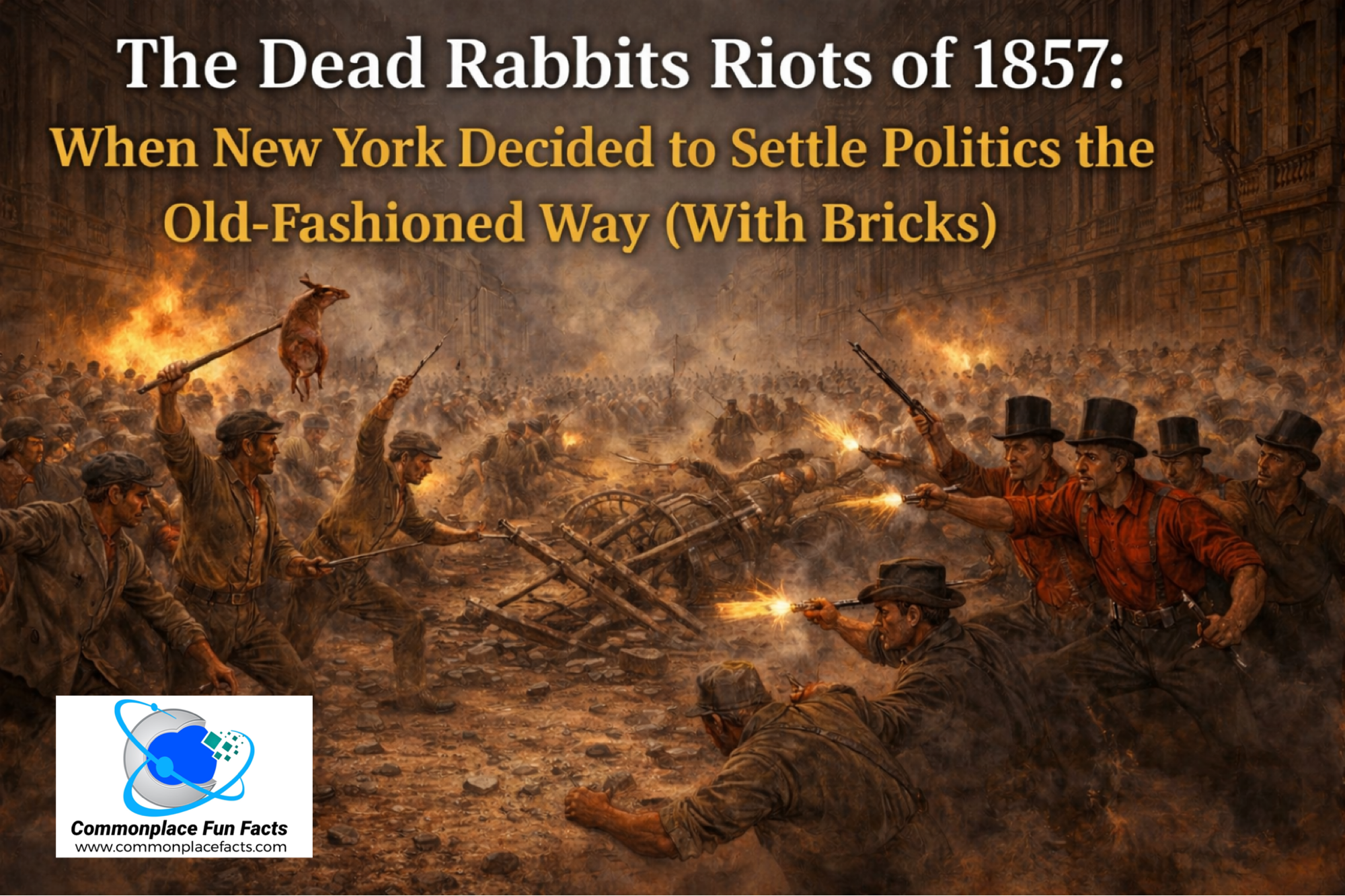

Violence, riots, rival gangs with names that sound like they were selected by pulling random words out of a hat, barricades in the streets. It all feels uncomfortably familiar—like something you might scroll past while checking the news over your morning coffee.
But this particular episode isn’t unfolding in real time. There are no live updates, no shaky phone videos, and no panel of experts explaining it all with impressive confidence and limited agreement. This is New York City in 1857, when civic unrest came with fewer hashtags and considerably more bricks, and when a dispute between groups called the Dead Rabbits and the Bowery Boys escalated into a full-scale urban brawl that briefly turned the streets of Manhattan into something resembling a war zone.
For two days, large sections of lower Manhattan turned into a battlefield. Rival gangs built barricades, exchanged gunfire, and conducted the sort of negotiations that involve clubs rather than compromise. This delightful civic moment is remembered as the Dead Rabbits Riots—a name that sounds like a children’s book but behaved more like a low-budget war film.
Contents
A City That Was Not Built for Calm Reflection
To understand how things got this out of hand, it helps to picture mid-19th century New York. The city was growing rapidly, fueled by waves of immigration, particularly from Ireland. Neighborhoods like Five Points were packed with people, opportunity was uneven at best, and social tensions were less “under the surface” and more “standing in the street holding a brick.”
This was also a time when law enforcement was… evolving. The city had recently reorganized its police forces, resulting in competing authorities who disagreed about who was in charge. It turns out that having two police forces arguing with each other is not ideal when thousands of people are also arguing with each other, but more violently.
The Gangs: Not Exactly a Book Club
The central players in this story were two rival groups with strong opinions, questionable branding decisions, and limited interest in conflict resolution.
The Dead Rabbits: Bricks, Politics, and Questionable Branding
The Dead Rabbits were one of the most notorious gangs in mid-19th century New York, which is saying something in a city where “notorious gang” was almost redundant.

Active from roughly the 1830s through the 1850s, they were primarily made up of Irish immigrants living in the Five Points neighborhood. Life in that part of the city was crowded, rough, and not especially welcoming, which made gang membership less of a hobby and more of a survival strategy, with violence included as a standard feature.
Their criminal résumé was impressively broad. Street fighting, robbery, assault, arson, and rioting were all part of the package. In other words, they were not specialists. They were generalists with enthusiasm.
The origin of their name is, fittingly, both strange and disputed. One popular story claims that during a gang dispute, someone threw a dead rabbit into the middle of a meeting. A faction took this as a sign—because 19th-century decision-making sometimes worked that way—and broke off to form a new group. They even adopted a dead rabbit on a pike as their symbol.
The name may not be quite as classy as the Forty Elephants, the notorious gang of women shoplifters who terrorized London for nearly two centuries, but it had one undeniable advantage: no one was going to forget it.
Other historians suggest something even more confusing: that the “Dead Rabbits” may not have been a clearly defined gang at all, but rather a nickname applied to members of other Irish groups, particularly the Roach Guards, another Irish gang—we know, branding was not exactly subtle in this period. In other words, it is entirely possible that one of the most famous gangs in New York history was, at least in part, a branding exercise created by rivals and newspapers.
What is not disputed is their influence. The Dead Rabbits were closely tied to political organizations like Tammany Hall and were known to act as enforcers during elections, encouraging voter participation in ways that would not be described today as “voluntary.”
They also had a flair for memorable personalities. Among the most legendary was Hell-Cat Maggie, a fighter said to have filed her teeth to points and worn brass fingernails into battle. Whether entirely accurate or slightly embellished, the story does suggest that subtlety was not a defining characteristic of the group.
At their peak, the Dead Rabbits fought hundreds of battles with rival gangs like the Bowery Boys, sometimes outnumbering both the police and, on occasion, the militia sent to restore order. This was less a street rivalry and more a recurring civic event.
The Bowery Boys: Firefighters, Nativists, and Occasional Rioters
The Bowery Boys were not just a gang. They were, in their own minds, the rightful owners of New York City—or at least the parts of it they hadn’t already set on fire by accident or competition.
Active from the 1830s through the 1860s, the Bowery Boys were based in the Bowery neighborhood of Manhattan and were made up primarily of native-born, working-class New Yorkers. Many of them were volunteer firemen, which meant they performed the valuable public service of putting out fires, occasionally after fighting other fire companies for the honor of doing so.

They were fiercely nativist, openly anti-immigrant, and particularly hostile toward Irish Catholics, which made them natural enemies of gangs from the Five Points, including the Dead Rabbits. Their clashes were frequent, enthusiastic, and involved weaponry far more dramatic than trash talk.
Unlike some of their rivals, the Bowery Boys often held regular jobs as mechanics, butchers, or tradesmen, and prided themselves on being “true” Americans. This did not prevent them from engaging in street fighting, rioting, and the occasional attempt to influence elections through methods that would not pass modern compliance training.
They were also known for their distinctive style: stovepipe hats, red shirts, and a swagger. To be fair, a stovepipe hat more or less requires a swagger.
It is worth pausing to clarify something that history has made unnecessarily confusing. These Bowery Boys are not the same as the group of actors who appeared in a series of films in the 1940s and 1950s. Those Bowery Boys were comedic performers who engaged in scripted antics and lighthearted mischief. The 1850s Bowery Boys, by contrast, engaged in unscripted chaos and the occasional urban uprising. One group made audiences laugh. The other made city officials reconsider their career choices.
No discussion of the Bowery Boys would be complete without mentioning Mose the Fireboy, a man who may or may not have existed in quite the way people imagined, but who absolutely existed in the public imagination—which, in 19th-century New York, was often more important.
Mose was a fictionalized character popularized in the 1840s through stage plays by Benjamin Baker. He was portrayed as a brawny, loyal, no-nonsense volunteer firefighter from the Bowery, complete with a fierce sense of neighborhood pride and a willingness to settle disputes with his fists if necessary. In other words, he was less a character and more a walking endorsement of Bowery Boys values.
The character is often linked to a real-life fireman named Moses Humphrey, though—as with many legends—the line between reality and theatrical embellishment quickly became… flexible.
On stage, Mose became wildly popular. Audiences loved him. Young men imitated him. Some of them took that imitation a bit too seriously. Contemporary accounts suggest that performances occasionally inspired rowdy behavior, as theatergoers embraced Mose’s particular approach to conflict resolution—namely, immediate and enthusiastic physical engagement.
In a city already brimming with tension, Mose helped turn the Bowery Boys into something more than a gang. He made them cultural icons.
How It Started (Or At Least How It Exploded)
At its core, the Dead Rabbits Riots were not just a gang fight that got out of hand. They were the product of deep ethnic tension between Irish immigrants and native-born Americans, political rivalries tied to competing power structures, and a city struggling to maintain order as it grew faster than its institutions could manage.
Like many large-scale disturbances, the exact spark of the Dead Rabbits Riots is somewhat unclear. What is clear is that on July 4, 1857—because nothing says “celebration of independence” like chaotic street fighting—violence broke out between rival factions.
What might have been a typical gang clash quickly escalated. And by “quickly escalated,” we mean that it turned into a multi-day riot involving hundreds of participants, barricades, and open combat in the streets.
Buildings were used as defensive positions. Groups advanced and retreated. Shots were fired. At one point, the scene reportedly resembled a military engagement, except with less coordination and more questionable decision-making.
Urban Warfare, But Make It Improvised
One of the more fascinating aspects of the riots is how organized the chaos became.

Residents found themselves in the middle of what can only be described as accidental warfare. Imagine looking out your window and realizing your neighborhood has become a tactical position.
In at least one reported clash, gunfire came not just from the street but from above. Men took to the rooftops, turning tenements into improvised fortresses and firing down into the chaos below. For anyone walking through the neighborhood at the time, the safest place was unclear—except that it was almost certainly somewhere else.
Witnesses described barricades hastily assembled from carts, barrels, and whatever else happened to be nearby. Behind them stood men armed with clubs, bricks, and the occasional firearm, defending their position with the seriousness of seasoned soldiers and the planning of people who had assembled their defenses about five minutes earlier.
At times, the fighting became so organized that parts of the neighborhood resembled a military engagement—if military engagements were conducted with furniture, loose bricks, and a flexible understanding of strategy. Rooftops became firing positions, streets became front lines, and anyone hoping for a quiet afternoon was advised to lower their expectations.
The Police: Present, but Not Exactly in Control
The police response did not go well.
At the time, New York was dealing with a dispute between the old Municipal Police and the newer Metropolitan Police. This meant that while gangs were busy fighting each other, law enforcement agencies were busy disagreeing about jurisdiction.
As a result, efforts to restore order were slow, fragmented, and often ineffective. Officers were outnumbered, outmaneuvered, and occasionally treated as just another faction in the chaos.
Eventually, authorities did what authorities tend to do when things spiral beyond their control: they called in the militia.
When the New York State Militia arrives to handle what started as a gang dispute, it is generally safe to conclude that the situation has escalated beyond “local issue.”
Casualties and Consequences
By the time order was restored, at least eight people had been killed, and many more were injured. The actual numbers may have been higher, as record-keeping during riots is not always precise, especially when the people doing the counting are also trying to avoid being hit with things.
The riots exposed serious weaknesses in the city’s institutions. Law enforcement needed reform. Coordination needed improvement. And perhaps most importantly, the city needed fewer situations in which hundreds of people felt that building barricades was a reasonable weekend activity.
A Preview of Worse Things to Come
If this all sounds dramatic, it was. Unfortunately, it was also something of a preview.
Just six years later, New York would experience the Draft Riots of 1863, which were even more destructive and deadly. Compared to that event, the Dead Rabbits Riots begin to look almost like a rehearsal—albeit one with real casualties and very real consequences.
The Dead Rabbits Riots also paved the way for another episode of civil unrest: the Straw Hat Riot of 1922, when chaos erupted in New York because groups of boys went around knocking men’s hats off. Yes, that was really a thing, and no, historians have not fully recovered.
Final Thoughts: When Civic Engagement Goes Sideways
The Dead Rabbits Riots are a reminder that cities do not become orderly overnight. They evolve, often through moments of tension, conflict, and the occasional episode of widespread chaos.
They also remind us that political disagreement, when combined with social tension and weak institutions, can produce outcomes that are… less than ideal.
Modern civic life has its share of heated debates, but at least most of them do not involve barricades made of furniture and a militia on standby. Progress, it seems, can sometimes be measured by the decreasing likelihood that your neighbor will fortify the street.
Still, if nothing else, the events of 1857 demonstrate one enduring truth: if you give people enough reasons to argue and not enough structures to manage it, they will find a way to improvise. And history suggests that their improvisation may involve bricks.
You may also enjoy…

The Curious Case of the Forty Elephants: When the Ladies Looted London
Discover the daring story of the Forty Elephants — London’s all-female gang who turned shoplifting into high society theater. Explore their cunning heists, fearless leaders, and the glamorous world of crime behind the city’s glittering storefronts.

The Straw Hat Riot: Yes, That Was Really a Thing?
In 1922, the Straw Hat Riot erupted in Manhattan when teenage boys attacked adults for wearing straw hats beyond the designated season. This clash between youthful enforcers and defiant adults escalated into chaos, causing significant disruption. The riots highlighted societal tensions over fashion and obedience to unwritten social rules, ultimately leading to the decline of…

The Gordon Riots: London’s January 6 Moment 240 Years Ahead of Its Time
Explore the Gordon Riots of 1780—a fiery clash of politics, religion, and mob rule. Discover how Lord George Gordon sparked one of London’s most destructive uprisings and its eerie parallels to modern protests.




Leave a Reply to lumandabnerCancel reply