
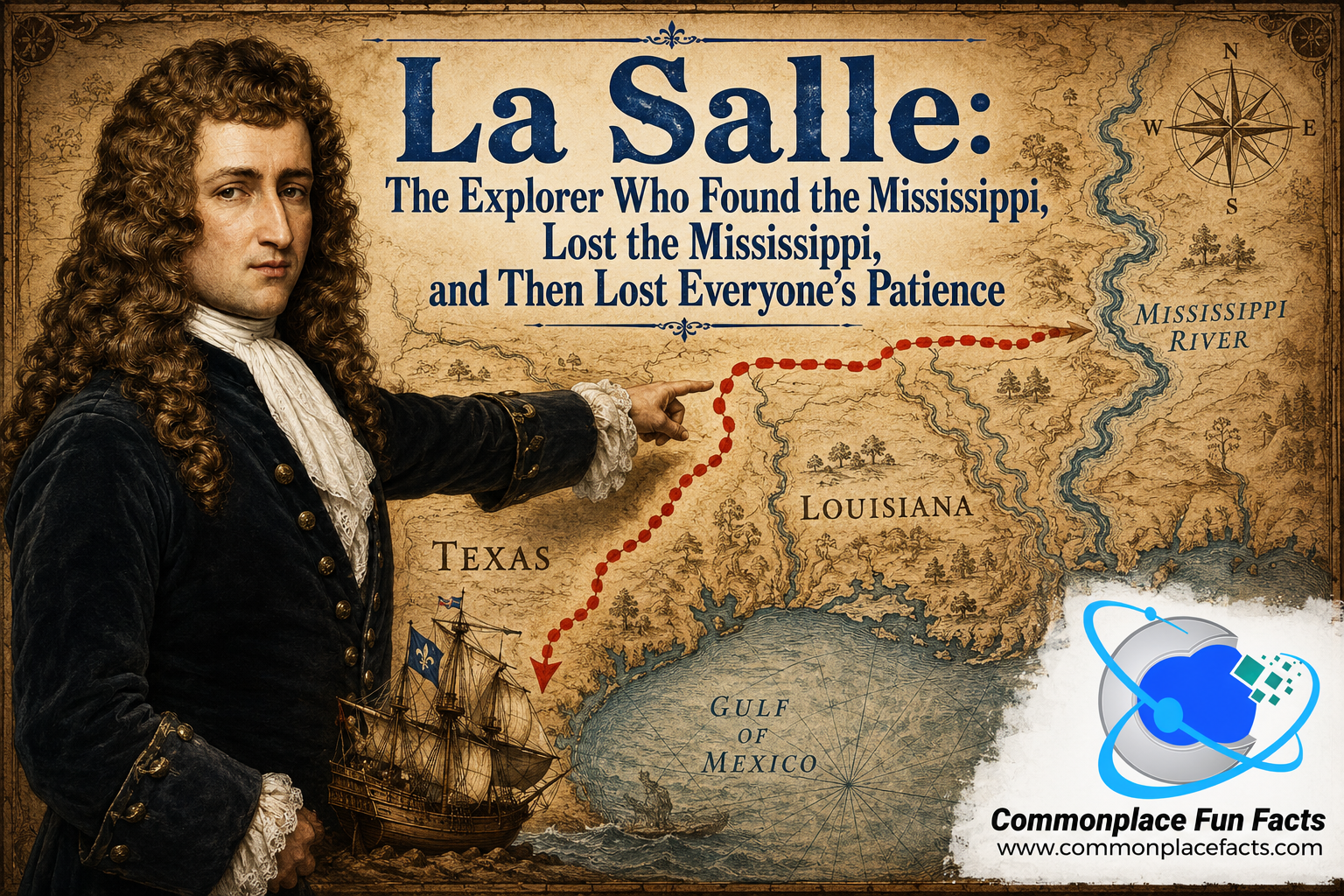

There are explorers who become famous because they find something no one expected. There are explorers who become famous because they cross oceans, map rivers, plant flags, and make kings feel very pleased with themselves. Then there is René-Robert Cavelier, Sieur de La Salle, who became famous because he found the mouth of the Mississippi River, claimed a huge chunk of North America for France, and then proved—rather dramatically—that finding something once is not the same thing as being able to find it again.
La Salle’s story has everything: ambition, royal sponsorship, bad maps, worse judgment, shipwrecks, starvation, mutiny, accidental Texas colonization, and the sort of workplace morale problem that ends with the boss being shot by his own employees. It was the kind of expedition that makes one wonder whether 17th-century France had a Department of Terrible Ideas and, if so, whether La Salle was its Employee of the Month.
Contents
The Man With the Very French Name and the Very Large Ambition
René-Robert Cavelier, Sieur de La Salle, was born in Rouen, France, in 1643. Like many ambitious Europeans of the 17th century, he looked at North America and saw not an already-inhabited continent full of complex Indigenous nations, languages, trade networks, and political realities, but a massive opportunity for France to draw a very large line on a very incomplete map.

To be fair, La Salle was not an armchair dreamer. He was tough, persistent, intelligent, and capable of surviving wilderness hardship that would send most of us into a full emotional collapse after the first mosquito. He explored around the Great Lakes, built forts, cultivated alliances, pursued the fur trade, and became obsessed with the idea that France could control the interior of North America by controlling its waterways.
The big prize was the Mississippi River. Whoever controlled the Mississippi controlled a vast artery through the continent. Rivers were the interstate highways of the 17th century, except with more canoes, fewer rest stops, and a much higher chance of dying from exposure.
Finding the Mississippi the First Time
In 1682, La Salle led an expedition down the Mississippi River to the Gulf of Mexico. Contrary to some retellings, he did not travel the length of the river almost entirely on foot. The expedition moved primarily by water, using canoes and river routes after reaching the Mississippi through the Illinois River system. This is an important distinction, because “canoeing down the Mississippi” and “walking to the Gulf of Mexico” are not the same activity, in much the same way that “taking an elevator” and “climbing the outside of the building with your fingernails” are not the same commute.

On April 9, 1682, near the mouth of the Mississippi, La Salle staged a formal ceremony and claimed the entire Mississippi River basin for France. He named it La Louisiane in honor of King Louis XIV, because if there is one thing kings enjoy, it is having enormous land masses named after them by people standing very far away from the nearest notary public.
It was an astonishing claim. The Mississippi drainage basin covered an immense portion of the continent—far more land than anyone in France could actually administer, defend, settle, or explain without pointing vaguely at a map and saying, “Somewhere over here, probably.”
Still, from a French imperial perspective, it was glorious. La Salle had gone down the river, reached the Gulf, and made France’s claim to the interior of North America dramatically larger. It was the kind of achievement that makes everyone briefly forget the practical details, such as logistics, geography, supply lines, and the minor inconvenience that Spain was already extremely interested in the Gulf Coast.
The Return to France: Hero, Salesman, and Possibly the Wrong Man to Trust With Directions
La Salle returned to France and presented a plan that was both bold and, in hindsight, the kind of thing that should have been read aloud slowly to see whether it still sounded reasonable.

He proposed sailing from France to the Gulf of Mexico, finding the mouth of the Mississippi from the sea, establishing a French colony there, and using it as a base to challenge Spanish power in the region. The idea had strategic appeal. France could gain a foothold near the Mississippi, threaten Spain’s silver-rich empire, and expand its influence in North America.
There was just one small problem: finding the mouth of the Mississippi from the Gulf was harder than La Salle made it sound.
River mouths do not always politely announce themselves. The Gulf Coast is a long, confusing stretch of bays, inlets, marshes, barrier islands, currents, and low-lying shoreline. Add incomplete maps, uncertain longitude calculations, stormy weather, unhelpful alligators, bad assumptions, and 17th-century navigational confidence, and suddenly “find the river” becomes less a mission plan and more a deeply optimistic mood.
Nevertheless, La Salle convinced the French crown. In 1684, he sailed from France with four ships and more than 300 people, including soldiers, sailors, colonists, craftsmen, women, children, and almost enough collective optimism to justify a fifth ship.
The Expedition Begins Falling Apart Immediately
The expedition was troubled almost from the start. One ship was captured by privateers in the Caribbean. There were disputes among officers. Supplies became a problem. Disease and delay began their usual grim work. La Salle’s leadership style, which seems to have combined determination, secrecy, stubbornness, and the interpersonal warmth of a damp dishrag, did not improve morale.
By early 1685, La Salle reached the Gulf Coast. He was supposed to find the Mississippi. Instead, he overshot it by hundreds of miles and landed at Matagorda Bay on the coast of present-day Texas.
This was not a small navigational oopsie. This was not missing your exit and having to circle back at the next cloverleaf. La Salle had intended to establish a colony near the Mississippi River. Instead, he had accidentally founded a French settlement in Spanish-claimed Texas, far west of where he needed to be.
History occasionally gives us metaphors so obvious they feel rude. La Salle set out to challenge Spain, missed the river, and landed in Spanish territory by mistake. That is not just irony. That is irony wearing a powdered wig and carrying a clipboard.
Welcome to Texas. You Were Aiming for Louisiana.
Once at Matagorda Bay, the expedition’s situation deteriorated with impressive commitment. La Salle’s supply ship, L’Aimable, ran aground while trying to enter the bay, costing the colony much of its cargo. Another ship, the Joly, eventually returned to France. That left La Salle with the small vessel La Belle, which was supposed to keep the colony connected and supplied.
That plan also went poorly.
The settlers established Fort St. Louis near Garcitas Creek, inland from Matagorda Bay. Calling it a “fort” gives the structure a confidence it did not entirely earn. The settlement was isolated, undersupplied, and planted in the wrong place. The colonists were not near the Mississippi. They were not near French Canada. They were not near help. They were near hardship, confusion, and the growing realization that “we meant to be somewhere else” is not a strong foundation for colonial planning.
Food became scarce. Disease spread. People died from hunger, exposure, illness, overwork, and violence. Some wandered off and disappeared. Others were killed in conflict with Native peoples. Relations with Indigenous groups varied, as they often did in early colonial encounters, but the French presence was unstable, intrusive, and increasingly desperate. The colonists were stranded strangers in a land they did not understand, led by a man who kept insisting the Mississippi had to be somewhere nearby.
It was not nearby.
As we have observed before, American history contains more than its fair share of wars, disasters, and decisions that probably needed a second meeting. La Salle’s return expedition belongs in that proud tradition, although it may have needed a second meeting, a third meeting, and one person willing to ask whether anyone had actually checked the coastline.
The Search for the River Becomes a Lifestyle
La Salle repeatedly set out overland trying to find the Mississippi. This is where the “almost entirely by foot” image belongs—not in the successful 1682 descent, but in the tragic Texas phase of the story, when La Salle and his men trudged across unfamiliar country looking for a river that was stubbornly refusing to appear where La Salle believed geography owed him one.

These marches were brutal. The men crossed prairies, rivers, forests, and wetlands. They dealt with hunger, thirst, illness, exhaustion, and the growing suspicion that their leader’s internal GPS had been purchased from a suspicious vendor operating out of a wagon behind Versailles.
Meanwhile, back at the settlement, things were not improving. In early 1686, La Belle, the expedition’s last remaining ship, was wrecked in Matagorda Bay during bad weather. That disaster effectively stranded the colony. Without a ship, the French settlers had no reliable way to resupply, retreat, or tell anyone in France, “Good news: we found Texas. Bad news: we were not looking for Texas.”
La Salle still did not give up. Whatever else may be said about him—and a considerable amount was certainly said, primarily behind his back—he was not easily discouraged. In 1687, he set out again, this time hoping to reach the Mississippi and eventually make contact with French settlements farther north.
By then, the expedition had shrunk dramatically. The original party of several hundred had been reduced by ship losses, death, desertion, and disaster. The exact numbers varied at different points, but the story’s general direction was unmistakable: La Salle’s expedition was getting smaller, hungrier, angrier, and less inclined to applaud during staff meetings.
Management Review: Needs Improvement
La Salle had courage. He had vision. He had endurance. He had ambition large enough to generate its own gravitational field. What he did not have, at least by the end, was the confidence of many of his men.
Leadership in an expedition like this required more than boldness. It required judgment, communication, flexibility, and the ability to persuade exhausted people that following you into more uncertainty was preferable to not doing that. La Salle’s men had followed him across sea and wilderness. They had lost ships, friends, supplies, and any lingering belief that this enterprise had been reviewed by competent adults.
Then came the murders—a sentence that generally indicates an enterprise’s employee-retention strategy had failed.
During the final overland journey in March 1687, factional conflict within the party turned deadly. Several men conspired against others. Members of the group were killed. La Salle, separated from some of his companions and trying to investigate what had happened, walked into an ambush.
On March 19, 1687, somewhere in present-day Texas, René-Robert Cavelier, Sieur de La Salle, was shot and killed by men from his own expedition. Pierre Duhaut is usually identified as one of the principal conspirators. According to accounts, La Salle’s body was stripped and left where it fell.
It was a grim end for a man who had claimed half a continent for France and then died because he could not locate the most important river on it a second time.
The Colony After La Salle: Somehow, Still Worse
La Salle’s death did not save the colony. The remaining settlers at Fort St. Louis continued to suffer. By the winter of 1688–1689, the settlement had collapsed. Karankawa people attacked the fort, killing the remaining adults. Several children were taken captive and were later recovered by the Spanish.
The Spanish, alarmed by the discovery of a French settlement in territory they considered theirs, responded by increasing their attention to Texas. In one of history’s many unintended consequences, La Salle’s failed colony helped spur Spain to strengthen its presence in the region. France did not get a thriving Mississippi colony out of the expedition. Spain got a warning flare.
This is one of the great ironies of the whole episode. La Salle set out to plant France near the Mississippi and threaten Spanish power. Instead, he missed the Mississippi, landed in Texas, lost his ships, stranded his colonists, got murdered by his own men, and encouraged Spain to take Texas more seriously.
As strategic outcomes go, this is somewhere between “unfortunate” and “please stop helping.”
The Shipwreck That Would Not Stay Lost
For more than three centuries, La Belle remained exactly where La Salle had left so many of his plans: buried, broken, and inconveniently located in Texas.
Then, in 1995, archaeologists located the wreck in Matagorda Bay. The Texas Historical Commission excavated the ship in 1996–1997. It was one of the most important maritime archaeological projects in North America.
The excavation produced an extraordinary collection of artifacts: the ship’s hull, three bronze cannons, thousands of glass beads, bronze hawk bells, pottery, and even the skeleton of a crew member. Altogether, the site yielded nearly two million artifacts, giving historians an unusually detailed look at what La Salle’s colonists brought with them to build a French colony in the New World. In other words, the expedition failed so thoroughly that it accidentally created a time capsule. History does enjoy leaving receipts.
The Texas Historical Commission later excavated Fort St. Louis, the settlement La Salle’s colonists established on Garcitas Creek in 1685. There, archaeologists found tens of thousands more artifacts, including cannons, musket balls, gunflints, pottery, coins, and other objects from the colony. Between the shipwreck and the fort, La Salle’s disaster became one of the best-documented colonial failures in North American archaeology.
Today, artifacts from the excavations can be seen at the Bullock Texas State History Museum in Austin and at museums along the Texas coast through the La Salle Odyssey exhibits. The conserved hull of La Belle is now displayed at the Bullock Museum, where visitors can look at the remains of the ship that was supposed to support France’s grand Mississippi colony and instead became a very soggy monument to the phrase, “Are we sure this is the right place?”

La Salle’s Legacy: Big Claim, Bigger Mess
It would be easy to treat La Salle as nothing more than a cautionary tale with boots. That would be unfair. He was an important explorer. His 1682 descent of the Mississippi helped shape French claims in North America. The name Louisiana survives because of him. His expeditions contributed to European knowledge of the continent’s interior, though that “knowledge” was often filtered through imperial ambition, poor assumptions, and a chronic habit of ignoring the people already living there.

Still, the Texas expedition is hard to read without wondering whether La Salle’s greatest talent was converting confidence into catastrophe.
He found the Mississippi from the north, then tried to find it from the sea and missed by hundreds of miles. He persuaded a king to support a colonial project, then deposited that project in the wrong place. He set out to challenge Spain, then accidentally strengthened Spanish interest in Texas. He led hundreds of people toward glory, and within a few years most were dead, scattered, captured, or wishing very strongly that they had chosen an exciting career as a wigmaker.
That is the strange brilliance of La Salle’s story. It is not simply that he failed. Plenty of explorers failed. Maps were bad. Navigation was hard. The continent was vast. Disease, weather, hunger, and politics could wreck even well-planned expeditions. The problem is that La Salle’s failure came wrapped in such grand ambition that every mistake echoes.
He claimed a river system so large it would shape the future of North America. Then he misplaced it.
The Moral of the Story
La Salle’s life reminds us that history is not always shaped by careful planning and smooth execution. Sometimes it is shaped by bad maps, worse assumptions, stubborn leaders, and the terrible moment when everyone realizes the river is not where the boss said it would be.
His 1682 achievement was real. His claim for France mattered. His role in the story of Louisiana and the Mississippi was significant. But the follow-up expedition was a masterpiece of imperial overconfidence. It began with a plan to rival Spain and ended with shipwrecks, starvation, a doomed settlement, and a murder in the Texas wilderness.
La Salle wanted to build a French empire at the mouth of the Mississippi. Instead, he gave history one of its great navigational punchlines: the explorer who found the Mississippi River, became famous for finding the Mississippi River, received royal backing to return to the Mississippi River, and then somehow misplaced the Mississippi River.
In fairness, it is a very large continent.
But still.
You may also enjoy…

Christopher Columbus: Explorer, Adventurer… and Con Man?
Uncover the untold story of Christopher Columbus, not just as the man who ‘discovered’ America, but as a master manipulator who used clever tricks and deception to complete his legendary voyage.

The Explorers Club Dinner of 1951: Did They Really Feast on Woolly Mammoth Meat?
In 1951, the Explorers Club claimed to serve woolly mammoth meat. Decades later, DNA testing revealed the truth: turtle soup. Here’s the bizarre tale.

The Kingdom the Mapmakers Forgot
1992 saw the birth of a new nation: the Kingdom of Torgu. If you happened to overlook this momentous occasion, don’t feel bad. The whole reason the new country sprang into existence was because of the people in charge of drawing the maps overlooked the area to begin with. The early 1990’s saw the birth…







Leave a Reply