
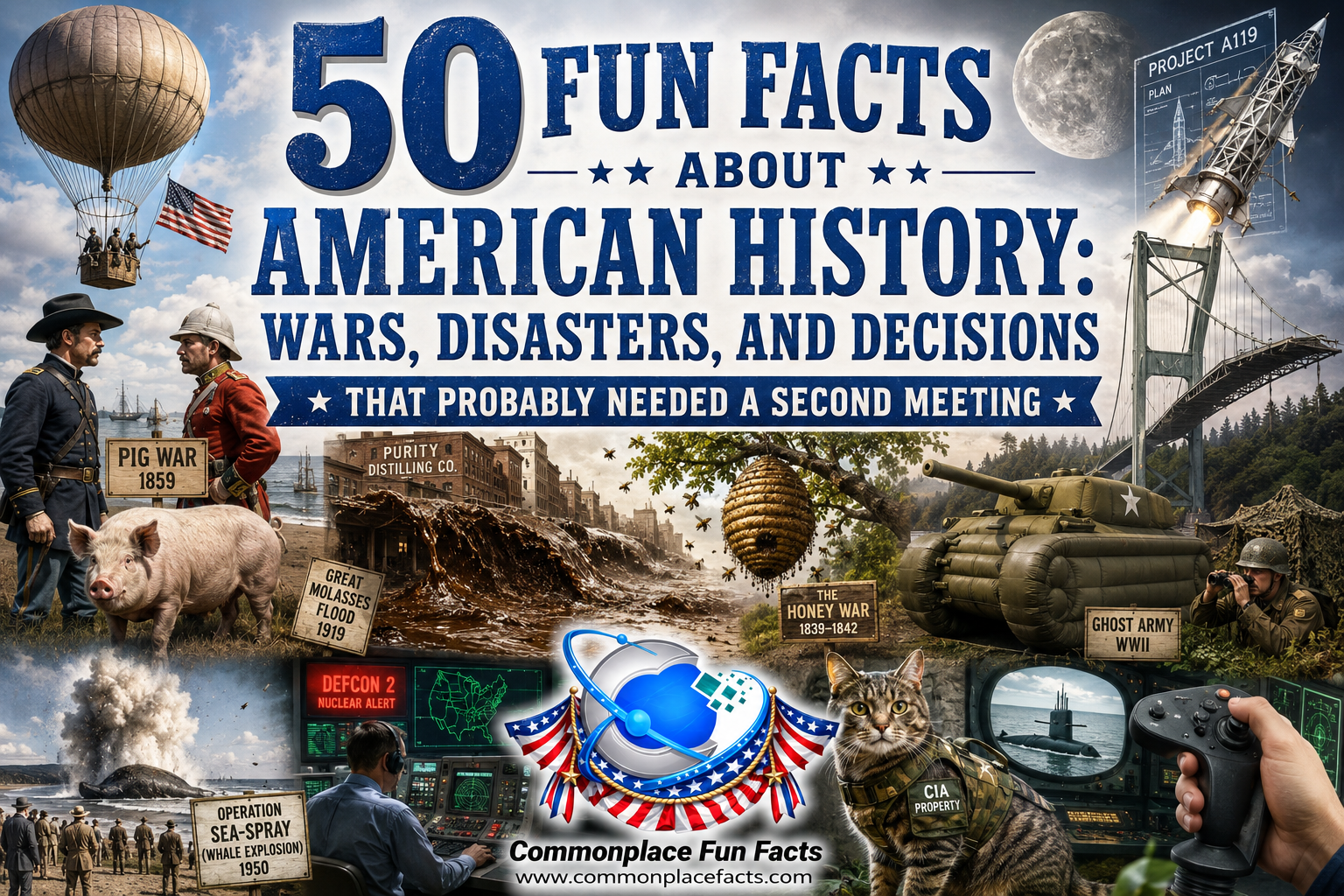

Wars, Disasters, and Decisions That Probably Needed a Second Meeting — Part 2 of Our Series of 250 Fun Facts About American History
As part of our ongoing effort to celebrate America’s 250th birthday with the proper mixture of pride, curiosity, and mild disbelief, we continue our semiquincentennial series of 250 fun facts about American heritage.
In Part 1, we covered 50 fun facts about the nation’s presidents and other political leaders. This installment presents a quinquagenary of curiosities focused on the weird, wonderful, and somewhat embarrassing moments when events escalated, plans unraveled, or someone somewhere confidently said, “This should work,” immediately before it did not.
In many cases, we’ve already written about these fun facts—usually in what could generously be described as enthusiastic (and occasionally excessive) detail. If something catches your interest—and we suspect it will, or you wouldn’t be reading this—just follow the provided link to dive deeper.
Some of these stories are amusing. Some are sobering. A few manage to be both at the same time, which is history’s way of keeping everyone slightly off balance.
Contents
Wars, Conflicts, and “We Almost Went to War Over That?”

- The Pig War of 1859 began when an American farmer shot a British pig. The resulting diplomatic standoff between the United States and Great Britain lasted months, proving that even livestock can have international consequences.
- The Honey War involved militias mobilizing over a boundary disagreement. Missouri and Iowa squared off in 1839 over a disputed border and a few unfortunate bee trees.
- The Aroostook War (sometimes called the Pork and Beans War) featured armed lumberjacks but no actual combat. Tension ran high along the Maine–New Brunswick border in 1838-1839, though the war itself remained mostly theoretical.
- The Toledo War determined ownership of Toledo. Ohio kept the city, while Michigan received the Upper Peninsula as consolation, which history suggests was a better deal.
- George Washington helped spark the French and Indian War at Jumonville Glen. On May 28, 1754, the 22-year-old Washington led a Virginia militia attack on a small French force in western Pennsylvania. The skirmish killed French officer Joseph Coulon de Jumonville and helped ignite the wider conflict that became the French and Indian War.
- The Civil War included a Balloon Corps. Union forces used balloons for aerial reconnaissance, introducing the concept of surveillance from above long before airplanes.
- Union and Confederate soldiers sometimes traded goods. Coffee, tobacco, and newspapers crossed enemy lines during informal truces.
- The Korean Axe Murder Incident nearly escalated into war. A dispute over trimming a tree in the DMZ led to a deadly confrontation and a massive U.S. show of force.
- Sonoma briefly became the capital of an extremely short-lived “California Republic.” On June 14, 1846, American settlers seized Sonoma, arrested Mexican commander Mariano Vallejo, and raised the Bear Flag. The republic lasted less than a month before U.S. forces took control, making it less a nation than a politically ambitious long weekend.
- The Egg War of 1863 turned California’s bird-egg business into an actual shooting war. Rival groups of egg collectors clashed on the Farallon Islands off San Francisco over control of valuable seabird egg harvesting grounds, leaving two men dead and proving that Gold Rush-era Californians could turn literally anything into armed conflict.
Military Plans That Seemed Better on Paper

- The U.S. Army experimented with camels. The Camel Corps performed well in the Southwest, but the idea was abandoned after the Civil War.
- The military developed bat bombs during World War II. The plan involved incendiary devices attached to bats. Testing proved… memorable.
- During World War II, the Ghost Army fooled German forces with inflatable tanks and theatrical trickery. From 1944 to 1945, the U.S. Army’s 23rd Headquarters Special Troops used fake vehicles, sound effects, false radio traffic, and visual deception to make the enemy believe large Allied units were where they were not. It was military strategy with a suspicious amount of community theater energy.
- The Cold War inspired psychic spy programs. Government-funded research explored whether minds could gather intelligence remotely.
- There were proposals to detonate nuclear devices for construction. Operation Plowshare aimed to use atomic explosions for engineering projects.
- A nuclear weapon was accidentally dropped on North Carolina. In 1961, disaster was narrowly avoided when a bomb failed to fully detonate.
- A training tape once triggered a nuclear scare. In 1979, a NORAD system briefly displayed a false incoming attack.
- The CIA tried to use cats as surveillance tools. Project Acoustic Kitty failed because cats remain fundamentally uncooperative.
- During the Cold War, the CIA issued operatives a “rectal tool kit” designed to survive capture. The tightly sealed capsule, intended to be hidden inside the body, contained tiny escape tools such as drill bits, saws, and knives. It is a sobering reminder that real espionage often involved uncomfortable logistics and contingency planning.
- Able Archer 83 nearly convinced the Soviet Union that World War III had begun. In November 1983, NATO conducted the Able Archer military exercise, simulating nuclear war procedures with unusual realism. Soviet leaders reportedly feared the drill might be cover for an actual first strike, bringing the Cold War alarmingly close to catastrophe because everyone involved was simply pretending a little too convincingly.
Disasters That Defied Expectations

- The Great Molasses Flood sent a wave through Boston. In 1919, a ruptured tank released a deadly surge of molasses.
- The Great Chicago Fire of 1871 spread rapidly through wooden structures. The famous cow story is likely a myth, but the destruction was very real.
- The Johnstown Flood killed over 2,000 people. A failed dam unleashed catastrophic flooding in 1889.
- The Tacoma Narrows Bridge collapsed dramatically. In 1940, wind-induced oscillations caused the bridge to twist itself apart.
- The Triangle Shirtwaist Factory fire of 1911 led to reforms. Unsafe working conditions resulted in the deaths of 143 people and eventually led to change in labor laws.
- The Texas City Disaster began with a ship fire. An explosion of ammonium nitrate caused massive destruction in 1947.
- The Dust Bowl of the 1930s was partly man-made. Farming practices contributed to severe environmental damage during drought.
- Three Mile Island became a nuclear cautionary tale. The 1979 accident reshaped public attitudes toward nuclear power.
- The Exxon Valdez spill devastated Alaskan waters. Millions of gallons of oil caused environmental damage in 1989.
- Exploding a whale turned into a legendary mistake. In 1970, Oregon officials used dynamite to dispose of a carcass—with messy results.
When Technology and Humans Failed to Coordinate

- Soldiers are ordered to “break step” when crossing bridges for a reason. Large groups marching in perfect rhythm can create synchronized vibrations strong enough to damage or even collapse a bridge through resonance. Military units therefore switch to an irregular walk while crossing, because history has demonstrated that patriotism and physics do not always cooperate.
- Railroads once operated without standardized time. This led to scheduling confusion and accidents, and it also resulted in the creation of time zones.
- A 10-year-old boy helped save Apollo 11’s return to Earth. In July 1969, a critical bearing failed at NASA’s tracking station in Guam while the astronauts were returning from the moon. The opening to reach the malfunctioning part was only 2½ inches wide, so engineers called in Greg Force, the 10-year-old son of the station director, whose small arm was able to pack grease into the bearing and restore communications with the spacecraft.
- Daylight Saving Time was suggested as a joke. Benjamin Franklin wrote a satirical article lampooning the French. His tongue-in-cheek suggestion about changing the clocks was the inspiration for Daylight Saving Time.
- Cold War nuclear engineers once had to solve the problem of reactor workers playfully pinching each other. At one U.S. nuclear facility, technicians discovered that static electricity generated by workers’ clothing could produce tiny sparks when someone was “goosed” or pinched from behind.
- NASA lost original moon landing telemetry. Even historic achievements can suffer from poor recordkeeping.
- A Mars mission failed due to unit conversion errors. Metric and imperial confusion doomed the spacecraft.
- The Christmas Bullet is widely considered one of the worst airplanes ever built. Designed in the early 1910s by Dr. William Christmas, the aircraft eliminated wing bracing because Christmas believed flexible wings were safer. Unfortunately, the wings detached during test flights, killing the pilots and proving that “revolutionary aviation theory” should ideally include at least a brief conversation with physics.
- The U.S. Navy uses Xbox controllers to help operate modern submarines. Rather than relying entirely on expensive custom hardware, the Navy adopted modified Xbox 360 controllers to control the photonic masts on Virginia-class submarines because sailors already understood the interface and it dramatically reduced training costs.
- For years, part of America’s nuclear launch code was allegedly “00000000.” During the Cold War, Strategic Air Command reportedly set the eight-digit launch control code for Minuteman nuclear missiles to all zeros so crews could launch quickly in an emergency. It was a sobering reminder that nuclear strategy sometimes balanced terrifying destructive power against the military equivalent of “we forgot the password.”
Decisions That Might Have Benefited from a Second Meeting

- Prohibition attempted to ban alcohol nationwide. It instead fueled organized crime and underground markets.
- America’s starling problem may have started with Shakespeare fan service. In 1890, Eugene Schieffelin released European starlings into New York’s Central Park as part of an effort to introduce birds mentioned in Shakespeare’s works to America. The birds multiplied spectacularly, spread across the continent, and became one of the country’s most troublesome invasive species.
- Colorado’s Constitution requires voter approval before anyone detonates a nuclear explosion. Article XXVI says no nuclear explosive device may be placed in the ground for detonation unless Colorado voters approve it first. Above-ground detonations require proof of financial resources to compensate anyone harmed. How effective this would be at deterring Colorado’s enemies during a nuclear war remains, shall we say, constitutionally untested.
- The Bay of Pigs invasion was hindered by a time-zone mix-up. In April 1961, the U.S.-backed invasion of Cuba was already in trouble when confusion over time zones reportedly caused supporting air cover to arrive too late to protect the landing force.
- The United States once considered nuking the Moon to impress the Soviets. In the late 1950s, Project A119 explored detonating a nuclear device on the lunar surface as a Cold War show of strength after the Soviet launch of Sputnik. The plan was never carried out, fortunately, leaving the Moon un-nuked and humanity with one fewer awkward thing to explain to future generations.
- Gold was confiscated during the Great Depression. Americans were required to turn in much of their gold holdings.
- Project Orion proposed sending spacecraft through the heavens by repeatedly detonating nuclear bombs behind them. In the late 1950s and early 1960s, U.S. scientists studied a spaceship design that would ride shockwaves from a series of nuclear explosions, which is either visionary engineering or the most aggressive possible interpretation of “rocket propulsion.”
- Jimmy Carter’s 1977 trip to Poland suffered from a translation problem that got awkward very quickly. During the visit, Carter’s interpreter reportedly turned routine diplomatic remarks into statements suggesting the president had “abandoned” America and lusted after the Polish people.
- A Seattle radio station accidentally broke Mazda infotainment systems. In 2022, some Mazda drivers found their car screens frozen after listening to KUOW, a public radio station whose digital broadcast included image data that certain Mazda systems apparently could not handle. The result was a very modern disaster: cars that still drove perfectly well but whose dashboards had been defeated by public radio.
- A drilling mistake made Louisiana’s Lake Peigneur vanish in a single afternoon. On November 20, 1980, a Texaco drilling rig accidentally pierced a salt mine beneath the 11-foot-deep lake, creating a massive whirlpool that swallowed the rig, barges, land, vehicles, and 3.5 billion gallons of water.
Coming Next
This is Part 2 of our semiquincentennial series.
In Part 3, we will explore 50 fun facts about the 50 states that make up this great country. Be sure to bring snacks, because it’s going to be a lengthy and interesting road trip.
You may also enjoy…

50 Fun Facts About Presidents and Politicians That Sound Made Up (But Aren’t)
Discover 50 surprising fun facts about presidents and politicians that sound unbelievable—but are completely true. From duels to pet raccoons, history is stranger than fiction.

The 1976 Bicentennial: Tall Ships, Freedom Trains, Beards, and Patriotic Weirdness
Explore America’s 1976 Bicentennial celebrations, from tall ships and Freedom Trains to painted fire hydrants, patriotic beards, coins, Disney parades, and small-town weirdness.

The 1876 Centennial Exposition: The Weird Ways America Celebrated Its 100th Birthday
Step back in time and discover the weird, fascinating, and surprisingly modern ways America celebrated its 100th birthday at the 1876 Centennial Exposition—from telephones to towering machines.



Leave a Reply