
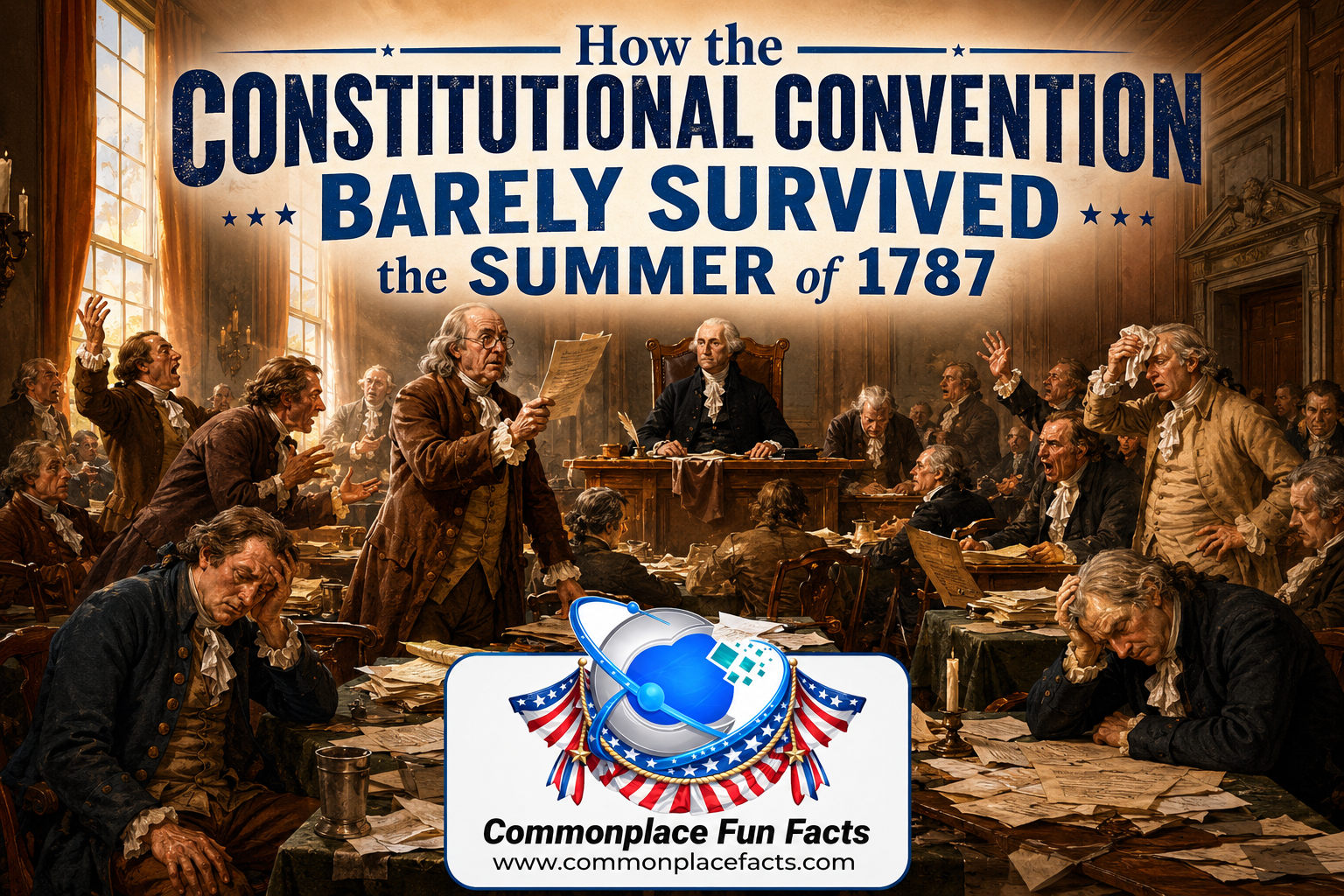

The United States Constitution is one of those documents we tend to imagine as inevitable. Of course it happened. Of course the Founders met in Philadelphia, stroked their chins, adjusted their waistcoats, sprinkled powdered-wig wisdom over the table, and emerged with a system of government that has lasted more than two centuries.
That is the tidy version. It is also the version that has been pressure-washed for classroom posters.
The real story was messier, hotter, and much closer to disaster. In the summer of 1787, the delegates to the Constitutional Convention argued behind locked doors, threatened to walk away, and came alarmingly close to proving that America’s first great national achievement might be winning independence from Britain only to lose a group project to itself.
At one of the Convention’s lowest moments, Benjamin Franklin rose with a warning, a plea, and a reminder of a fundamental truth: “God governs in the affairs of men.”
What happened next was not as simple as the textbook version suggests. Which, naturally, makes it much more interesting.
Contents
A Government Held Together with String and Hope
To understand why the Constitutional Convention almost failed, we first need to remember what came before it: the Articles of Confederation, America’s first attempt at national government.

The Articles were drafted during the Revolutionary War, when Americans were understandably nervous about creating a strong central authority. They had just spent years complaining about distant power, taxation, standing armies, royal officials, and a king who was living proof that being born into royalty did not necessarily guarantee any kind of skill in constituent relations. For those reasons, the new nation created a national government that was deliberately weak.
And when we say weak, we do not mean “modest.” We mean weak in the way a paper umbrella is weak during a hurricane.
Under the Articles of Confederation, Congress could declare war, conduct diplomacy, and make requests of the states. What it could not do very well was raise money, regulate commerce, enforce laws, or persuade thirteen independent-minded states to behave as if they were part of a single country rather than thirteen cats sharing one windowsill.
Congress could ask the states for funds, but it could not directly tax. This worked about as well as any system based on voluntary contributions from people who already believed someone else should pay first. The national government had debts from the Revolution. It had soldiers who wanted to be paid. It had foreign creditors looking at the new republic with the facial expression of a shopkeeper watching a customer pat all his pockets and say, “I know I had money when I came in.”
Commerce was also a mess. States imposed competing trade rules. Foreign governments doubted whether treaties with Congress meant anything if the individual states could ignore them. The country had won independence but had not yet figured out how to operate the machinery of independence without occasionally catching its sleeve in the gears.
Then came Shays’ Rebellion in 1786 and 1787, when armed farmers in Massachusetts, angry over debt and taxes, rose up against state authorities. The rebellion was eventually put down, but it terrified national leaders. To many, it looked like the Revolution had successfully overthrown one government only to produce a nation too feeble to preserve order under its own flag.
In other words, the United States had a problem. It had a name, a flag, a war record, and a growing suspicion that its government had been assembled from spare parts and optimism.
Philadelphia Was Supposed to Be a Repair Job
The Philadelphia Convention opened in May 1787. The official purpose was to revise the Articles of Confederation. This sounded modest. Respectable. Procedural. The kind of thing one might put on a committee agenda between “approve minutes” and “discuss window repairs.”
James Madison had other ideas.
Madison arrived prepared. Very prepared. The sort of prepared that makes everyone else at the meeting quietly hate you while also being thankful that at least one person had done the assigned reading. He had studied ancient confederacies, modern governments, republics, failures, structures, weaknesses, and every political cautionary tale he could get his hands on. He and the Virginia delegation came armed with what became known as the Virginia Plan, which proposed not merely revising the Articles, but replacing them with a stronger national government.
The Virginia Plan called for a national legislature, executive, and judiciary. It proposed that representation in the national legislature be based on population or financial contribution. It gave the national government real authority over the states. This was not a patch. This was not “tighten a few bolts and hope the wagon makes it to winter.” This was a new wagon.
The delegates had been sent to fix the roof. Madison showed up with blueprints for a new house, a demolition crew, and the calm confidence of a man who had already labeled the rooms.
Not everyone was thrilled.
Some delegates believed the Convention had exceeded its authority. Others feared the creation of a powerful central government would endanger the states. Still others worried that the entire project might alarm the public if word got out that the delegates were not merely revising the Articles but preparing to shove them into history’s filing cabinet under “nice try.”
It is easy, looking backward, to assume this was all moving naturally toward the Constitution. It was not. At the time, there was no guarantee that the Convention would produce anything. There was no guarantee that the states would ratify anything. There was no guarantee that the delegates would even stay in the room long enough to finish arguing.
The Locked-Door Republic
One of the Convention’s first major decisions was to conduct its business in secret. The doors were closed. The windows were often shut. Notes were guarded. Public discussion was discouraged. The delegates understood that they were engaged in dangerous political surgery, and they did not want every half-formed idea splashed across newspapers before it had been debated, revised, rejected, resurrected, and possibly disguised under a more agreeable name.

This secrecy had advantages. Delegates could speak freely. They could change their minds. They could propose bold ideas without immediately being denounced back home as traitors, monarchists, aristocrats, radicals, or whatever the 18th-century equivalent was of “please unsubscribe from my newsletter.”
But secrecy also added pressure. If the Convention failed, the public would have little reliable information about why. Rumor would rush in to fill the gap, as rumor always does, wearing muddy boots and carrying a torch. The delegates knew that failure could damage confidence in republican government itself.
The secrecy also reminds us that the Convention was not a tidy civic pageant. It was a gamble. The delegates were trying to create a government strong enough to function but restrained enough not to become the very tyranny they had rebelled against. This was not easy. It is still not easy. Human beings have been trying to get this balance right for thousands of years, usually while pretending that the problem began with the other party last Tuesday.
Inside Independence Hall, the arguments became intense. The weather was hot — a fact that became increasingly and uncomfortably relevant because the windows were kept closed to discourage eavesdroppers. The stakes were enormous. The delegates were brilliant, stubborn, proud, patriotic, suspicious, principled, self-interested, and occasionally all of those things before lunch.
The Constitution was being born in secret, which is another way of saying it was being born under conditions guaranteed to produce both candor and indigestion.
The Fight That Nearly Ended Everything
The issue that nearly destroyed the Convention was representation.
This sounds dull until one remembers that representation is where power puts on a powdered wig and pretends to be arithmetic.

The large states wanted representation based on population. This made sense to them because large states had more people. More people, they argued, should mean more representatives. Virginia, Pennsylvania, and Massachusetts did not see why a tiny state should have the same voting power as a large one. To them, equal state voting looked less like fairness and more like Delaware standing on a chair and demanding the same-sized crown.
The small states saw things differently. Very differently. Under the Articles of Confederation, each state had one vote. Small states feared that if representation were based entirely on population, they would be swallowed by their larger neighbors. They did not fight a revolution against Parliament just to be politically digested by Virginia.
William Paterson of New Jersey offered the New Jersey Plan, which preserved the principle of equal state representation. The large-state delegates pushed back. James Madison and James Wilson argued for proportional representation. Luther Martin, Gunning Bedford, and others defended small-state equality with the urgency of men who could see their political relevance being packed into a trunk and shipped to Richmond.
The debate became fierce. Delegates questioned one another’s motives. Some small-state delegates threatened to seek foreign alliances if their states were crushed in the new system. That was not exactly the sort of thing one puts on commemorative plates, but there it was.
By late June, the Convention was stuck. Not mildly stuck. Not “we need another committee” stuck. It was stuck in the deep, axle-breaking, everyone-get-out-and-push sense. The delegates had spent weeks debating and seemed no closer to agreement. The central question of the new government — who would be represented, and how — threatened to kill the entire project.
Into this moment stepped Benjamin Franklin and spoke the words that changed everything.
Franklin Stands Up
Benjamin Franklin was the oldest delegate at the Convention. At eighty-one, he was too weak to stand for long speeches without assistance, and some of his remarks had to be read for him. But age had not dulled him. Franklin remained one of the most respected men in America: printer, scientist, diplomat, revolutionary, inventor, wit, and professional botherer of lightning.
On June 28, 1787, as the Convention sat deadlocked, Franklin rose — or had his words presented — and offered one of the most remarkable appeals of the summer.

He began by acknowledging the obvious: the Convention had not made much progress. After weeks of debate, the delegates were still divided. They had searched history. They had examined ancient republics and modern governments. They had studied examples, theories, precedents, warnings, and political machinery from every available shelf. Yet the more they discussed, Franklin said, the more they seemed to be “groping as it were in the dark.”
It was a striking phrase. Groping in the dark. That is not how Americans usually imagine the Framers. We prefer them haloed by reason, quills moving gracefully, eyes fixed on posterity, perhaps with an eagle nodding approvingly in the background. Franklin’s description is more human and therefore more useful. These men were not floating above history. They were stumbling through it.
Franklin then reminded the delegates of the Revolution. During the war, he said, the Continental Congress had prayed daily in that very room for divine protection. Those prayers had been heard, he believed. The nation had survived. The cause had succeeded. They had seen enough, Franklin suggested, to know that human wisdom was not the only force at work in the affairs of nations.
Then came the line that has echoed through American history:
“I have lived, Sir, a long time, and the longer I live, the more convincing proofs I see of this truth — that God governs in the affairs of men. If a sparrow cannot fall to the ground without His notice, is it probable that an empire can rise without His aid?”
That sentence deserves to be heard in its full crisis context. Franklin was not sprinkling piety over a finished Constitution. He was speaking when the Convention might fail. He was not decorating success. He was pleading in uncertainty.
He warned that without divine help, the delegates would succeed no better than the builders of Babel. It was a pointed comparison. Babel was the biblical account of human ambition, confusion, and collapse — which, if we are being honest, is also a decent description of most committee meetings after the second hour.
Franklin then made a motion: that prayers “imploring the assistance of Heaven” be held every morning before the Convention proceeded to business, with one or more of Philadelphia’s clergy invited to officiate.
It was a call for humility. It was a call for help beyond their mortal abilities. Franklin was not asking the delegates to stop thinking. He was asking them to admit that their best thinking thus far had not been going especially well.
The Prayer Motion That Did Not Pass
This is where the story becomes more interesting than the simplified version.
Franklin’s motion was seconded by Roger Sherman of Connecticut, a man who had already signed the Declaration of Independence and would later sign the Constitution. Sherman was no minor figure. He understood compromise, institutions, and the delicate art of keeping a political project from bursting into flames.
But the motion did not pass.
Alexander Hamilton reportedly worried that beginning prayers at that late stage might suggest to the public that the Convention was in trouble. This concern is fascinating because the Convention was, in fact, in trouble. This is a bit like refusing to call the fire department because the neighbors might suspect the house is burning.
Others had concerns as well. Hugh Williamson of North Carolina pointed out that the Convention had no funds to pay a chaplain. And so, in one of those details too perfect for fiction, Benjamin Franklin proposed prayer at one of the most desperate moments in American political history, and the delegates hesitated partly because they did not have a budget line for clergy.
Edmund Randolph suggested that perhaps a sermon could be preached on July 4 and prayers begin afterward. The motion was adjourned without a vote.
So no, the Convention did not immediately fall to its knees, pray together, and emerge into the sunlight with the Great Compromise neatly folded in everyone’s pocket. History is rarely that tidy. It prefers to leave crumbs on the floor.
But the failure of the motion does not make Franklin’s speech unimportant. It makes it more revealing. His appeal showed how desperate the moment had become. It showed that at least one of the wisest men in the nation believed the delegates had reached the limits of reason, ambition, and parliamentary maneuvering. It showed that the Convention’s problem was not merely structural. It was spiritual, moral, and personal.
The delegates did not simply need a formula for representation. They needed humility. They needed restraint. They needed enough self-doubt to stop treating every disagreement as a hill on which the entire republic should be allowed to die dramatically.
They needed help from the Eternal One if they were going to see their nation last for any noticeable length of time.
Franklin’s prayer motion may have failed procedurally. His diagnosis did not.
The Great Compromise
The Convention staggered onward.
The representation crisis did not vanish after Franklin’s speech. The delegates continued wrestling with the problem. A committee was appointed to seek a solution, because when human beings cannot solve something in a large group, we often create a smaller group and hope the smaller group contains fewer people determined to be impossible.

The result was what became known as the Great Compromise, or the Connecticut Compromise, associated especially with Roger Sherman and Oliver Ellsworth. It created a bicameral legislature. In the House of Representatives, states would be represented according to population. In the Senate, each state would have equal representation.
Everyone got something. No one got everything. That is how you know it was a compromise.
Large states received proportional representation in the House. Small states received equality in the Senate. Revenue bills would originate in the House, giving the population-based chamber a special role in taxation. The arrangement was imperfect, awkward, and absolutely essential. Without it, the Convention likely would have failed.
On July 16, 1787, the compromise passed by a narrow margin. Five states voted for it, four against it, and Massachusetts was divided. That is not exactly a sweeping wave of unity. That is the constitutional equivalent of a chair being held together by one screw and a meaningful glance.
But it held.
The Great Compromise did not end all disputes. Far from it. The delegates still had to debate the presidency, the judiciary, federal powers, state powers, taxation, commerce, the slave trade, and the ratification process. The Convention remained difficult. Tempers still flared. Delegates still objected. Several still refused to sign.
But the compromise kept the Convention alive. It moved the delegates past the deadlock that had threatened to destroy the entire undertaking. It allowed the Constitution to continue taking shape.
That is one of the great lessons of the summer of 1787: the Constitution survived not because everyone agreed, but because enough people decided that not getting everything they wanted was better than getting nothing at all.
Franklin’s Final Lesson
Benjamin Franklin appears again at the end of the Convention, and once again he provides the right words at the right time.
On September 17, 1787, the delegates gathered to sign the Constitution. The final document was not everything anyone wanted. That is one reason it had a chance of surviving. A Constitution that perfectly satisfied one faction would have been rejected by the others faster than a dinner invitation from Benedict Arnold.
Franklin admitted that he did not approve of every part of the Constitution. He had objections. He had doubts. But he also recognized something important: he might be wrong.
That may be the most radical sentence in politics.
Franklin urged the delegates to “doubt a little of their own infallibility.” It was a magnificent phrase. It should be carved over the entrance to every legislative chamber, committee room, courtroom, social media platform, and family Thanksgiving table in America.
He encouraged the delegates to sign, not because the Constitution was perfect, but because it was the best they were likely to achieve. He believed the appearance of unanimity would strengthen the new government in the eyes of the public. He understood that a flawed but workable Constitution was better than a theoretically perfect one that existed only in speeches and abandoned drafts.
Not everyone signed. George Mason, Edmund Randolph, and Elbridge Gerry refused. Their objections mattered, and some of their concerns would fuel the demand for a Bill of Rights. The Constitution still had to survive the ratification debates, where Anti-Federalists would challenge it fiercely and Federalists would defend it with equal energy.
But thirty-nine delegates did sign.
Franklin’s two great interventions at the Convention form a kind of matched pair. In June, when the delegates were deadlocked, he reminded them that “God governs in the affairs of men.” In September, when the document was ready but still imperfect, he urged them to doubt their own infallibility.
Those are not separate lessons. They are the same lesson viewed from two angles. Human beings need help from above and humility within. Leave either one out, and politics becomes a contest between competing certainties, which is another way of saying everyone gets a shovel and the republic gets a hole.
The Constitution as a Near Miss
The Constitution almost did not happen.
That fact should change how we think about it. The Constitution was not inevitable. It was not the automatic result of American destiny. It was not produced by men who always knew exactly what they were doing. It was negotiated within an inch of its life by delegates who disagreed over fundamental questions and sometimes wondered whether the whole enterprise had gone too far to survive.
That does not make the Constitution less impressive. It makes it more impressive.
Anyone can admire a flawless machine that appears from nowhere fully assembled. It takes more imagination to appreciate a machine built in a hot room by tired men using argument, compromise, fear, ambition, principle, self-interest, hope, and the occasional desperate appeal to Heaven. The miracle is not that the Constitution was perfect. It was not. The miracle is that it happened at all.
Franklin’s prayer speech captures that fragile moment better than almost anything else from the Convention. He saw the delegates groping in the dark. He saw intelligence without agreement, learning without wisdom, and ambition without enough humility. He knew the American experiment had survived war, but it might yet be defeated by pride, suspicion, and procedural deadlock.
“If a sparrow cannot fall to the ground without His notice,” Franklin asked, “is it probable that an empire can rise without His aid?”
The delegates did not formally adopt his motion. No chaplain was hired. No neat inspirational scene followed. The Convention remained messy. The compromises remained difficult. The arguments continued.
But Franklin had named the need. The Convention required more than cleverness. It required humility. It required restraint. It required men who, however reluctantly, could doubt their own infallibility long enough to preserve the possibility of union. Most of all, it needed divine assistance.
The Constitution was born from that narrow space between collapse and compromise.
And perhaps that is why it still matters. It reminds us that republics are not self-sustaining machines. They are fragile arrangements built by imperfect people, maintained by imperfect people, and endangered whenever imperfect people become absolutely certain that they are the exception.
Benjamin Franklin had lived long enough to know better. He had seen empires, revolutions, experiments, failures, lightning storms, and committee meetings. By 1787, he knew that human wisdom was necessary, but not sufficient. The builders of a republic needed light.
In Philadelphia, they nearly lost their way.
Somehow, through argument, compromise, humility, and perhaps more providence than the minutes were prepared to admit, they found just enough of it.
Learn more about the Constitution at The National Constitution Center.
You may also enjoy…

Did George Washington’s Glasses Save American Democracy?
Learn how George Washington’s glasses played a key role in preventing the United States from becoming a monarchy.

Why Were 15 Bodies Buried in Benjamin Franklin’s Basement?
Benjamin Franklin was one of the best-known and well-loved of America’s Founding Fathers. Franklin’s brilliance and wit caused him to excel in almost every area of human understanding. He left his mark as a philosopher, scientist, inventor, statesman, and humorist. Was he also a mass murderer? For nearly twenty years prior to American independence, Franklin…

Is There a Loophole in the Constitution To Create a Dictatorship? Gödel’s Loophole Explored
Discover the bizarre true story of Kurt Gödel, the genius logician who found a legal loophole in the Constitution that could allow for dictatorship—and also invented a model for time travel.




Leave a Reply