
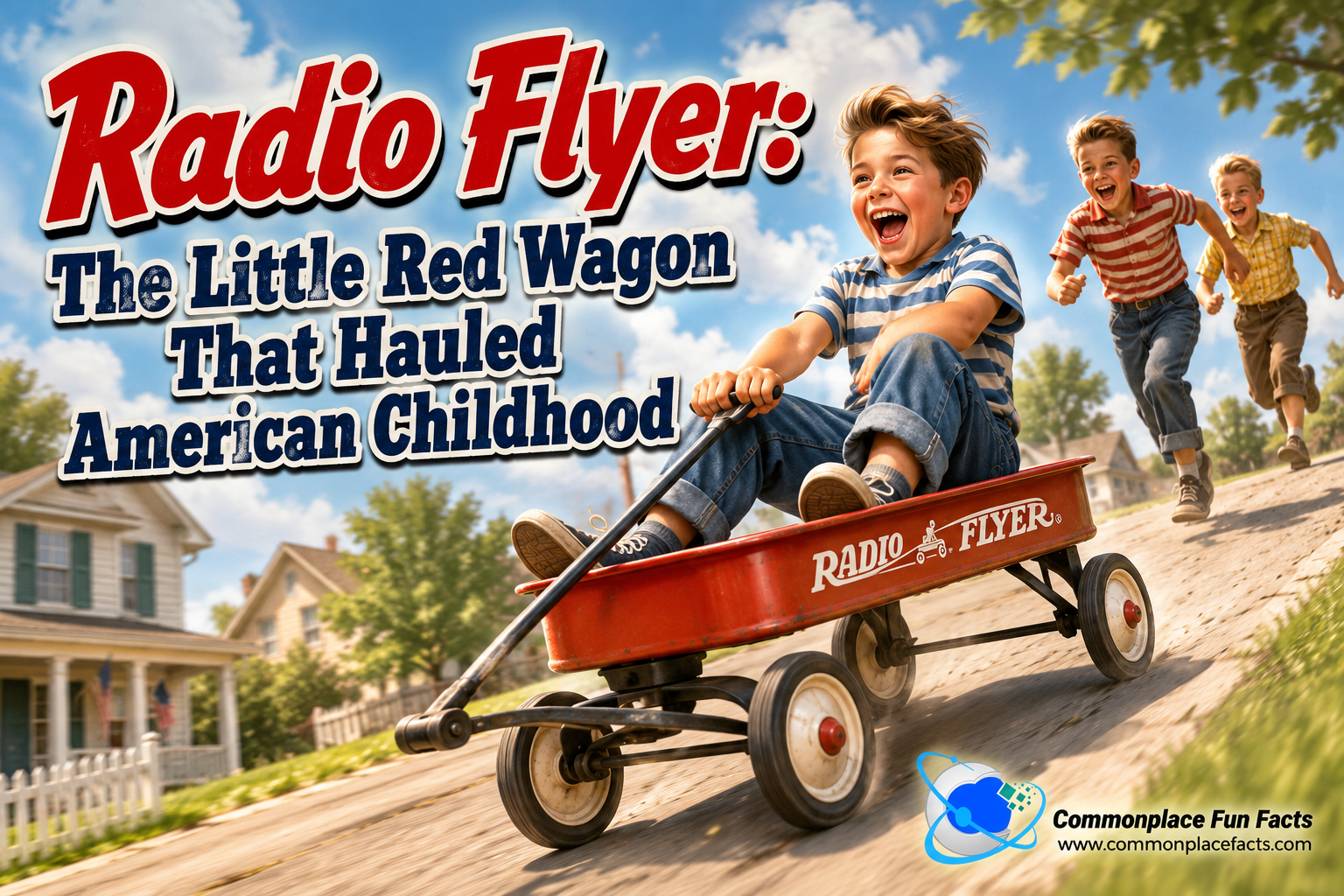

Before any of us got our driver’s license, bought our first car, and entered the universal adult experience of managing car payments, insurance premiums, and putting the mechanic’s children through medical school, many of us started with something much simpler and more magical: a little red wagon. If America has an official childhood utility vehicle, it is almost certainly the Radio Flyer.
The little red wagon is one of those objects that seems to have always existed, like crayons, swing sets, peanut butter sandwiches, and mysterious sticky substances on the back seat of the family car. It does not need batteries. It does not ask you to download an app. It does not require firmware updates, a subscription plan, or a privacy policy written by someone named Mr. Scratch.
It is a box on wheels with a handle. That is it. That is the magic.
For more than a century, the Radio Flyer wagon has hauled toys, siblings, newspapers, garden tools, picnic supplies, beach towels, dolls, dogs, rocks, dirt, sticks, and countless children whose views about personal freedom and invulnerability outweighed any warnings about coasting down a steep hill. It has been a toy, a tool, a vehicle, a stagecoach, a rocket ship, a delivery truck, a parade float, and a mobile court of appeals for disputes over whose turn it was to pull.
Its influence is not merely that it was popular. Lots of toys are popular for five minutes, usually after a television commercial convinces children that happiness requires a plastic object with twelve tiny accessories, nine of which will be missing by Tuesday. The Radio Flyer endured because it was simple, sturdy, useful, and open-ended. It gave children wheels and then got out of the way.
That story begins not with a toy company boardroom but with a teenage immigrant, a one-room workshop, and a wagon that was more interesting than the furniture it was supposed to help make.
Contents
Antonio Pasin and the Very Expensive Family Mule
Antonio Pasin was born in Italy in the 1897, the son and grandson of cabinetmakers. In 1914, at age sixteen, he came to the United States with woodworking skills, ambition, and not much else. His parents had to sell the family mule to pay for his passage.

This is the sort of detail that deserves a moment of silence. Somewhere in Italy, a mule went from family asset to immigrant financing instrument. That mule did not know it was helping launch one of the most recognizable toys in American history.
Pasin arrived in New York, eventually made his way to Chicago, and worked odd jobs until he could buy used woodworking equipment. By 1917, he had saved enough to rent a small workshop on the city’s west side. There he built handmade furniture, phonograph cabinets, wooden tricycles, and wagons. The wagons began as practical objects, useful for hauling tools and supplies. Then customers started noticing them.
People who came to buy phonograph cabinets began asking whether they could buy one of those wagons, too. Pretty soon, Pasin was selling more wagons than cabinets.
This is one of the great business lessons of history: when customers ignore the thing you are selling and point at the thing you are using to move it around, perhaps the universe is trying to save you several years of strategic planning.
Pasin listened. He leaned into wagons.
The Liberty Coaster: A Wagon With an Immigrant’s Name
In 1923, Pasin founded the Liberty Coaster Company. He named his early wagon the Liberty Coaster after the Statue of Liberty, which he had seen when he arrived in New York Harbor. It was a fitting name. The wagon was a child’s toy, yes, but it was also part of a larger immigrant story: a young craftsman coming to America, building something useful with his hands, and turning it into a business.

The first Liberty Coasters were made of wood and steel. Pasin built them at night and sold them during the day. It was not glamorous work, unless your idea of glamour involves sawdust, exhaustion, and the permanent smell of varnish. But it worked.
The wagon had a basic appeal that did not need much explanation. Children like things that move. Children like things that carry other things. Children like the illusion of command. Give a child a wagon and suddenly he is not merely standing in the yard; he is managing logistics. He is operating a freight line. He is pioneering westward expansion between the garage and the elm tree.
Parents also understood the appeal, partly because the wagon was useful. A Radio Flyer could carry children, groceries, tools, leaves, laundry, or the contents of a sandbox if a small person decided the sandbox needed to be relocated for reasons of state. This was not a delicate parlor toy. It had work to do.
The “Little Ford” Builds a Wagon for Everybody
Pasin’s real genius was not merely that he made a good wagon. It was that he figured out how to make a good wagon affordably and repeatedly. In the late 1920s and early 1930s, he borrowed manufacturing ideas from the automobile industry, including assembly-line production and stamped steel. These techniques allowed him to produce wagons that were strong, attractive, and inexpensive.
The approach earned him the nickname “Little Ford,” which is delightful, because apparently early twentieth-century America had only one metaphor for efficient manufacturing: Henry Ford, but smaller.
By 1930, Pasin was mass-producing steel-bodied wagons. The new wagons sold for less than three dollars each. That price mattered. A Radio Flyer was not supposed to be an ornamental toy for children whose nurseries had marble columns and emotional distance. It was marketed “for every girl and boy.”
Even during the Great Depression, the wagons sold at a rate of about 1,500 per day. That is an astonishing number, especially for a time when families were dealing with the worst economic downturn in modern industrial history.
The wagon succeeded because it sat at the intersection of durability and possibility. It was tough enough to survive actual children, which is the most rigorous product testing known to man. It was simple enough to be affordable. And it looked good enough that children wanted it before they had any idea what “stamped steel” meant, which is fair, because most adults are still only pretending.
Why “Radio Flyer” Sounded Like the Future
The name “Radio Flyer” came from two of the great modern fascinations of Pasin’s era: radio and flight. Radio represented the astonishing new world of invisible communication, with Guglielmo Marconi as one of its most famous pioneers. Flight represented daring, speed, and modern adventure, especially after Charles Lindbergh’s 1927 solo flight across the Atlantic.

So Pasin combined the two ideas and gave a humble wagon a name that sounded like it should be crossing the Atlantic while broadcasting jazz. It did neither, of course. The wagon did not fly, except under the supervision of older cousins, and it did not receive radio signals, unless one counts the universal childhood frequency of “this seems like a bad idea, but let’s try it anyway.”
Still, the name was brilliant. “Radio Flyer” sounded modern. It sounded speedy. It sounded as if the future had been bolted to four wheels and painted red. This was important because the wagon itself was not complicated. The name gave it motion, imagination, and a little technological sparkle.
It was not just a wagon. It was a Flyer. A child pulling one down the sidewalk could feel like a pilot, engineer, explorer, or delivery magnate. Childhood is generous that way. Give it a handle and a decent set of wheels, and it will build an empire before lunch.
The World’s Fair and the Giant Wagon Boy, Because Subtlety Was Apparently Closed That Day
In 1933, Chicago hosted the Century of Progress World’s Fair. Pasin decided this was Radio Flyer’s moment. He invested $30,000 into a wagon exhibit, a huge sum during the Depression and the sort of decision that makes accountants develop facial twitches.
The centerpiece was a massive “Coaster Boy” display: a 45-foot-tall figure of a boy riding an enormous wagon. This was advertising in the grand old American tradition of making something so large that people are forced to talk about it, if only to confirm that everyone else is also seeing the giant wagon child.
The exhibit sold miniature souvenir wagons for twenty-five cents. More than 100,000 of the tiny wagons were sold. That is not merely successful marketing. That is a small steel-wheeled invasion.

The stunt helped spread the Radio Flyer name far beyond Chicago. It also demonstrated something Pasin seemed to understand instinctively: children and parents respond to objects that feel both familiar and wonderful. A wagon was ordinary. A giant wagon was spectacle. A tiny souvenir wagon was portable memory. Together, they turned a useful toy into a brand.
One suspects the giant Coaster Boy also haunted a few dreams. Progress has its costs.
The Toy That Was Also a Tool
Part of the Radio Flyer’s influence came from the fact that it was never only a toy. It was useful in the real world, which children appreciate more than adults sometimes realize. Children do not merely want to be entertained. They want to do things. They want to help, imitate, move, carry, collect, transport, and occasionally create a minor municipal crisis in the driveway.
The wagon gave them a scaled-down version of adult competence. Adults had cars, trucks, carts, wheelbarrows, and delivery routes. Children had the Radio Flyer. It allowed them to participate in the grown-up world without being entrusted with anything truly dangerous, such as a lawn mower, a chainsaw, or a working knowledge of zoning ordinances.
A child with a wagon could haul newspapers on a route. He could carry garden supplies. An older sibling could tow a younger sibling. They could gather apples, move firewood, stage a parade, sell lemonade, transport dolls, or rescue stuffed animals from imaginary floods. One wagon could become whatever the day required.
That is the key. The Radio Flyer did not come with a fixed story. It did not tell children who they were supposed to be. It simply offered mobility and capacity. It said, in effect, “Here are wheels. Make poor choices responsibly.”
The Secret of a Great Toy: It Does Not Do Too Much
Modern toys often try very hard to impress adults. They light up, talk, sing, count, quiz, blink, beep, connect, and sometimes make a parent wonder whether anyone in the design meeting had ever met a child or merely read a memo about one.
The Radio Flyer took the opposite approach. It did almost nothing by itself. This is exactly why it worked.
Play experts have long recognized the value of open-ended materials. Studies have shown that open-ended materials allow children to decide how to use them, make choices, and experience the results of those choices. In simpler terms: basic is better. Simple, classic toys tend to support creativity, problem-solving, social interaction, and imaginative expression.
The Radio Flyer is practically a case study in this principle. It has no assigned plot. It has no screen. It has no character universe requiring a cinematic timeline, three prequels, and a streaming subscription. A wagon can be a spaceship in the morning, a farm truck after lunch, and a prisoner transport by late afternoon if the teddy bear has committed treason.
That freedom is the key. The wagon makes the child do the imaginative work. It supplies the platform, not the script. Children decide the mission, negotiate the roles, test the rules of physics, and learn that hills, gravity, and overconfidence are a dangerous committee.
Why Red?
Of course, the Radio Flyer is not merely a wagon. It is the little red wagon. The color became part of the identity so completely that a Radio Flyer in any other color looks vaguely like it is attending a costume party.

Why red? Nobody seems to know for certain. It appears that the company tried other colors over the years, but red consistently outsold them. Robert Pasin joked about possible Italian associations, including Ferraris and spaghetti sauce. This is not exactly peer-reviewed chromatic history, but frankly it is hard to improve upon.
Whatever the reason, red worked. It was bright, visible, cheerful, and energetic. It made the wagon look fast even when it was standing still. It looked like childhood had been dipped in enamel.
The design became visual shorthand. Red steel bed. White lettering. Black wheels. Long handle. You did not have to explain it. Generations recognized it instantly, the way people recognize a Coca-Cola bottle, a yellow school bus, or the exact sound a mother makes four seconds before she has reached “enough” with the shenanigans unfolding in the driveway.
Streamlined Dreams and Muscle-Car Wagons
Although the classic wagon stayed remarkably consistent, Radio Flyer did not freeze itself in 1930. Like many successful toys, it adapted to the look and spirit of changing times.

In the 1930s, Radio Flyer embraced the streamlined style that was sweeping American design. One example is the Streak-O-Lite Zephyr wagon, inspired by the sleek Burlington Zephyr train that caused a sensation at Chicago’s Century of Progress exposition. The wagon borrowed the language of modern speed: dashboards, lights, and machine-age styling. It was a child’s toy dressed like the future.
Later decades brought other changes. Radio Flyer added higher sides in the 1950s, borrowed bright colors and slick tires from muscle cars in the 1970s, and introduced an all-terrain Quad Shock Wagon in the 1990s. In other words, the wagon followed American transportation culture the way a small red duckling follows a very loud mechanical mother.
This helped keep the brand alive. Radio Flyer could change with the world without losing the essential idea. Whether styled like a train, a muscle car, or an SUV, the basic promise remained the same: wheels, cargo, imagination, adventure.
A Toy Hall of Famer, Naturally
In 1999, the Radio Flyer wagon was inducted into the National Toy Hall of Fame at The Strong in Rochester, New York. This was not surprising. If the Toy Hall of Fame had somehow overlooked the little red wagon, one imagines a delegation of irate children would have arrived pulling evidence behind them.
The Hall of Fame looks for toys with longevity, recognition, discovery, and innovation. Radio Flyer checks those boxes with the confidence of a child who has just announced that the wagon is now a spaceship and everyone needs to get in.
Its longevity is obvious. Its recognition is immediate. Its capacity for discovery is built into the design. And its innovation came not from technological complexity but from combining mass production, affordability, durability, and open-ended play in a single object.
It also did something subtler. It changed how children occupied space. A child with a wagon could go farther, carry more, include others, and transform ordinary sidewalks, yards, alleys, and driveways into routes, frontiers, roads, camps, forts, depots, and disaster zones requiring immediate parental intervention.
Why the Radio Flyer Still Matters
Radio Flyer’s official history describes the company today as still Chicago-based and family-owned, with a product line that now includes wagons, tricycles, scooters, go-karts, and electric bikes. That is a long way from Antonio Pasin’s one-room workshop, but the brand’s emotional center remains the same.

The wagon matters because it belongs to a category of toys that do not merely entertain children. They enlarge the child’s world. A ball does this. Blocks do this. A cardboard box does this. A stick absolutely does this, despite the stick’s limited marketing department. The Radio Flyer did it with wheels.
It gave children a first taste of independence. Not complete independence, of course. Nobody was suggesting a toddler head west with provisions and a map. But within the safe geography of a yard, driveway, sidewalk, or neighborhood, the wagon made a child mobile. It let children decide what mattered enough to haul. It gave them agency, responsibility, and just enough mechanical advantage to become overconfident.
It also connected generations. Grandparents remember pulling one. Parents remember riding in one. Children still understand one immediately. There is a very good chance you are remembering your own experience with a Radio Flyer wagon right now. There are few objects that can move so easily through time. A Radio Flyer wagon from decades ago may be scratched, dented, faded, and missing some dignity, but it still makes sense. A child does not need instructions. The handle is right there. The adventure is pending.
That may be the most impressive thing about it. In an age when toys increasingly come preloaded with storylines, characters, sound effects, and warning labels that read like international treaties, the Radio Flyer remains refreshingly plain. It trusts the child to supply the plot.
The Little Red Wagon That Carried More Than Toys
Antonio Pasin could not have known, when he arrived in America as a sixteen-year-old cabinetmaker’s son, that his wooden wagons would become one of the most enduring symbols of American childhood. He probably just knew that people kept buying them, which is one of the clearer messages the economy sends before it starts speaking in spreadsheets.
He built a wagon. Then he built a company. Then he built an icon.
The Radio Flyer endured because it combined immigrant ambition, industrial ingenuity, practical design, and child-sized freedom. It was affordable enough to spread widely, durable enough to survive use, attractive enough to become memorable, and simple enough to become anything.
It hauled toys, tools, leaves, groceries, siblings, puppies, picnic baskets, newspapers, beach gear, and the occasional unauthorized household object. But what it really hauled was imagination.
The little red wagon was never just a wagon. It was an entire childhood on wheels.
You may also enjoy…

Some Slick Stories Surrounding the Slinky
They say some people are like Slinky’s — they’re not really good for anything, but they bring a smile to your face when you push them down a flight of stairs. If that’s what you think, be prepared for an argument from some of the more than 300 million people who have purchased a Slinky…

The Big Flub Called Flubber
Learn about the disastrous toy Flubber that made kids sick.

Why Are Old Dolls So Creepy? The Psychology Behind Their Unsettling Stare
Why are old dolls so creepy? Explore the psychology, history, and uncanny valley effect behind antique dolls’ unsettling stare and lifelike features.





Leave a Reply