
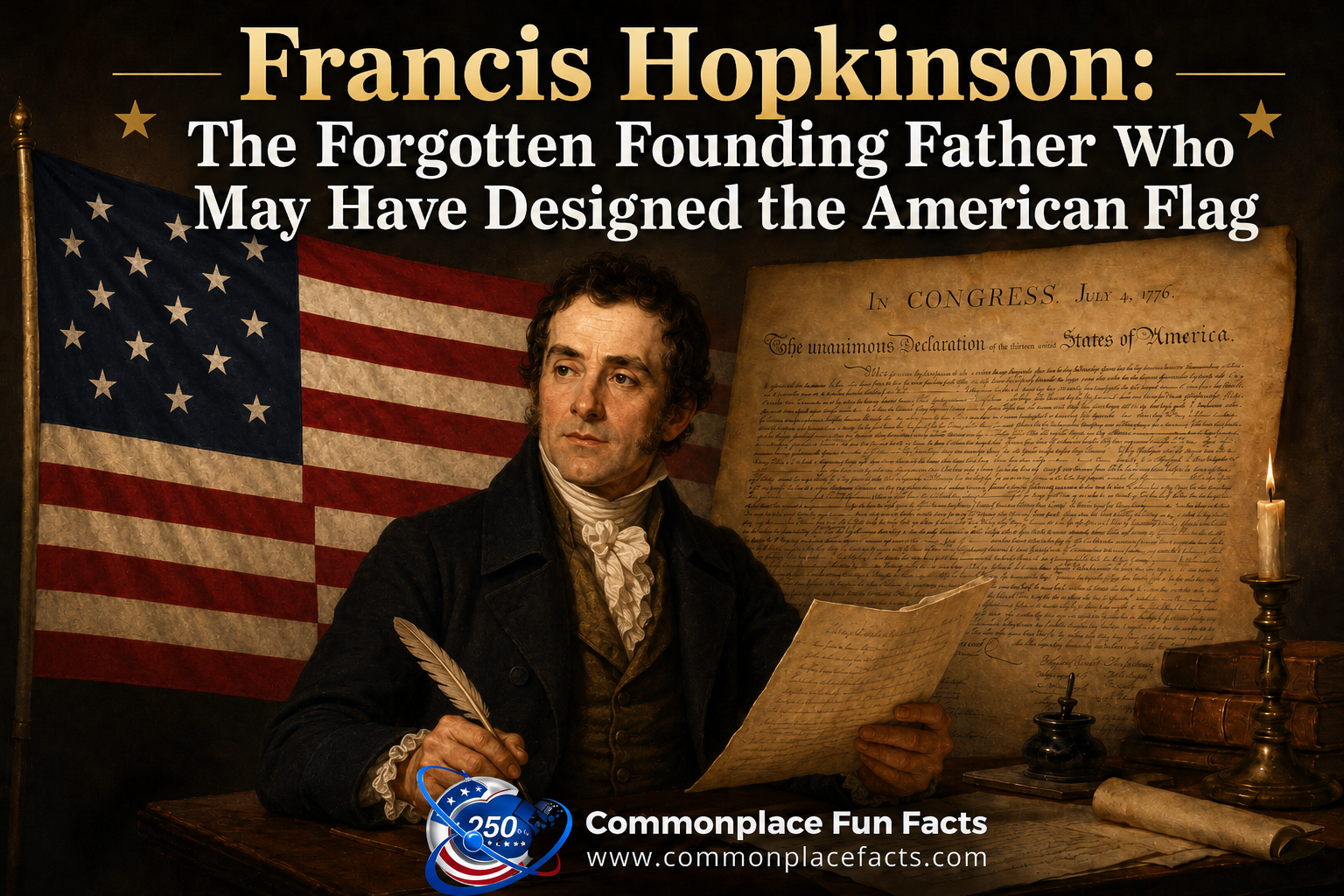

In May 1780, Francis Hopkinson sent the government of the United States a bill.
This was not unusual. Governments have been receiving bills since shortly after the invention of governments, usually followed by the invention of someone whose job is to explain why the bill cannot be paid until the proper form has been submitted in triplicate.
Hopkinson’s invoice, however, was a little different. He claimed that he had designed several official symbols for the new nation, including seals, currency, and “the Flag of the United States of America.” As compensation, he suggested that Congress reward him with “a Quarter Cask of the public Wine.”
It was a modest request. He was not asking for land, a pension, or a government office. He had helped design the visual identity of the United States and merely wanted the government to open the national wine cellar and send something respectable to his house.
Congress declined.
Thus began one of the nation’s earliest disputes over whether creative professionals should be paid for their work or simply feel honored by the exposure.
The invoice tells us a great deal about Francis Hopkinson. He was artistic, witty, slightly cheeky, and willing to remind the government that national symbols do not design themselves. He was also a signer of the Declaration of Independence, a lawyer, judge, poet, satirist, musician, composer, artist, inventor, political propagandist, and probable designer of the first American flag.
In other words, he was the Founding Fathers’ unofficial creative department.
Contents
The Founding Father With the Crowded Résumé
Francis Hopkinson was born in Philadelphia on October 2, 1737, into a family well connected to the city’s intellectual life. His father, Thomas Hopkinson, was associated with Benjamin Franklin and helped establish the educational institution that developed into the College of Philadelphia, now the University of Pennsylvania.

Francis became a member of the college’s first graduating class in 1757. He received a master’s degree three years later, studied law, and was admitted to the Pennsylvania bar in 1761.
That alone would have provided a perfectly respectable eighteenth-century career. He could have practiced law, accumulated clients, complained about judges, and spent the rest of his life explaining that “a quick legal question” is rarely quick, particularly when asked on Sunday morning outside church by someone who assumes friendship constitutes an unlimited retainer.
Hopkinson, however, approached specialization as though it were a character defect.
He played the harpsichord and organ. He sang. He composed music. He wrote poetry, essays, songs, pamphlets, political allegories, and satire. He painted portraits, designed seals, experimented with musical instruments, held public office, signed the Declaration of Independence, sat as an admiralty judge, defended the Constitution, and received one of George Washington’s first appointments to the new federal judiciary.
The founding generation produced several men who regarded having one career as an appalling lack of ambition. Gouverneur Morris wrote much of the Constitution’s final language, served as a diplomat during the French Revolution, lost a leg, pursued a vigorous romantic life, and recorded nearly everything in diaries. Benjamin Franklin was a printer, diplomat, scientist, inventor, writer, and apparently the person everyone called whenever electricity, France, or bifocals became involved.
Even among that exhausting group, Hopkinson stood out. He did not dominate one field so much as wander cheerfully through all of them, leaving behind songs, sketches, legal opinions, government symbols, political jokes, and unpaid invoices.
John Adams Examines a Curious Specimen
John Adams met Hopkinson during the summer of 1776 and described him to Abigail in a letter. Adams called him one of those “pretty little, curious, ingenious Men” and observed that Hopkinson’s head was “not bigger, than a large Apple.”
This was apparently intended as a physical description rather than a diagnosis.
Adams found Hopkinson’s appearance so unusual that he compared observing him to studying natural history. Nevertheless, he acknowledged that Hopkinson was genteel, well-bred, social, and accomplished in painting, sculpture, architecture, and music.
It was classic John Adams: admiration carefully wrapped in enough personal criticism to ensure that nobody became overly pleased with himself.
Hopkinson was small, stylish, sociable, and intellectually restless. His interests were not merely ornamental hobbies adopted by a gentleman who wished to appear cultured while standing near a harpsichord. He was a serious musician and writer. He performed with professional musicians, composed original works, and became one of the most effective satirists of the American Revolution.
His head may have resembled a large apple, but a surprising amount was happening inside it.
Rebellion, With Better Punchlines
Before the colonies declared independence, Hopkinson was already attacking British policy through satire.
His 1774 pamphlet A Pretty Story presented the conflict between Britain and its American colonies as a family dispute. A nobleman establishes farms for his children in a distant wilderness. The children succeed, the nobleman’s steward begins imposing demands on them, and the relationship deteriorates through greed, arrogance, and bad management.
It was all entirely fictional, of course. Any resemblance to King George III, Parliament, the colonies, and current political events was merely the kind of remarkable coincidence that kept printers out of prison.
Satire was a valuable political weapon during the Revolution. Most people did not read dense constitutional arguments for recreation, and those who did were already attending Continental Congress meetings. Songs, poems, parables, and jokes could carry political ideas to a much larger audience.
Hopkinson understood that ridicule could accomplish something solemn argument could not. It could make authority look foolish.
That mattered because political power depends partly on dignity. A government can withstand criticism. It has a much harder time recovering once everyone starts laughing at it.
The British Empire Opens Fire on Several Barrels
Hopkinson’s most famous satire arose from a peculiar episode during the British occupation of Philadelphia.
In late 1777, American forces attempted to attack British shipping in the Delaware River by floating gunpowder-filled kegs downstream. The devices were intended to explode when they collided with ships. It was an inventive plan combining explosives, river currents, surprise, and the optimistic assumption that wooden barrels would politely navigate toward strategically important targets.
The kegs caused little serious damage to the British fleet, but they produced considerable alarm. British troops and sailors reportedly fired repeatedly at suspicious objects in the water, including barrels, logs, and anything else that appeared to be drifting with revolutionary intent.
Hopkinson transformed the incident into “The Battle of the Kegs,” a mock-heroic song describing the British military’s desperate struggle against the floating enemy.
The song portrayed the British response as if the empire had faced an enormous invasion force rather than several poorly guided containers. Soldiers fired from shore. Ships opened fire. Officers issued orders. The mightiest military power in the world had encountered weaponized packaging material and was taking no chances.
“The Battle of the Kegs” became one of the Revolution’s most popular patriotic songs. The actual military operation accomplished relatively little. Hopkinson’s version of it inflicted the lasting damage.
The episode demonstrated his peculiar value to the revolutionary cause. Other men could organize troops or draft resolutions. Hopkinson could take an inconclusive attack and turn it into a public-relations defeat for the British Empire.
Every revolution needs someone who understands messaging.
He Also Signed the Declaration of Independence
Hopkinson’s creative work was not merely something he did from the sidelines while more important men founded the country.

After moving to Bordentown, New Jersey, he entered colonial politics and became an increasingly vocal opponent of British policy. In 1776, New Jersey sent him to the Second Continental Congress. He served there from June through November and signed the Declaration of Independence.
This is usually the point at which a Founder’s biography reaches its climax. A man signs the Declaration, the orchestra swells, the camera pulls back, and schoolchildren are assigned to memorize his name.
For Hopkinson, even signing the Declaration was merely one extraordinary item in the middle of the résumé.
He went on to chair the Continental Navy Board, serve as treasurer of the Continental Loan Office, work in admiralty law, support ratification of the Constitution, and join the federal judiciary.
His support for independence also carried personal consequences. British and Loyalist forces repeatedly targeted and looted his home in Bordentown. It is one thing to publish humorous attacks on the government. It is another to sign your name to the official breakup letter.
The Case Against Betsy Ross
Nearly every American child learns some version of the Betsy Ross story.
George Washington and other members of a congressional committee supposedly visited Ross’s upholstery shop in Philadelphia. They presented a proposed flag design featuring six-pointed stars. Ross demonstrated that a five-pointed star could be produced with one clever fold and snip of the scissors. The committee was impressed, the flag was born, and generations of elementary-school students received an unusually strong lesson in both patriotism and paper crafts.
Betsy Ross unquestionably made flags. She was a skilled upholsterer and businesswoman who supplied flags and other materials during the Revolution. The problem is that there is no contemporary documentation establishing the familiar story that she designed the first American flag at Washington’s request.
The story did not become public until 1870, nearly a century after the alleged meeting, when Ross’s grandson presented the family tradition to the Historical Society of Pennsylvania.
Family stories can preserve genuine history. They can also improve dramatically after several decades of holiday dinners.
Francis Hopkinson’s claim rests on something less sentimental but considerably more useful to historians: paperwork.
Did Francis Hopkinson Design the American Flag?
On June 14, 1777, the Continental Congress adopted a resolution stating that the flag of the United States would have thirteen alternating red-and-white stripes and a blue field containing thirteen white stars representing “a new constellation.”
The resolution did not identify a designer. It did not specify whether the stars should have five points or six. It did not establish whether they should appear in a circle, in rows, or scattered across the field with the casual disorder of office furniture after a government relocation.
As a result, early American flags varied considerably.

Hopkinson was serving as chairman of the Continental Navy Board when the flag was adopted. More importantly, three years later he wrote to the Board of Admiralty requesting compensation for designs he had produced for the government. His list included the Admiralty seal, the Treasury seal, designs for Continental currency, the Great Seal, and “the Flag of the United States of America.”
Nobody appears to have responded by accusing him of inventing the claim.
The government’s response was essentially that Hopkinson was not the only person involved in the designs and therefore should not receive full compensation. That objection suggests collaboration or consultation. It does not suggest that Hopkinson had nothing to do with the flag.
Most historians therefore regard Hopkinson as the strongest documented candidate for designing the first Stars and Stripes, or at least for creating its basic visual arrangement. That does not mean he personally sewed the first flag, selected every detail, or produced the familiar circular arrangement of thirteen stars commonly associated with Betsy Ross.
In fact, no surviving sketch conclusively shows exactly what Hopkinson’s flag looked like. Evidence from his other designs suggests he may have favored six-pointed stars rather than the five-pointed stars now used on the flag.
The safest conclusion is less dramatic than the traditional story but better supported: Betsy Ross was one of the people who manufactured early American flags, while Francis Hopkinson probably played a significant role in designing the national flag Congress adopted.
History would prefer one creator, one workshop, and one decisive snip of the scissors. Reality usually arrives as a committee project with incomplete minutes.
America’s First Graphics Department
The flag was not Hopkinson’s only contribution to the appearance of the new country.
He designed or contributed to seals for government departments and public institutions. He produced devices for Continental currency. He prepared proposals for the Great Seal of the United States, several elements of which appeared in the final design approved in 1782.

The Great Seal was not the work of one person. Congress formed three committees over six years, consulted several artists and heraldic experts, and considered numerous designs before Secretary of Congress Charles Thomson assembled the final version.
This was appropriate. Nothing says “E pluribus unum” quite like requiring fourteen people and three committees to design a picture of an eagle.
Hopkinson’s proposals included several features that became part of the national visual vocabulary: a shield with thirteen stripes, a constellation of thirteen stars, arrows, an olive branch, and other symbols connecting the states to a unified national identity.
These were not trivial decorative details. The United States was a new country trying to persuade its own citizens—and several skeptical European powers—that it was a real nation rather than a temporary disagreement with Britain that had become unusually violent.
It needed recognizable symbols. Flags had to fly over ships and forts. Seals had to authenticate government documents. Currency had to look official enough that someone might exchange actual goods for it. The nation needed a visual identity before anyone had thought to call such a thing “branding.”
Hopkinson helped supply it.
Washington gave the country military legitimacy. Jefferson supplied soaring prose. Franklin charmed France. Hopkinson made sure the new republic had a logo package.
A Quarter Cask of the Public Wine
That brings us back to Hopkinson’s request for payment.
In his first letter, he did not demand a large sum. He suggested that “a Quarter Cask of the public Wine” would be a suitable reward for his services.
There was an elegant eighteenth-century quality to the proposal. Hopkinson was not simply submitting an invoice. He was giving Congress an opportunity to behave like gentlemen.
Congress behaved like Congress.
Hopkinson later submitted a more formal bill for his designs. The government considered the claim but declined to pay it. The Treasury Board argued that Hopkinson had not been the only person consulted on the designs and that the public offices he already held obligated him to provide such services without additional compensation.
It was an early expression of the principle that a salaried employee who demonstrates an additional skill has volunteered to perform it forever at no extra cost.
The fledgling United States was also nearly broke. It was fighting a war, struggling with unreliable currency, and attempting to finance a government that possessed more ambition than revenue. Even a modest quantity of public wine may have appeared fiscally reckless.
Still, the symbolism is difficult to resist. The probable designer of the American flag asked the United States for a drink, and the United States told him to go drink by himself.
Some national traditions were established much earlier than we realize.
The First American Composer—With Qualifications
Had Hopkinson never entered politics or designed a national symbol, he still would have earned a place in American cultural history through music.
In 1759, he composed music for “My Days Have Been So Wondrous Free,” using words written by the Irish poet and clergyman Thomas Parnell. The piece is generally identified as the America’s earliest surviving secular composition by a native-born American.
That description requires several qualifiers, but historical claims usually do. Calling it simply “the first American song” would ignore Indigenous music, religious compositions, folk traditions, imported works, and songs that existed but were never written down or did not survive.
Still, “America’s earliest surviving secular composition by a native-born American” is not a bad accomplishment for someone whose primary profession was law.
Hopkinson composed patriotic songs, hymns, psalm settings, and pieces for voice and keyboard. He dedicated a collection of songs to George Washington and described them as the first musical works produced by an American poet and offered to the American public.
Hopkinson also invented an experimental musical instrument called the Bellarmonic, which produced bell-like tones using tuned metal components. Surviving descriptions are frustratingly limited and do not entirely agree on its construction, although some describe metal balls and others a set of steel bells. Hopkinson separately devised a keyboard mechanism for Benjamin Franklin’s glass armonica, because apparently composing music was not enough; he also felt obliged to redesign the equipment.
The family talent continued. Hopkinson’s son Joseph later wrote the lyrics to “Hail, Columbia,” which became one of the most popular patriotic songs of the early republic and served for many years as an unofficial national anthem. It later became the traditional ceremonial entrance music for the vice president of the United States, serving as the vice presidential counterpart to “Hail to the Chief.”
The Hopkinsons were the rare legal family whose intergenerational legacy included federal judgeships and patriotic hit singles.
Judge Hopkinson Faces Impeachment
Hopkinson’s legal career was nearly as eventful as his creative one.
In 1779, he became judge of Pennsylvania’s Admiralty Court. Admiralty courts handled disputes involving ships, captured vessels, cargo, maritime prizes, and the many other legal complications produced when private property and naval warfare occupied the same stretch of water.
These cases could involve enormous sums of money. They also attracted accusations of favoritism, corruption, and improper influence with roughly the same reliability that unattended food attracts ants.
In December 1780, Pennsylvania’s legislature impeached Hopkinson. The accusations included accepting improper payments from litigants, accepting bribes in connection with appointments, and dealing in questionable financial certificates.
He was tried and acquitted.
That final fact is important. “Impeached judge” has a wonderfully scandalous sound, but impeachment is an accusation and trial process, not a conviction. Hopkinson remained on the Admiralty Court for the rest of the decade.
He also became an active supporter of the proposed Constitution. He was not a delegate to the federal Constitutional Convention of 1787, despite claims that occasionally appear in shortened biographies. He participated in Pennsylvania’s ratifying convention, where the state considered whether to approve the finished Constitution.
President George Washington nominated Hopkinson in September 1789 to become the judge of the newly created United States District Court for the District of Pennsylvania. The Senate confirmed him two days later.
Thus, within nine years of his state impeachment, Hopkinson became one of the first federal judges appointed under the Constitution.
How Did Francis Hopkinson Become the Forgotten Founder?
Hopkinson died suddenly in Philadelphia on May 9, 1791, at the age of 53. His federal judicial service had lasted less than two years.

At the time of his death, he had been a congressman, Declaration signer, judge, writer, composer, artist, designer, and political satirist. Today, most Americans have never heard of him.
Part of the problem may be that his achievements were spread across too many fields.
Washington won the Revolution. Jefferson wrote the Declaration. Madison shaped the Constitution. Hamilton created the financial system and later received the rarest of historical honors: a Broadway musical in which the Treasury Department became emotionally compelling.
Hopkinson’s contributions are harder to summarize. He wrote a song, designed a seal, produced satire, sat on a court, created some currency, supported the Constitution, signed the Declaration, and probably designed the flag.
His influence was substantial but scattered. He left fingerprints everywhere and a monument almost nowhere.
The Betsy Ross story also proved more memorable than his documented claim. It offered famous characters, a cozy workshop, an ingenious woman, a dramatic demonstration with scissors, and a finished flag. Hopkinson’s version involved administrative correspondence, conflicting invoices, committee participation, a Treasury Board report, and an unpaid bill.
One of these works well in a school pageant. The other requires footnotes.
More broadly, history tends to remember the people who command armies, deliver famous speeches, and occupy the highest offices. It is less attentive to the people who create the songs, symbols, jokes, designs, and cultural language through which those events are remembered.
Hopkinson helped make the United States recognizable. Unfortunately for him, people remember the symbol more readily than the designer.
The Man Behind the Stars and Stripes
Francis Hopkinson did not fit the usual image of a Founding Father.
He did not command an army across the Delaware or write a constitutional treatise that later generations would quote solemnly during Senate hearings. He was a smaller, stranger, more versatile figure: a lawyer who composed songs, a judge who wrote jokes, a congressman who designed symbols, and a Declaration signer who found time to mock British soldiers for fighting barrels.
He helped give the new country a voice and a visual identity. His music entertained it. His satire encouraged it. His political service helped establish it. His designs allowed it to represent itself on flags, seals, money, and official documents.
For all of that, he asked for a quarter cask of wine.
The government refused to pay, and history largely forgot his name. The flag remained. The seals remained. The symbols became so familiar that few people thought to ask who had first arranged them.
More than two centuries later, Francis Hopkinson’s account is still outstanding.
The least we can do is remember the man—and raise a glass of lemonade in payment of a debt Congress left outstanding.
You may also enjoy…

Gouverneur Morris: The Most Unlikely Founding Father
Meet Gouverneur Morris—the overlooked Founding Father who wrote “We the People,” dominated the Constitutional Convention, survived a wooden leg, and lived a scandalously colorful life.

From Zero Stars to 50: The History of the American Flag
Explore the surprising history of the American flag—from chaotic early designs to the modern Stars and Stripes. Discover odd layouts, forgotten variations, and how the flag we know today finally took shape.

Yankee Doodle Once Promised Death to a Founding Father
One of the earliest and best-known patriotic songs of the United States is “Yankee Doodle.” Learned by every school child and sung every Independence Day, the song is a rich reminder of the heroic actions of America’s Founding Fathers. Speaking of Founding Fathers, few names loom larger than that of John Hancock. Strictly speaking, his…



Leave a Reply