

Benjamin Franklin is remembered as a printer, scientist, inventor, diplomat, statesman, philosopher, and founding father. He helped draft the Declaration of Independence, negotiated the American alliance with France, experimented with electricity, improved the postal system, and is generally credited with developing bifocals.
He was also one of the most interesting people history has ever produced. Given a choice of dinner companions from any era, Franklin would probably make a great many short lists.
That makes it particularly delightful that this same man once sat down and carefully explained how to become a truly disagreeable companion—the sort of person everyone hopes will leave the party early.
Contents
Benjamin Franklin Explains How to Become Unbearable
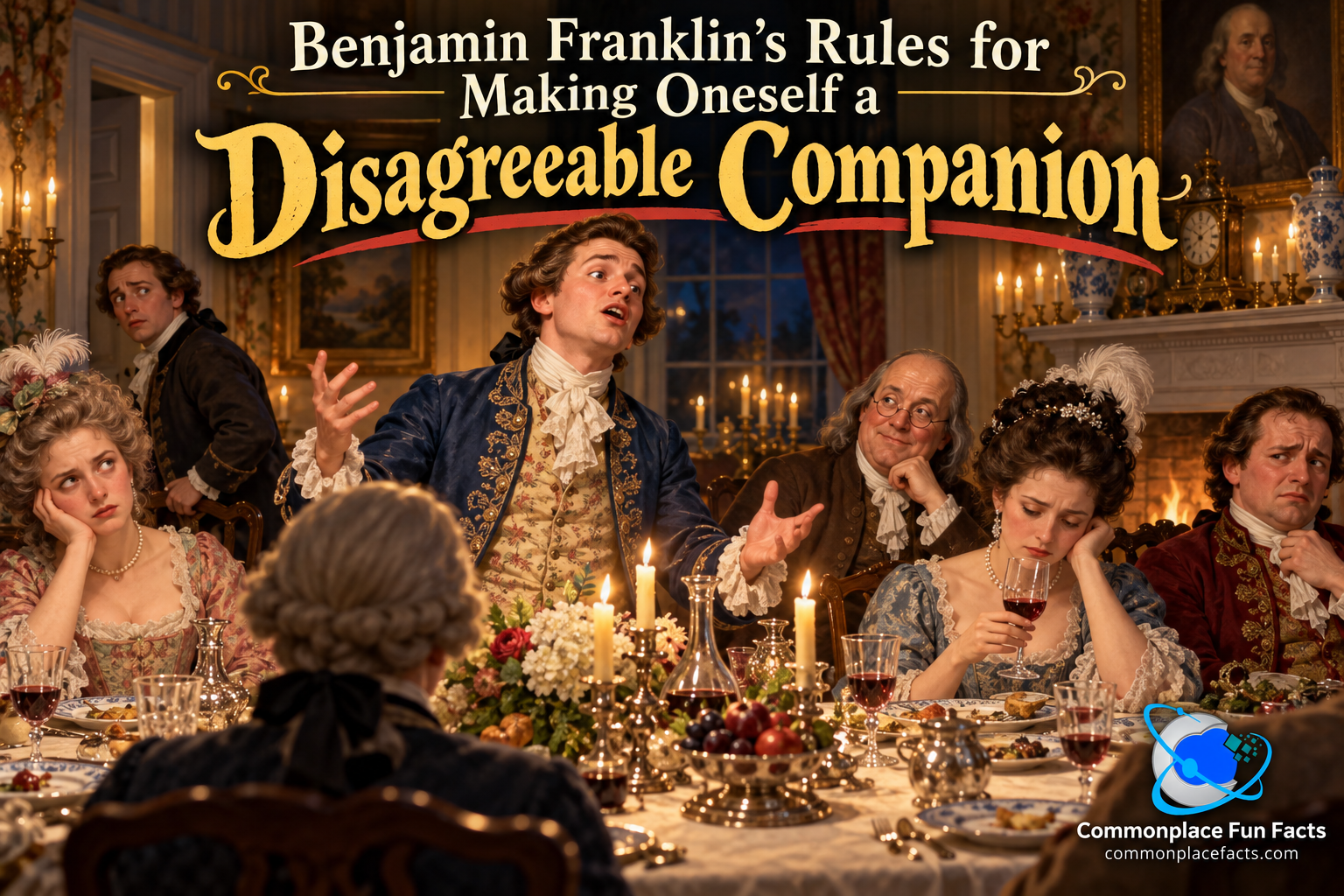
On November 15, 1750, the Pennsylvania Gazette published a short piece titled Rules for Making Oneself a Disagreeable Companion. It offered exactly what the title promised: practical instructions showing how a man blessed with wit and learning could make certain that nobody particularly enjoyed having him around.

The piece appeared without Franklin’s name attached. The editors of the Franklin Papers attribute it to him based on a later statement by his son William, who recalled that his father had written and published a piece on precisely this subject. The attribution also fits comfortably with Franklin’s other writings, in which he repeatedly demonstrated both an interest in conversation and an ability to turn ordinary human foolishness into something resembling an instruction manual.
This was hardly Franklin’s only venture into satire disguised as helpful advice. He later suggested that Parisians could save candles by simply getting out of bed earlier, an essay sometimes credited as the origin of daylight saving time. He also devoted a mock-scientific letter to the possibility of making human flatulence less offensive in the wonderfully titled Fart Proudly.
For Rules for Making Oneself a Disagreeable Companion, Franklin needed neither complicated science nor international diplomacy. He merely needed to observe what happens when an intelligent person decides that conversation exists primarily to provide him with an audience.
Franklin Had Some Experience With Disagreeable Companions
There is an additional reason Franklin’s essay works so well: he knew the problem from the inside.
In his Autobiography, Franklin remembered that as a young man he loved arguing with a friend named John Collins. The two were extremely fond of disputing with one another and trying to prove each other wrong. Franklin eventually concluded that this “disputatious turn” was a particularly bad habit because constantly contradicting people made a person “extremely disagreeable in company.”
Franklin had, in other words, conducted extensive field research.
He later received an even more personal performance review. A Quaker friend informed Franklin that people considered him proud, that his pride frequently revealed itself in conversation, and that he was not merely satisfied with being correct but tended to become overbearing about it. Friends willing to tell you that everyone finds you insufferable are apparently another useful eighteenth-century invention.
Franklin took the criticism seriously. He wrote that he began avoiding direct contradictions and overly confident expressions such as “certainly” and “undoubtedly.” Instead, he deliberately used softer phrases such as “I conceive,” “I apprehend,” and “it appears to me.” He found that conversations became more pleasant and, perhaps more importantly to Franklin, people became easier to persuade.
That background gives Rules for Making Oneself a Disagreeable Companion an extra layer. Franklin was not merely pointing at some tiresome fellow across the room. He had recognized some of these tendencies in himself and learned that being intelligent, knowledgeable, and correct does surprisingly little good if everyone starts looking for another room whenever you approach.

Benjamin Franklin’s Rules for Making Oneself a Disagreeable Companion
The complete essay appears below. We have lightly modernized the spelling, capitalization, abbreviations, and punctuation for present-day readers while otherwise preserving Franklin’s wording. The original transcription can be read at Founders Online.
Rules for Making Oneself a Disagreeable Companion
Rules by the observation of which a man of wit and learning may nevertheless make himself a disagreeable companion.
Your business is to shine; therefore, you must by all means prevent the shining of others, for their brightness may make yours less distinguished. To this end:
1. If possible, engross the whole discourse, and when other matter fails, talk much of yourself, your education, your knowledge, your circumstances, your successes in business, your victories in disputes, your own wise sayings and observations on particular occasions, etc., etc., etc.
2. If, when you are out of breath, one of the company should seize the opportunity of saying something, watch his words and, if possible, find something either in his sentiment or expression to contradict immediately and raise a dispute upon. Rather than fail, criticize even his grammar.
3. If another should be saying an indisputably good thing, either give no attention to it, interrupt him, draw away the attention of others, or, if you can guess what he means, be quick and say it before him. Or, if he gets it said and you perceive the company is pleased with it, acknowledge it to be a good thing and also remark that it had been said by Bacon, Locke, Bayle, or some other eminent writer. Thus, you deprive him of the reputation he might have gained by it and gain some yourself, as you show your great reading and memory.
4. When modest men have been treated by you in this way a few times, they will choose ever after to be silent in your company. Then you may shine on without fear of a rival, rallying them at the same time for their dullness, which will be to you a new fund of wit.
Thus, you will be sure to please yourself. The polite man aims at pleasing others, but you shall go beyond him even in that. A man can be present only in one company, but may at the same time be absent in twenty. He can please only where he is; you, wherever you are not.
The Rules Still Work Remarkably Well
Nearly three centuries later, Franklin’s instructions have aged distressingly well. Monopolize every conversation. Talk endlessly about yourself. Interrupt other people. Correct minor errors. Make sure everyone knows that you have already read whatever clever thing somebody else has just discovered. And, once everyone else has given up trying to participate, congratulate yourself on having been the most interesting person in the room.
The technology has changed, of course. Franklin’s disagreeable companion had to perform these feats in person, which at least imposed practical limits involving geography, available dinner invitations, and the occasional need to stop talking long enough to breathe. Modern civilization has generously supplied social media, comment sections, group texts, and online forums so that the truly dedicated practitioner can now irritate people on several continents simultaneously.
What makes the essay more than a collection of good eighteenth-century insults, however, is that Franklin understood the temptation behind the behavior. Being knowledgeable is pleasant. Being recognized as knowledgeable is even more pleasant. From there, it is only a short and surprisingly well-traveled road to treating every conversation as an opportunity to demonstrate that you are the cleverest person present.
Franklin eventually learned that winning every argument and winning people over are not the same thing. His wonderfully backward advice in Rules for Making Oneself a Disagreeable Companion makes the same point by showing us exactly what not to do. If your principal ambition is to shine, Franklin’s rules remain an excellent guide. Just remember the final benefit he promises: eventually, you may become so successful at it that people will be delighted whenever you are somewhere else.
You may also enjoy…

Benjamin Franklin’s Rules for How to Lose a Great Empire in 20 Easy Steps
Benjamin Franklin explained how to lose a great empire in 20 easy steps. Explore his hilarious 1773 satire—and why Britain should have taken the hint.

Rattlesnakes for Felons: Benjamin Franklin’s Plan to Repay Britain
Benjamin Franklin answered Britain’s convict shipments with “Rattlesnakes for Felons,” a satirical proposal to send rattlesnakes in return—and place them near Parliament.

“Fart Proudly”: The Hilarious Enlightenment Satire by Benjamin Franklin
“Fart Proudly” proves Benjamin Franklin had a wicked sense of humor. Discover the real story behind his infamous flatulence essay.






Leave a Reply