
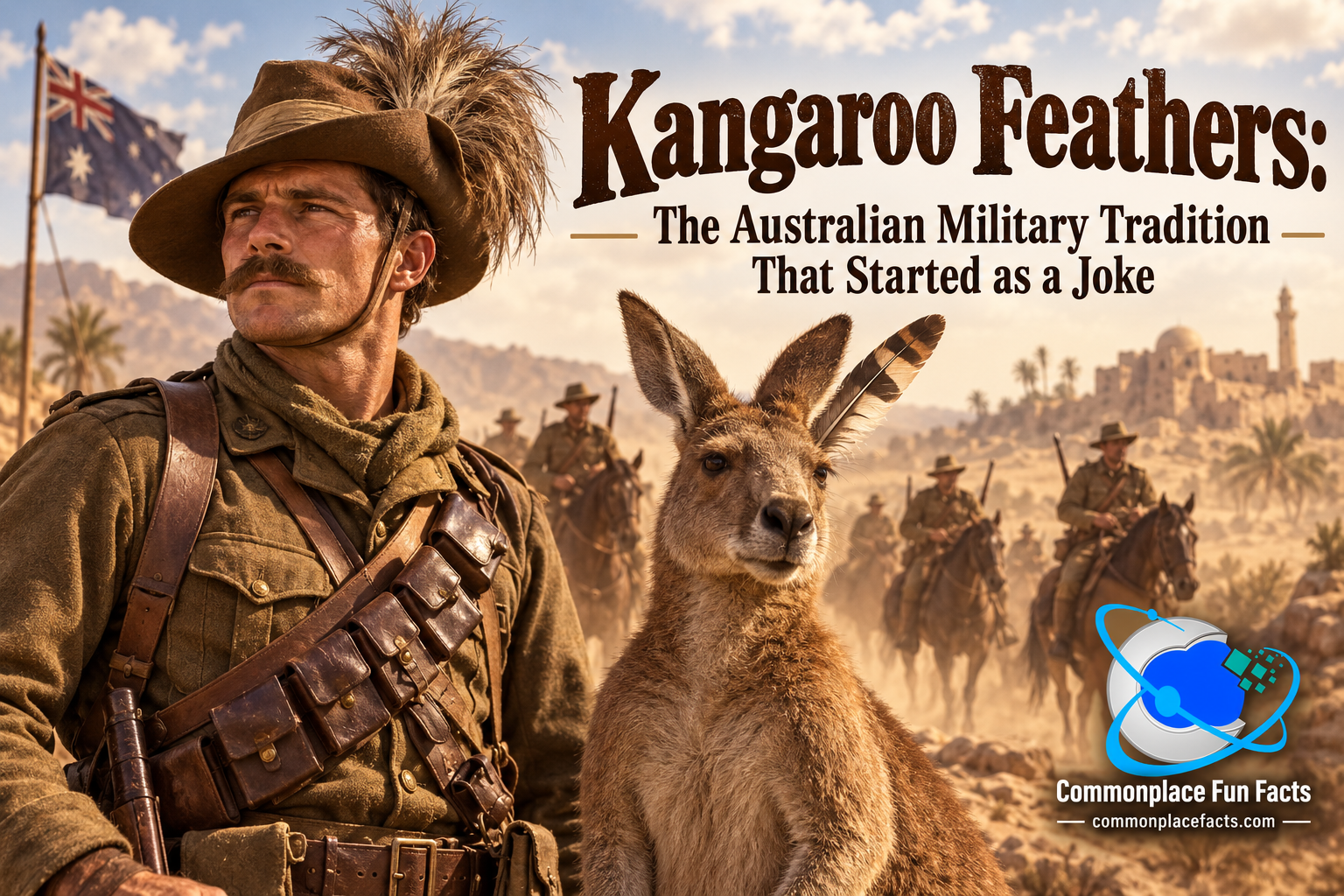

Australia has given the world a number of animals that appear to have been designed after the normal rules of zoology were suspended for the afternoon.
There are mammals that lay eggs, birds that stand taller than some adults, kangaroos that travel by bouncing, and koalas whose chief contribution to evolutionary theory seems to be demonstrating that eucalyptus leaves can support a surprisingly relaxed lifestyle.
Even by Australian standards, however, there are limits.
Kangaroos, for example, do not have feathers.
If this revelation is not a surprise to you, then you may wonder why we are even making this observation. It is, alas, because some Australian soldiers referred to one distinctive part of their uniform as “kangaroo feathers.” The nickname became associated with the Australian Light Horse during the First World War, although the tradition behind it was already decades old. The term remains part of Australian military lore today.
Explaining why requires going backward from the deserts of World War I to a labor dispute in Queensland, then forward again through mounted units, military regulations, arguments over who was entitled to decorate a hat, and an increasingly questionable relationship between the Australian Army and more than one species of large flightless bird.
As explanations for why somebody put feathers in a hat go, this one got out of hand remarkably quickly.
Contents
Before Kangaroo Feathers, There Was a Shearers’ Strike

The story begins not in the First World War but in Queensland in 1891, during one of the most significant industrial confrontations in Australian history.
The Great Shearers’ Strike began when pastoral employers attempted to reduce labor costs and weaken union influence. Unionized shearers refused to work under the proposed conditions, pastoralists brought in non-union labor, and tensions escalated dramatically.
Striking shearers established camps, some of them armed. Police and military units were deployed to protect property and non-union workers. Union leaders were eventually arrested, and 13 were sentenced to three years’ imprisonment. The strike failed in its immediate objectives, although it became an important episode in the growth of organized labor and Australian Labor politics.
So this was not an especially whimsical moment in Australian history.
The feathers, however, apparently were.
What Do Mounted Soldiers Do When Nothing Is Happening?
Among the troops called out during the strike was the Gympie Squadron of the Queensland Mounted Infantry.
According to the traditional account preserved by both the Australian Army and the Australian War Memorial, the soldiers relieved the monotony of long mounted patrols by chasing emus. They collected or plucked breast feathers from the birds and stuck them into their hats.
It was the sort of informal fashion choice that could easily have disappeared once somebody remembered there were actual uniform regulations.
Instead, it caught on.
The rest of the regiment followed the Gympie Squadron’s example, and the Queensland government eventually permitted the regiment to wear the emu plume officially in recognition of its service.
Thus began a military tradition apparently originating with bored mounted soldiers looking at a large flightless bird and thinking, “That would improve the hat.”
The Emu Gets Promoted to Military Insignia
The plume soon became much more than an improvised souvenir.

Queensland mounted troops wore it during the Boer War in South Africa. The Australian War Memorial still holds an emu plume associated with Private Sidney Joseph Cossart of the Queensland Mounted Infantry, dating from around 1899–1902.
After Australian Federation in 1901, mounted units in different states used various distinctive plumes. Queensland, South Australian, and Tasmanian units were among those authorized to wear emu feathers. According to the Australian government’s Anzac Portal, the emu plume appeared in Commonwealth Mounted Forces dress regulations from 1903 to 1912.
Then military bureaucracy performed one of its traditional functions and made everything more complicated.
When new compulsory-training regulations appeared in 1911–12, they contained no provision for the distinguishing plumes. The Queenslanders responded in the time-honored fashion of people who have discovered that official regulations no longer authorize a cherished tradition: they kept doing it anyway.
They paid for the plumes themselves and continued wearing them unofficially.
There are limits to what regulations can accomplish when the regulated population has horses, feathers, and strong opinions about hats.
World War I Turns a Queensland Tradition Into an Australian One
When the First Australian Imperial Force was raised after the outbreak of World War I, the familiar felt slouch hat became standard wear.

Queensland mounted troops wanted their feathers back officially.
Persistent lobbying eventually succeeded. Before Australian troops sailed overseas, Queensland mounted soldiers again received permission to wear their emu plumes. The Australian War Memorial reports that the announcement was greeted with enthusiastic cheering, suggesting that the men regarded the feathers as something considerably more important than optional millinery.
Then other Light Horse units began wearing them.
The Queenslanders were not universally delighted.
To them, the plume was a Queensland distinction with more than two decades of history behind it. Allowing everybody to wear one was roughly equivalent to discovering that the special family heirloom had just become available in the gift shop.
The issue eventually reached Defence Minister Sir George Pearce. In 1915, Pearce authorized all Australian Light Horse units to wear the emu plume.
Problem solved.
Except, naturally, it was not.
The Great Emu Feather Controversy
Some senior officers continued arguing that the plume properly belonged to Queensland.
Colonel Harry Chauvel, commanding the 1st Australian Light Horse Brigade and later one of Australia’s most distinguished soldiers, reportedly felt strongly that Queensland mounted troops should retain their exclusive claim. Lieutenant Colonel R.M. Stodart of the 2nd Light Horse Regiment called the broader authorization a “gross assumption of privilege.”
Others took almost the opposite position.
The commanding officer of the 7th Light Horse Regiment in New South Wales eventually described the plume as an “unnecessary and useless item” and said his regiment did not particularly want one.
This may be the only controversy in military history in which one side effectively argued, “Those feathers belong to us,” while another replied, “Fine. We didn’t want your feathers anyway.”
The debate did not stop the emu plume from becoming one of the most recognizable features associated with the Australian Light Horse.
So Where Do Kangaroos Enter This?
They don’t.
That was the joke.
During World War I, other Commonwealth soldiers encountering Australians in their feathered hats naturally asked what sort of plumage they were wearing.
The Australians replied that they were kangaroo feathers.

The Australian War Memorial describes this as a Light Horse practical joke. Exactly how many unsuspecting British, Canadian, New Zealand, or other Commonwealth soldiers walked away believing Australia contained feathered kangaroos is unfortunately not recorded.
It does, however, fit an established Australian cultural tradition remarkably well.
A persistent legend claims that the word kangaroo originated when Europeans asked an Aboriginal person what the animal was called and received a reply meaning “I don’t understand you.” That story is not true. Kangaroo comes from the Guugu Yimidhirr word gangurru, recorded by Cook’s expedition in 1770. The misunderstanding was subtler: gangurru referred to a particular kind of kangaroo, while Europeans turned it into a general name for the entire bouncing department of Australian wildlife.
Even so, the myth has persisted, and Australians have spent generations persuading outsiders of things that become increasingly questionable the longer one thinks about them. The Drop Bear, for example, is allegedly an oversized carnivorous relative of the koala that lurks in trees waiting to fall onto tourists. Australians have been known to recommend protective measures involving Vegemite, forks in the hair, and strategic caution around eucalyptus trees.
For readers who remain concerned that Australia’s wildlife may be taking an unnecessarily personal interest in them, our friends at Rocket Cat have developed the next logical step in marsupial preparedness: the Ultimate Drop Bear Defense Hammer™. It features, among other necessities, a reinforced titanium head, eucalyptus camouflage, and a built-in Drop Bear air horn—because apparently Vegemite behind the ears was never going to be enough.
“Kangaroo feathers” belongs to the same general school of international relations: identify someone insufficiently familiar with Australian wildlife, say something ridiculous with complete confidence, and see how long it takes before questions begin.
Given that parts of the internet have managed to develop an entire conspiracy theory arguing that Australia does not exist at all, feathered kangaroos seem almost restrained.
The Feather Shortage Gets Serious
Once all Australian Light Horse regiments were permitted to wear emu plumes, a logistical problem developed.
There were not necessarily enough emu feathers available where the Light Horse happened to be stationed.
This was particularly awkward in Egypt, where the indigenous emu population was, upon inspection, zero.
The sudden demand encouraged soldiers to consider alternatives. According to the Australian War Memorial, Sergeant J. Taggert of the 4th Light Horse Regiment later recalled that the shortage became serious enough that his unit had to place a guard on an ostrich farm at Heliopolis to prevent further “harassment” by Australian servicemen looking for substitute feathers.
Consider what this means.
Somewhere in Egypt during the First World War, military personnel had to protect ostriches from Allied soldiers who wanted to steal their feathers, pass them off as emu plumes, and then wear them while solemnly informing curious foreigners that they were kangaroo feathers. At that point, three different large animals had become involved in a single hat, and the identity of the one that had actually contributed the feather was the only one nobody mentioned.
Military historians tend to focus on logistics involving ammunition, horses, food, medical supplies, and water. Occasionally, however, the historical record reminds us that somebody also had to address the strategic security of the local feather supplies.
The Australian Light Horse Was More Than a Hat
The humor surrounding the plume should not obscure the importance of the units that wore it.

Australian Light Horse regiments served extensively during World War I, particularly in Egypt, the Sinai Peninsula, Palestine, Jordan, and Syria. They participated in operations protecting the Suez Canal and in the campaigns that eventually carried Allied forces north through Ottoman territory.
Their most famous action came at Beersheba on October 31, 1917, when mounted troops of the 4th and 12th Light Horse Regiments charged Ottoman positions late in the day and captured the town and its vital wells. The charge became one of the defining episodes in the mythology of the Australian Light Horse.
The Light Horse were mounted riflemen—often loosely described as mounted infantry—rather than traditional cavalry. Their horses primarily gave them mobility; they generally expected to dismount and fight on foot. This means that, in addition to ostrich feathers masquerading as emu feathers and being called kangaroo feathers, the Australian Light Horse did not ordinarily fight as cavalry. Beersheba was memorable partly because, on that occasion, the Light Horse finally did what its name seemed to have been promising all along and charged on horseback.
By then, the slouch hat and plume had become so closely associated with the mounted troops that the image eventually outlived the horse.
Australia and the Emu Have a Complicated Relationship
It is worth noting that Australian soldiers’ relationship with emus did not end with using their feathers as military decoration.
In 1932, the Australian government sent soldiers armed with Lewis machine guns to Western Australia to deal with thousands of emus damaging farmland.
The resulting episode became known—somewhat grandly—as the Great Emu War.
The operation did not go especially well.
The birds scattered, outran attempts to pursue them, survived surprising amounts of gunfire, and generally demonstrated that a large flightless bird can be an unexpectedly difficult military objective. Major G.P.W. Meredith famously compared their ability to withstand machine-gun fire to tanks.
The broad history of Australian military relations with the emu can therefore be summarized fairly efficiently: in 1891, Australian soldiers put its feathers in their uniforms; in 1932, they deployed machine guns against it. The emu, for its part, remains on the Australian coat of arms. Diplomatic relations are apparently complicated.
The Emu Plume Survived the Horses
The Australian Light Horse did not survive in its original form indefinitely. Mechanization transformed mounted units throughout the 20th century, and armored vehicles eventually assumed many of the roles once performed on horseback.
The feathers stayed.

In 1923, Australian Military Order 390 formally approved emu plumes for Light Horse units, provided they could be supplied without expense to the government. In other words, the Army officially recognized the tradition while simultaneously making clear that taxpayers were not necessarily going to finance everyone’s feather requirements.
By the late 20th century, the privilege had passed to the Royal Australian Armoured Corps, the organizational descendant of many of Australia’s mounted formations. In 1996, personnel of the Royal Australian Armoured Corps were authorized to wear emu plumes with the slouch hat.
The tradition remains alive today. The current Australian Army description of the slouch hat still identifies the emu plume as a feature worn by members of the Armoured Corps.
The Army Dress Manual goes considerably further. It specifies which regiments are entitled to wear emu tufts and even provides approved dimensions.
What began with soldiers improvising hat decorations during an industrial dispute therefore eventually reached the highest possible stage of institutional maturity:
There is now paperwork specifying exactly how big the feathers should be.
From Practical Joke to Military Tradition
There is something appealing about traditions whose origins are considerably less dignified than what they eventually become. According to Australian military tradition, the emu plume began with mounted soldiers passing the time during the 1891 Shearers’ Strike by chasing emus and decorating their hats with the feathers. The fashion spread through the regiment, became an official Queensland distinction, traveled to South Africa, and eventually followed the Australian Light Horse into the First World War. Along the way, officers argued over who was entitled to wear it, military regulations struggled to keep up, and a shortage of proper feathers became serious enough that ostriches in Egypt required protection from Australians apparently determined to maintain standards of military millinery.
By then, zoological accuracy had ceased to be much of a priority. Ostrich feathers could substitute for emu feathers, which Australian soldiers might then identify to curious foreigners as “kangaroo feathers.” The men wearing them belonged to the Light Horse, despite ordinarily dismounting before they fought. Somewhere along the way, an emu, a kangaroo, a horse, an African ostrich, several military bureaucracies, and a perfectly innocent hat had all become entangled in the same tradition.
And yet the tradition endured. The horses largely disappeared, mounted warfare gave way to mechanization, and the descendants of the Light Horse eventually became part of Australia’s armored forces. The feathers stayed. What began as an improvised decoration during a labor dispute ultimately became sufficiently respectable that the Australian Army now has regulations specifying who may wear the plume and how large it should be. Few traditions can claim a clearer progression from bored soldiers chasing wildlife to officially regulated feather dimensions.
More than a century after somebody apparently decided that “kangaroo feathers” was the proper answer to an innocent question, the emu plume remains part of Australian military tradition. Kangaroos, meanwhile, remain stubbornly featherless.
At least officially.
You may also enjoy…

The Great Emu War: Australia Declares War on Birds (and Loses)
In 1932, Australia declared war on a flock of emus—and lost. Discover the bizarre, hilarious true story of the Great Emu War, where machine guns met their match in flightless birds.

The Great Australia Hoax Conspiracy: Is It Really a Country? Is It Just a Corporation? Is There Really a Land Down Under?
Is Australia a real country or just a corporate hoax? Dive into the bizarre Australia hoax conspiracy theories claiming Australia doesn’t exist—or that it’s actually a U.S.-registered business. Explore the facts, the myths, and the humor behind this wild claim. Read more!

Beware the Drop Bear: Australia’s Fluffiest #1 Death Machine
Have you heard about the legendary and fearsome Australian Drop Bear? Learn about this terrifying — and adorable — deadly menace.






Leave a Reply