

There are several sensible ways to test a new form of transportation.
You could begin slowly. You could choose an empty room. You could make sure you knew how to steer. You might even devote a few minutes to the surprisingly important question of how you intend to stop.
John Joseph Merlin took a different approach.
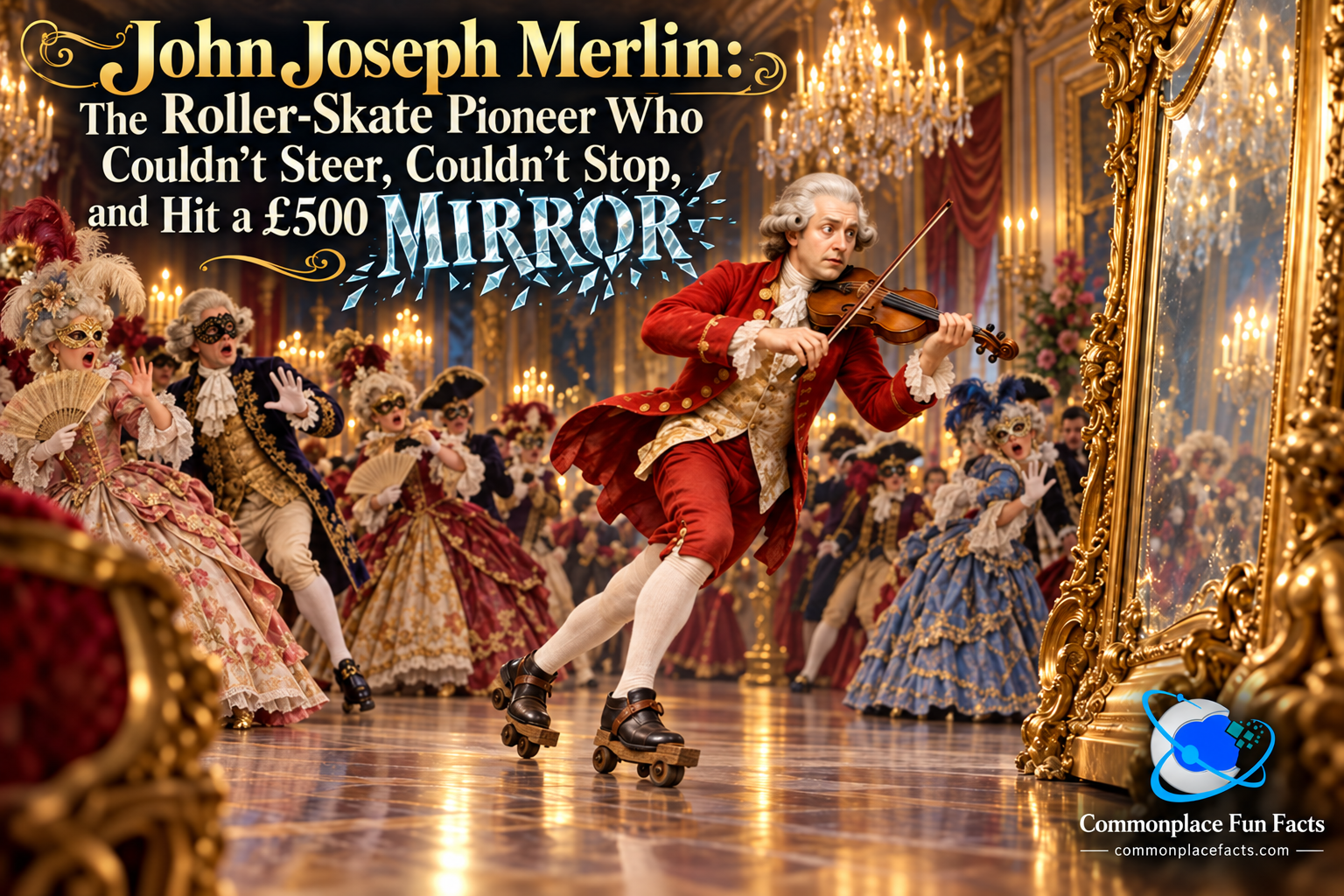
Sometime in the eighteenth century, the Belgian-born inventor arrived at one of London’s fashionable masquerades wearing a pair of his new roller skates. Just in case the novelty of shoes on wheels was insufficient to capture everyone’s attention, he also brought a violin and played it while skating among the guests.
The demonstration went splendidly right up until the point when Merlin discovered that his invention lacked two features that later generations would come to regard as fairly important.
Steering.
And brakes.
Unable to control either his direction or his speed, Merlin hurtled across the room and crashed into an enormous mirror reportedly worth more than £500. The mirror shattered. His violin was destroyed. Merlin was badly injured.
Roller skating had arrived.
Stopping would apparently be addressed in a future release.
Table of Contents
John Joseph Merlin Was Much More Than the Man Who Hit the Mirror
It is unfortunate for John Joseph Merlin that one of the most memorable moments of his long inventive career involved becoming airborne in the general direction of expensive interior decoration.

He deserved better.
Born in Huy, in what is now Belgium, in 1735, Merlin trained in Paris as a maker of mathematical instruments before moving to London in 1760. He arrived in the entourage of the Spanish ambassador and quickly established himself in a city that had become one of Europe’s great centers of scientific instruments, clockmaking, music, mechanics, and wealthy people willing to pay for something clever enough to impress their friends.
Merlin was exceptionally well suited to that environment.
He made clocks. He developed weighing machines. He built musical instruments. He designed wheelchairs. He worked on automata. He devised mechanical devices for domestic use. He experimented with equipment intended to assist people with disabilities.
He was, in other words, the sort of inventor who looked around at ordinary life and concluded that nearly everything could benefit from additional gears.
History has produced several people of this type. Joseph Bramah, another great British mechanical inventor of the period, improved locks, toilets, beer pumps, and hydraulic machinery. We have previously looked at what happened when Bramah’s supposedly unbeatable lock encountered one particularly stubborn American locksmith.
Merlin’s interests were even harder to categorize.
The best modern scholarly description of him may be the one used by historian Margaret Debenham: an “Ingenious Mechanick,” musical-instrument maker, and flamboyant showman. “Ingenious Mechanick” also sounds suspiciously like the name of a supervillain invented by a very imaginative middle schooler who had not yet mastered spelling but was already deeply committed to capes, gears, and world domination.
The flamboyant showman aspect is important.
Merlin did not merely invent things.
He liked an audience.
Did John Joseph Merlin Invent Roller Skates?
Merlin is frequently called the inventor of roller skates.
As is often the case whenever history identifies the one person who “invented” something, reality immediately begins clearing its throat. The Science Museum Group says Merlin is widely credited with creating roller skates during the 1760s, while also acknowledging earlier references to wheeled skates. It is therefore safer to call him one of the earliest roller-skate inventors or, perhaps even better, a roller-skate pioneer.
What we know about Merlin’s skates comes largely from later descriptions. They were fitted with small metal wheels arranged so the wearer could glide across a floor in something resembling the motion of an ice skater.
The important point is that these were not the familiar four-wheel roller skates that generations of children later wore while discovering that concrete was significantly less forgiving than carpet.
The early designs placed the wheels in a line.
In principle, they looked more like the ancestors of modern inline skates.
This means that the eighteenth century managed to anticipate Rollerblades before it had figured out a reliable way to make the things turn.

There Was One Small Engineering Problem
Putting wheels under a person’s feet is one problem.
Determining what happens after the person begins moving is another.
Merlin appears to have succeeded admirably at the first.
The second remained under development.
Our best-known early account of the resulting difficulty comes from Thomas Busby’s Concert Room and Orchestra Anecdotes of Music and Musicians, first published in 1825, about twenty-two years after Merlin’s death.
Busby described Merlin’s invention as a pair of skates running on “small metallic wheels.” Merlin put them on, took up his violin, and joined a masquerade at Carlisle House in Soho Square.
Unfortunately, Busby explained, Merlin had provided no adequate means of slowing himself or controlling his direction.
This feels like something that ought to have appeared fairly high on the pre-party checklist.
Merlin nevertheless proceeded.
He began skating.
He began playing the violin.
And somewhere ahead of him stood a mirror.
This Was Not the Ideal Place to Discover That You Could Not Stop
Carlisle House was not somebody’s modest sitting room where Merlin risked knocking over a flowerpot.
Under its celebrated proprietor Teresa Cornelys, the mansion in Soho Square had become one of London’s fashionable entertainment centers. Wealthy subscribers attended dances, concerts, operas, card parties, and extravagant masquerades there during the 1760s and early 1770s.
Cornelys expanded and lavishly decorated the property, creating what Horace Walpole called a “fairy palace” for concerts, balls, and masquerades.
In other words, if you had recently invented uncontrollable wheeled footwear, Carlisle House offered practically every feature one might hope to avoid during the initial testing phase:
Expensive furnishings.
Crowds.
Hard surfaces.
And apparently one exceptionally valuable mirror located directly along Merlin’s eventual flight path.
In Busby’s later account, Merlin slammed into the mirror, smashed it “to atoms,” broke his violin to pieces, and seriously injured himself. If the objective had been to make sure everyone remembered the demonstration, it was an overwhelming success.
If the objective had been to make sure everyone remembered the demonstration, it was an overwhelming success.
Was It Really a £500 Mirror?
Then there is the mirror. Modern retellings sometimes omit its reported price, perhaps because £500 sounds so preposterous that sensible writers instinctively assume somebody added a zero. Busby’s 1825 account really does say the mirror was worth more than £500.
That was an extraordinary amount of money, although converting eighteenth-century currency into modern dollars is notoriously treacherous. Depending on whether we compare consumer prices, average earnings, social status, economic power, or the emotional impact of explaining to an insurance company that a violinist on experimental skates had just gone through the drawing-room mirror, modern equivalents can vary enormously.
It is sufficient to say that £500 represented a very expensive piece of glass. Such extravagance would not have been completely out of character at Carlisle House, where Cornelys spent heavily transforming the property into one of London’s grandest venues for fashionable entertainment.
Still, the £500 valuation comes from an account written decades after the event, so it should be treated as a reported figure rather than an invoice recovered from beneath Merlin.
The Violin Wasn’t Just a Prop
There is another detail that makes the story better: Merlin did not simply grab a violin because roller skating seemed insufficiently dangerous by itself. He was genuinely a musical-instrument maker. Surviving examples include stringed instruments and keyboard instruments; Christie’s has even sold a cello bearing Merlin’s name, which fetched £7,150—more than enough to pay for the mirror, if a couple of centuries too late. He also experimented with harpsichords and pianofortes and moved comfortably in London’s musical circles.
He became friendly with Johann Christian Bach, the youngest son of Johann Sebastian Bach, who had settled in London and became known as the “London Bach.” Merlin also became acquainted with painter Thomas Gainsborough, who painted his portrait in 1781.
Merlin appears in the painting without roller skates, presumably because Gainsborough had expensive mirrors too.
Instead, he is presented as a gentleman holding a small precision balance of the type used for weighing coins. The portrait is a useful reminder that Merlin was not viewed by his contemporaries merely as an eccentric tinkerer. He had become a respected and fashionable figure whose inventions, musical instruments, and mechanical demonstrations attracted elite attention.
Roller Skates Were Among Merlin’s More Normal Inventions
The easiest way to understand Merlin is to stop thinking of the skates as an isolated act of madness. They fit quite comfortably into the rest of his career.
Merlin was hardly the last inventor to decide that an ordinary human activity desperately needed more machinery. More than a century later, James C. Boyle would patent an automatic hat-tipping device that raised, rotated, and replaced a gentleman’s hat whenever he bowed. There appears to be a recurring type of inventor who looks at something humanity has managed perfectly well for centuries and asks, “Yes, but what if it had gears?”
Merlin constructed weighing and measuring machines, developed clocks and watches, experimented with wheelchairs and other mobility devices, designed musical instruments and automata, and devised equipment intended to let blind people participate in card games. He also worked with jeweler and entrepreneur James Cox on some of the most elaborate mechanical curiosities of the age.
Among the mechanical wonders produced in James Cox’s workshop was the spectacular Silver Swan automaton, a life-size mechanical bird containing about 2,000 moving parts. Three clockwork mechanisms animate its music, the shimmering glass “water,” and the swan itself; Merlin designed the particularly ingenious mechanism controlling its head and neck as it appears to preen and catch a silver fish. The eighteenth century had not yet produced television, so people were forced to entertain themselves by building mechanical silver birds containing 2,000 moving parts.
Standards have slipped considerably since then.
Merlin’s inventions were not confined to practical utility. He understood that machinery could astonish people, making him an interesting predecessor to later inventor-showmen who demonstrated their creations at exhibitions, lecture halls, and public events. Long before nations began building enormous temporary palaces to show off inventions at world’s fairs, Merlin understood that the machine itself was only part of the attraction. The other part was making sure everybody was looking at it.
Merlin Built His Own Mechanical Museum

Eventually Merlin stopped waiting for invitations and created a place where people could come directly to him. He established Merlin’s Mechanical Museum in Princes Street near Hanover Square, where visitors could see his clocks, musical instruments, automata, weighing devices, and assorted mechanical novelties. The Science Museum Group describes the museum as a popular place of both “amusement and instruction.”
That combination is revealing. Merlin did not draw a sharp line between useful machinery and entertaining machinery. A clever mechanism could solve a problem, demonstrate craftsmanship, teach visitors something, and make paying customers stare at it.
Preferably without crashing into anything.
His approach also makes the roller-skate demonstration easier to understand. Showing up at a fashionable masquerade wearing a new invention while playing music was not entirely out of character; Merlin was marketing himself. The eighteenth century did not have product-launch videos or social media influencers, but it did have large rooms full of rich people who would tell everyone they knew about the inventor who had just gone through a mirror.
One works with the technology available.
Merlin Had Invented Motion. Someone Else Had to Invent Control.
Despite Merlin’s memorable demonstration, roller skates did not immediately sweep across Europe. The basic difficulty remained control. Early inline skates attempted to reproduce ice skating on an ordinary floor, but small rigid wheels did not lean and carve across a surface in the same way that a steel blade moves across ice.
Inventors nevertheless kept trying. In 1819, French inventor Charles-Louis Petibled received a patent for a three-wheel inline skate. Robert John Tyers patented his five-wheel “Volito” in Britain in 1823, and other variations followed.
They could roll.
Rolling had never really been the problem.
James Plimpton Finally Made Roller Skates Behave Themselves
The major breakthrough came about a century after Merlin’s experiments. In 1863, American inventor James Leonard Plimpton patented a new roller skate with two pairs of wheels arranged side by side. More importantly, his design allowed the wheel assemblies to pivot when the skater shifted weight.
Suddenly, roller skates could turn, greatly reducing the need to use architectural features as emergency braking systems.
Plimpton’s design helped turn roller skating from an ingenious novelty into a popular recreation. Skating rinks opened, equipment improved, and successive waves of roller-skating enthusiasm spread through Europe and the United States. The familiar quad skate became dominant, while Merlin’s inline arrangement largely disappeared.
Then the Inline Skate Came Back
There is a pleasing historical irony in what happened next. After more than a century of quad skates dominating popular roller skating, inline skates returned to prominence in the late twentieth century.
Modern inline skates were not simply direct descendants of Merlin’s eighteenth-century contraption. The technology, materials, bearings, wheel design, boots, and control systems had changed beyond recognition. But the basic visual idea was once again familiar: several wheels arranged in a line beneath the foot.
Merlin had therefore managed the unusual engineering achievement of being roughly two centuries ahead of fashion while simultaneously being several seconds behind the mirror.
The Best Inventions Usually Need a Second Draft
It would be easy to remember John Joseph Merlin only because he smashed an expensive mirror, but that would miss the more interesting point. Merlin lived during an extraordinary period of mechanical experimentation, when inventors were applying clocks, gears, springs, wheels, pumps, and precision manufacturing to problems that earlier generations had simply accepted.
Some of his inventions were practical, some were beautiful, and some were designed largely to make people say, “How on earth did he do that?” At least one carried its inventor across a ballroom faster than he had intended.
That is how invention often works. The first person proves something can be done; the next person figures out how to make it useful. Merlin proved that a man could put wheels on his feet and glide across a room while playing the violin.
What he had not yet worked out was a compelling reason for the man to stop before reaching the wall.
You may also enjoy…

Did Johannes Gutenberg Invent the Printing Press? The True Story of the Accidental Inventor Who Just Needed the Money
Johannes Gutenberg didn’t plan to change the world—he missed a deadline, ran out of money, and invented the printing press as Plan B.

Meet Ralph Teetor: The Amazing Blind Inventor Who Revolutionized the Way We Drive
Discover the inspiring story of Ralph Teetor, the blind inventor who created cruise control and transformed modern driving. Learn how his remarkable touch, vision, and ingenuity revolutionized the way we move.

The Accidental Genius Behind Band-Aids: How One Clumsy Wife Helped Heal the World
Discover the heartwarming origin of Band-Aids—how a loving husband’s solution for his accident-prone wife became one of the most iconic medical inventions in history.




Leave a Reply