
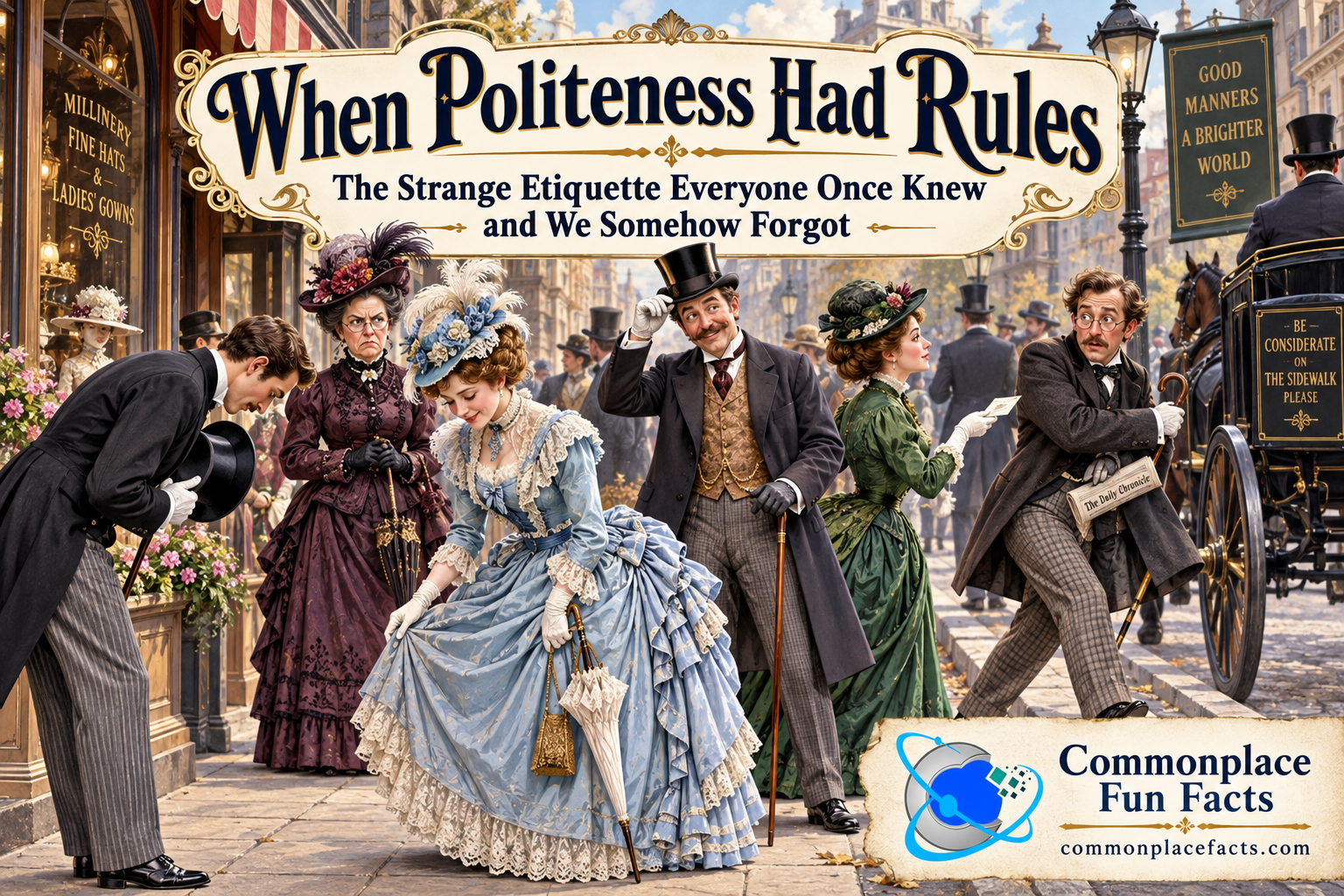

Imagine walking down a city street in 1881 and spotting someone you know coming toward you.
This should be simple. You recognize the person. The person recognizes you. You say hello. Everyone continues with the day.
If only it were that simple. As the John Wick movies remind us, there are rules; without them, we live with the animals. In this case, we’re talking about specific rules of etiquette that quickly separated the well-mannered from hoi polloi.
If you were a man meeting a woman, you might need to know whether she was supposed to acknowledge you first. You had to decide whether to bow, how deeply to bow, whether to remove your hat, how to hold the hat while bowing, whether the person accompanying you also needed to salute her, and whether stopping to talk would itself violate etiquette. If you had already encountered the same person several times that afternoon, additional rules determined whether another bow was necessary.
And heaven help you if you deliberately looked directly at someone and refused to acknowledge a bow. That was the dreaded “cut direct,” the social equivalent of declaring war while remaining impeccably dressed.
For much of Western history, etiquette was not merely a collection of suggestions about which fork to use. It was an elaborate social language. A bow could communicate rank. A calling card could announce friendship, congratulations, condolences, departure, or a carefully calibrated degree of interest. Gloves could tell people whether you understood the occasion. The side of the sidewalk on which you walked could demonstrate whether you were a gentleman. Even leaving a dinner party required enough knowledge of precedence that an entire room might remain trapped because one elderly woman had failed to realize everyone was waiting for her to go home.
Most of these rules eventually disappeared. The interesting part is why.
Contents
Etiquette Was the Operating System of Society
It is easy to read an old etiquette manual and conclude that our ancestors suffered from an alarming surplus of free time. Books devoted hundreds of pages to introductions, bows, visiting, gloves, invitations, dinner seating, carriage behavior, mourning clothes, dances, weddings, servants, street encounters, and the terrifying possibility that someone might use the wrong visiting card.
But the rules were doing real work.
In societies where social rank mattered greatly, where men and women interacted under significant restrictions, where strangers could not simply exchange telephone numbers, and where reputation could determine whom you married, where you worked, and which doors opened for you, etiquette provided a standardized way of navigating other people.
The Library of Congress notes that etiquette manuals multiplied during the nineteenth century as industrialization, growing cities, and an expanding middle class made society more fluid. The books functioned as a form of self-help. People who had not grown up knowing the rules could buy a manual and learn how to behave in “good society.”
That was important because social mobility creates an awkward problem. It is wonderful to acquire enough money and status to be invited to dinner with the fashionable people. It is somewhat less wonderful to arrive and discover that everybody else apparently received a secret briefing about the forks.
By the 1830s, manuals were explaining not merely table manners but calling cards, invitations, dances, introductions, conversation, clothing, and the proper organization of a ball. Later in the century, mass-market editions could be remarkably cheap; an 1868 ballroom guide that sold for just ten cents. America was democratizing access to aristocratic behavior, which is a wonderfully American solution to the problem of class distinction.
We have previously looked at an earlier version of this impulse in George Washington’s 110 Rules of Civility. Those rules included timeless principles such as showing respect and exercising self-control, alongside reminders not to spit offensively, clean your teeth at the table, or make noises with your body in company.
Apparently civilization has always required periodic maintenance.
Bowing Once Told Everyone Where Everyone Stood
Bowing seems today like ceremonial behavior associated with royalty, the theater, or cultures where it remains an ordinary form of greeting. In Britain and Europe, however, bows and curtsies once performed an additional job: they expressed social hierarchy.

Historian Penelope J. Corfield, writing about the rise of handshaking in Britain between 1700 and 1850, describes a society in which greetings varied according to rank. Lower-ranking men traditionally bowed and removed their headgear before their social superiors, who might merely acknowledge them with a nod. Lower-ranking women made deep curtsies to those above them.
In other words, two people could meet without exchanging a word and still stage a small demonstration of the social order.
This worked reasonably well when everyone knew everyone else’s place. It worked less well as Britain urbanized.
In a village, people generally knew who owned the estate, who rented the farm, who ran the shop, and who would be expected to bow to whom. In rapidly growing commercial cities, the distinctions became murkier. Merchants, professionals, tradesmen, manufacturers, and members of an expanding middle class increasingly encountered people whose precise position could not be calculated before everyone reached the other side of the street.
At approximately the same time, another greeting was spreading.
The Handshake Was Quietly Undermining the Bow
The handshake was ancient, but it was not originally the fashionable everyday greeting of British polite society. Corfield traces its expansion in the eighteenth and early nineteenth centuries particularly through commercial networks and among Quakers.
Merchants had an obvious use for it. Shaking hands could confirm an agreement and signal mutual trust. Quakers had a different reason: their religious commitment to human equality made elaborate gestures acknowledging social rank unattractive. A handshake allowed two people to greet each other on essentially equal terms.
That symbolism mattered.
A bow could say, “I recognize that you stand above me.” A handshake could say, “We meet each other as participants in the same transaction.” It did not eliminate class, wealth, titles, or privilege—history rarely cooperates that efficiently—but it gave people a greeting that did not require first calculating who deserved the deeper spinal adjustment.
By 1850, handshaking had become firmly established in Britain alongside older forms of greeting. Meanwhile, deep bows and curtsies were increasingly reserved for formal settings, while everyday versions shrank into nods, small inclinations, and touches of the hat.
Etiquette was becoming less acrobatic.
By 1881, Even Bowing Had Been Downsized
John H. Young’s 1881 American etiquette manual Our Deportment demonstrates how far the bow had already retreated.
Young explained that gentlemen greeting one another generally needed only an inclination of the head, a gesture of the hand, or a touch of the hat. Most significantly, he announced that the body was not to bend at all. The head was sufficient.
Several centuries of hierarchical bowing had been reduced to something that could be performed without involving the torso.
Even so, there were still rules.
In England, Young explained, strict etiquette held that when a woman encountered a male acquaintance on the street, she should give the first bow of recognition. The logic was not merely that women enjoyed ceremonial priority. Allowing the woman to initiate recognition gave her control over whether a man she had previously met could approach or acknowledge her publicly.
Young thought Americans could relax about this. He recommended that whoever recognized the other person first should simply bow, preferably resulting in simultaneous salutations and sparing everybody the mental arithmetic.
Forty years later, however, Emily Post’s 1922 Etiquette still said that under formal circumstances a woman was supposed to bow to a gentleman first, although people who knew each other well could dispense with the rule and acknowledge each other naturally.
Post also advised that if you kept passing the same acquaintance repeatedly within a short period, you did not need to bow indefinitely. Two or perhaps three acknowledgments were sufficient. After that you could simply smile or look away.
This was useful guidance for anyone trapped in a department store with an acquaintance traveling in approximately the same shopping orbit.
The “Cut Direct” Was Victorian Social Nuclear Warfare
Failure to bow could be accidental. Deliberately refusing to bow was another matter.
Etiquette manuals called this the “cut direct.” You looked at a person you unquestionably recognized and intentionally refused to acknowledge him or her.
Post described the maneuver as such a serious breach of civility that only an extremely grave offense could justify it. A gentleman, according to her rules, essentially could not “cut” a respectable woman at all.
The important distinction was intent. Forgetting someone’s face was unfortunate. Being distracted was forgivable. Looking directly at someone and communicating, with nothing more than your expression, “You no longer exist in my universe” was unmistakable.
Today we have blocking, unfriending, ghosting, leaving messages on read, and pretending not to notice someone in the supermarket.
Technology advances. Humanity economizes the gestures.
And Then There Was the Hat
A gentleman’s hat functioned almost as an extension of the bow.
Post provided detailed instructions for how a man should remove a derby or high hat when bowing, how far forward it should move, how the brim should be held, and how the movement should change when greeting someone deserving particular respect. A man greeting a woman, thanking a stranger, apologizing, or acknowledging someone who had performed a courtesy might be expected to lift his hat.
This was sufficiently routine that, as we have previously discovered, James C. Boyle patented an automatic hat-tipping device in 1896. His spring-loaded contraption lifted and rotated the wearer’s hat whenever he bowed.
It is difficult to imagine a better symbol of a culture’s commitment to etiquette than the moment someone decides good manners need gears.
Hat tipping as an everyday ritual disappeared for a fairly obvious reason: men gradually stopped wearing hats everywhere they went. By the 1960s, hats were shifting from everyday necessities to optional embellishments. The greeting did not become rude; the equipment required to perform it simply vanished.
Calling Cards Were the Social Media of the Nineteenth Century
If bowing governed what happened when people unexpectedly met, calling cards governed what happened when they intentionally sought each other out.

Before telephones made it possible to ask whether someone was available, respectable visitors could arrive at a house, present a card, and wait to learn whether the person they sought was receiving callers.
The card was not merely identification. It was communication.
Complicated Victorian conventions surrounded calling cards. Cards could announce a visit, document that a visit had occurred, offer congratulations or condolences, or indicate other social intentions. Some nineteenth-century conventions even used folded corners or initials to communicate particular messages.
A tray filled with cards could serve as visible evidence that the household had many callers. Cards belonging to socially prominent visitors might conveniently find themselves near the top.
Social networking existed long before the internet. It was simply slower and required stationery.
You Could Say Goodbye in French Without Actually Seeing Anyone
One especially charming survival of the calling-card system remained in Emily Post’s 1922 rules.
If you were leaving town for the season—or permanently—you could write “P.P.C.” on your visiting card and leave or mail it to acquaintances. The initials stood for pour prendre congé, French for taking one’s leave.
It did not replace a personal farewell when someone had shown you particular kindness. Etiquette was complicated, but apparently not so complicated that three initials could discharge every human obligation.
Still, the system allowed you to announce efficiently, “I am leaving town and hereby acknowledge that our social relationship existed.”
We accomplish approximately the same thing today by posting a photograph from the airport.
“Not at Home” Did Not Mean What the Words Meant
The calling system produced another wonderfully peculiar convention.
Suppose you arrived at Mrs. Jones’s house and asked whether she was at home. The servant replied that Mrs. Jones was “not at home.”
Mrs. Jones might have been fifteen feet away.
The phrase meant that she was not receiving visitors. Post was adamant that this was not a lie. “Not at home” was a recognized social formula meaning “not at home to callers,” whether the woman was shopping, sleeping, dressing, writing letters, or sitting upstairs listening to the visitor being dismissed.
Post even argued that saying someone was “not receiving” was actually less polite because it removed the comforting possibility that she might genuinely be absent. “Not at home” preserved uncertainty.
This was etiquette performing one of its most useful functions: allowing people to avoid each other without requiring anyone to say, “Mrs. Jones is here, but not for you.”
Whole Neighborhoods Once Had Visiting Hours
Nineteenth-century social calling became so organized that fashionable women could designate regular afternoons when they were “at home” to visitors.
An 1881 invitation might simply announce “At Home Thursday, from four to seven.” Visitors could then arrive knowing they were expected. Some neighborhoods developed customary days on which large numbers of residents received callers.
By 1922, Post was already nostalgic about the practice. She wrote that the younger generation of fashionable New Yorkers barely knew what a formal “day at home” was, although she remembered a time when neighborhoods had regular calling days and carriages moved from house to house.
She also identified part of what had happened.
Life had accelerated from what she called the “slow carriage pace” to the speed of the motor age.
The telephone helped too. Instead of dressing formally, traveling across town, presenting a card to a servant, and hoping Mrs. Jones happened to be available for a fifteen-minute conversation, you could call first.
Technology had discovered the appointment.
The Chaperone Was a Reputation Management System
Among the most restrictive old etiquette rules were those governing unmarried women and chaperones.

In late nineteenth-century upper-class American society, a young unmarried woman’s interactions with men could be heavily supervised. Formal introductions mattered. Private meetings mattered. Going somewhere alone with a man could matter very much indeed because reputation itself had social and marital consequences.
A study of New York high society by historian Maureen E. Montgomery found that strict chaperonage was introduced into American society in the 1880s, had taken firm hold by 1900, and was already fading by the 1920s, when even engaged couples were no longer generally thought to require it. Emily Post caught the transition almost perfectly.
Her 1922 chapter was still titled “The Chaperon and Other Conventions,” and some of its advice sounds like dispatches from another planet. A young unmarried woman living alone might require a resident chaperone. A young woman was not supposed to entertain a man late at night after returning from a party. Certain restaurant meals, bachelor apartments, overnight trips, and unchaperoned outings could expose her to criticism.
Yet Post also admitted that the old system was weakening. She specifically noted that young women now had greater freedom, could participate in sports and country-club activities without constant supervision, and under appropriate circumstances could even drive a motorcar alone or take a young man along.
The automobile was quietly doing to chaperonage what the handshake had done to the deep bow.
Young people could leave the parlor.
Bicycles, automobiles, colleges, employment, movies, restaurants, and the emerging practice of “dating” created social spaces beyond the carefully supervised drawing room. Once young adults could travel independently and meet outside the home, maintaining a system based on constant adult supervision became increasingly impractical.
Etiquette surrendered because the geography of courtship changed.
Gloves Were Not Merely for Keeping Your Hands Warm
Clothing came with its own elaborate etiquette.
Our Deportment instructed gentlemen and ladies in 1881 to wear gloves on the street, at evening parties, the opera or theater, receptions, church, formal calls, while riding, and while driving. White gloves belonged at balls; other settings called for different colors and materials.
Emily Post was still regulating gloves in 1922. Women wore them to formal dinners but removed them completely at the table. Men wore white gloves at the opera, at balls, and while serving as wedding ushers. Formal luncheons came with their own glove rules.
Post even confronted one of etiquette’s genuine engineering problems: where a woman wearing a slippery evening gown was supposed to put her gloves, fan, and napkin during dinner without sending the entire collection cascading onto the floor.
This is the sort of difficulty that disappears when society finally decides everyone can just have pockets.
Gloves survived as an important element of fashionable women’s dress well into the twentieth century. In the 1950s, gloves remained normal for events such as proms and debutante balls. By the mid-1960s, however, the expectation had reversed dramatically: young women who once would have been embarrassed to appear without gloves were now likely to be embarrassed wearing them.
The rule did not gradually become easier to remember.
Fashion simply killed it.
A Gentleman Had to Know Which Side of the Sidewalk Belonged to Him
Some etiquette rules governed not what you wore but where you physically placed yourself.
Emily Post’s 1922 instructions were unequivocal: when a gentleman walked with one or two ladies, he took the curb side of the sidewalk.
The practical reasoning becomes clearer when we remember what nineteenth-century streets were like. They were filled with horses, carriages, mud, dust, manure, and—eventually—automobiles capable of throwing some combination of those substances toward pedestrians. The curb side exposed the gentleman to the street while giving his companion the more protected position.
An 1899 etiquette article explicitly explained that the man took the outside so that passing vehicles would splash his clothes rather than a woman’s dress. Men’s clothes, it confidently observed, were easier to brush clean.
Etiquette was therefore prepared to defend a woman from mud, although apparently not by permitting her to wear something that could simply be put in a washing machine.
The custom survived automobiles and is still occasionally taught as traditional courtesy, but it ceased to be a widely understood requirement as gender-specific etiquette weakened and streets became cleaner and more standardized.

Men Were Supposed to Stand When Women Entered
Post also declared that a gentleman should rise when a woman entered a room. If a woman addressed a seated man, he stood while answering her. At a restaurant, where fully standing every time an acquaintance passed the table could become disruptive, a man could perform a sort of ceremonial half-rise.
This may be the first documented compromise between chivalry and not knocking over your soup.
The practice belonged to a larger system in which men demonstrated deference by standing, removing hats, opening doors, offering seats, carrying packages, assisting women into carriages, and positioning themselves protectively in public.
Many individual gestures survive. Holding a door, giving up a seat to someone who needs it, or standing to greet a guest can still be courteous. What largely disappeared was the automatic rule that one sex owed these gestures to the other merely because of gender.
As women entered workplaces, traveled independently, voted, drove, managed money, and occupied public life on increasingly equal terms, etiquette based on permanent female dependence became harder to reconcile with ordinary experience.
The courtesy did not necessarily vanish.
The classification system did.
Dinner Guests Once Needed Permission to Escape
Formal dinner parties generated enough etiquette to justify an advanced degree.
Who entered first mattered. Who escorted whom mattered. Seating mattered. The hostess had obligations. The host had obligations. The guest of honor had obligations.
One of those obligations was apparently knowing when everyone else wanted to go home.
Post explained that in earlier times the female guest of honor was required to be the first person to leave. Everybody else remained until she made her move.
This occasionally produced an obvious difficulty: the guest of honor herself might be sitting there late into the evening wondering why none of these people had the good sense to go home.
Eventually she would realize that the good sense in question was hers.
By 1922, Post said the rule had relaxed. The guest of honor still ordinarily made the first move, but if the evening was growing late, another woman could depart without committing a social atrocity.
This is a useful reminder that etiquette did not disappear overnight. It eroded at the edges. First the rule became inconvenient. Then exceptions appeared. Then people stopped noticing whether anyone followed it. Eventually someone found the old rule in a book and turned it into an internet article titled “You Won’t Believe What Dinner Guests Used to Do.”
We are doing somewhat better than that here.
Why Did All These Etiquette Rules Disappear?
There was no single moment when society gathered around a conference table and voted to abolish bowing, gloves, calling cards, chaperones, and ceremonial sidewalk positioning.
Several enormous changes simply made the old system less useful.
Hierarchy Became Less Comfortable
The decline of deep bowing provides the clearest example. Traditional bows and curtsies openly expressed differences in rank. The spread of handshaking offered a greeting that could symbolize equality instead.
Modern societies certainly did not eliminate hierarchy, as anyone who has attempted to schedule a meeting involving three corporate vice presidents can confirm. But openly dramatizing personal inferiority became less acceptable.
Technology Eliminated Entire Categories of Etiquette
The telephone weakened formal calling. Automobiles weakened chaperonage and changed visiting habits. Cleaner streets and enclosed vehicles made certain protective customs less important. Mass communication spread fashion rapidly, while radio, movies, and later television provided models of behavior that competed with printed etiquette manuals.
Many rules disappeared not because people became less polite but because the situation requiring the rule ceased to exist.
You do not need elaborate etiquette concerning what to do with your top hat at dinner if you no longer own a top hat.
Daily Life Got Faster
Emily Post herself noticed this in 1922. The leisurely schedule that supported formal calls and weekly “at home” afternoons was being overtaken by motorcars, telephones, work, clubs, entertainment, and faster urban life.
A twenty-minute courtesy visit makes sense when social visiting is a principal form of recreation. It becomes less attractive when getting there requires fighting traffic and the purpose of the visit can be accomplished with a text message and an optional emoji.
Women’s Roles Changed
Many nineteenth-century etiquette rules rested on assumptions about female dependence, vulnerability, reputation, and restricted access to public life. As those assumptions changed, rules governing escorts, chaperones, introductions, restaurants, employment, travel, and public interaction necessarily changed with them.
The woman who was once not supposed to eat dinner alone with a man might eventually be his supervisor.
At that point, deciding who is permitted to walk closest to the curb starts to feel somewhat less urgent.
Formal Domestic Life Shrunk
Much upper-class etiquette assumed the presence of servants. Someone answered the door. Someone received cards. Someone announced visitors. Someone told callers whether the lady of the house was “at home.” Someone managed coats, carriages, dinner service, and messages.
When domestic staffs disappeared from most middle-class households, much of the ceremonial machinery became difficult to maintain.
“Not at home” works beautifully when delivered by a discreet butler.
It loses something when you are hiding behind your own curtains.
Bowing Did Not Actually Disappear
Old etiquette rarely vanishes completely. More often it retreats into specialized settings.
The British Royal Family, for example, still recognizes the traditional bow and curtsy. Its current guidance says there are no obligatory codes of behavior when meeting the King, Queen, or another member of the Royal Family. Those who wish to observe tradition may give a neck bow if male or a small curtsy if female. A normal handshake is also perfectly acceptable.
That is several centuries of social change compressed into one paragraph.
Once, bowing helped define the social order. Now it is an optional traditional gesture, while the egalitarian handshake that spread through merchants and Quakers stands beside it as an equally acceptable choice.
Etiquette Did Not Die. It Changed Its Clothes.
It is tempting to conclude that modern people have abandoned etiquette entirely.
We have not.

We still have rules about invitations, weddings, funerals, introductions, business meetings, elevators, public transportation, restaurants, telephones, email, texting, social media, and who pays for what. We merely regard our own rules as common sense because we learned them without reading a 600-page manual.
Put your phone away during dinner. Do not reply-all unnecessarily. Do not photograph strangers without permission. Do not send twenty consecutive text messages when one paragraph would do. Do not play videos at full volume in public. Answer an invitation by the requested date. Do not trap someone in a conversation after the person has plainly tried three times to leave.
Future historians may find some of these rules just as peculiar as we find calling cards and chaperones.
They may wonder why human beings developed an elaborate convention in which someone could send a message, see that it had been delivered, see that it had been read, and then spend four hours interpreting the absence of a reply.
We should probably avoid feeling superior to the Victorians.
At least their ghosting came on engraved stationery.
What the Old Rules Were Really Trying to Do
Behind the bows, gloves, hats, cards, chaperones, sidewalk positions, and dinner rituals was a remarkably durable idea: living among other human beings requires some way of minimizing uncertainty and unnecessary offense.
Some old rules expressed hierarchy that later generations rejected. Some protected reputations in ways that became restrictive. Some depended on technology, clothing, servants, or gender roles that disappeared. Others solved practical problems that simply stopped being problems.
But the basic purpose of etiquette survived.
A good rule tells us how to make another person comfortable without requiring a negotiation every time two people meet. That was true when the proper response involved removing a hat and bowing. It remains true when the proper response involves silencing a phone.
The rules change because society changes.
The need not to be obnoxious has proven considerably more durable.
You may also enjoy…

The 1896 Automatic Hat-Tipping Device That Made Good Manners Effortless
In 1896, James C. Boyle patented an automatic hat-tipping device that tipped, spun, and reset itself—and he even planned to put advertising on it.

The Road Hill House Murder: When Victorian England Discovered That Evil Could Wear Good Manners
A chilling Victorian mystery: the Road Hill House murder, Constance Kent’s shocking confession, and the case that changed modern detective work.

Good Manners Overrule Royal Privilege
According to an often-repeated legend, Lord Kingsale retains a royal privilege that allows him to keep his hat on in the presence of the sovereign. This right allegedly was granted by King John in the 13th century. The problem with the story is that it doesn’t appear to be based on any historical fact. Another who is…





Leave a Reply