
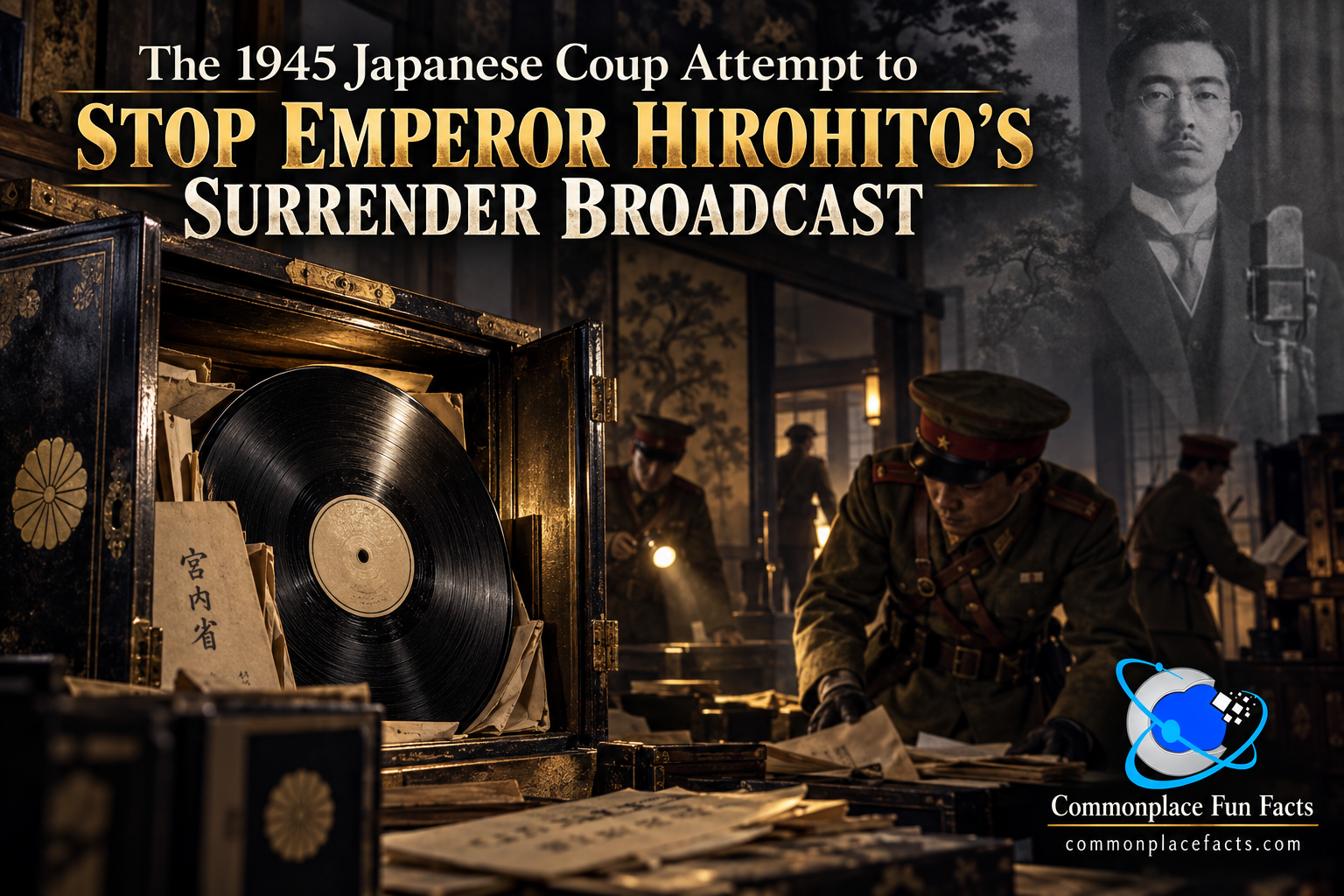

Late on August 14, 1945, Emperor Hirohito entered a room inside the Imperial Palace in Tokyo to do something unprecedented for a Japanese emperor: record a message that would be broadcast directly to the nation.
Japan had decided to accept the Allied terms for ending World War II, and Hirohito was going to tell his people himself. Since broadcasting an emperor live apparently seemed insufficiently nerve-racking, technicians from Japan’s national broadcasting organization, NHK, recorded the message onto phonograph discs so it could be transmitted across the country at noon the following day.
There was only one small problem. A group of Japanese Army officers had decided that Japan was not going to surrender, regardless of what the emperor said. Their solution was straightforward: seize the Imperial Palace, isolate the emperor, find the recordings, destroy them, take over the radio station, and keep the war going.
Thus, during the final hours before Japan’s surrender announcement, the success of that announcement suddenly depended in part on whether a group of armed men could find a few phonograph records hidden somewhere inside a very large building.
Contents
The War Was Over. Except for the People Who Disagreed.
By August 1945, Japan’s military situation had progressed well beyond “concerning” and was approaching the point where the word situation itself seemed unduly optimistic.
Hiroshima had been destroyed by an atomic bomb on August 6. The Soviet Union entered the war against Japan on August 8. On August 9, the second atomic bomb devastated Nagasaki—after Kokura escaped becoming the target through an extraordinary combination of clouds, smoke, and circumstance.

Caption: Emperor Hirohito in formal military dress uniform in 1935, a decade before his recorded surrender broadcast announced Japan’s acceptance of the Allied terms. Photographer unknown; Library of Congress collection, via Wikimedia Commons, public domain.
Even then, Japan’s leaders could not agree on surrender.
The country’s Supreme Council for the Direction of the War—the so-called Big Six—had repeatedly divided over what conditions Japan should demand before ending the war. Some leaders hoped to preserve not merely the emperor but other elements of the existing political and military system. Others recognized that Japan’s negotiating position had acquired the unfortunate weakness of possessing virtually no leverage whatsoever.
Emperor Hirohito finally intervened.
After another deadlock on August 14, he made clear that Japan should accept the Allied terms. The cabinet followed his decision, and preparations began for an extraordinary announcement to the Japanese people.
The emperor himself would speak.
This mattered in a way that is difficult to appreciate today. Most ordinary Japanese had never heard Hirohito’s voice. The emperor occupied a position far removed from the experience of an elected politician who might appear on television every Tuesday to discuss infrastructure funding. His direct voice carried profound authority.
That was precisely why some officers desperately wanted to make sure nobody heard it.
Major Hatanaka Has a Different Plan
The central figure in the plot was Major Kenji Hatanaka, an officer in the War Ministry’s Military Affairs Section.

Hatanaka was not alone in opposing surrender. Even War Minister General Korechika Anami had argued strongly for continuing the war before Hirohito made his final decision. But there was an important difference between opposing the emperor before he decided and rebelling after he had decided.
Anami understood that difference.
When officers approached him about resisting the surrender, he would not give them the backing they needed. Whatever his own views, the emperor had spoken. Anami ordered the Army to obey.
This left Hatanaka in a difficult position. To stage a successful military coup, it is generally helpful to have some senior military officers supporting the military coup.
He did not.
Nevertheless, Hatanaka and several like-minded officers convinced themselves that if they could act decisively enough, the rest of the Army might follow. They believed the emperor had been poorly advised or improperly influenced by the peace faction around him. If they could isolate him, suppress the surrender announcement, and place Tokyo under military control, perhaps they could reverse the decision.
There was an obvious philosophical difficulty here.
The officers claimed to be defending the imperial system by defying the emperor’s explicit command.
This problem was solved in the time-honored fashion of political extremists everywhere: by concluding that they understood what the leader really wanted better than the leader did.
Meanwhile, Hirohito Was Making a Record
While the plotters were trying to decide how to save the emperor from his own decision, Hirohito was preparing to make it considerably harder for them.
The text of the Imperial Rescript on the Termination of the War was not completed until late on August 14. According to the National Archives of Japan, officials were still making changes so late that corrections had to be physically added to the official document rather than rewriting the whole thing.

This is comforting in its own way. Apparently even history-changing documents can reach the final draft stage while someone is saying, “Could we make one more little change?”
NHK technicians had already brought recording equipment to the palace. At about 11:25 p.m., Hirohito began reading the rescript.
The first attempt was not satisfactory; Hirohito’s voice was too quiet, so he recorded the address again. Because the speech lasted more than four minutes, it had to be preserved across multiple recording discs, and more than one set was produced. The result was several fragile pieces of recording media carrying a message intended to end a war—which was about to become inconvenient when armed men started looking for them.
One recording would be used for the broadcast, while another provided a backup. From a modern perspective, this may sound technologically primitive, but consider the alternative: somewhere in Tokyo, history’s most consequential audio file had effectively just been saved more than once, and nobody had yet invented cloud storage.
The recordings had to survive until noon.
Hide the Emperor
Hatanaka needed control of the Imperial Guards Division, the troops responsible for protecting the palace. That meant he needed Lieutenant General Takeshi Mori, the division’s commander. Hatanaka and several conspirators went to Mori’s headquarters and tried to persuade him to join the uprising.

Mori refused, and Hatanaka shot him. Another conspirator killed Mori’s brother-in-law, Michinori Shiraishi, who was present at the meeting.
With the general dead, the rebels proceeded to exploit one of the more alarming weaknesses of paper-based command systems: they used Mori’s official authority to issue false orders. The forged directives sent Imperial Guards troops into position around the palace. Many of the soldiers participating had no idea they were taking part in a coup; as far as they knew, they were carrying out legitimate orders to protect the emperor.
Telephone lines were cut, entrances were secured, palace police were disarmed, and officials and NHK technicians were detained. By the early hours of August 15, armed rebels controlled much of the Imperial Palace grounds.
Now they just had to find the records.
Somewhere in This Palace Are the Records
The Imperial Palace complex was not particularly cooperative. It was sprawling, dark, confusing, and—because Tokyo was under an air-raid blackout—considerably less illuminated than anyone conducting a frantic search for phonograph records might have preferred.

The rebels began combing offices and rooms. They were not merely looking for the recordings; they also wanted senior imperial advisers, including Lord Keeper of the Privy Seal Kōichi Kido and Imperial Household Minister Sōtarō Ishiwata, both of whom had supported surrender. The officials had gone into hiding, and the records had also disappeared.
The man primarily responsible for their disappearance was imperial chamberlain Yoshihiro Tokugawa. The name was not incidental. Tokugawa was a descendant of the family whose shoguns had ruled Japan for more than two and a half centuries before imperial rule was restored in the nineteenth century. Now a descendant of the old shogunate found himself protecting the emperor from members of the emperor’s own army. History sometimes develops a sense of humor when left unsupervised.
Tokugawa had hidden the recordings in an inconspicuous safe in an office associated with the empress’s household. According to later accounts, papers were piled around or over the safe, helping it blend into its bureaucratic surroundings.
The rebels found Tokugawa and demanded to know where the recordings were. He refused to tell them. According to an Associated Press account published after his death, Tokugawa held his ground despite the threats, and one rebel struck him hard enough to break his glasses.
The safe remained undiscovered, and the records remained inside. The coup plotters had managed to seize much of the Imperial Palace, kill its guard commander, issue forged military orders, cut communications, detain officials, and place the emperor himself in effective isolation.
Their search was defeated by office storage.
The Most Important Lost Records in Tokyo
The search continued for hours. According to the U.S. Naval History and Heritage Command, the blackout caused by ongoing American air operations made the already labyrinthine palace even harder to search.
There is something almost unbearably strange about the situation. American bombers were still operating over Japan because the surrender had not yet been fully communicated. Inside the palace, Japanese officers were searching in darkness partly caused by those raids for the recording that would announce the surrender and help bring those raids to an end.
Meanwhile, Hirohito remained inside the palace. He had made his decision, recorded his message, and gone to bed while soldiers loyal to him in theory but not particularly in practice occupied the grounds around him.
The rebels never found the discs. That failure alone did not doom the coup, but another problem was becoming impossible to ignore: nobody important was joining it.
The General Who Did Not Feel Like Participating in Treason
The conspirators desperately needed the Eastern District Army, which controlled military forces in the Tokyo area. Its commander was General Shizuichi Tanaka, and Tanaka was not interested.

As the night progressed, it became increasingly clear that Hatanaka had mistaken his own determination for a nationwide military movement. Senior commanders refused to support him, and units outside the immediate palace area were not rising in revolt. Lieutenant Colonel Masataka Ida, who had initially sympathized with resistance to surrender, reportedly warned Hatanaka that the Eastern District Army was moving against the coup and urged him to abandon it.
Hatanaka did what people sometimes do when their revolution is collapsing around them: he asked for airtime. He wanted to broadcast an explanation of his actions to the Japanese people and perhaps rally public or military support.
The request was refused. Shortly before 5:00 a.m., Hatanaka went to the NHK broadcasting facility and again tried to get on the air. He still had a pistol, and the combination of “armed insurrectionist” and “unscheduled programming request” did not improve his chances. NHK personnel would not give him a microphone.
By dawn, General Tanaka personally entered the palace grounds, confronted the rebellious officers, condemned what they had done, and ordered them back to their units. By approximately 8:00 a.m., the coup was over.
The conspirators had controlled parts of the Imperial Palace for much of the night, killed two men, and come frighteningly close to throwing Japan’s surrender into chaos. But they had never found the records.
One Last Attempt to Explain
Hatanaka and fellow conspirator Lieutenant Colonel Jirō Shiizaki did not immediately disappear. Instead, they spent part of the morning moving through Tokyo distributing leaflets explaining why they had acted.
Hatanaka traveled by motorcycle. Shiizaki reportedly went on horseback, giving the final hours of Imperial Japan the peculiar visual character of a historical epic that had accidentally wandered into the wrong century.
Shortly before the emperor’s scheduled broadcast, both men killed themselves near the Imperial Palace. Hatanaka used the pistol with which he had killed General Mori; Shiizaki stabbed himself and then shot himself. Within roughly an hour, the voice they had tried to suppress would be heard across Japan.
At Noon, Japan Heard Its Emperor
At noon on August 15, 1945, Japanese radio stations carried an announcement of exceptional importance. The national anthem was played, followed by a voice that almost nobody listening had ever heard before: Hirohito began reading the Imperial Rescript.

It was not exactly the sort of speech one would write today if the objective were clarity. The emperor spoke in highly formal, archaic Japanese, and the recording quality was poor. Many listeners found the language difficult to understand. He did not say, “Japan has surrendered.” He did not even use the Japanese word for surrender.
Instead, Hirohito announced that Japan had accepted the provisions of the Potsdam Declaration and observed, with almost heroic understatement, that the war situation had developed “not necessarily to Japan’s advantage.” He also referred to the enemy’s use of “a new and most cruel bomb” and warned that continuing the war threatened not merely Japan’s destruction but potentially human civilization itself. The surviving text and an English translation can be read through the Atomic Heritage Foundation.
The speech became known as the Gyokuon-hōsō, commonly rendered in English as the “Jewel Voice Broadcast.” For millions of listeners, the emperor’s unfamiliar voice confirmed something nearly unimaginable: the war was ending.
The Broadcast Did Not Magically Stop Every Gun
It is tempting to treat noon on August 15 as the moment somebody flipped the giant WORLD WAR II switch to OFF. History, having never encountered a clean ending it could not complicate, declined to cooperate.

The formal Instrument of Surrender would not be signed aboard the USS Missouri until September 2. Orders and information had to reach Japanese forces scattered across enormous distances. Some commanders initially resisted, and fighting continued briefly in several places. Even after the emperor’s broadcast, Vice Admiral Matome Ugaki, commander of Japan’s kamikaze forces, took off on a final suicide mission rather than accept the war’s end.
For a handful of Japanese soldiers, the war lasted considerably longer. The most extreme example was Teruo Nakamura, who remained in hiding until 1974—more than 29 years after the emperor told Japan that the war was over.
But the broadcast mattered enormously because it placed the emperor’s own authority behind surrender. Any officer who wanted to continue fighting could no longer plausibly claim that resistance represented obedience to the imperial will.
That was precisely what Hatanaka had understood, and it was why the records had to disappear.
How Close Did the Japanese Coup Attempt Come to Succeeding?
The answer depends on what we mean by success. The conspirators had little realistic prospect of permanently reversing Japan’s strategic defeat. By August 15, surrender communications had already passed through diplomatic channels, Japan’s military position was catastrophic, the Soviet offensive was underway, and senior commanders refused to join Hatanaka.
The National WWII Museum describes the coup as dramatic but unlikely to succeed in the larger sense. That does not make it harmless.
Had the rebels destroyed the recordings, detained or killed key surrender advocates, taken effective control of broadcasting, and convinced additional Army units that they were acting under legitimate orders, they could have delayed the emperor’s public announcement and created severe confusion at precisely the moment Japan’s government was trying to bring millions of armed men under a single surrender order. At minimum, the result could have been more fighting and more deaths.
The coup was unlikely to reverse Japan’s defeat. It was entirely capable, however, of making things considerably worse on its way to failing.
The Broadcast Survived Because They Couldn’t Find the Records
World War II was not ended by phonograph records. Japan’s surrender resulted from enormous military, political, diplomatic, and human forces: years of devastating war, blockade, conventional bombing, Hiroshima, Soviet entry into the conflict, Nagasaki, internal political struggle, and finally the emperor’s decision to accept defeat.
But for a few hours on the night of August 14–15, 1945, those forces converged on something astonishingly small: a recorded voice. Hirohito had already decided what Japan would do, and the government had already begun acting on that decision. Yet the emperor’s ability to tell his own people depended on whether a handful of palace employees could keep the recordings hidden from armed men wandering through darkened corridors.
The rebels had troops, guns, swords, and control of much of the Imperial Palace. They had even acquired the commanding general’s official seal, admittedly through the somewhat irregular procedure of murdering him first.
What they did not have was a good filing system.
At noon, the records began to turn, and the emperor spoke.
And this time, Japan heard him.
You may also enjoy…

Jake DeShazer: The Doolittle Raider Who Returned to Japan as a Missionary
Jake DeShazer survived 40 months as a WWII POW after the Doolittle Raid—then returned to Japan as a missionary. Discover how solitary confinement, a shared Bible, and radical forgiveness reshaped his life.

Japan’s Death Penalty: Where Mystery Meets Justice and Spontaneity
Explore Japan’s secretive death penalty system, where inmates face hanging without warning. Learn more about this haunting practice and its implications. #Justice #Japan

Kokura: The Japanese City That Was Almost Nuked
Kokura was almost the second atomic bombing target. A last-minute switch, a forgotten city, and a massive invasion plan tell the fuller story.





Leave a Reply