
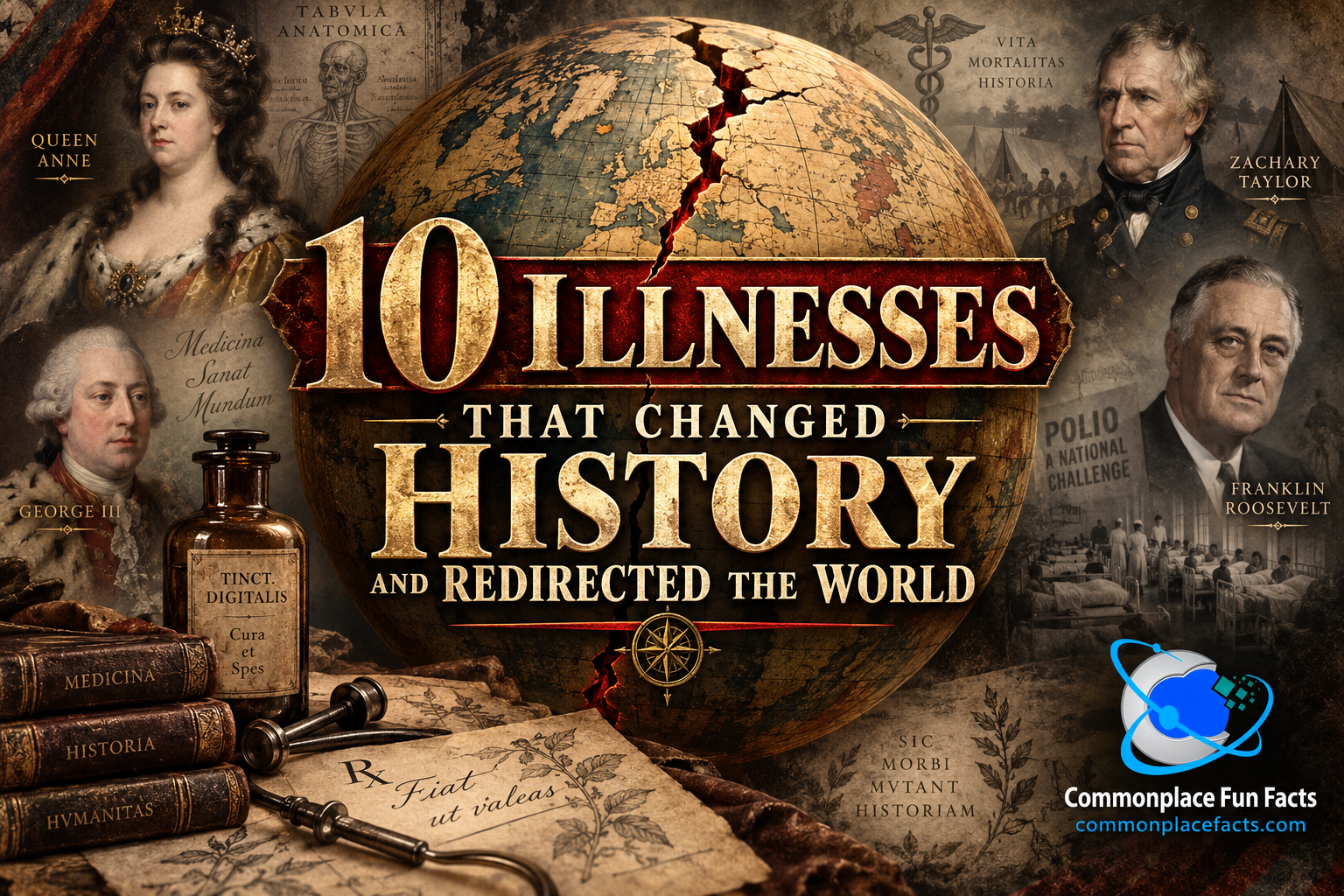

History likes to present itself as the work of grand forces. Empires rise because of military power. Governments fall because of revolution. Borders move because of wars, treaties, diplomacy, economics, nationalism, religion, and Very Important Men standing beside enormous maps while pointing at places they intend to make somebody else’s problem.
All of that is true. It is also true that history has occasionally been redirected because somebody’s blood would not clot, somebody’s throat developed cancer, somebody’s digestive system staged an insurrection, or a mosquito happened to be carrying something considerably more consequential than an irritating bite.
That is the less dignified side of history: governments are run by human bodies, and bodies are alarmingly unreliable. Kings get sick. Presidents have strokes. Royal couples fail to produce heirs. Armies encounter diseases their generals did not include on the campaign map. Entire constitutional arrangements can suddenly depend upon whether one particular person is capable of getting out of bed.
This makes the subject of illnesses that changed history both fascinating and slightly dangerous. There is a thriving cottage industry devoted to diagnosing dead people from portraits, secondhand descriptions, and medical records written by physicians who believed bloodletting was an excellent response to nearly everything short of excessive blood loss. Napoleon has supposedly been defeated by hemorrhoids. Henry VIII has accumulated enough proposed diagnoses to qualify as a small teaching hospital. Alexander the Great has been posthumously diagnosed with almost everything except seasonal allergies.
We are going to resist that temptation as much as possible.
The examples that follow are not here merely because a famous person had an interesting medical problem. In each case, an illness, disability, reproductive problem, inherited condition, or epidemic had an identifiable historical consequence. Sometimes it altered a succession. Sometimes it changed a government. Sometimes it destroyed an army or helped redraw a continent. The diagnosis may occasionally be disputed, because dead patients remain annoyingly reluctant to come in for follow-up testing, but the historical consequences are considerably easier to see.
Contents
Queen Anne: Repeated Pregnancy Loss and the Dynasty That Never Was
Queen Anne of Great Britain spent much of her adult life doing something that would normally be regarded as intensely private: trying to have a child who would live long enough to inherit the throne.

For a monarch, unfortunately, reproduction was not private. It was constitutional policy conducted in a bedroom.
Anne married Prince George of Denmark in 1683. According to the official history of the Royal Family, she experienced eighteen pregnancies, although other official historical sources count seventeen. Whatever the precise tally, the result was tragically clear: none of Anne’s children survived to adulthood. Her longest-lived child, William, Duke of Gloucester, died in 1700 just days after his eleventh birthday.
For Anne and George, this was an almost unimaginable sequence of personal tragedies. For Parliament, it was also a constitutional emergency. Anne was next in line to the throne, but there was no surviving Protestant child waiting behind her. England had spent much of the previous century demonstrating that disputed royal succession was an excellent way to turn theology into artillery.
Parliament therefore enacted the Act of Settlement of 1701, directing the succession toward Sophia of Hanover and her Protestant descendants. Sophia died shortly before Anne, so when Anne died without a surviving child in 1714, Sophia’s son became George I.
And just like that, Britain had the House of Hanover.
The Hanoverian succession influenced British politics for generations. It helped provoke Jacobite uprisings by supporters of the displaced Stuart line, strengthened the principle that Parliament could determine who occupied the throne, and eventually gave Britain George III, the monarch who would have some difficulties with thirteen North American colonies that had become unusually opinionated about taxation.
We do not need to settle exactly why Anne suffered so many unsuccessful pregnancies. Historians and physicians have proposed several explanations, but retrospective diagnosis is especially hazardous when dealing with seventeenth-century obstetric records. The historically important fact is much simpler: Anne had no surviving heir, Parliament had to plan around that biological reality, and the British crown passed to an entirely different dynasty.
The course of British history turned partly on treaties, wars, religion, and parliamentary power. It also turned on a nursery that kept becoming empty.
Charles II of Spain: When the Royal Family Tree Became a Wreath
If Queen Anne’s problem was a dynasty running out of children, Charles II of Spain represented a dynasty that had perhaps spent too many generations being excessively creative about where those children came from.

The Spanish Habsburgs had a firm belief in marrying within the family. This kept inheritances, alliances, territories, and awkward holiday gatherings conveniently concentrated. It also meant that the family tree gradually became less of a tree and more of a decorative knot.
We have previously explored the spectacular consequences in “How Royal Inbreeding Broke an Empire: The Tragic, Bizarre Lives of Charles II of Spain and Ferdinand I of Austria.” Charles was the unhappy culmination of generations of close-kin marriage. He suffered lifelong physical problems, failed to produce a child in either of his marriages, and died in 1700 at the age of 38.
Modern genetic researchers have attempted to quantify just how tangled the Habsburg pedigree had become. A 2009 study in PLOS ONE calculated Charles’s inbreeding coefficient at approximately 0.254. For comparison, the theoretical coefficient for the child of a brother-sister or parent-child union is 0.25. In other words, generations of strategic royal marriage had given Charles a calculated level of inbreeding slightly higher than that expected from one of those extraordinarily close unions—a statistical comparison that is grim enough without asking genetics to make it any worse.
The researchers proposed possible genetic explanations for Charles’s extensive health problems and infertility, although those diagnoses remain hypotheses. What does not require a medical degree is the fact that Charles had no children.
That mattered because he was not merely a man without children. He was the king of Spain without children, and the Spanish monarchy came attached to an enormous collection of European and overseas possessions coveted by nearly everybody with an army.
When Charles died, he left the Spanish throne to Philip of Anjou, grandson of Louis XIV of France. Other European powers were deeply unhappy about the possibility that the Bourbon dynasties of France and Spain might become too closely connected. The resulting dispute helped produce the War of the Spanish Succession, a major European conflict that lasted more than a decade.
No single medical condition “caused” that war. Great powers had been maneuvering around the Spanish succession for years, and dynastic ambition was doing plenty of work on its own. But Charles’s inability to produce an heir was the problem around which all that maneuvering revolved.
A European war did not begin because one king was sick. It began because Europe had built a political system in which the health and fertility of one king could become everybody else’s military emergency.
George III: When the King’s Illness Became a Constitutional Problem
George III is best remembered by Americans as the king on the receiving end of the Declaration of Independence, which is the sort of unfavorable performance review that tends to overshadow the rest of a sixty-year reign.

He is also remembered for recurrent episodes of severe illness involving both physical and mental symptoms. For generations, the most famous explanation was porphyria, a group of metabolic disorders that can cause neurological and psychiatric symptoms. We have previously examined the condition in “Porphyria: The Creepy Dracula Disease That Creates Real Vampires.”
The porphyria diagnosis for George III is now heavily disputed. Other researchers have argued for psychiatric illness or other causes, and after more than two centuries there is little prospect of the king appearing at a modern clinic and clearing things up.
Fortunately, his exact diagnosis is not what makes the case historically important.
George’s illness became so severe that at times he could not perform the duties of the monarchy. That presented Britain with a surprisingly basic constitutional problem: what do you do when the king is alive, still the king, but unable to be king?
The problem first produced a major political crisis in 1788. George recovered before a regency could formally be established, but another severe relapse in 1810 proved lasting. Parliament finally enacted the Regency Act of 1811, transferring royal authority to George’s eldest son, the future George IV, as Prince Regent.
The statute explicitly stated that the king’s illness had interrupted his personal exercise of royal authority and that someone therefore needed to perform the constitutional functions belonging to the Crown. Parliament was essentially required to write instructions for operating the monarchy while its principal component was temporarily unavailable.
The episode exposed a weakness in a constitutional system that depended upon a living human being occupying an office designed to symbolize permanent authority. Parliament debated not only what to do about George, but what should happen if another monarch became incapacitated in the future. Modern British regency law still provides procedures for royal incapacity, with parliamentary research explicitly tracing the issue back to George III’s incapacity in 1811.
George’s illness did not suddenly transform Britain into a modern constitutional monarchy. Power had been shifting toward ministers and Parliament for generations. But his incapacity demonstrated in unusually practical terms that the machinery of government had to be capable of operating when the monarch could not.
Political theory is impressive. Sometimes constitutional development is simply what happens when someone asks, “What if His Majesty cannot sign anything today?” and the answer turns out to be, “We should probably have a law for that.”
Frederick III: The Cancer That Reduced an Emperor’s Reign to 99 Days
Few historical illnesses invite counterfactual speculation more enthusiastically than the throat cancer of German Emperor Frederick III. We have already taken a detailed look at the story in “Was World War I Caused By a Doctor’s Misdiagnosis?”

The short version is that Frederick was the heir to the newly created German Empire and had political instincts quite different from those of his son, Wilhelm. Frederick was influenced by British liberal ideas, opposed some of Otto von Bismarck’s authoritarian methods, and had married Victoria, the eldest daughter of Britain’s Queen Victoria.
Then his throat began causing trouble.
By 1887, Frederick had developed serious laryngeal disease. Medical disagreements delayed definitive treatment, and cancer eventually became undeniable. The German Historical Museum’s biography records that his illness was publicly identified as laryngeal cancer in November 1887.
His father, Wilhelm I, stubbornly continued being alive until March 1888. Frederick therefore inherited the German throne only after his cancer was advanced and his voice was gone. He governed largely through written notes and gestures and died on June 15, just 99 days after becoming emperor.
His 29-year-old son succeeded him as Wilhelm II.
This is where historical imagination tends to run loose in the hallways. Frederick was comparatively liberal; Wilhelm became associated with a much more assertive imperial style; Germany was a major participant in World War I; therefore, people are tempted to draw a straight line from Frederick’s cancer to the trenches of 1914.
That line is much too straight.
World War I resulted from alliances, nationalism, military planning, imperial competition, Balkan instability, the assassination of Archduke Franz Ferdinand, political decisions made across several governments, and enough additional factors to keep historians arguing indefinitely. We cannot know what Frederick would have done had he lived another twenty years, much less whether he could have prevented a war whose causes extended far beyond Germany.
What we can say is significant enough: cancer reduced Frederick’s reign to just 99 days and placed his very different 29-year-old son, Wilhelm II, on the German throne in 1888. Frederick’s illness therefore changed who governed one of Europe’s most powerful states during a critical period, without requiring us to guess how long he otherwise would have lived or what he might have accomplished.
History did not necessarily turn because one doctor misread a throat. But the timing of a cancer diagnosis helped determine which man sat on the German throne while Europe marched toward the twentieth century.
Tsarevich Alexei: The Hemophilia That Opened the Palace Door to Rasputin
When Nicholas II and Alexandra finally welcomed a son in 1904 after the births of four daughters, the Russian imperial succession appeared secure. The Romanovs had their heir.
Then they discovered that Alexei had hemophilia.

Hemophilia interferes with normal blood clotting, which meant that relatively minor injuries could produce dangerous internal bleeding. Alexei had inherited the condition through his mother, Alexandra, a granddaughter of Queen Victoria, whose descendants carried the mutation into several European royal families.
This was not merely a medical problem. In an absolute monarchy, the health of the heir was a matter of state, and Nicholas and Alexandra guarded Alexei’s condition as a closely held secret.
The secrecy had an unforeseen consequence. Alexandra became increasingly dependent upon Grigori Rasputin, the Siberian religious figure whom she believed could relieve Alexei’s suffering. As Smithsonian’s history of the Russian Revolution explains, Rasputin’s perceived ability to help the boy gave him extraordinary credibility with the imperial family.
There may even have been a mundane medical reason why Alexei sometimes improved when Rasputin intervened. One historical explanation notes that Rasputin urged Alexandra to keep doctors away from Alexei during at least some crises. If those doctors had been giving aspirin, then relatively new and not yet understood to inhibit blood clotting, stopping the medication could genuinely have helped a child with hemophilia.
To Alexandra, however, the improvement appeared miraculous.
Rasputin gained unusual access to the imperial family and eventually offered political advice as well as spiritual comfort. Because Alexei’s condition remained secret, the Russian public could not understand why the empress placed such trust in this controversial outsider. Rumors filled the vacuum, as rumors generally do when governments decide secrecy will make everyone less suspicious.
By World War I, Rasputin had become a political liability. His association with Alexandra fed damaging stories about corruption, manipulation, sexual misconduct, and foreign influence. Some claims were exaggerated or invented, but their political impact did not depend upon their accuracy.
Alexei’s hemophilia did not cause the Russian Revolution. That would require overlooking military disaster, food shortages, economic breakdown, political repression, autocracy, social unrest, the failures of Nicholas II, and several decades of Russian history that would object rather strongly to being omitted.
But hemophilia created the private desperation that brought Rasputin deep into the imperial household. The secrecy surrounding that illness then made Rasputin’s presence look inexplicable and sinister to people already losing confidence in the monarchy.
A missing clotting protein did not overthrow the Romanovs. It did, however, help create one of the strangest and most damaging relationships in the dynasty’s final years.
Zachary Taylor: Five Days of Stomach Trouble and a New President
On July 4, 1850, President Zachary Taylor attended ceremonies in Washington, D.C. It was hot. Afterward, according to the Library of Congress chronology of Taylor’s presidency, he consumed ice water and fresh fruit and soon developed severe gastrointestinal symptoms.

Five days later, he was dead.
His physicians called the illness “cholera morbus,” a nineteenth-century term applied to severe gastrointestinal disease rather than necessarily the specific cholera infection we recognize today. Food poisoning, contaminated water, gastroenteritis, and other explanations have been proposed. The famous cherries-and-milk story has received so much attention that one might assume the fruit was later arrested and questioned.
The exact item on the presidential menu is not the important part.
At the time Taylor became ill, Congress was locked in a bitter struggle over slavery in territories acquired after the Mexican-American War. Henry Clay had proposed what became the Compromise of 1850, a collection of measures addressing California statehood, the territories of Utah and New Mexico, the Texas boundary dispute, the slave trade in Washington, D.C., and a much stronger federal law requiring the return of escaped enslaved people.
Taylor opposed Clay’s omnibus compromise approach and had impeded its progress. His vice president, Millard Fillmore, thought differently. The Miller Center’s account of the transition notes that Fillmore had already indicated that, if necessary, he would cast a tie-breaking Senate vote in favor of the compromise.
Taylor died on July 9. Fillmore became president on July 10 and openly backed compromise legislation. By September, Congress had enacted the package of separate bills that became known collectively as the Compromise of 1850, including the Fugitive Slave Act.
The change mattered. The Fugitive Slave Act strengthened federal mechanisms for recapturing people who had escaped slavery and provoked fierce resistance in the North, increasing sectional hostility during the decade before the Civil War.
It would be ridiculous to say that contaminated water, cherries, or anything else in Taylor’s digestive tract caused the Civil War. America had managed to create more than enough causes without help from a bowl of fruit.
But Taylor’s sudden illness replaced one president with another at the precise moment Congress was deadlocked over the slavery crisis. Fillmore supported legislation Taylor had opposed, and the political direction of the presidency changed within five days.
Taylor already has several supporting roles in the Commonplace Fun Facts archives, including his family connection to Jefferson Davis in “The Love Story That Linked Jefferson Davis and Zachary Taylor.” His final contribution to history was less romantic: an unidentified gastrointestinal illness altered presidential leadership at one of the most combustible moments of the antebellum era.
Woodrow Wilson: The Stroke That Left a President in Office
Woodrow Wilson’s road to the White House was itself the product of one of those historical chain reactions that looks ridiculous in retrospect but nevertheless happened. As explored in “The Princeton Decision That Sent Woodrow Wilson Into Politics—and Possibly Changed the 20th Century,” a bitter dispute over where Princeton University should locate its Graduate College helped drive Wilson out of academia and into politics. He resigned as Princeton’s president in October 1910 and, just over two years later, was elected president of the United States. History occasionally turns on battlefields; other times it turns because university trustees cannot agree where to put a building.
By 1919, Wilson had gone from arguing about campus planning to trying to reorganize international relations after World War I. He returned from the Paris Peace Conference determined to persuade the United States to ratify the Treaty of Versailles and join the League of Nations. Wilson approached the project with the confidence of a man who had once declared that Providence had put him in the presidency, a degree of certainty we previously examined in “Woodrow Wilson: Predestined to be President.”

The United States Senate was less convinced of divine instructions regarding treaty ratification.
Republican Senator Henry Cabot Lodge and other senators objected particularly to the League’s collective-security commitments. Some were willing to support ratification with reservations. Others opposed the treaty entirely. Wilson, meanwhile, resisted significant compromise and took his case directly to the public during an exhausting national speaking tour.
His health collapsed.
Wilson suffered a major stroke in October 1919, leaving him partially paralyzed and seriously impaired. The U.S. Senate Historical Office describes his worsening medical condition as having deprived him of the political resilience that had helped produce earlier legislative victories. Even after his stroke, Wilson continued refusing the reservations needed to gain support from moderate Republicans.
The Senate rejected the treaty in November 1919 and again in March 1920. The United States never joined the League of Nations.
Wilson’s stroke was not the only reason. He and Lodge had been antagonists before Wilson became seriously ill. Republican senators had substantive constitutional and foreign-policy objections, while Wilson had already made strategic decisions that damaged his prospects, including excluding leading senators from the American peace delegation. The treaty fight was well underway before his catastrophic stroke.
But illness sharply narrowed the range of possibilities. A president who might once have negotiated, pressured, persuaded, or recalculated became physically debilitated and increasingly inaccessible while one of the most important foreign-policy debates in American history continued around him.
That created a second constitutional problem. Wilson remained president even though the extent of his disability was concealed from most of the country. His wife, Edith, doctors, and close aides controlled access to him and decided what matters reached his attention. Edith later denied that she exercised presidential powers herself, and the popular description of her as America’s “first female president” greatly overstates what can be demonstrated. Still, a remarkably small group of unelected people had become the gatekeepers to an incapacitated chief executive.
There was no Twenty-Fifth Amendment. There was no modern procedure for declaring presidential inability. There was just Article II, a vice president, an extremely sick president, and a political establishment apparently hoping the whole thing would somehow work itself out.
The experience helped expose a constitutional gap that would not be formally addressed until ratification of the Twenty-Fifth Amendment in 1967. Sections 3 and 4 created procedures for transferring presidential powers when a president is unable to discharge the duties of the office. We took a closer look at that constitutional safety valve—and the awkward question of what happens when a president is alive but unable to do the job—in “What if the President Goes Stark-Raving Mad? Presidential Succession Due to Disability.”
Wilson’s stroke affected history in two distinct ways: it influenced the final phase of the Treaty of Versailles fight, and it demonstrated how poorly the American constitutional system handled presidential incapacity.
Sometimes illness changes a policy. Sometimes it reveals that nobody wrote down what happens when the person making the policy can no longer reliably make it.
Yellow Fever in Saint-Domingue: The Mosquito That Helped Double the United States
So far, our illnesses have mostly afflicted people wearing crowns, presidential waistcoats, or other clothing suggesting that someone else handles the laundry. But disease can influence history on a much larger scale.
For one spectacular example, we need to travel to the French colony of Saint-Domingue, now Haiti, at the beginning of the nineteenth century.
Saint-Domingue had been France’s enormously profitable Caribbean colony, built upon enslaved labor and sugar production. Beginning in 1791, enslaved people launched a revolution that developed into a long, complex struggle against slavery and colonial rule.
Napoleon Bonaparte wanted the colony back.
His plans extended beyond the Caribbean. France had regained Louisiana from Spain, and Napoleon envisioned an American colonial empire in which Saint-Domingue would serve as the lucrative Caribbean center while Louisiana supplied food and other resources. The Mississippi Valley was not supposed to become an American heartland. It was supposed to become the pantry behind Napoleon’s sugar empire.
In 1802, Napoleon sent a large expedition under his brother-in-law, General Charles Leclerc, to reassert French control over Saint-Domingue.

Then yellow fever arrived at the planning meeting without an invitation.
The mosquito-borne disease tore through French forces. Combat with Haitian troops was already costly, but yellow fever proved devastating. The U.S. State Department’s history of the Louisiana Purchase specifically notes that the French army in Saint-Domingue was being decimated by yellow fever as Napoleon reconsidered his American ambitions.
France’s position deteriorated further as another war with Britain approached. Napoleon now faced an awkward strategic question: why retain a huge North American territory that was difficult to defend when the Caribbean colony that was supposed to make the whole system worthwhile was slipping away?
American representatives Robert Livingston and James Monroe had gone to France hoping to buy New Orleans and perhaps West Florida. Instead, Napoleon offered them all of Louisiana.
For $15 million.
The United States acquired approximately 828,000 square miles, roughly doubling the country’s territory. Thomas Jefferson then had to deal with the mildly inconvenient fact that the Constitution did not specifically say, “The president may purchase approximately one France-sized chunk of continent whenever Napoleon has a liquidation sale.” He proceeded anyway.
The Louisiana Purchase opened the way for the westward expansion explored by Lewis and Clark, whose expedition produced, among many more dignified achievements, the archaeological gift of mercury-laced laxative deposits discussed in “Lewis and Clark’s Laxative: How Mercury Pills Became Archaeological Evidence.”
Yellow fever did not singlehandedly cause the Louisiana Purchase. Haitian resistance mattered enormously. So did Napoleon’s renewed war with Britain, French finances, American diplomacy, and the vulnerability of distant French territory.
But this is not a speculative connection invented after the fact. The collapse of the Saint-Domingue expedition, with yellow fever slaughtering French troops on a vast scale, helped destroy Napoleon’s plan for an American empire. Once that plan collapsed, Louisiana became expendable.
A virus carried by mosquitoes in the Caribbean therefore helped create the circumstances under which the United States doubled in size.
Thomas Jefferson gets a monument. James Monroe gets a doctrine. Mosquitoes, as usual, perform important historical work with very little interest in receiving credit.
Smallpox at Tenochtitlan: The Epidemic That Joined the Conquest
When Hernán Cortés and his forces confronted the Mexica Empire in the early sixteenth century, they were not acting alone. They relied heavily upon Indigenous allies who had their own reasons for opposing Mexica power. They possessed unfamiliar weapons and animals. They exploited political divisions. They used violence, diplomacy, deception, siege warfare, and opportunism with great enthusiasm.
They also carried pathogens.
Smallpox reached central Mexico in 1520, apparently introduced by members of a Spanish expedition sent from Cuba. The disease spread into Tenochtitlan, the great island capital of the Mexica Empire, where the population had no previous exposure to smallpox and therefore lacked acquired immunity to it. The virus had found an extraordinarily susceptible population, with catastrophic consequences.
The effects were catastrophic.

A review of the history of epidemic disease identifies the 1520–1521 smallpox epidemic as a pivotal factor in the fall of Tenochtitlan. The disease killed large numbers of residents, including the ruler Cuitláhuac, weakened defenders, disrupted political and military organization, and struck a society already struggling against invasion.
Cortés returned to besiege Tenochtitlan in 1521. By then, disease had already done work no Spanish weapon could duplicate.
The city fell in August.
It is important not to tell this story as though a few hundred Spaniards simply arrived and conquered millions of people because Europeans had guns and germs. Cortés depended upon tens of thousands of Indigenous allies, particularly Tlaxcalans and others who opposed Mexica dominance. Political divisions within Mesoamerica were essential to the conquest.
But smallpox was also essential.
Disease continued devastating Indigenous populations throughout the Americas after conquest, with repeated epidemics causing demographic losses on a scale that is difficult to comprehend. The destruction reshaped economies, societies, political structures, settlement patterns, and the balance of power throughout the hemisphere.
Smallpox would eventually become the target of one of humanity’s greatest medical achievements: vaccination and, ultimately, global eradication. The disease that devastated Tenochtitlan in 1520 was officially declared eradicated by the World Health Organization in 1980.
Commonplace Fun Facts has encountered smallpox before from a very different direction. Benjamin Franklin lost his four-year-old son Francis to the disease and later expressed lifelong regret that the boy had not been inoculated, a story explored in “Heartbreaking Warning to Anti-Vaxxers From Benjamin Franklin.”
At Tenochtitlan, though, smallpox did not merely kill individuals. It altered the conditions under which an empire fought for survival.
Armies usually bring weapons to war. In this case, one of the most consequential weapons was invisible, unintended, and multiplying on its own.
Franklin Roosevelt: The Paralysis That Helped Finance the Defeat of Polio
Not every historically significant illness changes history by killing someone, destroying an army, ending a dynasty, or leaving a government desperately rereading its constitution.
Sometimes the response to illness changes history instead.

In August 1921, Franklin D. Roosevelt was 39 years old, politically ambitious, physically vigorous, and apparently headed toward a promising public career. Then he developed fever, weakness, and rapidly progressing paralysis while at his family’s summer home on Campobello Island.
The diagnosis was poliomyelitis.
Roosevelt survived, but he never regained the normal use of his legs. He used braces, wheelchairs, assistance from others, and carefully choreographed public appearances that allowed him to project an image of standing or walking. His effort to navigate public life with paralysis has already produced some wonderfully strange episodes, including the logistical adventure described in “FDR’s Fishing Trip and Near Exposure of His Bare Buns.”
There is a modern medical debate worth acknowledging. Some researchers have argued that Roosevelt’s symptoms fit Guillain-Barré syndrome better than poliomyelitis, while a later review of the same historical evidence strongly defended the original polio diagnosis. The question cannot now be settled with laboratory testing: there is no evidence that Roosevelt underwent a lumbar puncture during the illness, and several modern tests capable of distinguishing the conditions did not yet exist.
Historically, however, Roosevelt’s illness was diagnosed, treated, and understood as poliomyelitis. That distinction matters. Whatever actually attacked his nervous system in 1921, Roosevelt, his physicians, his family, the public, and the institutions he later created understood his paralysis in the context of polio. His entire campaign against the disease grew from that understanding.
Roosevelt searched for therapies and eventually became deeply involved with Warm Springs, Georgia, where warm-water exercise offered people with paralysis greater mobility. In 1927 he established the Georgia Warm Springs Foundation. He later helped create the National Foundation for Infantile Paralysis in 1938.
The organization became famous through a fundraising campaign promoted by entertainer Eddie Cantor. Americans were encouraged to mail small donations to the White House—a “march of dimes.” The name stuck so effectively that eventually almost nobody remembered what the organization was officially called.
The Franklin D. Roosevelt Presidential Library traces the enormous fundraising effort that followed. The March of Dimes funded medical research, patient care, rehabilitation, and eventually work by Jonas Salk on a polio vaccine.
In 1954, the organization coordinated one of the largest medical field trials in history, involving approximately 1.8 million children. In 1955, the Salk vaccine was announced as safe and effective. Polio cases in the United States subsequently plummeted.
Roosevelt had died ten years earlier.
The disease that nearly ended his political career instead became one of his enduring causes. Roosevelt’s paralysis helped transform polio from an individual medical tragedy into a national philanthropic campaign capable of raising enormous sums for research and rehabilitation.
It also failed to keep him out of politics. As discussed in “When Someone Tells You, ‘You Can’t Do That,’” Roosevelt returned to public life, became governor of New York, and then became the only American president elected four times.
Whether the original diagnosis was poliomyelitis or Guillain-Barré syndrome, the historical consequence is unusually clear. Roosevelt believed he was fighting polio, built institutions to fight polio, inspired millions of people to contribute to that fight, and helped create the financial infrastructure that supported the development and testing of Jonas Salk’s vaccine. The Salk vaccine sent American polio rates plunging after 1955, and the later Sabin oral vaccine helped carry the campaign further; indigenous transmission of wild poliovirus in the United States was eliminated by 1979.
Sometimes history is changed by getting sick.
Sometimes it is changed by what someone decides to do afterward.
Illnesses That Changed History: When Biology Had Other Plans
There is an understandable tendency to separate medical history from “real” history. Diseases belong in one chapter. Kings, wars, constitutions, presidents, empires, and revolutions belong in another. This makes organizing textbooks easier, which is apparently one of civilization’s most persistent goals.
Actual history is much less cooperative.
Queen Anne’s reproductive tragedies helped redirect the British succession toward Hanover. Charles II’s childlessness turned the future of the Spanish monarchy into a European military problem. George III’s incapacity forced Parliament to create a regency. Frederick III’s cancer gave Germany a 99-day emperor and an unusually young Wilhelm II. Alexei’s hemophilia helped bring Rasputin into the center of the Romanov court. Zachary Taylor’s fatal stomach illness changed presidential leadership during the crisis over slavery. Woodrow Wilson’s stroke affected the fight over the Treaty of Versailles while exposing a dangerous constitutional gap.
Then disease steps out of the palace entirely. Yellow fever helped wreck Napoleon’s Caribbean expedition and, along with Haitian resistance and looming war with Britain, helped make the Louisiana Purchase possible. Smallpox devastated Tenochtitlan during the Spanish conquest. Roosevelt’s paralysis ultimately contributed to a nationwide movement that financed the research leading to an effective polio vaccine.
None of these stories means illness alone determines history. That would simply replace one kind of oversimplification with another. Armies, institutions, economics, political movements, personalities, ideas, religion, geography, technology, chance, and millions of ordinary people all matter.
But health belongs on the list.
The problem is that human beings are astonishingly fond of constructing permanent institutions around temporary biological equipment. We build monarchies around bloodlines and then discover the bloodline cannot produce another heir. We vest executive authority in one person and then discover that person has had a stroke. We send an army across an ocean and then encounter a mosquito population that has declined to recognize the chain of command.
History books make civilization look sturdy. Marble buildings help with the illusion.
Underneath all of it, however, are lungs, nerves, arteries, chromosomes, immune systems, joints, digestive tracts, and occasionally an appendix with ambitions of its own. Nations may imagine themselves governed by constitutions and grand principles, but sooner or later biology asks for the floor.
And biology, as history repeatedly demonstrates, does not recognize parliamentary procedure.
You may also enjoy…

The World of Warcraft Pandemic That Taught Scientists About Real Ones
A World of Warcraft bug became a virtual pandemic—and helped scientists understand how real outbreaks spread through human behavior.

Was World War I Caused By a Doctor’s Misdiagnosis?
Could a British doctor’s error have changed the course of history? Discover how a misdiagnosed sore throat helped pave the way for World War I.

The Mysterious Illness That Killed 80% of a Nation
At a time when much of the world’s attention is on the COVID-19 coronavirus global pandemic, it is appropriate to remember an epidemic that history has largely overlooked, despite the fact that it wiped out as much as 80% of a country’s population. You have heard of the Black Death and the Spanish Flu, but…



Leave a Reply