
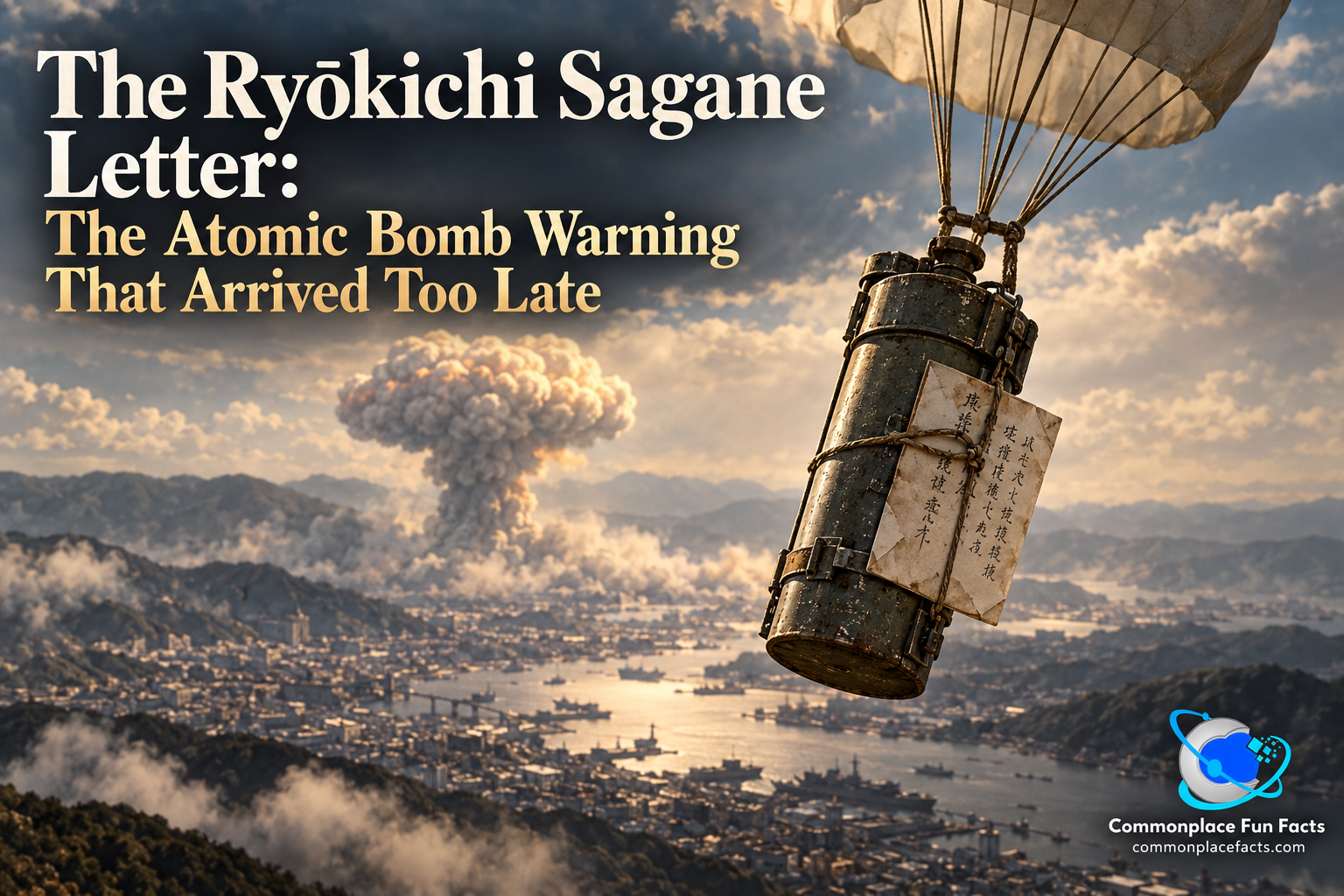

On the morning of August 9, 1945, several American B-29s approached Japan carrying an assortment of items that no reasonable postal service would have accepted.
One aircraft carried an atomic bomb.
Another carried scientific instruments designed to measure what happened when that bomb exploded.
And attached to those instruments were three copies of a handwritten personal letter.
The letter was addressed to one man: Japanese nuclear physicist Ryōkichi Sagane. It had been written by three American scientists who knew him personally and who had helped create the weapon about to be used against his country.
It was part warning, part plea, and part astonishing attempt at peer-to-peer diplomacy. The United States had spent billions of dollars developing the most technologically sophisticated weapon in human history, and three of the scientists involved decided that what the situation really needed was a handwritten note to an old colleague.
They sent it by air mail.
Very, very aggressively.
Contents
The Physicist on the Other Side
Ryōkichi Sagane was not a random name selected from the Tokyo telephone directory.
Born in 1905, he was the son of Hantarō Nagaoka, one of Japan’s most important early physicists. Sagane followed the family profession and entered Tokyo Imperial University, studying physics before moving into nuclear research during an era when scientists were only beginning to appreciate how much trouble the atomic nucleus was eventually going to cause everyone.

In 1935, Sagane traveled to the University of California, Berkeley, to work at Ernest Lawrence’s Radiation Laboratory. Lawrence had developed the cyclotron, a machine used to accelerate charged particles to high energies. Japan wanted cyclotron expertise of its own, and Sagane was sent to learn from the people who knew how to make one work.
Among the young scientists at Berkeley was Luis W. Alvarez, who would eventually win the 1968 Nobel Prize in Physics.
Alvarez and Sagane worked together and became acquainted as fellow experimental physicists. Alvarez later remembered that both men became skilled cyclotron operators and that Sagane had helped him with laboratory techniques during their research.
At the time, the two men belonged to the international community of physicists, where nationality mattered rather less than whether someone knew why the equipment had suddenly stopped working.
Then came World War II.
Sagane returned to Japan. Alvarez remained in the United States. Scientific colleagues who had once worked in the same laboratory found themselves citizens of nations trying very hard to destroy each other.
By 1945, Alvarez was working on the Manhattan Project, the sprawling secret American effort to develop the atomic bomb—which, as it happens, had already experienced the peculiar problem of a science-fiction writer nearly describing its secret weapon before the public knew it existed.
Three Days After Hiroshima
On August 6, 1945, the B-29 Enola Gay dropped the uranium bomb nicknamed Little Boy over Hiroshima.
Alvarez was there—not aboard the Enola Gay, but aboard the accompanying B-29 The Great Artiste. His team had developed parachute-borne instruments that could measure the pressure wave from the explosion and transmit the data back to the aircraft.

That meant Alvarez had one of history’s most exclusive front-row seats. He was not simply a scientist who had worked somewhere in the vast Manhattan Project bureaucracy. He witnessed the weapon’s use.
Three days later, another atomic mission was scheduled.
Its primary target was Kokura, the Japanese city that almost became synonymous with the second atomic bombing. Nagasaki was the secondary target. Weather, smoke, visibility, fuel consumption, and the sort of contingency-driven decision-making that tends to make historians reach for aspirin eventually sent the bombers toward Nagasaki instead.
Before that mission, however, Alvarez thought about his former Japanese colleague.
A Letter to Professor Sagane
Alvarez drafted a letter to Sagane. Fellow Manhattan Project scientists Philip Morrison and Robert Serber helped edit it.
The message did not identify the writers by name. Instead, the sender line read: “From: Three of your former scientific colleagues during your stay in the United States.”

That description would presumably narrow things down considerably for a nuclear physicist in August 1945.
The scientists appealed to Sagane not merely as a Japanese citizen but as someone who understood nuclear physics. They urged him to use his professional standing to convince the Japanese General Staff that the new weapon was real, that the United States had created the industrial capacity to manufacture atomic bombs, and that continued resistance would bring further devastation.
The letter referred to the Trinity test in New Mexico, the destruction of Hiroshima, and the atomic weapon being used that very morning. Its authors warned that America’s production facilities were continuing to operate and that Japan should not assume the bombs already used represented the entire American supply.
Then came the sentence that made the message something more complicated than a threat.
“As scientists, we deplore the use to which a beautiful discovery has been put.”
It is difficult to find another sentence that so neatly captures the moral contradiction facing many of the people who created the atomic bomb. They had participated in one of the greatest scientific and engineering achievements in history and were now asking an old colleague to help prevent that achievement from being repeated over additional cities.
Their proposed communications system was less sophisticated than the bomb.
They were going to drop the letter out of an airplane.
How to Send a Letter During an Atomic Bombing
Alvarez wrote out an original copy and made two carbon copies. Each was placed in an envelope, and the three envelopes were attached to the parachute-equipped pressure gauges that would be released during the mission.

The instruments had an entirely practical purpose. They were designed to measure the blast wave from the atomic explosion and send the information by radio back to the observation aircraft.
The letter was essentially additional cargo.
On August 9, Bockscar, piloted by Major Charles Sweeney, carried the plutonium bomb Fat Man. The accompanying Great Artiste carried the instrumentation package.
When the aircraft reached Nagasaki, The Great Artiste released the instrument canisters beneath parachutes.
Down they came toward Japan: pressure gauges, radio equipment, parachutes, and three copies of a personal message from American physicists to their Japanese friend.
At 11:02 a.m., Fat Man exploded over Nagasaki.
Somewhere beneath the aircraft, Sagane’s mail was still descending.
The Letter Survived. Its Mission Didn’t.
The remarkable thing is that at least one copy of the letter survived.
Japanese military authorities recovered it. Unfortunately, the American scientists’ improvised postal system had a rather serious delivery-time problem.
The message did not reach Sagane in time to do what its authors wanted.
On August 15, six days after Nagasaki, Emperor Hirohito’s recorded announcement of Japan’s surrender was broadcast to the Japanese people—but not before a group of Japanese officers attempted to stop the surrender broadcast. The formal surrender took place aboard the USS Missouri on September 2.
Accounts differ on exactly when the letter finally reached Sagane. Washington State University’s archival account says a Japanese naval officer gave it to him in October 1945. A more recent 2026 scholarly account in The European Physical Journal H says Sagane was first notified that a letter addressed to him had been found, but did not actually retrieve it until late November or early December, when he traveled to Sasebo.
By then the war was over.
Consequently, we do not have to wrestle with the tempting counterfactual question of whether Sagane could have changed history by carrying the warning to Japan’s leaders. Whatever influence he might or might not have possessed, the letter never gave him the opportunity to use it.
This extraordinary attempt at nuclear-physicist-to-nuclear-physicist wartime diplomacy had been defeated by slow mail.
Now the Recipient Wanted to Find the Sender
There was another problem. Sagane had his letter, but he did not officially know who had written it.
The authors had left their names off the message. Sagane apparently suspected that Alvarez was one of them and wanted to get the original back to him.
An opportunity arrived in March 1946 when Sagane met Wilson Compton, president of Washington State College, who was visiting Japan as part of an American educational mission during the occupation.
This turned out to be an unusually useful coincidence. Compton knew Alvarez. Even better, Compton came from a family in which knowing famous physicists was approximately as unusual as knowing someone who owned a refrigerator. His brother Arthur Compton was a Nobel Prize-winning physicist who had played a major role in the Manhattan Project.
Wilson Compton agreed to help return the letter to Alvarez. Washington State College retained the original envelope and a copy of the unsigned letter, while the original eventually made its way back to the United States.
Four Years Later, the Letter Finally Got a Signature
On December 22, 1949, more than four years after the Nagasaki mission, Alvarez and Sagane were together again.
 Sagane watches as Alvarez signs the letter in December 1949, more than four years after it was dropped over Japan. Image from Shoji Nagamiya, “The atomic bomb: its history and the struggles of scientists,” The European Physical Journal H, CC BY 4.0.
Alvarez finally acknowledged his authorship by signing the original letter.
He added a short personal inscription to “my friend Sagane.”
The words are striking precisely because everything surrounding them was so enormous. Between the time the two men had worked together at Berkeley and the time Alvarez signed that letter, their countries had fought a world war, cities had burned, an atomic weapon had been invented, Hiroshima and Nagasaki had been destroyed, Japan had surrendered, and humanity had entered an age in which civilization itself could theoretically be placed on the endangered-species list. If that sounds melodramatic, Cold War planners would eventually consider ideas such as Project Sundial, a proposed weapon designed on a scale where “doomsday bomb” was less hyperbole than specification.
Yet there they were again: two physicists who had once operated cyclotrons together.
Sagane had returned to the United States in 1949 for a second extended period of research. In 1951, his name appeared on a Physical Review paper from the University of California’s Radiation Laboratory at Berkeley.
The scientific relationship that war had interrupted had not disappeared entirely.
The Strangest Piece of Mail in the Atomic Age
The letter to Ryōkichi Sagane did not stop the war. It did not prevent the bombing of Nagasaki. It did not reach its recipient soon enough to influence anyone’s decision.
Measured strictly by its intended purpose, it failed.
But that may be precisely what makes it so fascinating.
Atomic history is usually told through presidents, generals, target committees, bomb designs, casualty estimates, diplomatic cables, and enormous industrial facilities hidden behind fences. The Sagane letter reduces the story to something unexpectedly personal.
Three scientists remembered a man they had once worked with.
They knew he would understand what they had made.
They hoped he might persuade others to understand what would happen next.
So on the morning an atomic bomb was carried toward Japan, another airplane carried a message for their old colleague.
The bomb reached its destination first.
You may also enjoy…

Kokura: The Japanese City That Was Almost Nuked
Kokura was almost the second atomic bombing target. A last-minute switch, a forgotten city, and a massive invasion plan tell the fuller story.

The Mother Who Told Her Son He Would Be All Right
Meet the mother whose quiet encouragement inspired her son to honor her in one of history’s most consequential moments.

The 1945 Japanese Coup Attempt to Stop Emperor Hirohito’s Surrender Broadcast
In August 1945, Japanese officers tried to seize the Imperial Palace, destroy Hirohito’s surrender recording, and keep World War II going. This is the story of hte 1945 Japanese coup attempt to stop the public from hearing the Emperor’s voice.



Leave a Reply