
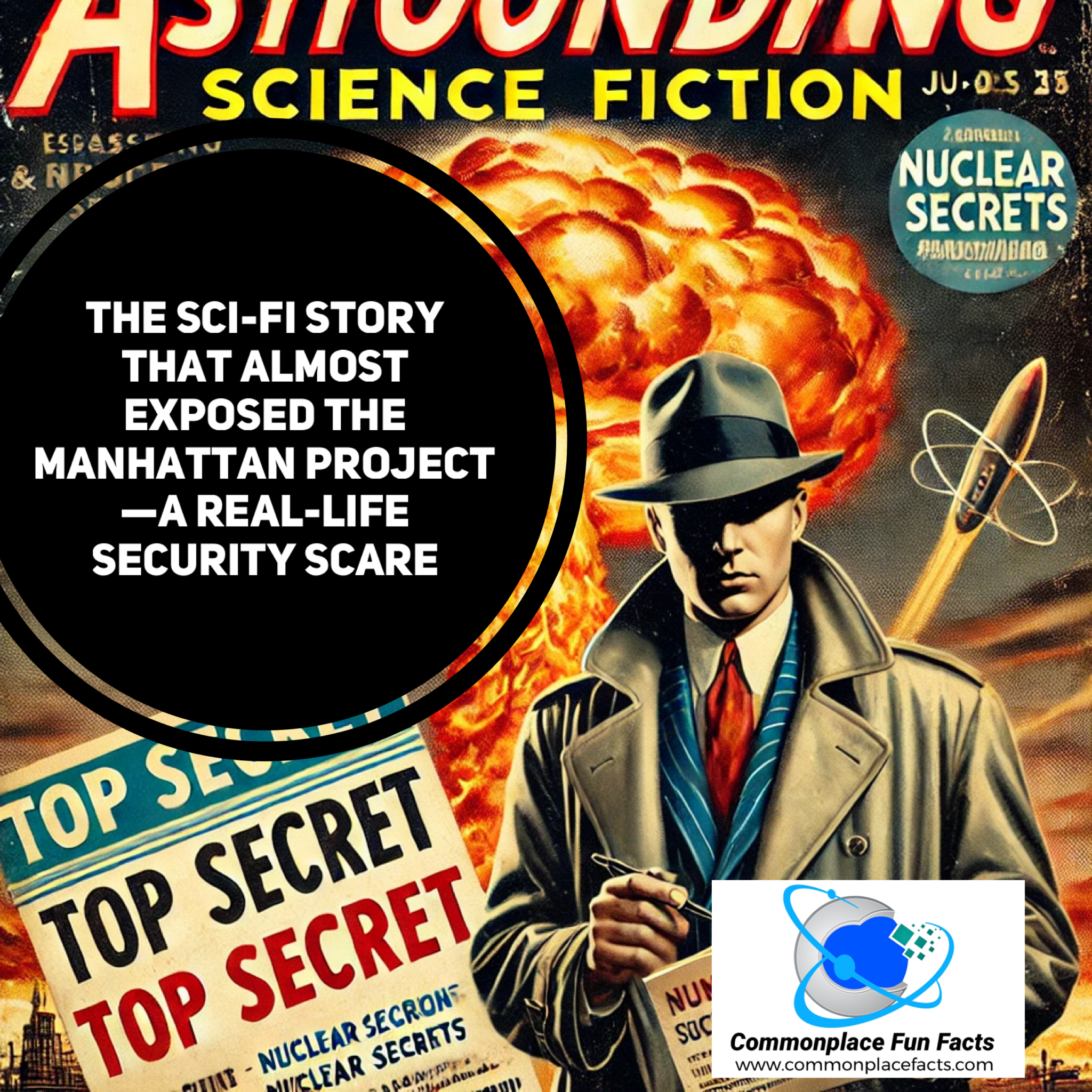

One Little Sci-Fi Magazine — A Whole Lot of Panic
In March 1944, the scientists working on the Manhattan Project at Los Alamos, New Mexico, had a lot on their plates. They were, after all, in the middle of developing the most devastating weapon ever conceived. Naturally, they needed a little downtime. Some took to playing chess, others went for walks, and a few cracked open the latest issue of Astounding Science Fiction magazine.
Little did they know that this innocent pastime was about to cause a full-blown security crisis.
Contents
The Fictional Bomb That Hit a Little Too Close to Home
Featured in that issue was a short story called “Deadline,” written by Cleve Cartmill. The story was set on the planet Karthor—a barely disguised stand-in for Earth—and followed a secret agent named Ybor on a mission to assassinate Dr. Citric, a scientist who had developed a doomsday weapon capable of obliterating entire continents.
“Have you heard of U-235? It’s an isotope of uranium…. they are not all that sure that once started, it would stop before all of it has been consumed in something like a micro-microsecond of time.”
— from “Deadline”
At first glance, it seemed like just another pulpy wartime sci-fi tale. But then Ybor started describing the weapon:
“Have you heard of U-235? It’s an isotope of uranium. They got it out of uranium ores by new atomic isotope separation methods. Now they have quantities measured in pounds. But they have not brought the whole amount together… because they are not all that sure that once started, it would stop before all of it has been consumed in something like a micro-microsecond of time.”
At this point, the scientists at Los Alamos exchanged nervous glances. Because this was not just science fiction. It was exactly what they were working on—the Manhattan Project, the ultra-top-secret program to build the world’s first atomic bomb.
Cartmill’s story described, with eerie accuracy, the fundamental principles of atomic bomb detonation, uranium isotope separation, and even the risks of setting off an uncontrollable chain reaction that could theoretically destroy the planet.
The most unsettling part? As far as anyone knew, Cartmill didn’t have clearance to any classified information.
A Security Nightmare for the Manhattan Project
Within hours, alarms were ringing across the Manhattan Project’s intelligence division. Captain B.W. Menck, head of the project’s security and counterintelligence division, dispatched an agent to investigate.

The first stop: John W. Campbell, the editor of Astounding Science Fiction.
Campbell, described in intelligence reports as an “egotist” (which is spy-speak for “a real piece of work”), claimed full credit for the technical details in “Deadline.” He insisted that he had provided Cartmill with everything he needed to know, using nothing more than publicly available sources and his own scientific background.
Investigators weren’t convinced.
Next on their list was Edgar R. Norton, a technician at Bell Laboratories, who had been seen having lunch with Campbell. Then they zeroed in on science fiction writer Will Jenkins, whose previous work had been flagged for containing “too much sensitive technical information.” Then they dug into his connections—because apparently, every sci-fi writer in America knew each other—and soon, the net widened to include heavyweights like Isaac Asimov and Robert Heinlein.
At this point, the investigation had less in common with a serious national security probe and more with a bizarre conspiracy board, complete with red string connecting sci-fi nerds.
A Wild Goose Chase While the Real Spies Watched
After exhaustive digging, surveillance, and even interrogations of Cartmill’s mailman, investigators found nothing to suggest that “Deadline” was the result of an actual security leak.
Cartmill, when questioned, claimed that he’d pieced together his bomb design from open-source physics books and his own experience working with radioactive materials. Eventually, even intelligence officers had to admit that the details in “Deadline”—while impressively accurate—were just educated guesses.
The panic prompted … an extreme solution: banning all science fiction publications for the rest of the war
Still, the panic prompted Colonel W.B. Parsons of the Manhattan Project’s Oak Ridge office to propose an extreme solution: banning all science fiction publications for the rest of the war. He even suggested revoking their mailing privileges, essentially making it illegal to distribute them.
His reasoning? If a sci-fi writer could connect the dots and figure out how an atomic bomb worked, then surely, enemy spies could do the same. More alarmingly, he worried that Manhattan Project workers—who were deliberately kept in the dark about the bigger picture—might also read these stories and realize what they were really building.
Campbell, for his part, agreed to suppress the Swedish edition of Astounding Science Fiction to prevent the Germans from getting their hands on it. But the idea of banning all sci-fi publications? That didn’t happen.
Ironically, while intelligence agencies were busy tracking down a bunch of nerds who just wanted to write about space battles, actual spies were leaking atomic secrets to the Soviet Union the entire time.
The Real Security Breach Wasn’t in Astounding Science Fiction
As history would soon reveal, the biggest threats to Manhattan Project security weren’t coming from magazine stands—they were coming from inside the operation.
Klaus Fuchs, a theoretical physicist working on the bomb, was actively passing information to the Soviet Union. He wasn’t alone. The Soviet spy network included chemist Harry Gold, machinist David Greenglass, and his now-infamous sister Ethel Rosenberg and her husband, Julius. Their espionage efforts led to the Soviets testing their own atomic bomb in 1949—five years ahead of American predictions.
But that wasn’t even the only accidental leak.
In 1945, an unrelated company, Kodak, started receiving complaints from customers about unexplained fogging in their photographic film. After some detective work, a Kodak scientist discovered that the film had been contaminated by fallout from the first atomic bomb test at Trinity. In other words, a film developer in Rochester, New York, accidentally discovered the Manhattan Project’s existence before the public even knew atomic bombs were real.
This all took place on the heels of a massive investigation to determine if details of the top secret D-Day invasion had been leaked through a series of crossword puzzles. Needless to say, this was not the most trusting of times.
When Science Fiction Becomes Reality
In the end, Cleve Cartmill’s Deadline didn’t lead to a major security breach, but it did highlight just how close science fiction can come to reality—sometimes uncomfortably close.
It also serves as a reminder that, for all of our attempts at secrecy, the truth has a funny way of slipping through the cracks. Whether through a dedicated Soviet spy ring or a science fiction writer armed with a physics textbook, it was only a matter of time before the atomic age became public knowledge.
And perhaps most importantly, this story proves that sometimes the only difference between science fiction and reality is the passage of time.
You may also enjoy…

Project Sundial: The Doomsday Bomb That Could Have Wiped Out Humanity
Discover the chilling story of Project Sundial, a 1950s U.S. plan to build a nuclear bomb so powerful it could destroy humanity. Learn why it never happened and its lasting legacy on global security.

The Secret Disaster That Saved D-Day
Everyone knew the outcome of the war would be settled in Europe. For that to happen, it would require an invasion of unprecedented force. Over 7,000 ships and landing craft would have to transport nearly 200,000 men across the English Channel to storm the beaches of France. Although only a handful of people knew the…

D-Day Shrapnel Makes Up 4% of the Sand on Omaha Beach
Despite all the years that have passed since the invasion, the D-Day shrapnel still composes as much as 4% of the sand on the D-Day beaches.


Leave a Reply