
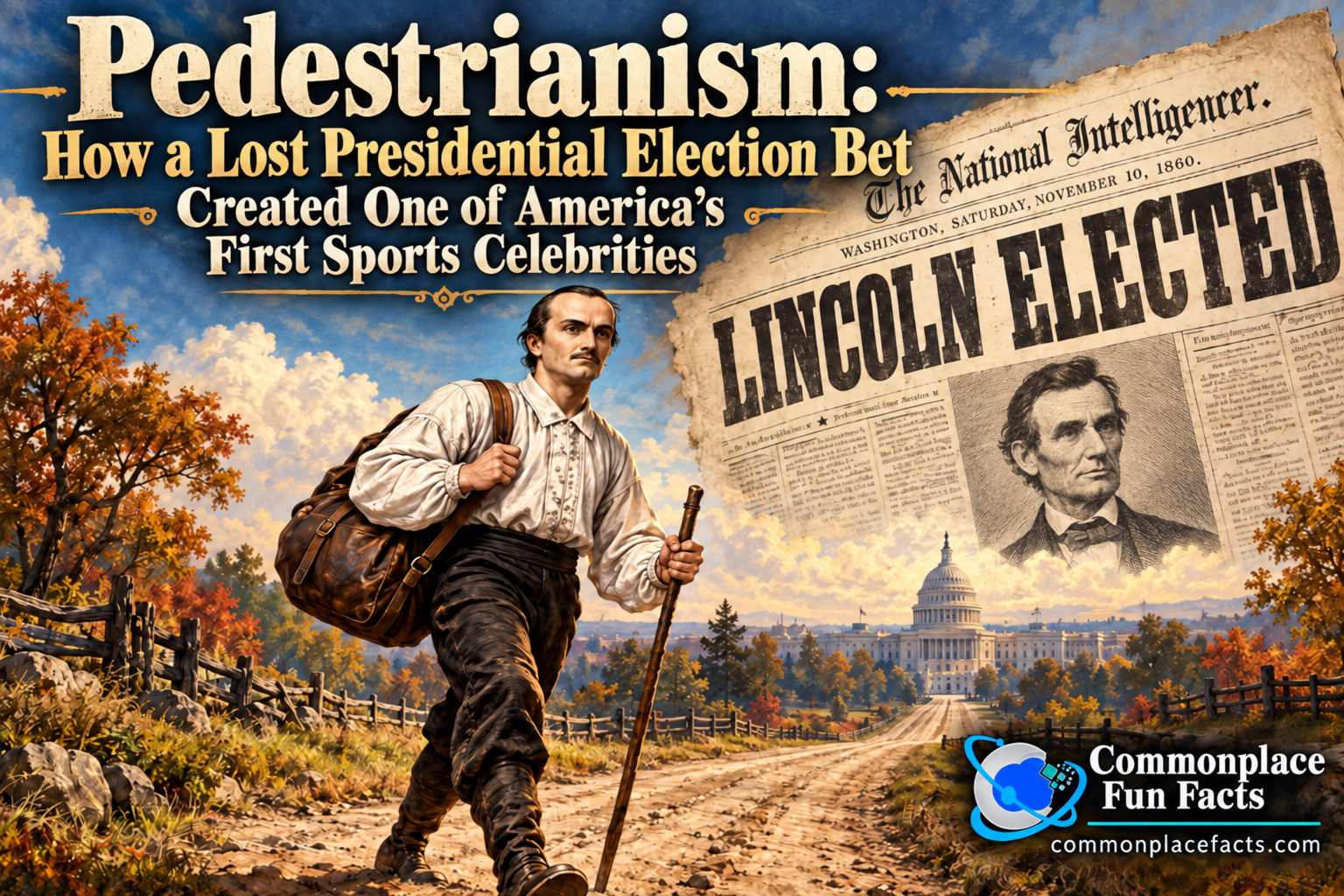

In 1860, Edward Payson Weston made the sort of political wager that should have resulted in nothing worse than wounded pride and perhaps buying somebody dinner.
Instead, it helped launch a sporting career.
Weston bet that Abraham Lincoln would lose the presidential election to Stephen A. Douglas. If Lincoln won, Weston agreed to walk from Boston to Washington, D.C., in time for the inauguration.
Lincoln won.
Weston started walking.
What followed was supposed to be payment of a bet. Instead, crowds gathered to watch him pass, newspapers tracked his progress, and Weston discovered something unexpected: people were willing to treat long-distance walking as entertainment.
Over the next several decades, that discovery helped make “pedestrianism” one of America’s first major spectator sports. Professional walkers competed for prize money before thousands of spectators. Newspapers covered their races. Gamblers wagered on them. Successful pedestrians became celebrities, appeared in advertising, endorsed products, and cultivated rivalries.
Yes, there was once a period in American history when paying admission to watch someone walk around a track for six days sounded like a perfectly reasonable evening out.
Contents
The Election Bet That Started It All
Edward Payson Weston was born in Providence, Rhode Island, in 1839 and grew up in an era when walking was less a fitness activity than something people did because nobody had yet invented Uber.

His path toward celebrity began with the presidential election of 1860.
According to a detailed history of pedestrianism published by Smithsonian, Weston wagered that Abraham Lincoln would lose the election. If Lincoln won, Weston promised to walk approximately 478 miles from Boston to Washington in under ten days and arrive in time for the inauguration.
This was not the sort of wager one made if one had carefully studied the Electoral College map.
Lincoln won decisively.
Weston left Boston on February 22, 1861, and headed south on foot.
The journey immediately began attracting attention. Weston had announced his route in newspapers, and people gathered along the way to see whether the young man who had backed the wrong presidential candidate would actually make good on his promise.
He did make it to Washington.
He did not make it in time.
Weston arrived in Washington on March 4, four hours and 12 minutes after the deadline he had set for himself—and after Lincoln’s inauguration had already taken place. Smithsonian notes that a run-in with a debt collector along the way helped cost him the time he needed to make his deadline.
There are many ways to lose an election bet. Being detained over unpaid debts somewhere between Boston and Washington is one of the more thorough approaches.
Lincoln Was Apparently Following Along
By the time Weston reached Washington, his private wager had become public entertainment.
According to contemporary accounts later summarized by Smithsonian, Abraham Lincoln himself had followed Weston’s progress. The newly inaugurated president reportedly offered to pay Weston’s fare home.
Weston declined.
That refusal turned out to be a very good career decision.
The walk had made him famous. Newspapers had followed him. Crowds had turned out to watch him. People suddenly knew the name Edward Payson Weston.
For a man who had just failed to arrive on time, things were going remarkably well.
The inauguration itself was already surrounded by enough peculiar history. As noted in our collection of strange presidential inauguration facts, Lincoln delivered his first inaugural address while his defeated rival Stephen Douglas stood nearby and even held Lincoln’s hat for part of the ceremony.
Somewhere outside the main event, the man who had wagered against Lincoln was discovering that walking toward the president could be more profitable than betting against him.
From Losing a Bet to Becoming a Professional Pedestrian
Weston was not content to let newspapers tell the story for him. In 1862, he published The Pedestrian: Being a Correct Journal of “Incidents” on a Walk from the State House, Boston, Mass., to the U.S. Capitol, at Washington, D.C., his own account of the journey that had unexpectedly made him famous. The book chronicled his February 22–March 4, 1861 trek and preserved many of the incidents surrounding the attempt. Weston even acknowledged that literature might not be his strongest event, asking readers to overlook the book’s imperfections on the grounds that “the author can walk better than he can write.” Considering what happened next, he had chosen the more lucrative of the two talents.
After the Civil War, Weston began turning walking into a profession.

In 1867, he walked from Portland, Maine, to Chicago, covering approximately 1,200 miles in 26 walking days, with Sundays excluded, and finishing within the time allowed by the challenge. By the time he reached Chicago, Weston had become one of the best-known endurance athletes in the country.
His performances were no longer merely long trips from one city to another. They became organized spectacles.
Audiences paid admission. Promoters advertised the events. Newspapers published updates. Spectators placed bets on whether Weston would complete the advertised distance within the allotted time.
These exhibitions helped ignite the American boom in the sport generally known as pedestrianism. Competitive walking had much older roots in Britain, but Weston became one of the figures who transformed it into a major American spectacle.
The name sounds as though it describes people moving rather cautiously through a shopping mall. In the late nineteenth century, however, pedestrians were serious endurance athletes who pushed themselves to extremes that would make many modern ultramarathoners reconsider their recreational choices.
Walking Becomes a Spectator Sport
Pedestrian contests took several forms.
Some were point-to-point endurance walks. Others required competitors to cover a specific distance within a set time. Pedestrianism included both “heel-and-toe” events, which required a walking gait, and “go-as-you-please” races, which allowed competitors to walk, jog, or run. The most spectacular multiday contests kept athletes circling indoor tracks for days, resting strategically and trying to accumulate more miles than their rivals.
Six-day races became particularly popular.
The reason for six days rather than seven was conveniently biblical: Sunday presented difficulties in societies where public sporting events on the Sabbath could provoke considerable opposition. The solution was to begin early in the week, walk nearly continuously for six days, and stop before religious objections interfered with ticket sales.
Large indoor arenas hosted the events. Spectators came and went throughout the day and night. Bands played. Vendors sold food. Gambling flourished. Newspapers posted mileage totals.
The walkers kept circling.
It was part athletic contest, part carnival, part endurance experiment, and part opportunity to watch someone gradually reconsider every decision that had brought him to lap 1,742.
Edward Weston Gets a Rival
Weston’s dominance inevitably produced competitors.
His most famous rival was Irish immigrant Daniel O’Leary, who became one of the great stars of pedestrianism. In 1875, O’Leary defeated Weston in a six-day race and acquired the title “Champion Pedestrian of the World.”

The rivalry helped transform professional walking from an individual exhibition into something closer to organized sport.
That mattered because sports become much easier to sell once spectators have somebody to root for and somebody else to hope develops a blister.
Promoters understood this perfectly. Weston and O’Leary could be marketed against one another. Their contrasting personalities and backgrounds added drama. Newspapers treated their encounters as major sporting events.
Before professional baseball had completely established its cultural dominance and decades before radio or television could create national sports audiences, pedestrianism offered something simple and highly marketable:
Two men. Two tracks. Six days. Whoever covered the most miles won.
Then the Sport Became Enormous
By the late 1870s and early 1880s, pedestrianism had become a genuine mass entertainment phenomenon.
One of the most important promoters was Sir John Astley, a British aristocrat and sportsman who sponsored international endurance competitions. His events helped bring together American and British pedestrians and elevated walking into a transatlantic sporting craze.

Thousands of spectators attended major races. Newspapers devoted substantial coverage to standings, injuries, strategies, and rivalries. Prize money grew.
Pedestrianism produced the basic machinery of modern professional sports long before anyone could watch instant replay.
There were celebrity athletes.
There were sponsors.
There were endorsements.
There was gambling.
There were scandals.
There were people arguing about whether competitors were cheating.
Human civilization had already achieved most of the necessary components of ESPN. It was merely waiting for electricity to catch up.
Frank Hart Walked His Way to a Fortune
One of pedestrianism’s most remarkable stars was Frank Hart, born Fred Hichborn in Haiti.
Hart became a protégé of Daniel O’Leary and rose to national prominence during an era in which Black athletes faced enormous racial barriers in most professional sports.

In 1880, Hart won a major six-day race and captured the O’Leary Belt. According to Smithsonian, his winnings exceeded $21,000.
That was a staggering amount of money in 1880, equivalent to hundreds of thousands of dollars today.
Hart’s success complicates the assumption that nineteenth-century American professional sports were uniformly closed to Black competitors. Pedestrianism certainly existed within the same racist society as everything else, but its loosely regulated structure sometimes created openings unavailable elsewhere.
If you could walk farther than everybody else, promoters had a financial incentive to put you on the track.
Capitalism occasionally discovers equality when there are enough tickets involved.
Women Became Pedestrian Celebrities Too
Women also entered the sport, despite contemporary medical warnings that strenuous physical activity was supposedly dangerous to female health.

Professional female walkers, commonly called “pedestriennes,” attracted enormous crowds.
One of the most famous was Ada Anderson, an English athlete whose endurance feats became sensations in Britain and the United States. Women undertook 100-mile walks, 24-hour events, six-day contests, and increasingly elaborate challenges designed to demonstrate just how much punishment the human body could tolerate before lodging a formal complaint.
Anderson once undertook a challenge requiring her to walk a quarter-mile during every consecutive quarter-hour for thousands of repetitions.
The feat was not merely athletic. It required repeatedly sleeping for only a few minutes before waking up and walking again.
Smithsonian notes that women’s pedestrian competitions could be particularly brutal. Competitors sometimes walked in hard-soled shoes because gamblers and saboteurs threw tacks, broken glass, and other objects onto tracks in hopes of affecting results.
Apparently simply watching exhausted women walk for days was insufficient entertainment. Somebody inevitably decided the sport needed caltrops.
Pedestrianism Had All the Problems of Modern Sports Too
Once enough money entered pedestrianism, many of the less charming features of professional athletics arrived right behind it.
Race fixing became a problem. Gambling interests attempted to manipulate results. Managers exploited competitors. Athletes used stimulants to remain awake and continue walking.
Some races became exercises in sleep deprivation more than ordinary athletic endurance.
The physical toll could be enormous. Competitors suffered swollen feet, exhaustion, digestive problems, hallucinations, and injuries. Yet spectators continued turning up because the suffering was part of the attraction.
There is something reassuring about discovering that nineteenth-century sports fans were not fundamentally different from modern ones.
They simply had fewer screens and more sawdust.
Weston Turned His Feet Into a Brand
Edward Payson Weston did not merely walk.
He monetized walking.

One such method can be seen in an 1889 trademark registration for a product called “Weston’s Foot-Cure”, advertised as a preparation for feet suffering from the consequences of walking, marching, or standing.
This is outstanding vertical integration.
First become famous for walking unreasonable distances. Then sell people something for the condition of their feet after they imitate you.
Modern influencers would recognize the business model instantly.
Weston also appeared on promotional materials, souvenir programs, photographs, and advertisements. The Library of Congress preserves a 1910 souvenir program devoted to Weston and his walks, complete with photographs and accounts of his feats.
Long before athletes built brands on social media, Weston had figured out that athletic fame could sell almost anything—including relief from the activity that made him famous.
He Kept Walking Long After Most People Would Have Stopped
Weston’s career becomes increasingly unreasonable when his age is considered.
In 1907, when he was approaching 70, he repeated his old Portland-to-Chicago route and actually improved upon his time from four decades earlier.

Then, in 1909, at age 70, Weston set out from New York for San Francisco.
Weston had hoped to cover the transcontinental route in 100 days. He ultimately walked approximately 3,895 miles and reached San Francisco in 104 days.
At an age when many people begin evaluating whether a restaurant is too far from the parking lot, Weston walked across the United States.
He was not finished.
In 1913, at age 74, he walked 1,546 miles from New York to Minneapolis in 51 days.
By then automobiles were increasingly common, aviation was developing rapidly, and modern transportation was beginning to shrink the country.
Weston responded by continuing to walk across it.
So Why Did Pedestrianism Disappear?
The sport’s decline had several causes.
Its novelty faded. Scandals involving gambling and race fixing hurt its reputation. Bicycle racing offered spectators greater speed. Baseball continued expanding into America’s dominant professional sport. Boxing drew huge crowds. New forms of entertainment competed for attention.
Walking gradually returned to being something people did primarily to get somewhere.
Pedestrianism never disappeared completely, however. Race walking remains an Olympic sport. Ultramarathons, endurance hikes, and long-distance walking challenges continue attracting competitors who apparently believe ordinary marathons end suspiciously early.
The modern fascination with endurance therefore has recognizable nineteenth-century ancestors.
We have changed the shoes.
We have improved nutrition.
We have invented GPS watches.
We have not entirely cured the human desire to see what happens if someone keeps going long after common sense has suggested otherwise.
The Presidential Connection Is Fitting
There is something particularly appropriate about Abraham Lincoln accidentally helping to launch Weston’s career.
Lincoln himself accumulated a surprising collection of odd footnotes outside the great events for which he is remembered. He was the author of a published murder mystery, became the only U.S. president to receive a patent, and even acquired his famous beard after corresponding with an 11-year-old girl named Grace Bedell.
After his death, Lincoln continued accumulating improbable stories, including the bizarre history of his remains being reinterred seventeen times.
Helping create professional pedestrianism merely by winning an election fits rather neatly into the collection.
Weston’s Final Years Were Less Triumphant
Edward Payson Weston lived until 1929.
His final years carried an unfortunate irony. A contemporary United Press obituary reported that the man once celebrated for walking extraordinary distances ultimately lost much of his mobility and spent his final period in a wheelchair.
He died at age 90.
By then the sporting world that had made him famous had largely vanished. Baseball stadiums filled with crowds. Boxing champions became national celebrities. Radio was beginning to turn local contests into shared national events.
The era when tens of thousands of people could become excited about someone walking in circles for nearly a week had receded into memory.
Which may say less about nineteenth-century audiences than we would like to believe.
After all, modern viewers routinely watch golf.
The Forgotten Sport That Looked Surprisingly Modern
Pedestrianism feels bizarre today because walking seems too ordinary to be a spectator sport.
But almost everything surrounding it looks remarkably familiar.

Celebrity athletes cultivated public personas. Promoters sold tickets. Newspapers covered rivalries. Sponsors attached their names to competitors. Fans chose favorites. Gamblers studied statistics. Athletes endorsed products. Scandals erupted over cheating and performance enhancement.
The only thing missing was a television contract.
And it all traces, at least in part, back to a young man who confidently predicted that Abraham Lincoln would lose an election.
Weston lost the bet.
He missed the inauguration.
He became famous anyway.
Sometimes history rewards being right.
Every now and then, it pays considerably better to be spectacularly wrong.
You may also enjoy…

Eukonkanto — the Sport of Wife Carrying
Have you heard of the extreme sport of wife carrying? Find out about Eukonkanto in this informative article.

How Lincoln’s Beard Led to One of the Best-Selling Board Games
In 1860, Milton Bradley initially profited from selling lithographs of a clean-shaven Abraham Lincoln but faced financial ruin when Lincoln grew a beard. Learn how Lincoln’s beard prompted Bradley to create “The Checkered Game of Life,” a successful board game that eventually led to the founding of the Milton Bradley Company, shaping family entertainment.

Explore the Action-Packed and Wrinkle-Free World of Extreme Ironing
What do you do if you are an adrenaline junkie and you find such things are ironing your clothes far too mundane for your frenetic lifestyle? Why not combine them and take a shot at earning immortality as a champion in the sport of Extreme Ironing? Extreme ironing involves ironing clothes in locations that are…


Leave a Reply