
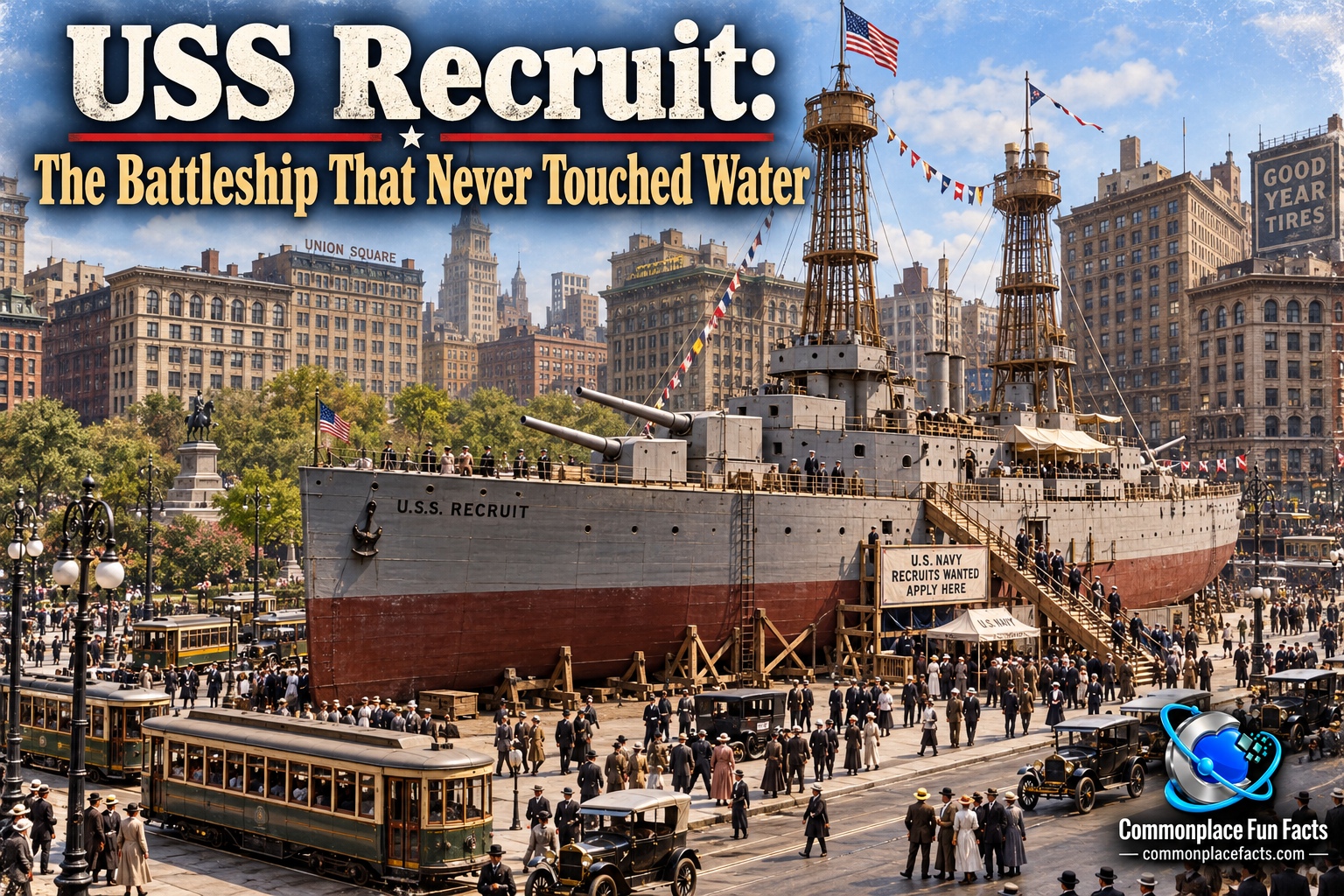

On May 30, 1917, the United States Navy welcomed a new battleship into service. It had gun turrets, towering masts, a smokestack, a uniformed crew, and enough military hardware to make a passing German submarine reconsider its career choices.
There was just one small problem.
The battleship was sitting in the middle of Manhattan.
Not in the Hudson River. Not in New York Harbor. Not even in an unusually ambitious bathtub. The vessel occupied a substantial portion of Union Square, surrounded by sidewalks, office buildings, streetcars, and New Yorkers who had presumably grown accustomed to seeing strange things but were not expecting a battleship.
Its name was the USS Recruit, and although it would serve the Navy for nearly three years, entertain thousands of visitors, and receive credit for helping enlist approximately 25,000 sailors, it would never travel a single nautical mile.
Its engines were nonexistent. Its enormous guns were wooden. Its chances of encountering an enemy submarine were reassuringly low.
And yet, by the standards of the mission it was assigned, the USS Recruit may have been one of the more successful battleships of World War I.
Contents
America Enters World War I and New York Has a Recruiting Problem
On April 6, 1917, the United States entered World War I, joining a conflict that had already consumed much of Europe for nearly three years. The country suddenly faced the monumental task of transforming its relatively small peacetime military into a force capable of fighting an industrialized war overseas.
The Army would eventually receive a substantial boost from conscription. The Navy and Marine Corps, however, depended on volunteers to fill their expanding ranks.
This created an embarrassing situation for New York City.
New York had been assigned a recruiting goal of 2,000 men. Unfortunately, only about 900 had volunteered.
For a city that considered itself the commercial capital of the nation, failing to produce enough sailors was not particularly flattering. New York had millions of residents, an enormous waterfront, and a perfectly respectable maritime tradition. Apparently, what it lacked was sufficient enthusiasm for signing up to spend an uncertain amount of time aboard a warship while people in Europe were busily demonstrating the dangers of doing so.
Mayor John Purroy Mitchel decided something needed to be done.
Mitchel and his Mayor’s Committee on National Defense began looking for ways to make naval service more appealing. Among the committee’s members was businessman James Gillespie Blaine Ewing, who helped develop an idea that was either an inspired publicity campaign or evidence that somebody had misunderstood the phrase “bring the Navy to New York.”
They would build a battleship.
In a park.
As Ewing subsequently explained, the project was advertising propaganda, pure and simple. The reasoning was straightforward: if young men were reluctant to visit a Navy recruiting office, perhaps they would be more interested in visiting an enormous battleship, especially one conveniently located near public transportation.
It was an advertising strategy that could not be accused of lacking ambition: if prospective sailors wouldn’t come to the Navy, the Navy would come to them.
Building a Battleship Without the Inconvenience of Water
Construction began in Union Square in the spring of 1917. Architect Donn Barber and artist Jules Guérin designed the extraordinary structure to resemble an American battleship, drawing inspiration from contemporary naval architecture and possibly the earlier USS Maine (BB-10), a pre-dreadnought battleship. Historical accuracy was clearly important to the designers, although making the finished product seaworthy was apparently somewhat lower on their list of priorities.
The result was an impressive imitation of a modern warship, constructed primarily from wood and canvas.

Published accounts disagree about its precise length. The U.S. Naval Institute describes a vessel approximately 250 feet long, while The Mariners’ Museum and Park gives a length of 200 feet. Both describe a beam of approximately 40 feet. Whatever the precise measurement, this was not the sort of structure someone could mistake for a modest garden shed.
The Recruit featured three twin-gun turrets carrying six replicas of 14-inch naval guns. Ten additional wooden 5-inch guns occupied positions along the sides of the vessel. Two towering cage masts rose above the deck, accompanied by a conning tower and a smokestack that looked imposing despite having no actual smoke to contribute.
The wooden 14-inch guns were especially impressive, although their military usefulness was limited by the fact that they were, well, wood.
Presumably, if a German battleship had appeared on Broadway, the crew would have been forced to resort to strongly worded objections.
Not everything aboard was imitation, however. The Recruit had actual communications equipment, navigational instruments, searchlights, and smaller weapons used for demonstrations. It also contained recruiting offices, medical examination rooms, showers, officers’ accommodations, and facilities for the sailors assigned to operate it.
There was even a heating system supplied by natural gas from the city’s utility network, giving the vessel a distinction that considerably more seaworthy battleships could not claim. The Recruit was connected to the local gas supply rather than dependent on a shipboard furnace.
According to research published by The Mariners’ Museum, the project’s original estimated cost of approximately $10,000 ultimately grew to something closer to $22,000. Much of the construction was funded through private donations, discounted materials, and contributed labor.
Some New Yorkers complained that the money could be put to better use elsewhere in the war effort. Although construction was financed through private donations, donated labor, and discounted materials rather than Navy appropriations, critics questioned whether such resources should be devoted to building a battleship that would never leave the park. It was a reasonable objection, especially when the alternative was helping supply an actual war effort instead of constructing a remarkably convincing imitation of one.
The committee maintained that the structure would pay for itself by generating enlistments.
As it turned out, that argument had considerable merit.
May 30, 1917: A Battleship Joins the Navy in Union Square
On May 30, 1917, the finished battleship was formally christened in front of an enormous crowd.

Mayor Mitchel’s wife, Olive, performed the christening honors. The mayor then presented the vessel to the Navy, which accepted the unusual addition to its New York recruiting operations.
Contemporary newspapers frequently described the ceremony as the commissioning of the USS Recruit. There is, however, an interesting technical qualification. The U.S. Naval Institute notes that definitive Navy documentation establishing formal commissioning has proved elusive.
In other words, the Recruit was unquestionably operated by the Navy, staffed with actual sailors, and treated ceremonially like a naval vessel. Whether it technically possessed the formal commissioned status assigned to conventional warships is less certain.
This is the sort of distinction that historians appreciate and naval bureaucrats probably lose sleep over.
The public, meanwhile, was considerably less concerned with the paperwork. New Yorkers had a battleship in their park, and they intended to enjoy it.
The surviving photographs preserved by the Library of Congress show the remarkable sight: a large naval vessel rising from the pavement, surrounded by ordinary city buildings and curious pedestrians.
It looked as though someone had accidentally delivered a battleship to the wrong address and the Navy had decided it would be more embarrassing to admit the mistake than to leave it there.
Life Aboard a Battleship That Never Sailed
The Navy did not treat the Recruit as an oversized playground. The sailors stationed aboard followed a routine intended to resemble actual shipboard life.
Reveille sounded at 6 a.m. The crew scrubbed the decks, polished equipment, attended instructional classes, practiced naval procedures, stood watch, and maintained the vessel in proper military condition.

Consider the psychological challenge of that assignment.
A sailor aboard an ordinary battleship might awaken in Norfolk, cross the Atlantic, and eventually encounter the enemy. A sailor aboard the Recruit awakened in Union Square, spent the day practicing naval procedures, and looked over the railing at essentially the same collection of buildings he had seen yesterday.
There was no rough weather, no salt spray, and no possibility of being ordered to steer around an iceberg.
There was, however, plenty of deck scrubbing.
Some traditions of naval life apparently remain sacred regardless of whether the ship can float.
The public was invited aboard for tours. Visitors could inspect the facilities, examine navigational instruments, talk with sailors, and gain some understanding of what life in the Navy involved. The recruiting station was staffed by people who could answer questions about service requirements and assist prospective volunteers.
At night, the ship became even more conspicuous. Powerful searchlights illuminated the surrounding skyline, while electric lights transformed the vessel into a dramatic feature of the Manhattan landscape.
There were also shipboard mascots. The Mariners’ Museum records a collection that included a rabbit, a Dalmatian puppy, a bird, and a goat named General Byng, whose disposition was reportedly less than ideal.
One imagines that a temperamental goat aboard a wooden battleship in a crowded city park presented administrative challenges not covered in the standard naval training manual.
Still, military mascots were hardly unusual during World War I. As we explored in our account of Tirpitz, the German pig who survived a sinking cruiser and joined the Royal Navy, wartime naval establishments demonstrated a surprisingly broad definition of acceptable animal personnel.
Compared with the British Navy’s adventures in porcine recruitment, the Recruit‘s goat was practically conventional.
The Battleship Becomes a Floating Entertainment Center, Minus the Floating
The USS Recruit was much more than a recruiting office disguised as a warship. It quickly became a major public attraction.
Its decks hosted patriotic rallies, Liberty Bond drives, speeches, concerts, dances, boxing matches, and theatrical performances. Naval musicians entertained the public, while visitors attended receptions and community events.

There were vaudeville performances, musical productions, and appearances by entertainers. The ship’s musicians and performers helped transform the naval recruiting operation into a particularly elaborate form of show business.
The Army also recognized the potential of combining military service with show business. During World War I, Irving Berlin organized the soldier-performed revue Yip, Yip, Yaphank, which premiered in 1918. More than two decades later, he returned to the formula with This Is the Army, a World War II stage production that became a major Hollywood musical in 1943. We explored that entertaining intersection of military discipline and theatrical ambition in our history of This Is the Army. Apparently, military recruiters and Broadway producers had independently discovered that a catchy tune could accomplish things that a stern lecture could not.
The Recruit also served as a setting for the 1917 motion picture Over There, adding a brief cinematic career to its already unusual service record.
All this activity reflected an important reality of wartime recruiting. Asking young men to enlist was considerably easier when the conversation could begin with an enjoyable afternoon aboard a battleship rather than an intimidating visit to a government office.
It also helped translate a distant European war into something New Yorkers could see and experience. The conflict was no longer merely newspaper headlines, recruiting posters, and photographs of military operations overseas. A representation of the Navy’s war effort stood directly in the middle of one of America’s busiest cities.
The whole enterprise blended patriotism, public relations, education, entertainment, and military recruitment into one enormous wooden spectacle.
And then someone decided it needed camouflage.
The Navy Camouflages a Battleship That Everyone Can See
In July 1918, the USS Recruit underwent one of the most extraordinary transformations in its already unusual career.
Members of the Women’s Reserve Camouflage Corps, associated with the National League for Woman’s Service, arrived to repaint the vessel using a technique known as dazzle camouflage.
Traditional camouflage generally attempts to make an object blend into its surroundings. Dazzle camouflage worked on almost the opposite principle.
Developed during World War I and famously championed by British naval artist Norman Wilkinson, the technique employed sharply contrasting colors, irregular geometric shapes, and disruptive patterns. Its primary purpose was not necessarily to conceal a ship from enemy observers. Instead, it was intended to confuse them about the vessel’s size, direction, orientation, and speed.
In an age when submarine commanders depended heavily on visual observation and calculations to launch torpedo attacks, an incorrect estimate of a target’s course could be the difference between success and failure.
Thus, real ships at sea received startling patterns of stripes, blocks, and angular designs that made them resemble enormous floating experiments in modern art.
The Recruit, being a naval recruiting installation, received the same treatment.
This resulted in the unusual spectacle of camouflage being applied to a battleship that was permanently located in a city park and surrounded by buildings.
There was no need to conceal its direction of travel. Its direction of travel was nonexistent.
There was no possibility of deceiving a submarine captain about its speed. Its speed was zero, a figure that remained remarkably consistent throughout the war.
And if an enemy observer had somehow managed to lose sight of it, the observer could simply have asked a passing New Yorker for directions to Union Square.
Nevertheless, the camouflage served a genuine public-relations purpose. It demonstrated a modern naval technique and gave visitors another reason to pay attention to the Navy.
The Women Who Turned a Battleship into Modern Art
The painters responsible for the Recruit‘s transformation deserve particular attention.
The Women’s Reserve Camouflage Corps brought together women with artistic training who were learning to apply their abilities to military deception. Their work included creating disguises for equipment, experimenting with methods of concealment, and developing techniques for altering the appearance of military objects.
Camouflage historian Roy R. Behrens has documented this unusual episode in his research on the women who painted the USS Recruit. Contemporary newspaper reporting identifies 24 participating women and credits artist William Andrew Mackay with designing the camouflage scheme. The project combined artistic innovation, wartime service, and public spectacle, demonstrating that women artists were contributing to military camouflage at a time when their opportunities for direct military service remained limited. It also proved that nothing attracts attention quite like having two dozen uniformed women paint a battleship in the middle of Manhattan.

Members of the Women’s Reserve Camouflage Corps paint the USS Recruit in Union Square in 1918, applying dazzle camouflage intended to confuse enemy submarine commanders about a ship’s speed and direction. Considering that this particular battleship was permanently stationed in the middle of Manhattan, determining its speed should not have presented an especially difficult challenge. Photograph: National Archives, The Unwritten Record.
Wearing khaki uniforms, the women climbed ladders and scaffolding, applying dramatic geometric patterns across the wooden hull. The resulting design incorporated contrasting colors that contemporary accounts variously described as including white, black, blue, green, and pink or mauve.
This was not a secret operation conducted in some remote military installation. It took place in full view of Manhattan pedestrians.
The National Archives preserves remarkable photographs of the women painting the USS Recruit, as well as images of their experiments with disguising military equipment and even themselves.
Some of their training involved blending into natural surroundings by masquerading as rocks or other landscape features. This sounds rather like a theatrical exercise until one remembers that concealment could mean survival on an actual battlefield.
In a scholarly study of women and World War I camouflage, Emily James examines how these public demonstrations combined military research, artistic innovation, and publicity. The women were performing technically demanding work, but their activities also provided an additional attraction for crowds.
There is a wonderful irony here.
At sea, dazzle camouflage was designed to confuse an enemy’s ability to understand what he was looking at. In Manhattan, the Navy applied it to a stationary battleship specifically to encourage people to look at it.
The camouflage could hardly make the Recruit less conspicuous.
But then, being conspicuous was the entire point.
Did the USS Recruit Really Enlist 25,000 Sailors?
The most frequently repeated statistic about the USS Recruit is that it helped enlist approximately 25,000 men into the United States Navy.
The figure appears in contemporary reporting and has been repeated by respected naval historians. The U.S. Naval Institute’s 2022 account credits the vessel with roughly that many recruits over its nearly three years of operation.
There is a qualification worth making. Although some historical accounts credit approximately 25,000 enlistments to the USS Recruit, the National Maritime Historical Society describes that figure as the number of sailors enlisted by the recruiting district. Precisely how many of those men enlisted directly aboard the wooden battleship is less certain. The vessel clearly contributed to the recruiting effort, but attributing every one of those 25,000 enlistments to a single stationary ship may give the Navy’s publicity department more credit than the surviving evidence warrants.
That distinction matters, although it does little to diminish the accomplishment.
The Recruit gave the Navy a highly visible presence in the heart of New York City. It attracted crowds, generated newspaper coverage, showcased naval life, and provided an easy way for potential recruits to make contact with the service.
Its initial purpose was to help solve New York’s shortage of volunteers. In that respect, the experiment appears to have been a considerable success.
It is difficult to imagine a conventional recruiting office producing the same publicity unless the building itself caught fire, and even then the resulting enlistment figures would probably be disappointing.
The Recruit had demonstrated something advertisers and military recruiters would continue to understand throughout the twentieth century: an unforgettable spectacle can be an extraordinarily effective way to communicate a message.
The message here was simple.
Join the Navy.
Preferably one of the ships that can actually move.
The War Ends, and the Battleship Prepares for Its First Voyage
On November 11, 1918, an armistice brought the fighting on the Western Front to an end. The formal peace settlements would take considerably longer, but Americans had good reason to celebrate. By then, real battleships had participated in a global conflict with far-reaching military and political consequences, while the USS Recruit had successfully defended Union Square against an enemy invasion that, fortunately, never materialized.
In Germany, sailors at Kiel had rebelled against orders for a final naval engagement, helping trigger a revolution that contributed to the collapse of the German Empire. That remarkable episode is examined in our article, “The 1918 Kiel Mutiny: The Revolt that Ended World War I.”
Meanwhile, the USS Recruit had successfully completed the war without firing its wooden main guns, dodging a torpedo, or inconveniencing the maritime insurance industry.
For a time, the Navy continued operating its Union Square recruiting station. Concerts, public appearances, and recruiting activities continued, although the wartime enthusiasm that had helped make the attraction successful gradually faded.
Eventually, city officials decided the battleship had occupied Union Square long enough.
But there was no reason to abandon such a successful publicity attraction entirely. The Navy had another location in mind.
Coney Island.
Specifically, the plan called for moving the Recruit to Luna Park, where the vessel could continue operating as a recruiting station while benefiting from the enormous crowds attracted to the amusement district.
This would require the battleship to undertake its first and only journey.
Unfortunately, the journey presented a logistical problem.
There was no practical way to sail the ship to Coney Island, largely because the vessel possessed neither a functioning hull nor the ability to float.
The Navy would have to dismantle it, transport the pieces, and rebuild it at the new location.
On March 16, 1920, the USS Recruit‘s crew assembled for a formal farewell ceremony. The colors and commissioned pennant were lowered, and the vessel’s career in Union Square came to an end.
The following day’s newspapers treated the event as the beginning of the ship’s voyage to Coney Island. The Recruit would finally be moving.
In pieces, admittedly, but moving.
The Voyage That Never Happened
Workers began dismantling the great wooden battleship, preparing to relocate it to Brooklyn.
And then the project encountered the sort of obstacle that has defeated ambitious plans throughout human history.
The cost estimates arrived.
According to the U.S. Naval Institute’s historical account, the proposed relocation was abandoned because moving and reconstructing the vessel would cost more than the structure was worth.
There is a familiar bureaucratic quality to this conclusion. After nearly three years of successful service, the Navy discovered that its battleship was more expensive to move than to abandon.
Consequently, the Recruit was never reconstructed at Coney Island.
The ultimate disposition of its materials has not been conclusively established. Some accounts suggest that the wood and other components were likely reused elsewhere, but a definitive record of where everything ended up has not emerged.
The ship simply disappeared from Union Square, leaving behind photographs, newspaper accounts, and the memories of New Yorkers who had once seen a battleship parked in the middle of their city.
After all that preparation, the USS Recruit had finally been scheduled to travel somewhere.
It didn’t make that trip, either.
Not Quite the Last Battleship to Remain on Dry Land
The USS Recruit was unusual, but the idea of training sailors aboard stationary mock ships did not disappear with its dismantling.

Later naval installations constructed landlocked training vessels to familiarize recruits with shipboard routines, equipment, and procedures before they went to sea.
Among the best-known was another USS Recruit, built at the Naval Training Center in San Diego in 1949. Constructed with a wooden framework covered in sheet metal and resting on a concrete foundation, this landlocked training vessel was designed to resemble a destroyer escort. Nicknamed USS Neversail, it taught generations of recruits the fundamentals of shipboard procedures, drills, and seamanship without requiring anyone to leave California. Unlike its Manhattan predecessor, the San Diego USS Recruit survives today as a historic landmark, proving that even a battleship can enjoy a lengthy career provided nobody insists that it actually float.
The National Maritime Historical Society has documented the history of these make-believe training ships, whose service proved that an ability to remain afloat is not always a prerequisite for performing useful naval work.
The original Manhattan Recruit, however, was something different. It was part training facility, part recruiting station, part architectural curiosity, and part public-relations spectacle.
It was a battleship that functioned as a gigantic advertisement for battleships.
The Battleship With No Sea Legs and No Naval Battles
Most naval histories measure a warship’s accomplishments in battles fought, miles traveled, enemy vessels sunk, and decorations earned. The USS Recruit offers a somewhat different set of statistics.
It never sailed into battle. It never encountered an enemy warship. It never crossed an ocean, navigated a harbor, or even experienced a particularly challenging wave.
Yet its influence extended far beyond Union Square.
Thousands of men were introduced to naval service because of it. Its publicity helped bring national attention to the Navy’s wartime recruiting efforts. Its decks hosted countless community events. And its transformation by women camouflage artists became part of the history of military art, public advertising, and women’s contributions to World War I.
There is also something endearing about the sheer absurdity of the enterprise. A city struggling to meet a recruiting quota built a battleship in a park, staffed it with real sailors, installed modern equipment, painted it in submarine-confusing camouflage, and then persuaded thousands of men to volunteer for a life at sea.
The ship was an imitation, but its work was real.
For comparison, we have previously explored the remarkable career of the USS O’Bannon, a genuine World War II destroyer whose legend includes an alleged attack on a Japanese submarine using potatoes. Naval history has never been entirely predictable about what qualifies as an effective weapon.
The Recruit needed neither torpedoes nor potatoes. Its most effective armament was an ingenious publicity campaign.
Nearly three years after its construction, the Navy’s strangest battleship completed its service with no combat casualties, no damage from enemy fire, and a recruiting record that would have been the envy of ordinary recruiting stations.
It was the rare battleship that could claim an entirely successful career without ever leaving its original parking space.
And when the Navy finally ordered it to set sail, the USS Recruit managed one last remarkable accomplishment.
It became a battleship whose proposed maiden voyage was canceled because moving it would cost more than the vessel was worth. Most warships are retired because they have grown too old, suffered too much damage, or become technologically obsolete. The USS Recruit achieved the same distinction because the Navy discovered that moving it to Brooklyn was simply too expensive.
You may also enjoy…

USS Barb: The World War II Submarine That Sank an Aircraft Carrier—and Blew Up a Train
Discover how USS Barb became one of WWII’s deadliest submarines, sinking ships, firing rockets, rescuing POWs, and even destroying a train.

USS William D Porter: The Navy’s Unluckiest Ship
Discover the strange story of the USS William D Porter — the unluckiest ship in the US Navy.

The 1918 Kiel Mutiny: The Revolt that Ended World War I
The 1918 Kiel Mutiny: how German sailors refused a suicidal naval order, sparked a revolution, toppled the Kaiser, and ended a world war — all before lunch.




Leave a Reply