
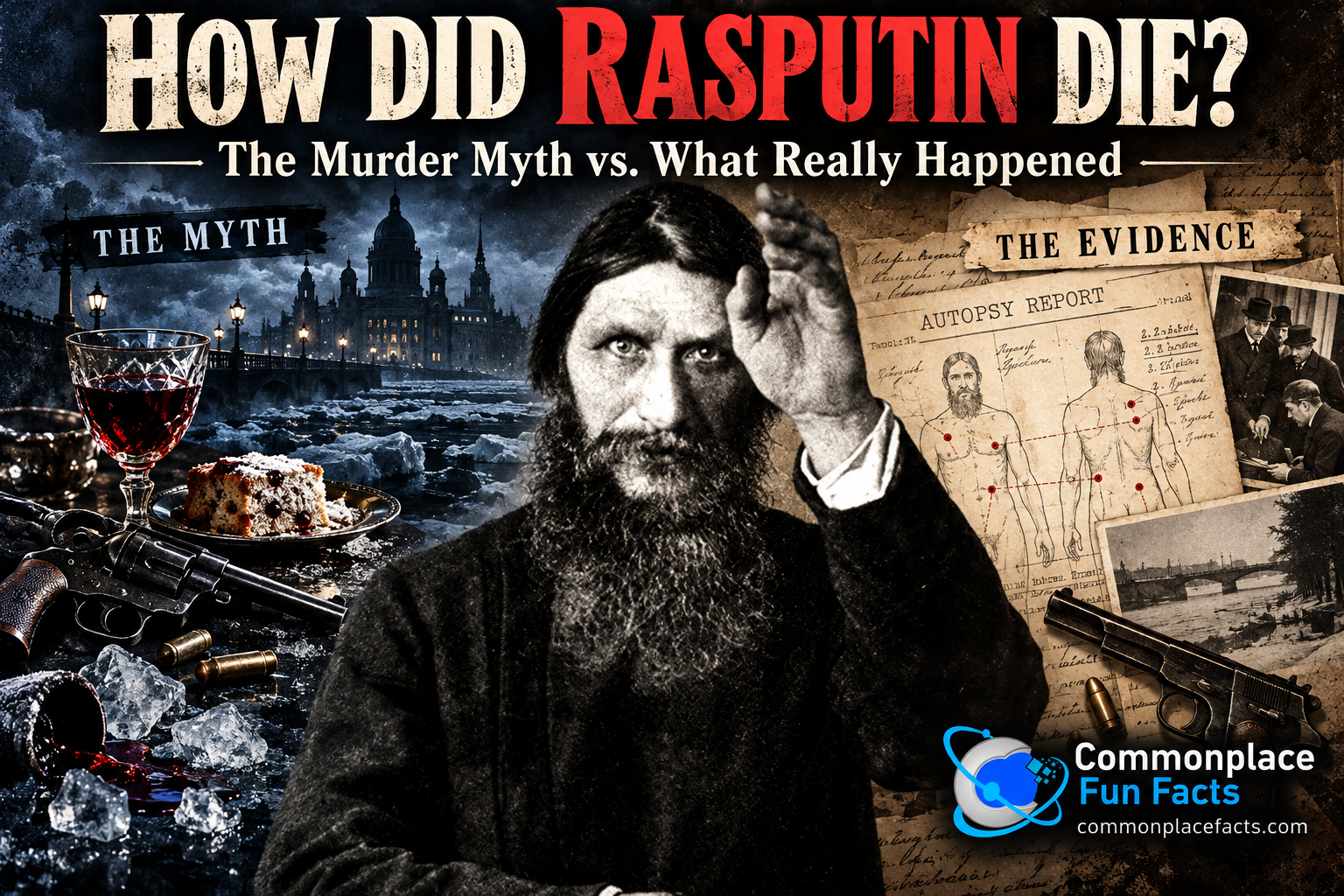

According to one of history’s most durable murder stories, Grigori Rasputin was poisoned with cyanide. It did not work. He was shot. That did not work either. He supposedly sprang back to life, attacked his assassins, was shot some more, beaten, bound, dumped through a hole in the ice, and finally drowned after making one last effort to escape.
As if that were not enough, another story claims that when Rasputin’s body was later burned, heat caused his tendons to contract and the corpse appeared to sit upright in the flames. Apparently even cremation had difficulty convincing Rasputin that the evening was over.
It is a magnificent story.
There is just one minor historical inconvenience: much of it probably did not happen. Answering the question “How did Rasputin die?” requires a bit more digging than what the popular story offers.
Table of Contents
Who Was Grigori Rasputin?
Grigori Rasputin was born into a Siberian peasant family in 1869 and eventually acquired a reputation as a religious mystic and healer. He is routinely called the “Mad Monk,” although he was not actually a monk. Accuracy has never been one of the nickname industry’s more burdensome requirements.
Rasputin’s rise to prominence was closely connected with Russia’s imperial family. Tsar Nicholas II and Empress Alexandra’s only son, Tsarevich Alexei, suffered from hemophilia, the hereditary blood-clotting disorder that had entered several European royal families through the descendants of Queen Victoria.

Alexei’s illness was far more than a private family concern. He was heir to the Russian throne, and relatively minor injuries could result in dangerous internal bleeding. Alexandra became convinced that Rasputin could somehow relieve her son’s suffering, giving the Siberian mystic extraordinary access to the imperial household.
That relationship is one reason Alexei appears in our look at illnesses that changed the course of history. A defective clotting gene did not cause the Russian Revolution, but it helped place one exceptionally controversial man alarmingly close to the center of imperial power.
Why Did Russian Aristocrats Want Rasputin Dead?
By World War I, Rasputin had become a political liability for the Romanovs. Rumors circulated about his personal behavior, his relationship with Alexandra, and his influence over appointments and government policy. Some accusations were exaggerated, others remain disputed, and a few appear to have been enthusiastically improved in the retelling.
None of that made him popular.
A group of Russian aristocrats concluded that removing Rasputin might save the monarchy from further embarrassment. Among the conspirators were Prince Felix Yusupov, Grand Duke Dmitri Pavlovich, and politician Vladimir Purishkevich. On the night of December 29–30, 1916—December 16–17 under the Russian calendar then in use—they lured Rasputin to Yusupov’s Moika Palace in Petrograd.
The Legendary Murder of Rasputin
The version of the murder that became famous owes a great deal to Yusupov’s later memoirs. According to his account, the conspirators served Rasputin cakes and wine laced with cyanide.
Rasputin ate and drank.
Nothing happened.
This was inconvenient, particularly since cyanide is traditionally expected to contribute rather decisively to an assassination.
Yusupov therefore shot Rasputin. Believing him dead, the conspirators left his body for a time. Then, according to Yusupov, Rasputin suddenly revived, grabbed him, and attempted to escape into the courtyard. Purishkevich fired several more shots. The conspirators eventually wrapped the body, transported it to the Little Nevka River, and dropped it through the ice.
From there the story became increasingly difficult to kill, which is appropriate considering its subject.
Did Rasputin Really Survive Cyanide Poisoning?
Probably not, because there is considerable reason to doubt that Rasputin consumed cyanide in the first place.
A modern forensic review published in Forensic Science, Medicine and Pathology examined the surviving evidence and concluded that the famous poisoning story is not supported by the autopsy evidence. No poison was reported at autopsy, and other details of Yusupov’s account do not match the physical evidence.
In other words, Rasputin’s apparent ability to consume a potentially lethal dose of cyanide without so much as asking for an antacid may have had a remarkably simple explanation: he probably did not consume a lethal dose of cyanide.
Was Rasputin Still Alive When He Was Thrown Into the River?
Another famous part of the legend says Rasputin was still alive when the conspirators threw him into the freezing river. Some versions even claim that his hands were partially freed when the body was recovered, suggesting that he struggled underwater before finally drowning.
The forensic evidence points in a much less cinematic direction.
The modern forensic analysis identifies a close-range gunshot wound to Rasputin’s forehead. The wound would have been immediately incapacitating and fatal. That means Rasputin was almost certainly dead before his body went into the river.
Smithsonian Magazine’s examination of Rasputin’s murder likewise notes the substantial differences between the surviving evidence and the spectacular story later told about the assassination.
So How Did Rasputin Actually Die?
The precise sequence of events can no longer be reconstructed with certainty, largely because the principal witnesses were also the men trying to explain why they had just murdered somebody.
That is not generally considered ideal laboratory conditions.
The available forensic evidence indicates that Rasputin suffered multiple gunshot wounds, including a close-range shot to the forehead that would have been fatal. His body was then wrapped and dumped into the Little Nevka River. The dramatic claims that poison failed, that Rasputin repeatedly rose from the dead, and that drowning finally accomplished what cyanide, bullets, and blunt-force trauma could not are not supported by the strongest surviving evidence.
Why Did the Rasputin Murder Myth Become So Famous?
Part of the answer is Felix Yusupov himself. His later descriptions transformed an assassination into something resembling a supernatural horror story. Instead of simply shooting an inconvenient political figure, the conspirators had supposedly confronted a nearly indestructible embodiment of evil.
It was a considerably more flattering way to describe the evening.
The legend also fit Rasputin’s existing reputation. Long before his death, newspapers and political enemies had portrayed him as sinister, sexually depraved, hypnotic, manipulative, or even demonic. Once someone has been assigned the role of mysterious evil sorcerer, “he was shot and died” seems disappointingly inadequate.
Popular culture enthusiastically helped. Rasputin became the subject of books, plays, movies, songs, and enough lurid retellings to ensure that the legend remained better known than the autopsy. One particularly important film was MGM’s 1932 Rasputin and the Empress, which also produced a famous lawsuit that helped explain why movies now insist that any resemblance to actual persons is purely coincidental.
Even Rasputin’s Corpse Acquired a Legend
Rasputin was initially buried near the imperial residence at Tsarskoye Selo. After the Russian Revolution began in 1917, his body was exhumed and burned.
Predictably, even that was not permitted to be ordinary.
A later story claimed that as the corpse burned, Rasputin appeared to sit upright in the flames. Heat can cause muscles and tendons in a corpse to contract, so the story acquired a conveniently scientific-sounding explanation. Reliable evidence that Rasputin actually performed one final posthumous sit-up, however, is another matter entirely.
By that point, facts were hardly necessary. Rasputin had become one of those historical figures around whom legends reproduce faster than historians can swat them.
The Real Rasputin Death Was Strange Enough
The truth does not require Rasputin to have been immune to cyanide, resistant to bullets, alive beneath the ice, or attempting to sit up during his own cremation.
He was a Siberian peasant mystic who gained extraordinary access to the last imperial family of Russia because the heir to the throne suffered from a secret and potentially fatal genetic disorder. His presence helped fuel public suspicion of an already troubled monarchy. A group of aristocrats decided the solution was murder, killed him inside a palace, dumped his body into a river, and then helped create a version of events in which their victim seemed practically supernatural.
Rasputin did not need to survive poison, bullets, beatings, and drowning to become legendary.
He merely needed his assassins to have good imaginations.
You may also enjoy…

Michael Malloy: The Man Who Wouldn’t Die (No, Seriously, He Just Wouldn’t)
Michael Malloy’s murder was supposed to be easy. Instead, the “man who wouldn’t die” drank poison, ate shrapnel, survived a hit-and-run, and became a legend. Here’s the true crime tale so strange, you’ll think it’s fiction.

Monica Meyer: The Strange Death of the Mayor Who Drowned in Raw Sewage
Discover the tragic and bizarre true story of Monica Meyer, the mayor who met a shocking fate in a sewage tank. A strange death but true political incident that still baffles today.

Michael Godwin: The Murderer Who Escaped the Electric Chair—Then Electrocuted Himself on a Toilet
Michael Godwin escaped South Carolina’s electric chair—only to accidentally electrocute himself while repairing headphones on a prison toilet.




Leave a Reply