

The Romans were not exactly shy about leaving things behind.
They left roads, aqueducts, temples, coins, mosaics, military forts, household utensils, legal documents, graffiti, tombstones, plumbing, tax records, shopping complexes, and enough statues to ensure that generations of schoolchildren would know exactly what a toga looked like.
They even left us complaints scratched onto walls.
What they apparently did not leave was a note explaining one of the strangest objects they ever made.
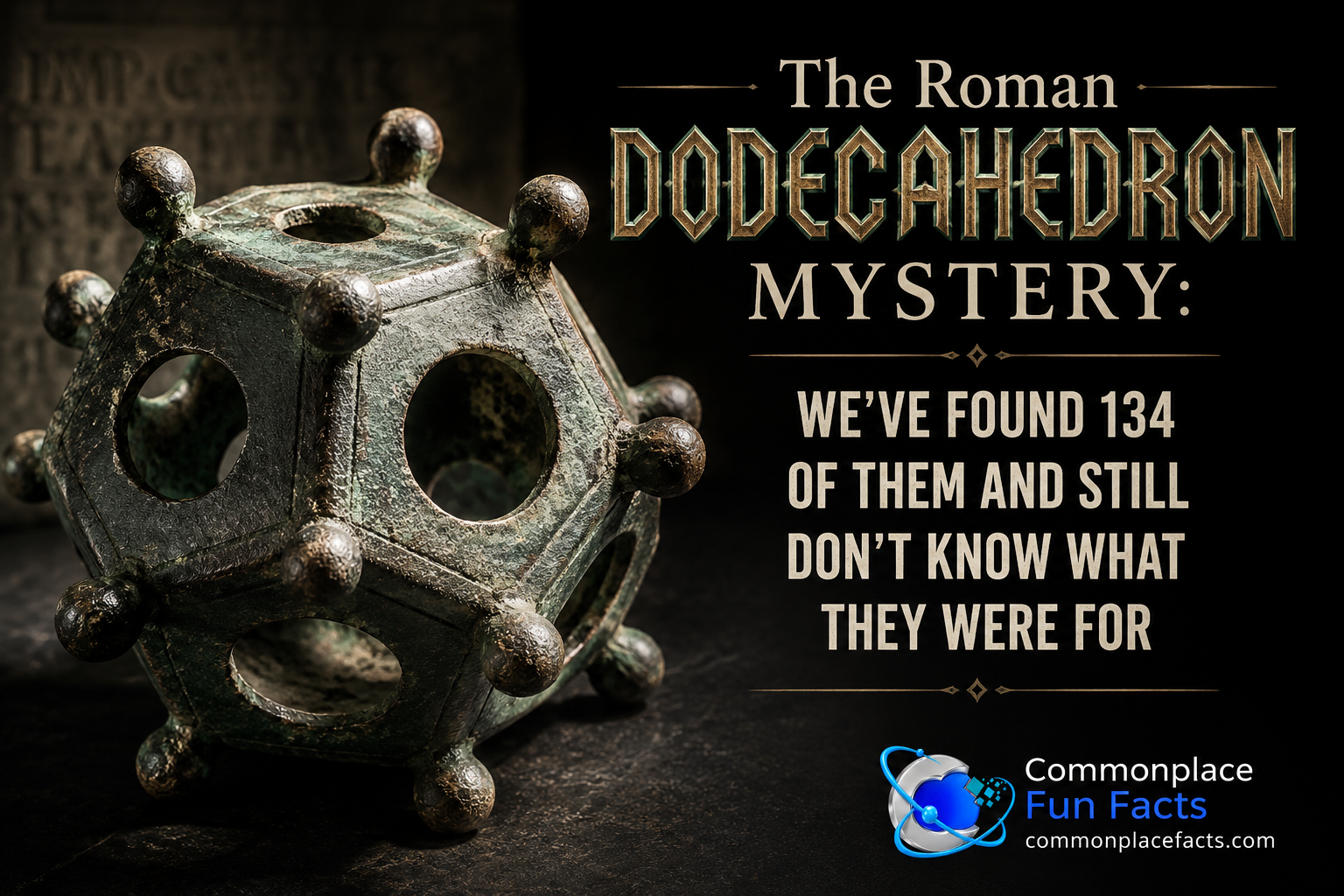
It is called the Roman dodecahedron, although “Gallo-Roman dodecahedron” is often more accurate. It is a small, hollow object generally made from copper alloy. It has 12 pentagonal faces, 20 corners, 30 edges, a round hole in the middle of every face, and a little knob sticking out from every corner.
Archaeologists have been finding them for nearly 300 years.
At last count, there were about 134 known examples.
And after nearly three centuries of staring at them, measuring them, excavating them, reproducing them, debating them, and occasionally attempting to knit with them, we still do not know what they were for.
Contents
A 1,700-Year-Old Thingamajig
The basic design is remarkably consistent. Each dodecahedron is a hollow, roughly spherical object constructed from 12 pentagons. Every pentagonal face has a circular opening in its center, but those openings are different sizes. Many are surrounded by engraved concentric circles.

At every one of the object’s 20 vertices is a small ball or knob, giving the whole thing the appearance of something halfway between a very complicated die and an accessory from an unusually demanding board game.
The objects generally date from around AD 200 through the late fourth century. They were made with considerable skill, usually from copper alloys such as bronze, and at least some were produced using lost-wax casting.
They were not standardized. Their dimensions vary. Their weights vary. Their hole sizes vary. Their decorative patterns vary.
One Romano-British example in the British Museum, found near Fishguard in Wales, is about 12.8 centimeters (5 inches) across and weighs 553 grams (about 1.2 pounds). Others are considerably smaller. The holes themselves can range from about 6 millimeters (just under 1/4 inch) to 4 centimeters (about 1.6 inches) across.
That variation is important, because an impressive percentage of the proposed explanations for the dodecahedron depend on it being a precision instrument.
This is somewhat inconvenient when the precision instruments refuse to agree with one another.
The Romans Left Us Everything Except the Instructions
The first known Roman dodecahedron was reported in 1739, when an example discovered at Aston in Hertfordshire was presented to the Society of Antiquaries of London.
That means scholars have had almost three centuries to figure this out.
The Romans have not been especially helpful.
No surviving Roman text has been identified that clearly describes one of these objects. No known inscription labels one. No ancient instruction manual helpfully says, “Roll three times to determine your attack strength against invading barbarian hordes.” Most remarkably, no securely identified Roman artwork shows anyone using one.
This is frustrating because the Roman world was quite capable of writing things down. We have documents about military supplies, land transactions, lawsuits, recipes, medicine, plumbing, agriculture, religion, astronomy, engineering, and interpersonal disputes of almost heroic pettiness.
Yet somewhere between “how to construct an aqueduct” and “who owes whom six denarii,” civilization apparently forgot to record what the bronze object covered in holes and knobs was supposed to do.
There Is Something Odd About Where They Turn Up
If this were an ordinary piece of Roman technology, we might expect to find examples scattered throughout the empire.

We do not.
Roman dodecahedra are overwhelmingly concentrated in the northwestern provinces of the Roman Empire: modern France, Belgium, Germany, the Netherlands, Britain, and nearby regions.
A detailed recent catalogue found roughly 70 percent of known specimens in the old Gallic and Germanic provinces and about 20 percent in Britain. Around 90 percent came from territory that, for a brief period in the third century, belonged to the breakaway Gallic Empire.
Perhaps the strangest geographical fact is where they have not been found.
As of the current catalogue, none has been discovered in Italy, the Roman heartland. They are also absent from Spain, North Africa, and the eastern provinces of the empire.
So we call them “Roman dodecahedra,” but apparently nobody thought Rome itself needed one.
This regional pattern has led scholars to suspect that the objects arose from the blending of Roman and Celtic cultures rather than from some standard piece of Roman equipment distributed throughout the empire.
Which brings us to the obvious question.
What did people in that part of the empire know that they neglected to tell us?
Everyone Has a Theory
If you spend enough time researching Roman dodecahedra, you eventually discover an important rule of historical mysteries:

When nobody knows what something was used for, everybody knows what it was used for.
Theories have included surveying instruments, rangefinders, astronomical calculators, calendars, candlesticks, dice, children’s toys, weapons, gauges, sizing devices, decorative objects, religious artifacts, fortune-telling devices, scepter heads, knitting tools, and probably several things that someone thought up five minutes after buying a 3D printer.
Some of these are more plausible than others.
The surveying theory, for example, proposes looking through pairs of differently sized holes to estimate distances or the dimensions of distant objects. It sounds impressively technical until you confront the problem that the dodecahedra are not manufactured to a common standard. A measuring instrument whose measurements change depending upon which instrument you bought has a fairly serious customer-service problem.
A scholarly analysis published as far back as 1970 concluded that the distance-measuring theory did not work convincingly.
Other researchers have proposed astronomical or agricultural calendars, perhaps using sunlight passing through the holes to identify important dates.
Again, there is an obvious difficulty: if the device depends upon geometry, hole size, and solar angles, one would expect considerably more standardization.
The Romans were many things, but they were probably not telling farmers, “Plant the barley when the sunlight hits the third hole, unless you borrowed Lucius’s dodecahedron, in which case all bets are off.”
But You Can Knit With It
One of the most popular modern theories is that the dodecahedron was some kind of knitting device.
People have made replicas and demonstrated that yarn can be wrapped around the corner knobs and worked through the openings to produce tubular knitted objects, including finger-shaped tubes that look suspiciously suitable for gloves.
This is genuinely clever.
It is not, however, the same thing as proving that Romans used dodecahedra to make gloves.
That distinction matters. Human beings are remarkably talented at finding unintended uses for objects. You can open a paint can with a screwdriver, scrape ice from a windshield with a credit card, and use a hardcover book to stabilize a wobbly table. None of this proves that screwdrivers were invented by paint manufacturers, credit cards originated in the automotive industry, or Gutenberg revolutionized printing because medieval furniture was badly leveled.
The knitting demonstration proves that a dodecahedron can be used for knitting. So far, no archaeological evidence proves that it was.
There is also the awkward matter of materials. Casting an elaborate bronze object required labor, fuel, metal, and considerable expertise. If your goal was simply to hold yarn in place, it seems reasonable to ask why you would choose one of the more technically demanding metal objects in the neighborhood.
The ancient world occasionally did things the hard way, of course. Civilization has not entirely recovered from that habit.
Could It Be a Candleholder?
Another enduring suggestion is that the dodecahedra held candles.
There is at least something behind this idea, although considerably less than is sometimes implied. A dodecahedron found at Feldberg in 1892 was recorded as having traces of yellow wax inside it, although modern scholars caution that the old observation may not be fully reliable. And one can certainly insert a candle into a suitably sized opening, as every wax-covered skull in gothic horror movies can attest.
But once again, “a candle fits in it” and “this object was designed as a candlestick” are not interchangeable statements.
The objects were themselves made using processes involving wax, and wax had numerous uses in the Roman world. The evidence has not been strong enough to settle the question.
Besides, if the Roman goal was merely to keep a candle upright, the civilization that mastered concrete, arches, and hydraulic engineering probably could have devised something requiring fewer than 12 pentagons and 20 decorative knobs.
The Possibility That It Was Never a Tool at All
Increasingly, researchers have looked beyond strictly practical explanations.
The archaeological contexts are intriguing. Dodecahedra have been found in ordinary settlements and military sites, but also in graves, coin hoards, rivers, and locations associated with religious activity. Some appear to have been valued possessions rather than disposable hardware.
That does not automatically make them religious objects. Archaeology has occasionally acquired a reputation for taking anything inexplicable and placing it in the large conceptual drawer marked “RITUAL — PROBABLY.”
There is a reason Horace Miner’s famous description of the mysterious Nacirema remains such an effective lesson in anthropology. Strip an ordinary practice of its familiar context, describe it from the outside, and brushing your teeth can begin to sound like an alarming religious ceremony involving specialized magical instruments.
The same caution applies here. A Roman dodecahedron might have been sacred, magical, or ceremonial. It might also have been something so commonplace to its owners that nobody thought its purpose required explanation. Unfortunately, everybody who knew has been unavailable for comment for roughly 1,700 years.
In this case, however, the ritual interpretation deserves more than a shrug.
The dodecahedron itself had symbolic significance in ancient philosophy. In Plato’s Timaeus, the five regular solids were associated with the structure of the physical cosmos, and the dodecahedron occupied a particularly cosmic position in that scheme.
A 2025 study by Michael Guggenberger and Stephen Leach explored the possibility that the Gallo-Roman objects reflected Platonic and Pythagorean ideas that had mingled with religious traditions in the Celtic provinces. They suggest that the objects may have had symbolic, ritual, or divinatory purposes.
That does not mean someone has finally cracked the case. It means ritual use currently fits several pieces of evidence without requiring us to pretend the evidence says more than it does.
The universe may have been represented by a 12-sided bronze object full of mysterious holes.
Which, considering the universe, seems appropriately unhelpful.
Then Someone Found a Nearly Perfect One in Norton Disney
One of the most important recent discoveries happened in June 2023 near Norton Disney, Lincolnshire.
Norton Disney is, despite appearances, the name of an English village and not the result of an especially confusing corporate merger.
The Norton Disney History and Archaeology Group was excavating a Roman site near the Fosse Way and a known Roman villa when, on the next-to-last day of the dig, a volunteer uncovered a complete dodecahedron.
It was an exceptional find.
Many older dodecahedra entered museum collections long before modern archaeological methods could establish precisely where and how they had been deposited. The Norton Disney example, by contrast, was found in situ—still in its archaeological context.
It stands about 8 centimeters (3.1 inches) tall and weighs roughly a quarter of a kilogram (about 9 ounces). Analysis found it to be a copper alloy, and it survives complete and in remarkably good condition.
More importantly, archaeologists could study what surrounded it.
Subsequent excavation showed that the dodecahedron had been deposited about a meter (3.3 feet) below the modern surface in a large pit roughly 5 meters (16.4 feet) across and 3 meters (9.8 feet) deep. The pit appears originally to have been dug for sand and later backfilled with Roman debris, including masonry, pottery, bone, and other material. Pottery indicates the backfilling took place in the late third or fourth century.
At first glance, this seemed like exactly the discovery that might solve the dodecahedron mystery.
Naturally, it did not.
Investigators reported no unmistakable evidence that the dodecahedron had been placed there as part of a ritual deposit. Why an elaborate and valuable object ended up in a backfilled quarry pit remains unclear.
Archaeology had finally found one of these things in a well-documented context, only for the context to answer the question with the archaeological equivalent of, “Huh. That’s weird.”
A Brand-New Theory Arrived in 2026
The dodecahedron mystery remains active enough that new explanations continue to appear.
In 2026, researcher Greg Lamb published an experimental study proposing that dodecahedra might have been used to form standardized objects from wax, perhaps components associated with cords, documents, seals, or identification.
Using replicas, the experiments showed that the differently sized holes could indeed help shape consistent pieces of wax.
It is an interesting idea, and it comes with the advantage of actually testing what the object can do rather than merely looking at it thoughtfully from several angles.
But even the study acknowledged the limitation that has haunted nearly every dodecahedron theory: there is no direct archaeological evidence showing Romans doing this.
Experimental archaeology can tell us whether something works.
History still has to tell us whether anyone did it.
So the wax-forming theory joins knitting, surveying, astronomy, candleholding, divination, and all the other candidates in the waiting room.
The Most Interesting Answer May Still Be “We Don’t Know”
There is an understandable temptation to treat every historical mystery as a puzzle that must eventually yield a satisfying answer.
Sometimes it does.
Sometimes somebody finds an inscription, excavates a workshop, discovers an overlooked manuscript, or realizes that an object everyone has been calling a “ceremonial implement” is actually an ancient toilet brush.
Curiously, as of this writing, “ancient toilet brush” is one theory that has yet to be proposed for the Roman dodecahedron.
But sometimes the evidence simply does not survive.
The Roman dodecahedron is a useful reminder that the ancient world was filled with ordinary knowledge that nobody thought needed explaining. People knew how objects worked because everyone around them knew how they worked. There was no reason to write instructions for future archaeologists who would appear 1,700 years later carrying carbon-dating equipment and increasingly desperate expressions.
It is a little like finding a fidget spinner, noting the precision manufacturing required to make it and the way it spins effortlessly, then speculating that it was used as a timekeeping device, part of a sophisticated courting ritual, or a component of some larger mechanical apparatus for moving furniture.
Imagine an archaeologist in the year 3726 finding a USB cable.
The plastic survives, but the computers do not. No manuals remain. The archaeologist notices that some cables have different connectors on either end. Thousands of examples have been found in homes, offices, automobiles, airports, landfills, graves, and that drawer in the kitchen where humanity apparently agreed to store obsolete chargers forever.
One scholar argues that the cable was jewelry. Another demonstrates that it can be used to tie bundles of sticks together. A third notes its association with automobiles and concludes that it was a ceremonial automotive object. Someone on the 38th-century equivalent of YouTube confidently announces that it was used to predict the solstice.
All of them can make the cable do something.
None of them knows why we made it.
That may be roughly where we are with the Roman dodecahedron.
We know what it looks like. We know approximately when it was made. We know where these objects tend to occur. We know that people invested significant effort in producing them, that some have been found in graves and hoards suggesting they could be valued possessions, and that they circulated in a part of the Roman world where Roman and Celtic traditions overlapped.
We have about 134 examples.
What we do not have is the one thing some ancient craftsperson could have saved us all considerable trouble by scratching into the side:
“Here’s what this is for.”
Apparently that would have been asking too much.
You may also enjoy…

Have the Mysteries of the Voynich Manuscript Finally Been Unlocked?
For 500 years, the Voynich Manuscript has baffled cryptologists with its strange plants, astronomical drawings, and indecipherable script. Has modern computing and Google Translate finally unlocked its secrets?

Body Ritual Among the Nacirema: Understanding Horace Miner’s Satirical Study
Discover Horace Miner’s satirical essay on the Nacirema, exposing American rituals through anthropological parody still taught in classrooms today.

The Lost Roman Concrete Recipe: Secrets of Ancient Durability Explored
Discover why ancient Roman concrete remains unmatched in durability compared to modern methods. Learn the secrets the lost Roman concrete recipe and its fascinating history.






Leave a Reply